
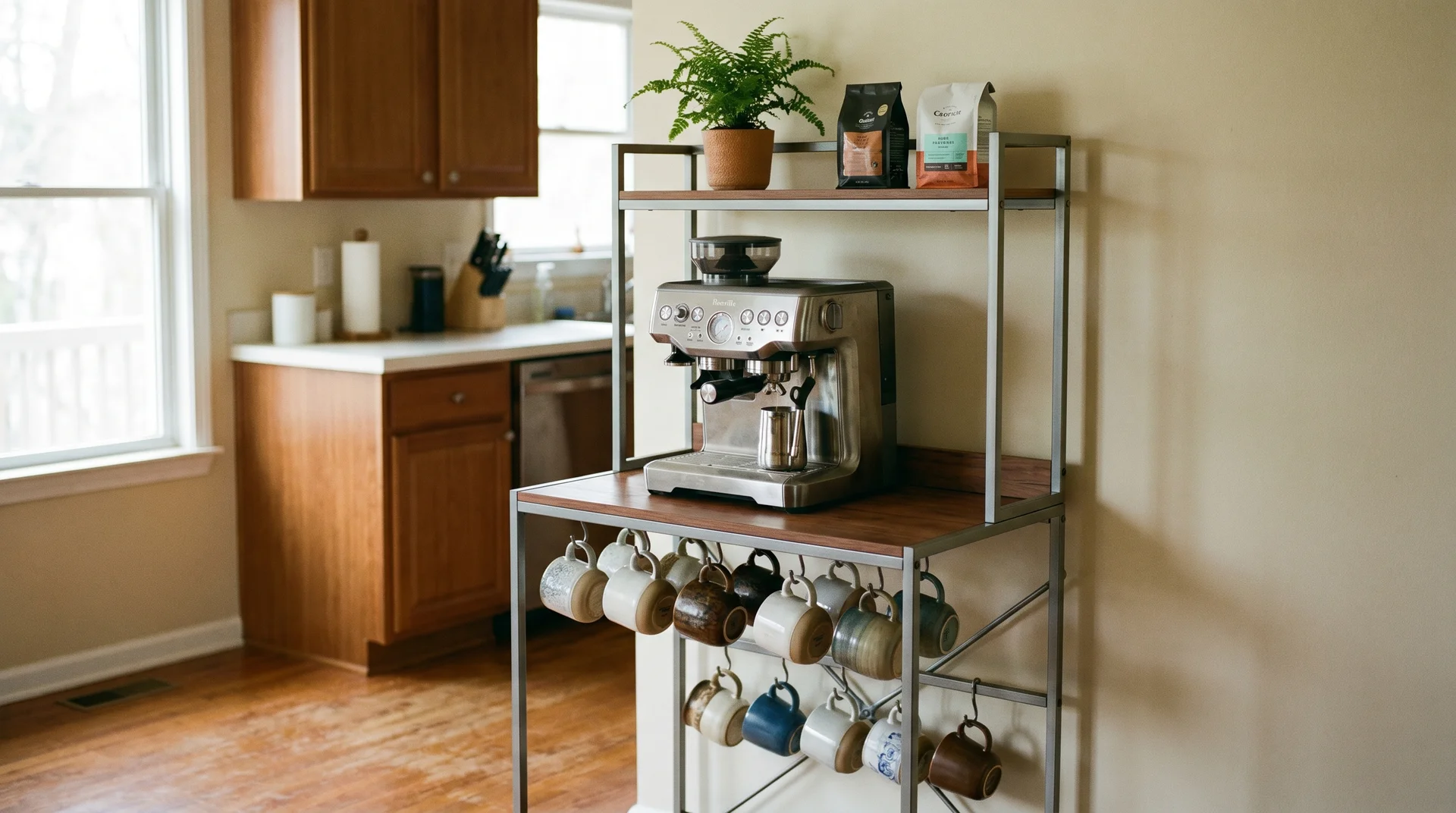
A baker’s rack is a freestanding, open-shelf storage unit with multiple tiers that holds kitchen items in plain view. It requires no wall mounting and no built-in cabinetry.
Whether it improves your kitchen depends on two things: where you put it and how you load it. Both are easier to get right before you buy than after.
What a Baker’s Rack Is
A baker’s rack is open-shelf, freestanding kitchen furniture with multiple tiers.
The tiers sit open on all four sides, so everything you store is visible from the front, the sides, and the back.
Most models stand between 50 and 72 inches tall and 22 to 40 inches wide. They sit on the floor with no wall mounting required.
Modern versions often include hooks for utensils, a wine rack section, or a built-in power strip in the frame. Some add a closed cabinet at the base.
The core structure is always the same: a tall, open, freestanding unit that stores things in plain sight.
Open shelving in a kitchen requires a different way of thinking than closed storage does.
Everything on a baker’s rack is on display. Every item you put there is a visual decision, whether you treat it as one or not. That distinction matters more than most buying guides suggest, and it’s worth understanding before the rack arrives.
Where the Name Baker’s Rack Comes From
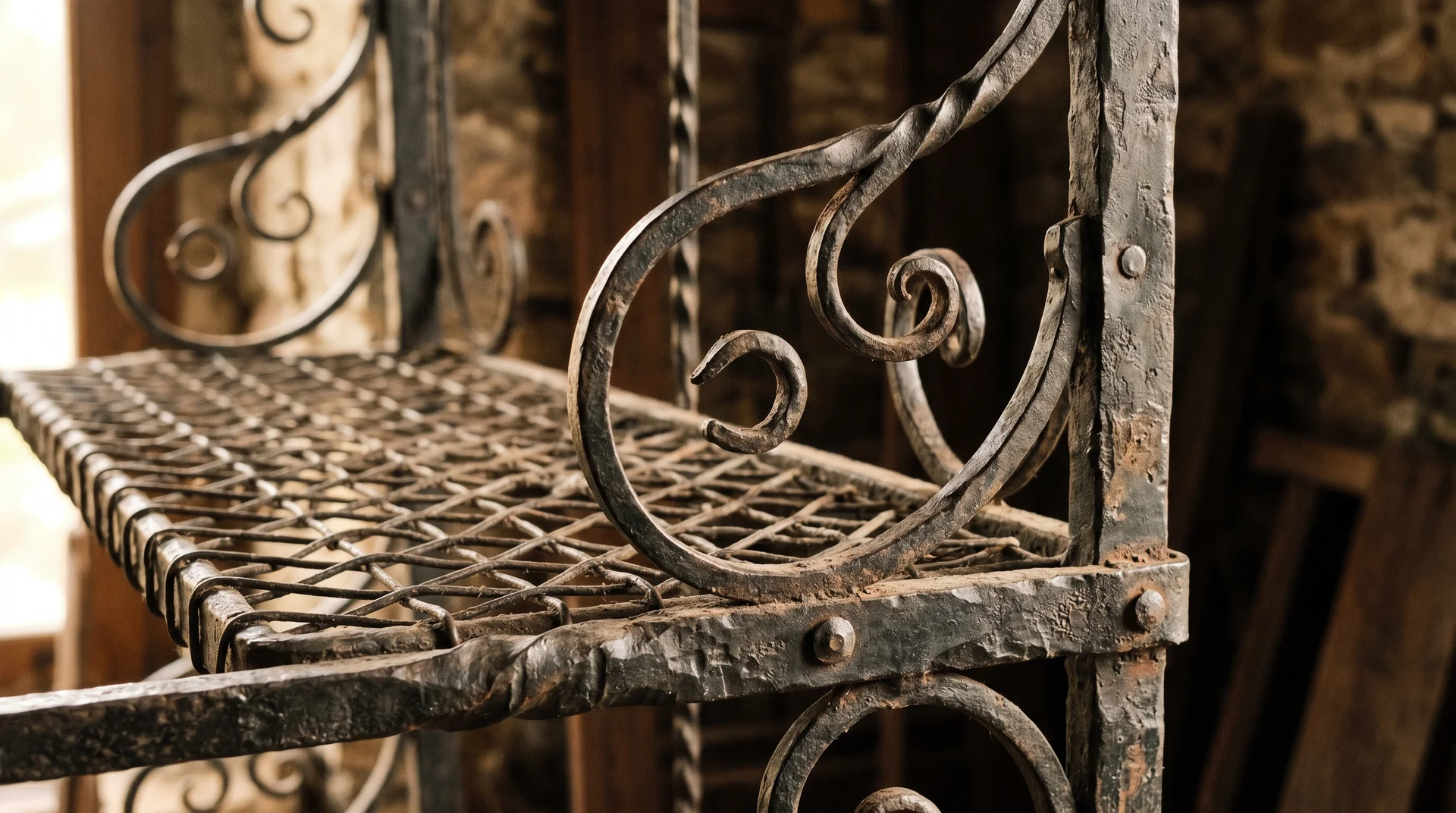
Baker’s racks originate from 17th-century France, where iron shelving cooled freshly baked bread after it came out of the oven.
Metal shelves are thermally conductive. Heat transfers away from a hot pan quickly on contact with iron or steel. Air circulates freely on all sides, which keeps baked goods from steaming and softening their crust.
That cooling design explains why modern baker’s racks still look the way they do. The open frame solved a baking problem that most home kitchens no longer have. What remained is a structure that uses floor space without blocking light or closing off the room.
Baker’s Rack vs. Kitchen Cart vs. Etagere
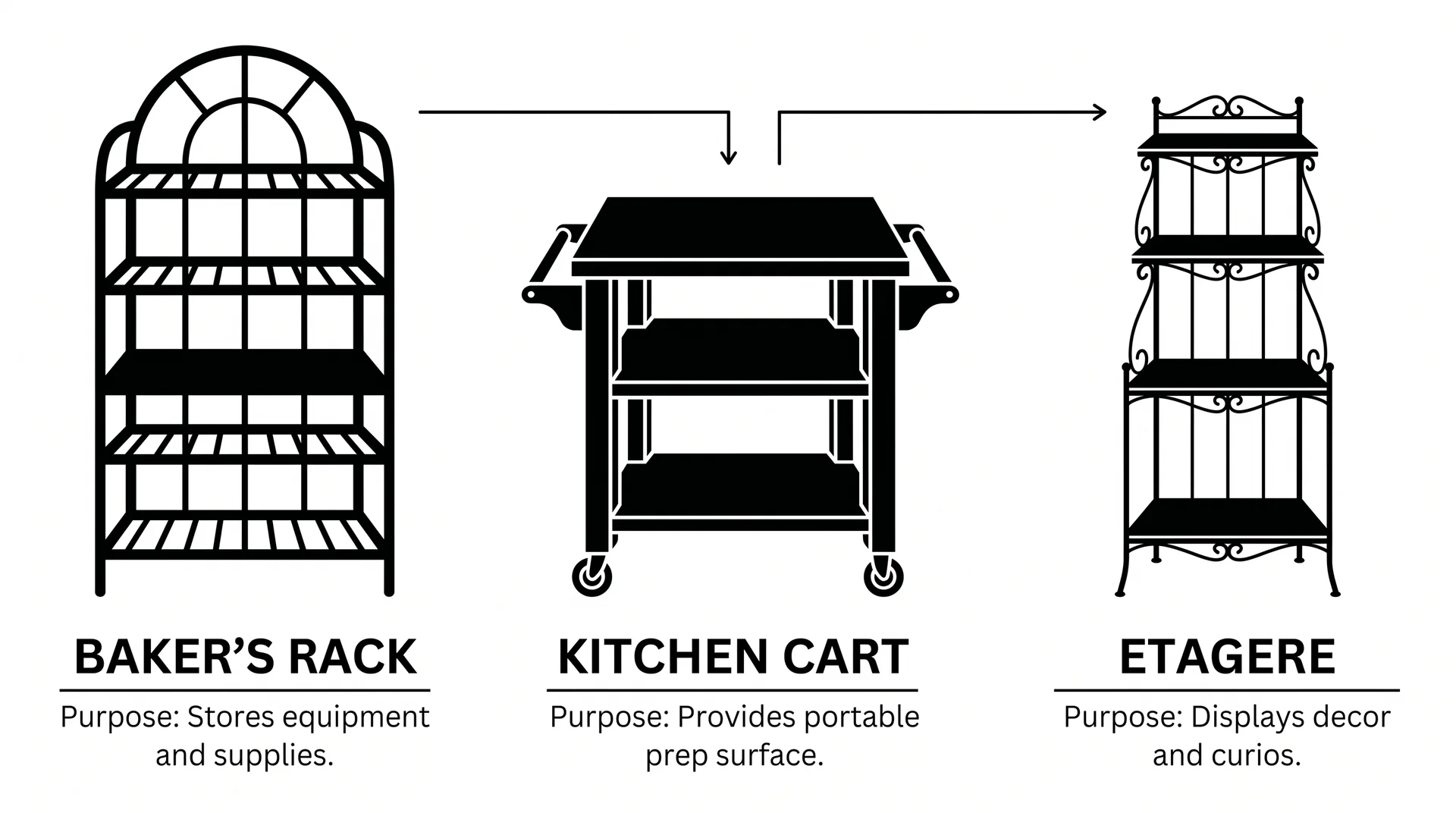
These three terms name different objects with different purposes, even though most product listings use them interchangeably.
Buying the wrong object for your actual need is easy when the names overlap. Here is what distinguishes them:
| Feature | Baker’s Rack | Kitchen Cart | Etagere |
|---|---|---|---|
| Primary purpose | Storage and display | Prep work and mobility | Display and decor |
| Mobility | Typically stationary; some models have wheels | Designed to roll and reposition freely | Stationary |
| Work surface | Sometimes present, secondary | The primary feature | None |
| Storage type | Mostly open; hybrid models add closed storage | Often includes drawers or a cabinet | Fully open |
| Typical material | Metal frame with wood or metal shelves | Wood, butcher block, or metal | Metal, glass, or decorative wood |
| Best role in a kitchen | Extra storage and appliance staging | Additional prep surface | Decorative accent with light storage |
If you need a surface for food prep, a kitchen cart is the right choice. A baker’s rack is for storage and display, and the types below reflect how much variation exists within that single category.
The Types of Baker’s Racks You’ll Find
Three main formats dominate the current market.
Each one carries a different visual weight and fits differently into a kitchen’s existing aesthetic. The format you choose has as much to do with the room’s style as it does with your storage needs.
Traditional Wrought Iron
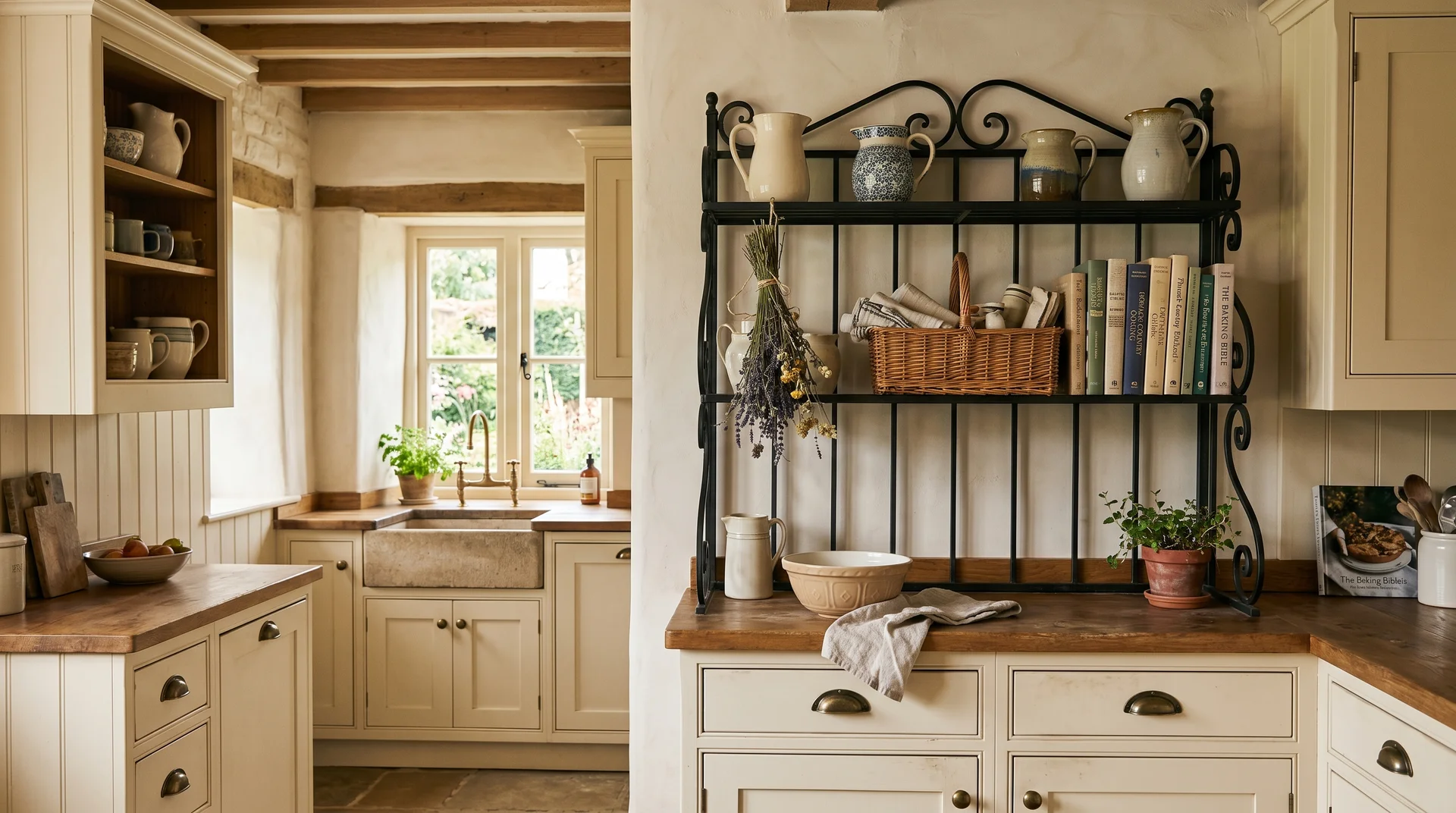
Traditional wrought iron baker’s racks read as cottage, Victorian, or French country in almost every kitchen.
The scrollwork, curved legs, and decorative metalwork suit a kitchen with warm tones, aged hardware, and layered decor. That’s the context where wrought iron reads as genuinely character-rich. Put it next to flat-front cabinetry and matte fixtures, and it competes with everything else in the room.
I still like a well-placed wrought iron rack in the right kitchen. The right kitchen for one is rarer than most product photos suggest, which is worth knowing before you fall in love with the finish.
The execution reality with wrought iron is maintenance.
These racks are heavy, which means they stay put. The decorative detail that makes them visually appealing is also harder to clean than a flat metal frame. Wrought iron crevices collect grease in a working kitchen, and that’s worth accounting for before choosing a finish with a lot of surface detail.
Modern Industrial (Metal Frame and Wood Shelves)
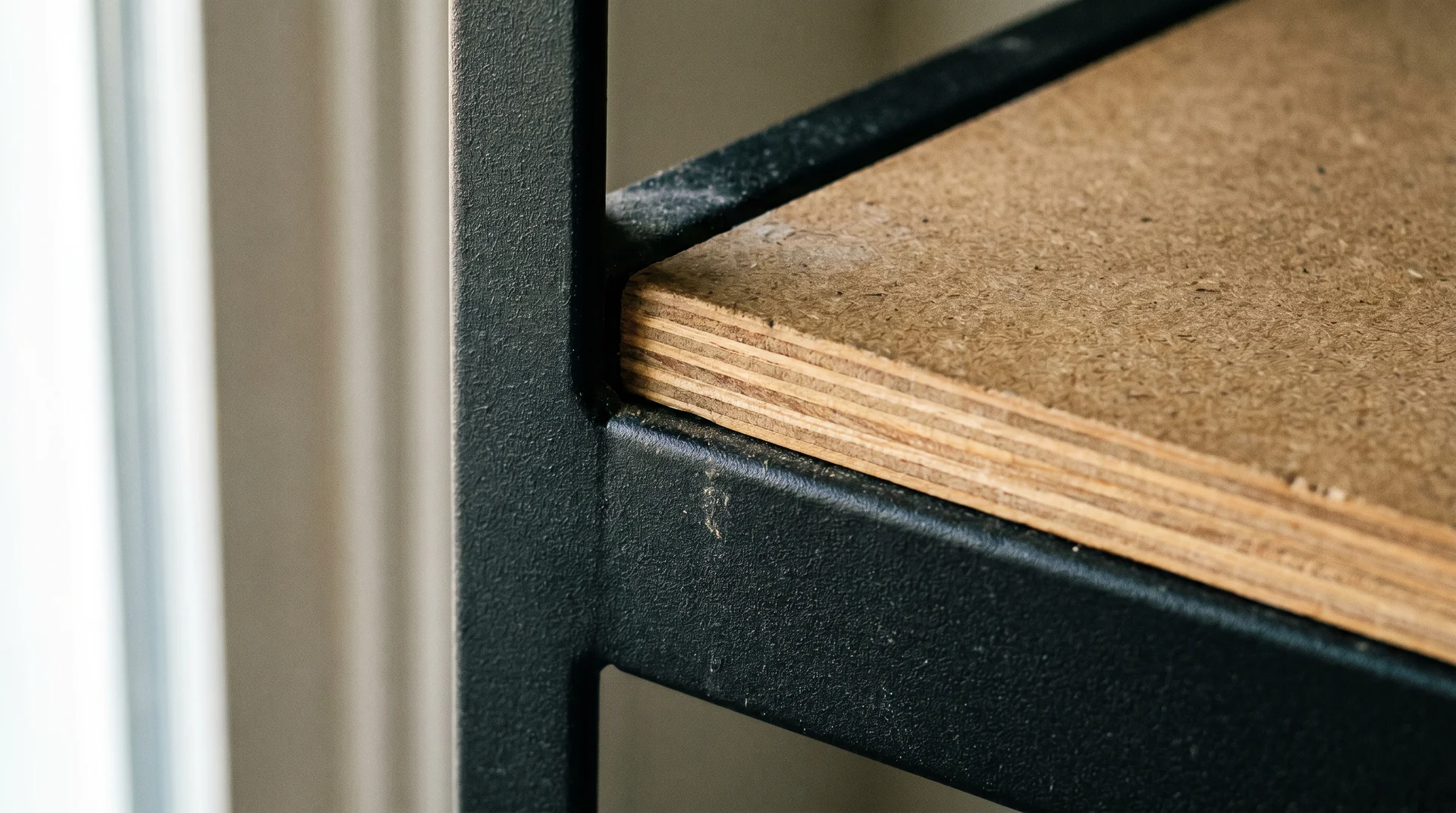
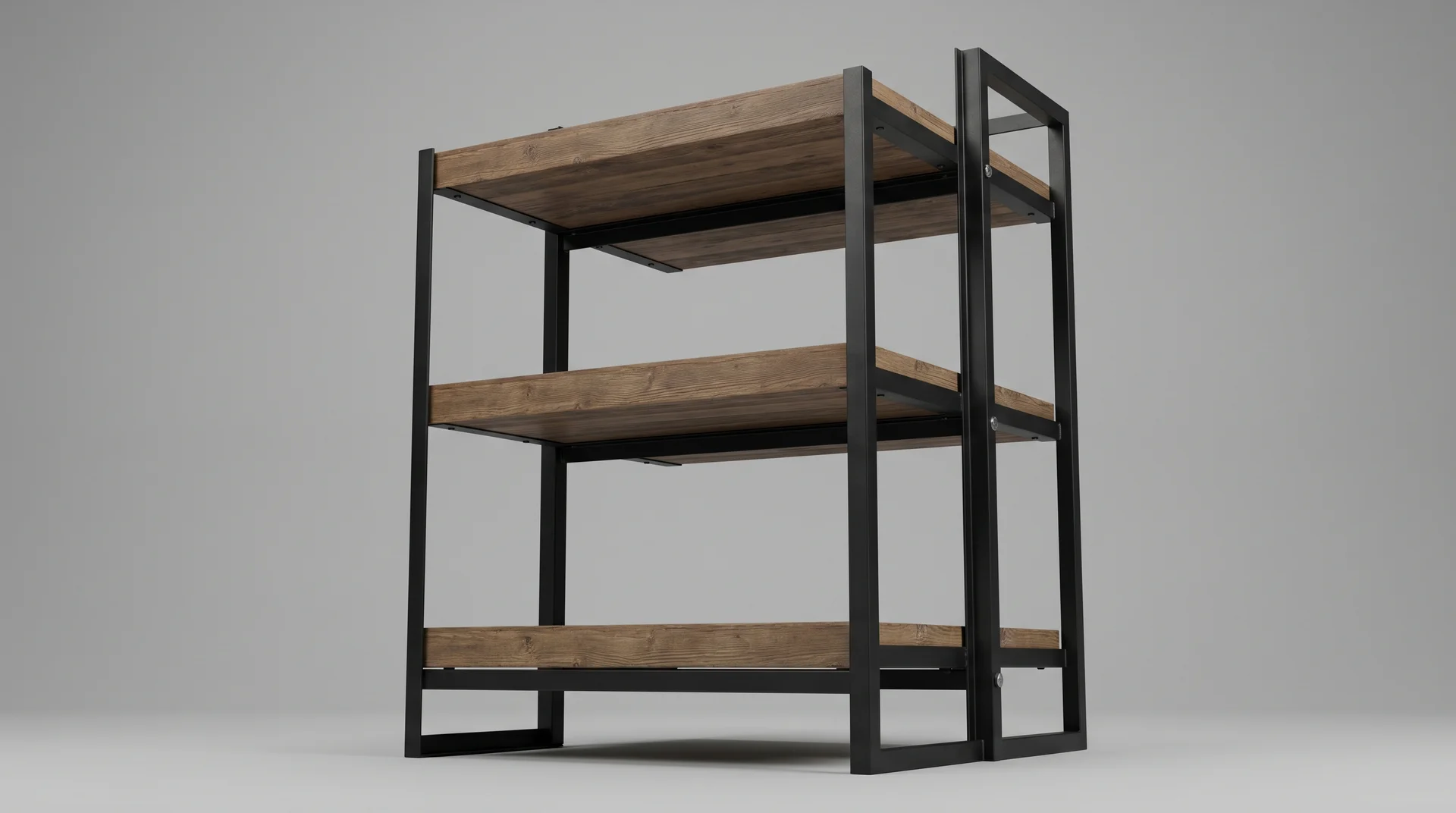
Industrial baker’s racks with powder-coated steel frames and engineered wood shelves are what most people buy today.
You’ll find them at Wayfair, Amazon, and Walmart in the $60 to $200 range. Frame finishes run from matte black to rustic brown to antique bronze. Shelves are typically 15mm particle board with a wood-effect surface coating.
The real design problem at this price point is material limitation.
For under $150, particle board and powder-coated steel are what the budget buys. Both materials have real limits. Particle board is vulnerable to standing water.
If the rack will hold a dripping coffee maker or a plant watered in place, the shelf surface will degrade over time. That’s the constraint the price point hands you. Buy knowing it, and plan your rack’s use accordingly.
Baker’s Rack with Cabinet or Drawers
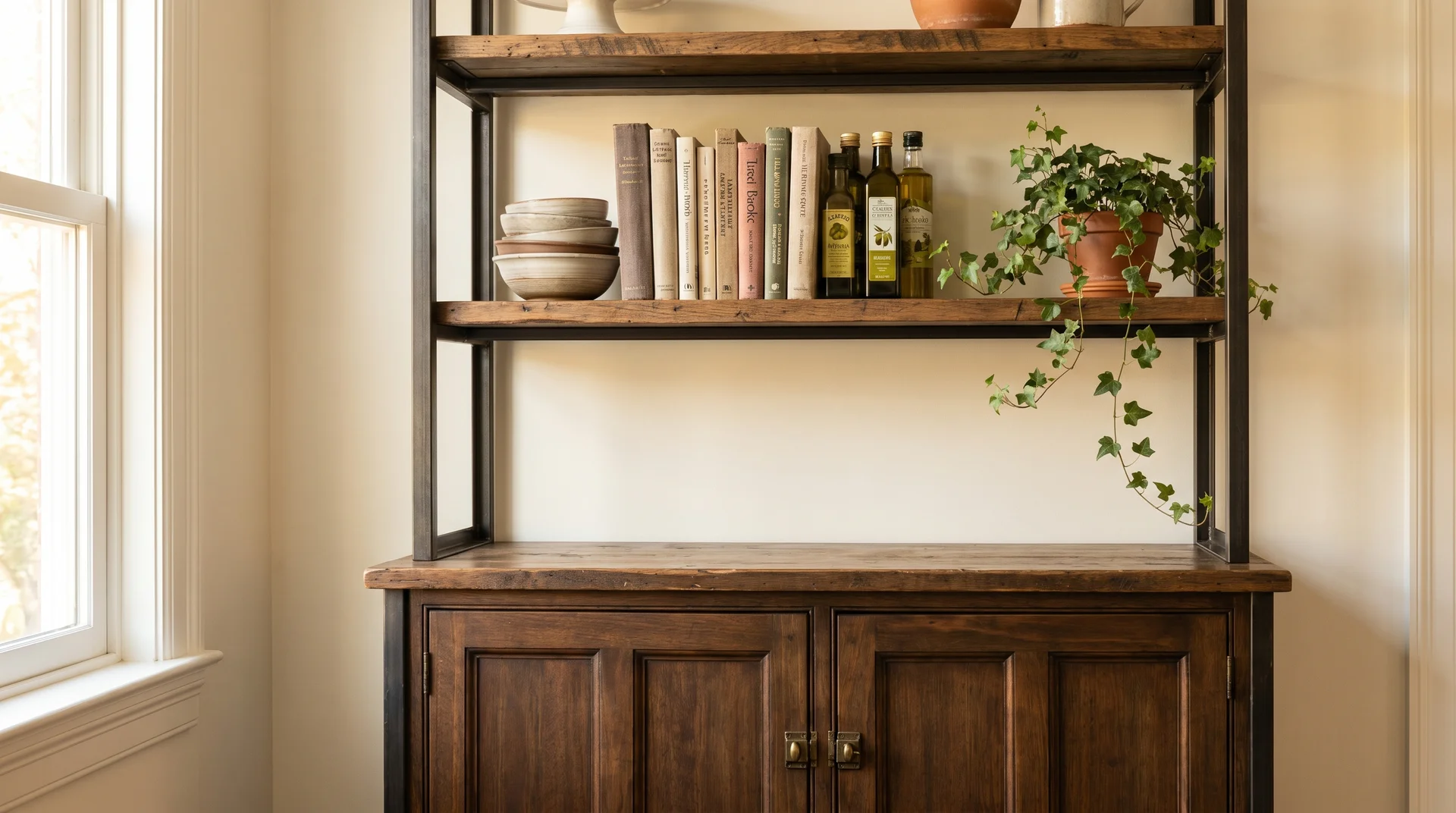
Baker’s racks with a cabinet section combine open shelving above with concealed storage below.
This format exists because not everything you store looks good on open display. The closed section holds bulk pantry items, plastic containers, or anything functional but visually inconsistent.
The proportion of open to closed storage matters. A hybrid where the cabinet section takes more than half the total height reads as a pantry cabinet with a shelf on top. That’s a different object with different placement logic.
What Happens to Most Baker’s Racks After Six Weeks
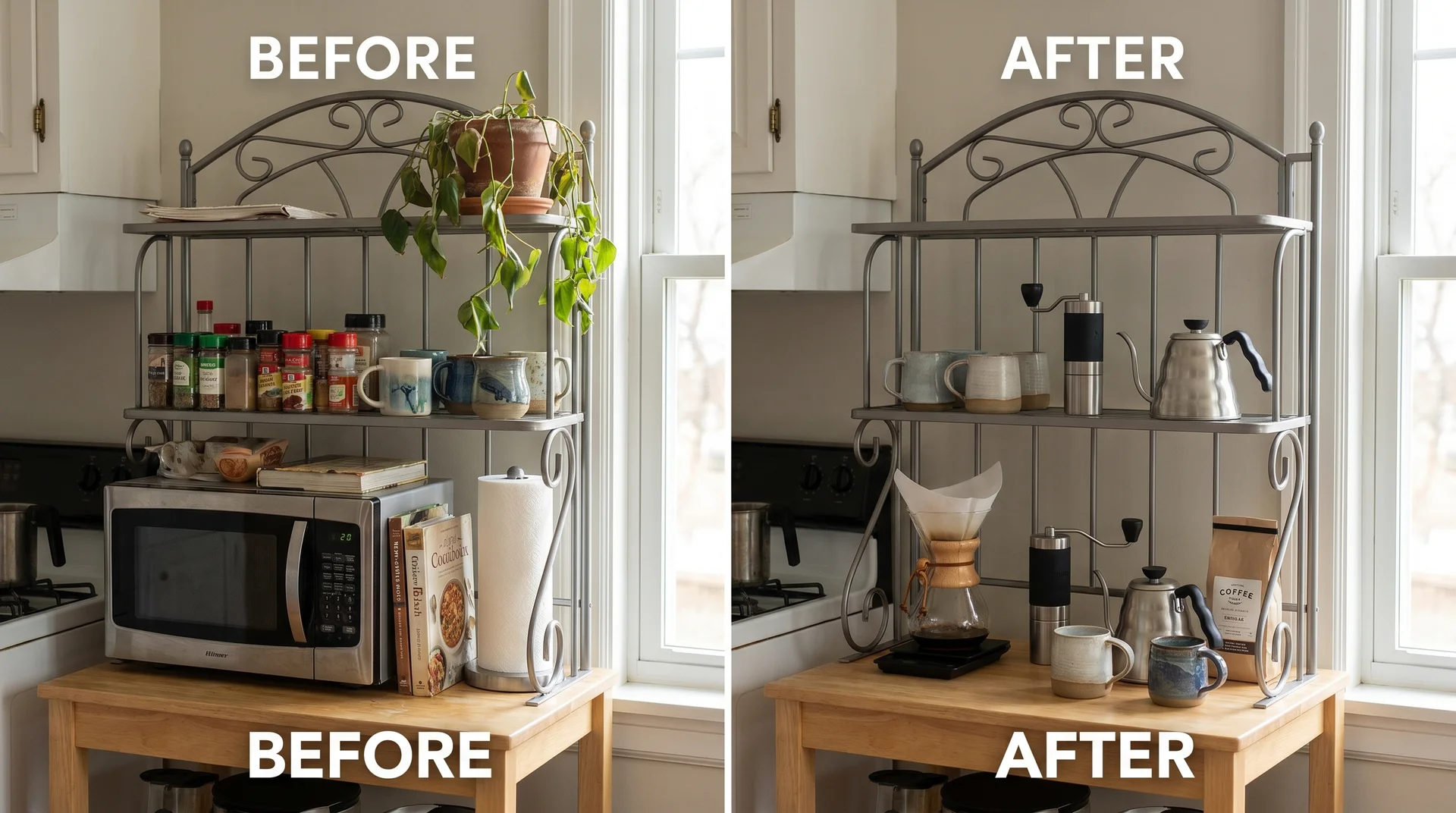
Most baker’s racks end up looking worse than their product photo.
You’re standing in your kitchen two weeks after the rack arrived. The appliance is on the middle shelf, spice jars have filled in around it, and a cookbook is propped against the back wall. Nothing fits anywhere else.
This is how open shelving fills up. There was no loading plan. The result looks worse than the clutter it was supposed to solve.
The issue is rarely the rack itself.
I keep a reference folder of photographed real kitchen failures from twelve years of completed projects. Open shelving shows up in it more than any other single category. The rack arrives clean and organized, and within six weeks, it becomes the place for everything that didn’t fit anywhere else.
The One-Hero Rule Applied to a Baker’s Rack
Decide on one dominant purpose for the rack before you load it.
I call this the one-hero rule. It came from a kitchen project I got badly wrong. I over-specified every surface and every display area, nothing landed visually, and my client cried at the reveal.
I redesigned that kitchen at my own cost: $6,000. The rule came from working out what had failed. Every room needs one dominant visual statement, and everything else submits to it.
For a baker’s rack, the hero is the single purpose that organizes everything else on it. The most common options that hold together visually:
- A coffee and espresso station, with the machine as the visual anchor and mugs, beans, and accessories grouped around it
- An appliance staging area, with a microwave stand or stand mixer as the primary object and supporting items organized below
- A kitchen plant display, with plants leading visually, and minimal additional storage on the remaining shelves
- A coordinated pantry station, with matching vessels, jars, and baskets as the organizing visual element
Choose the hero before anything goes on the rack. Editing a loaded rack is much harder than deciding on paper first.
A baker’s rack that carries too many visual purposes reads as storage that got out of control.
Where to Put a Baker’s Rack So It Actually Works
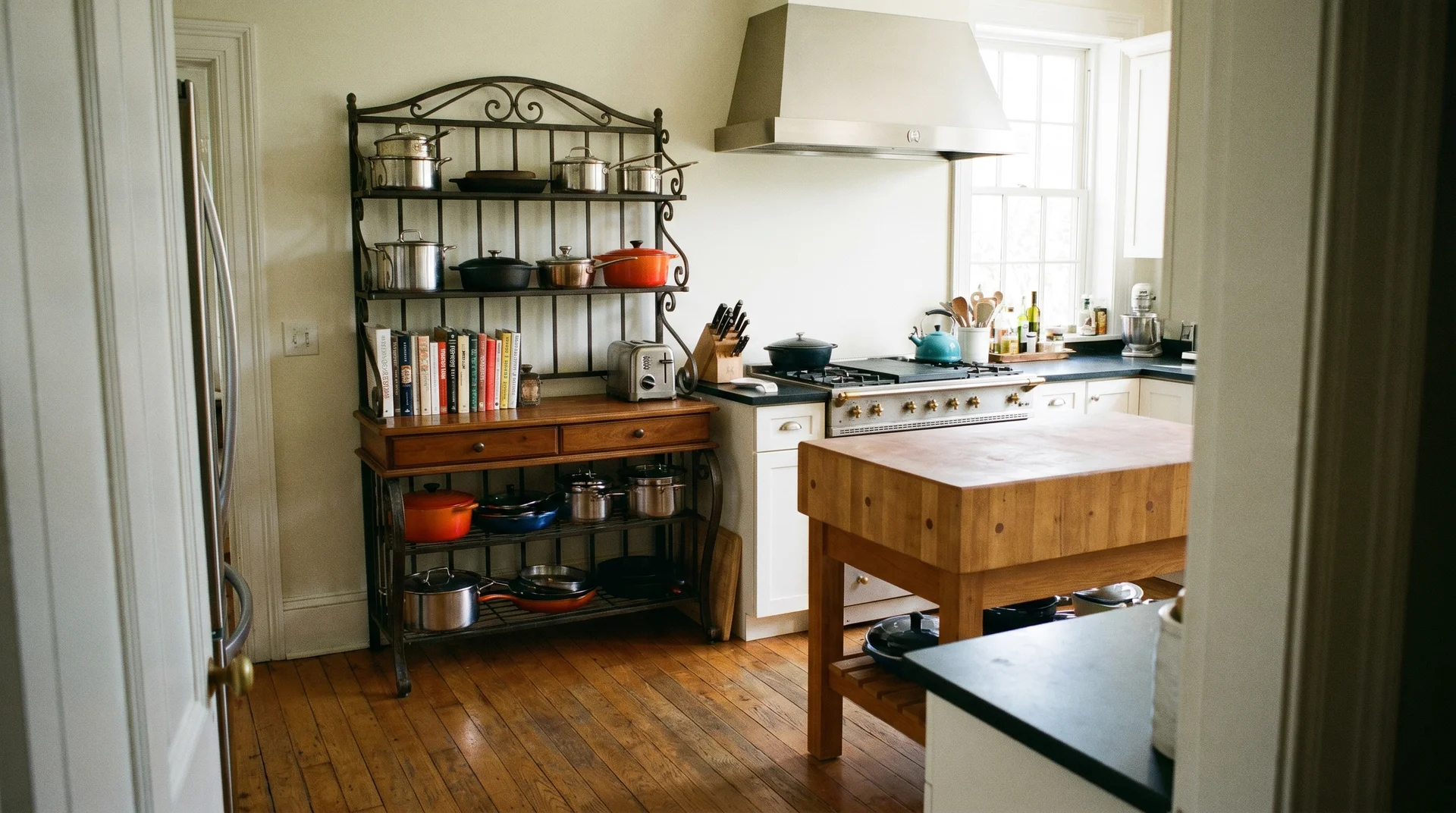
Where you place a baker’s rack determines whether it works.
Most people find open floor space in their kitchen and put the rack there. That logic works fine for utility shelving in a garage. In a kitchen, the wrong wall undermines a baker’s rack regardless of how well it’s loaded.
Most kitchens have more visual competition than their owners realize. That means the baker’s rack needs a calm wall, one that isn’t already carrying a strong existing statement.
Finding the Right Wall
The baker’s rack belongs on a wall where it reads as a deliberate destination.
Walk into your kitchen and note where your eye stops first. That’s the room’s existing dominant element: the range, the statement backsplash, or the refrigerator wall. The baker’s rack belongs on a different wall.
This is the same principle behind the one-hero rule: one element leads, and everything else supports it. A room with two competing anchors on opposite walls reads as unsettled. Give the rack a wall where it can lead its section of the room without fighting for attention.
Before settling on a position, confirm these three things:
- Clearance: Leave at least 36 inches of clear floor space in front of the rack. You’ll reach upper shelves, pull appliances forward, and open any lower cabinet doors from directly in front.
- Outlet proximity: If the rack will hold appliances, the nearest outlet should be within cord distance without running across a traffic path. A rack with a built-in power strip helps, but check the cord length before committing to a wall position.
- Floor level: Most racks in the $60 to $200 range include adjustable feet. Use them. A rack on uneven tile wobbles every time you set something down, and that constant small movement stresses the frame connections over time.
When a Baker’s Rack Won’t Work in Your Kitchen
Some kitchens don’t have room for a baker’s rack to work as a design element.
A narrow galley kitchen with one main aisle is the clearest case. Adding a freestanding unit blocks movement and makes the room feel tighter. A galley kitchen usually runs short on overall storage volume, and a freestanding rack can’t address that problem.
A kitchen where every wall already carries a strong visual statement presents a different situation. How to approach open shelving as part of a broader decor system belongs in a different article, with different criteria. The style question that comes next, though, applies to both scenarios.
Are Baker’s Racks Outdated?
The format itself still works.
The ornate wrought iron version peaked in the 1990s and reads as dated in most contemporary kitchens. The farmhouse and industrial formats that replaced it have been so common in the market that they’re approaching the same point. That’s a trend problem.
The discipline question outweighs the style question.
A clean rack with one clear visual purpose reads as intentional in almost any kitchen. I’d rather see a simple industrial rack loaded with one strong purpose than an ornate antique piece loaded with everything the owner couldn’t find a better place for.
A crowded rack reads as dated regardless of its age.
How to Choose the Right Baker’s Rack for Your Kitchen
Measure your available wall space before looking at finishes.
Most baker’s racks run 22 to 40 inches wide and 14 to 18 inches deep. Standard heights fall between 50 and 72 inches. A rack proportioned to its wall reads as considered; one that’s too narrow for the space reads as provisional.
Matching the Finish to Your Kitchen
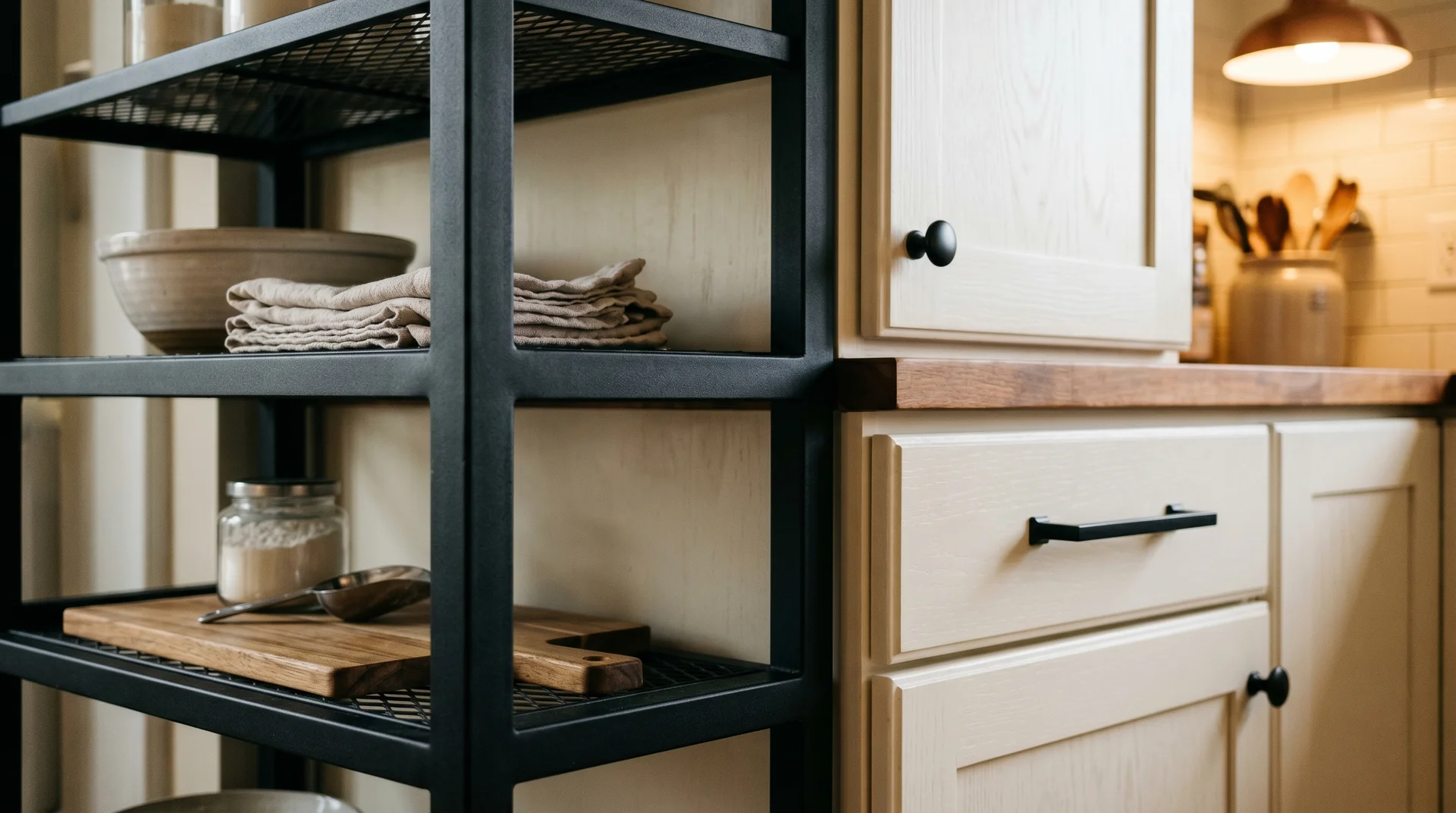
Match the frame finish to at least one existing metal element already in your kitchen.
This is the one area where I hold genuine uncertainty. Kitchen finishes vary too much for a single rule, and what I’ve seen across more than 200 projects doesn’t compress into general advice cleanly.
Visual consistency matters more than a perfect match. A matte black baker’s rack in a kitchen with matte black faucets and pulls reads as deliberate. The same rack in a kitchen with brushed nickel hardware reads as a separate decision that was never planned.
You need a visible thread between the rack and the room.
Warm wood tones in your existing kitchen pair well with a rustic brown and metal frame. A cool-toned kitchen pairs better with a simple all-metal dark finish than a wood-and-metal hybrid.
Open Shelves, Hybrid, or Fully Enclosed
Choose the format based on what you’ll actually store.
Stand in your kitchen and think through the ten items most likely to end up on this rack. Most people find that at least half of what they plan to store is better kept out of view. If that’s true, a hybrid format will serve you better than a fully open rack.
Open shelving rewards visual discipline. Hybrid storage is more forgiving of inconsistency. Knowing which one describes your actual storage habits matters more than any product specification.
Two questions settle the decision. Where does the rack live, and what’s the single hero?
If you can answer both before you buy, the rest of the choice follows. Most people who struggle with a baker’s rack skipped one of those questions.