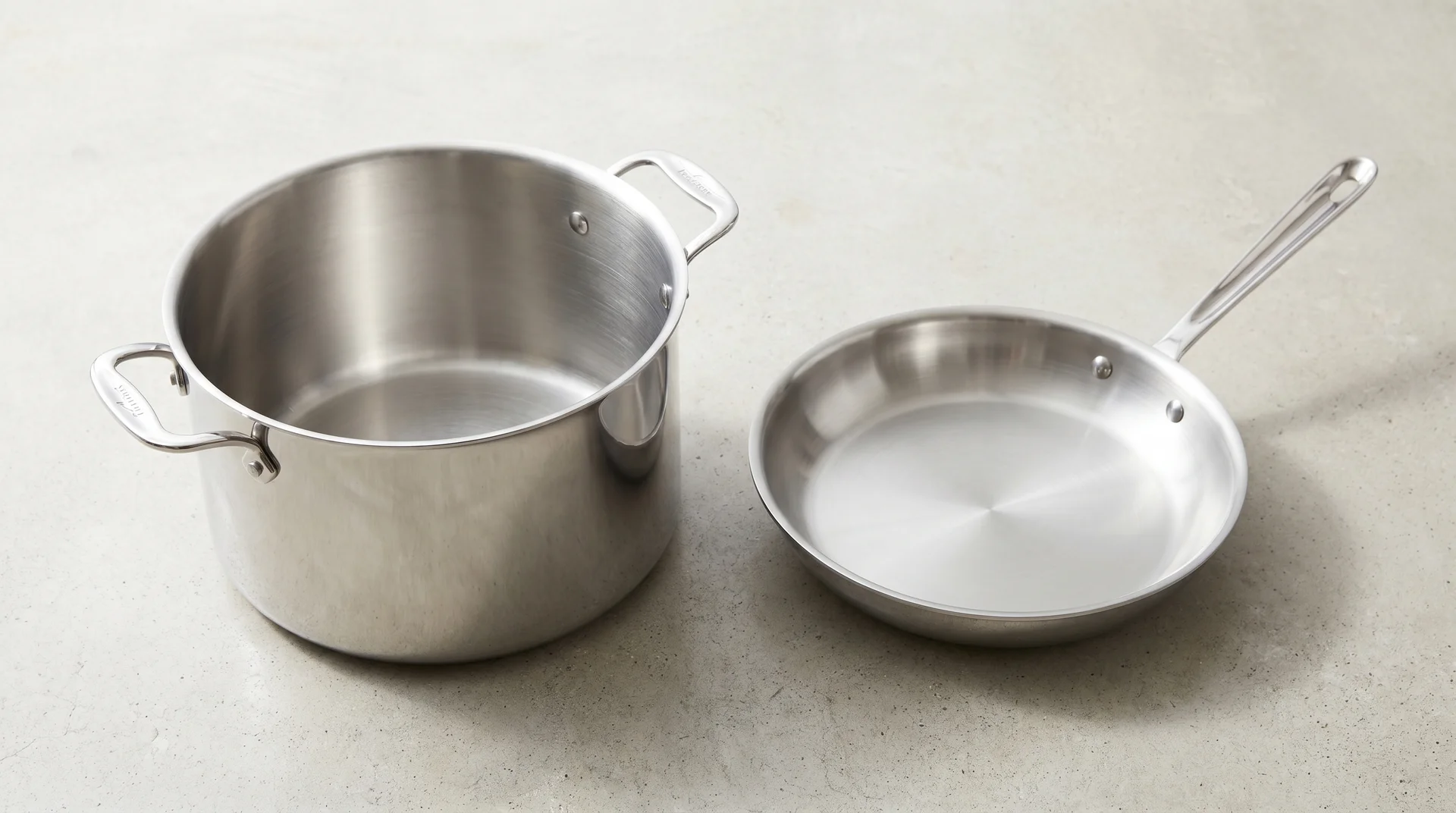
People treat the difference between a pot and a pan as a naming question. It’s a cooking technique question. The names don’t tell you what these vessels do. The shape does.
What Separates a Pot From a Pan
A pot is a deep vessel with tall sides and two loop handles, built for cooking with liquid.
A pan is shallower, with one long handle, and built to let moisture escape.
That structural difference drives every practical consequence this article covers.
What Does a Pot Actually Do?
Most people think pots are defined by their size. That’s the wrong frame.
A pot’s defining feature is what its shape does to moisture. Once you understand that, every pot decision makes sense.
Traps Moisture
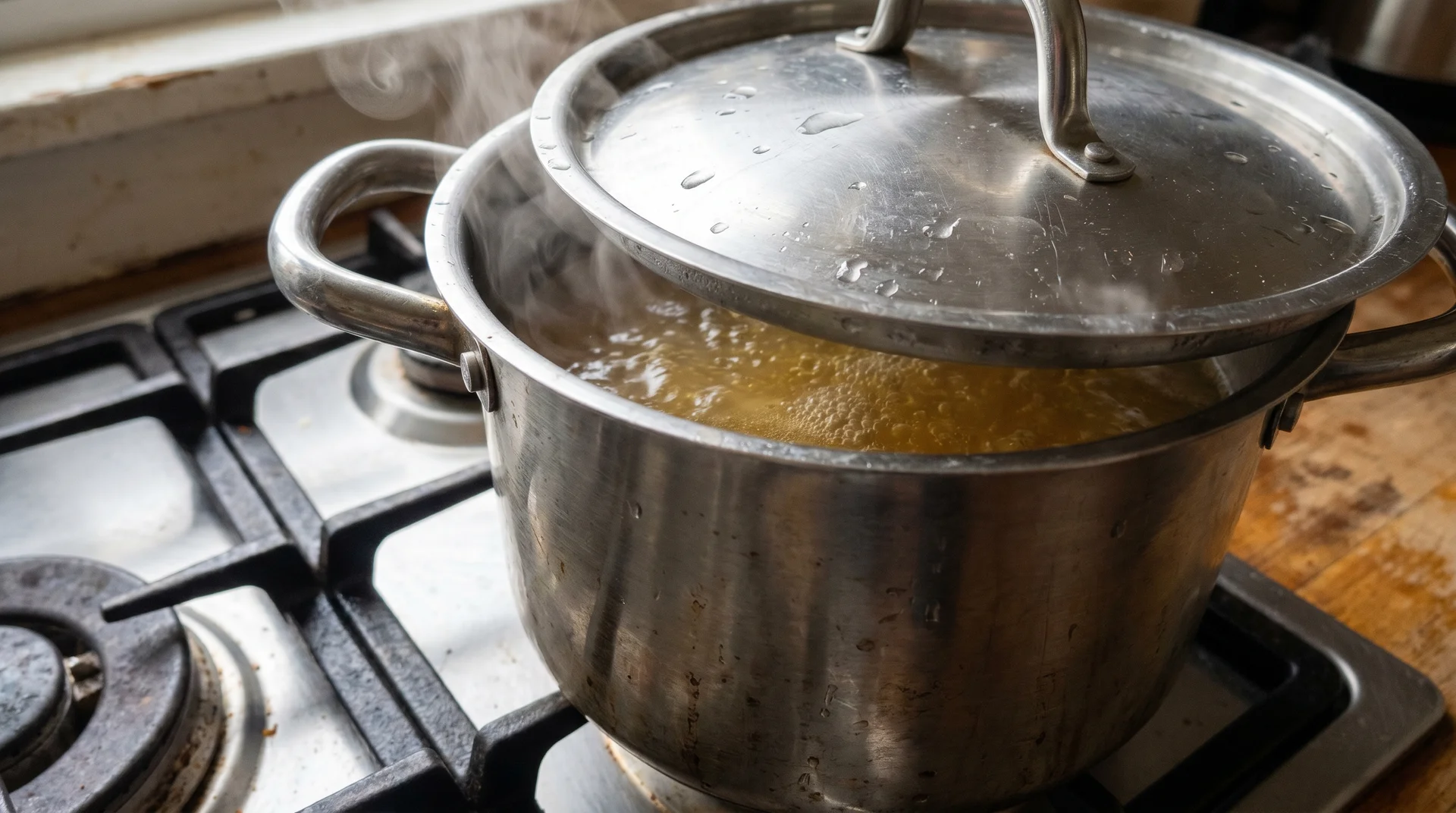
That’s the functional purpose of a pot. When a pot sits on the heat, its narrow opening slows evaporation.
Harold McGee documents in On Food and Cooking that evaporation rate directly affects flavor concentration in long-cooked stocks. The moisture can’t escape fast, so it cycles back through the food instead.
A stock built in a stockpot develops a deeper flavor than the same stock rushed in a wide pan.
If you’ve ever had a sauce dry out faster than the recipe said it should, this is probably why.
Lids intensify this. A tight-fitting lid brings evaporation nearly to zero. Braising relies on this almost entirely.
Some braises benefit from leaving the lid slightly ajar, which allows controlled reduction while still retaining most moisture.
Types of Pot
Not every pot is built the same way.
The differences between them matter for specific cooking tasks. Here are the four types you’ll encounter most often, each shaped for a different cooking environment.
- Stockpot: Tall, straight sides and a thin bottom. Good for pasta water, soups, and stocks. Thin walls heat quickly, so reach for a Dutch oven when you need gentle, even heat.
- Dutch oven: Heavy walls, a tight-fitting lid, and oven-safe construction. Holds and distributes heat very well. The best choice for braising, slow cooking, and dishes that move from stovetop to oven.
- Saucepot: Medium height, wider base than a saucepan, two loop handles. Better for large batches of sauce or soup than a saucepan. Most home cooks don’t own one, and most should.
- Saucepan: Tall sides, one long handle, 1–4 quart range. For practical purposes, treat it as a small pot. It gets its own section below.
I think the Dutch oven is the most versatile pot in a home kitchen. The stockpot gets used more often. The Dutch oven handles harder tasks.
What a Pan Actually Does
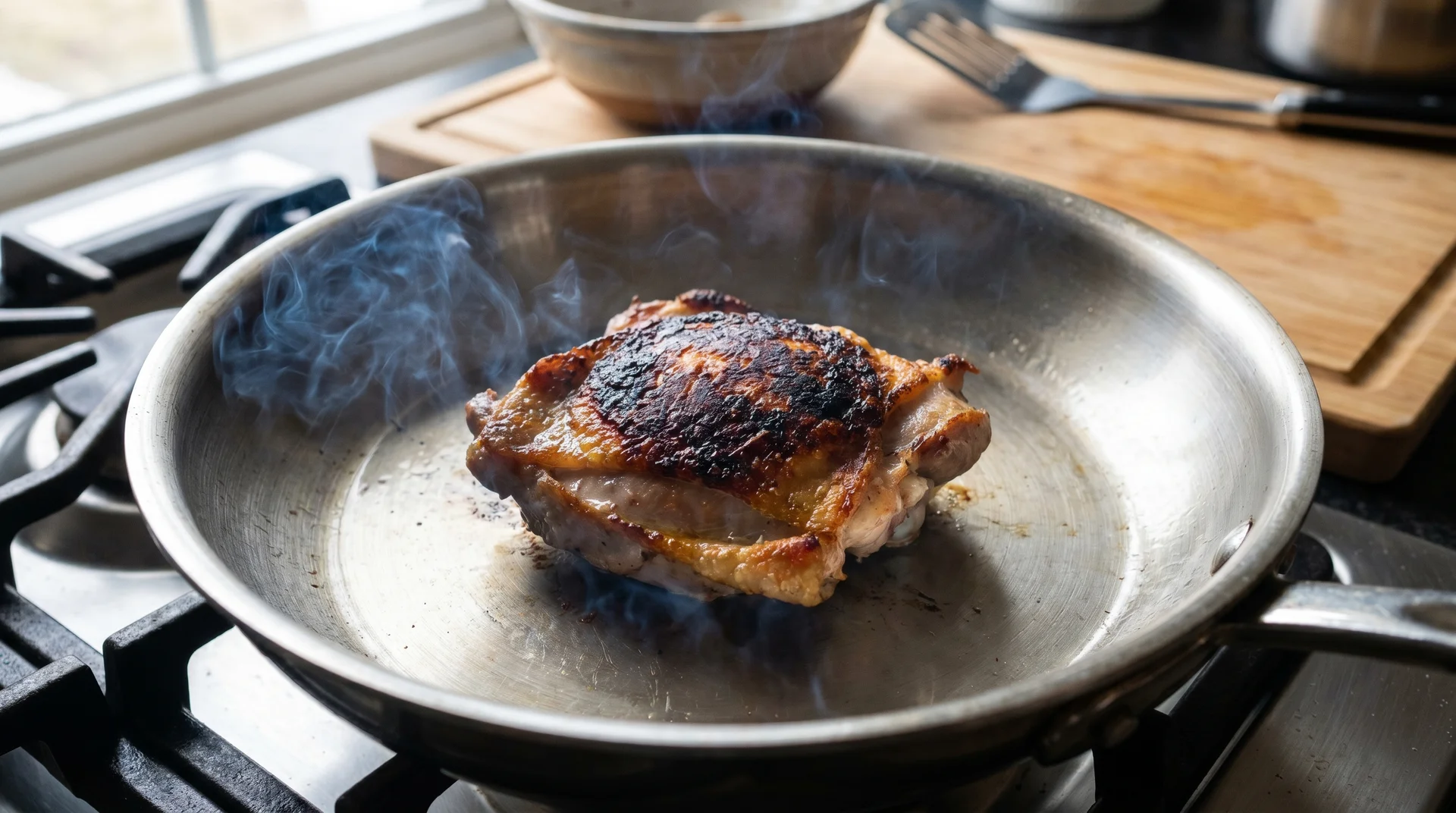
A pan’s defining feature is its wide base and low sides. That shape creates an environment nearly opposite to a pot’s.
Lets Moisture Out
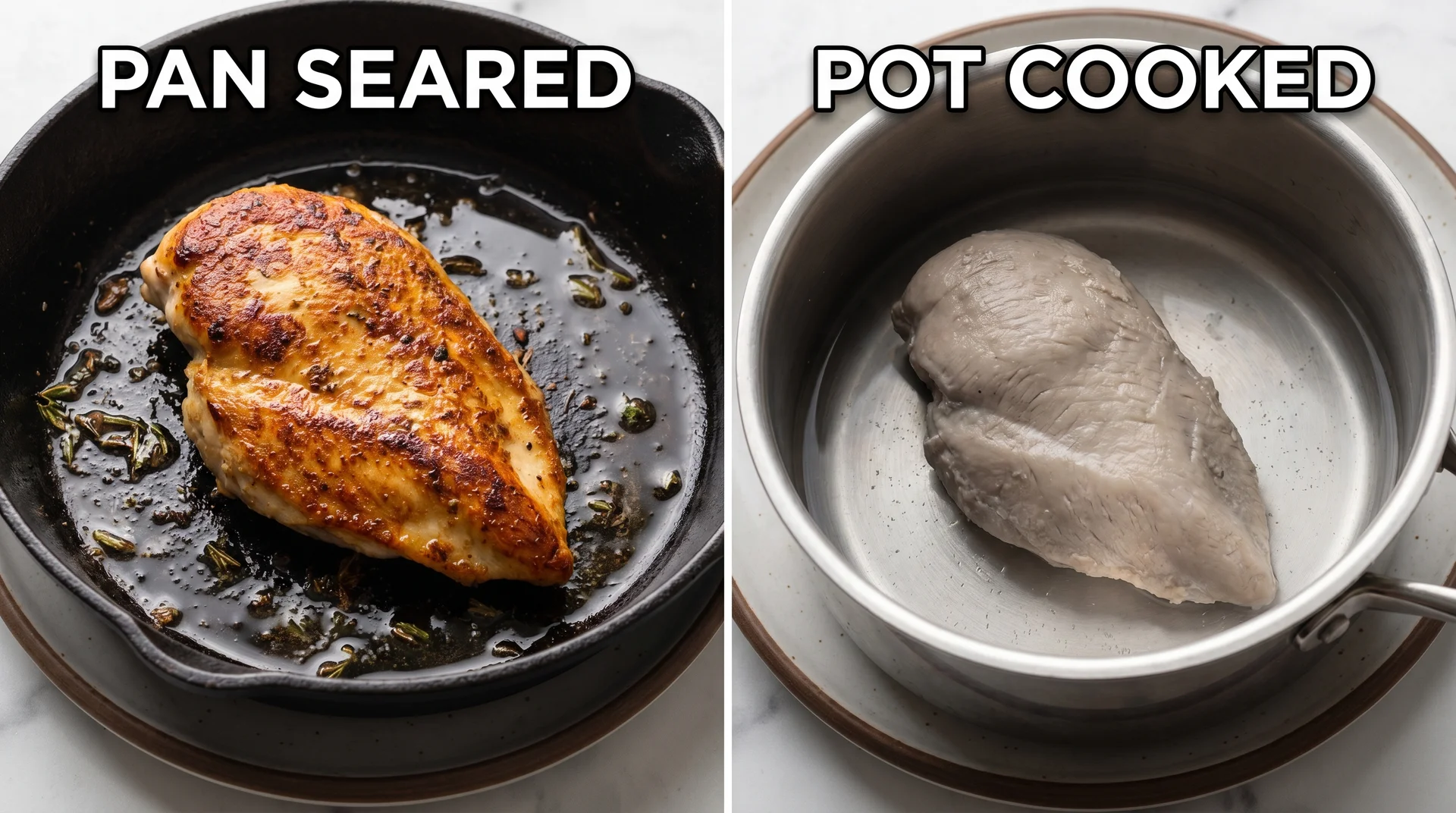
Pans let moisture escape fast. That’s what makes browning possible. If you’ve ended up with gray chicken instead of a brown crust, the vessel is worth examining.
Browning requires a dry food surface. The Maillard reaction creates the color and deep flavor you get from a proper sear. It only activates when surface moisture has been driven off by heat.
A wide, low-sided pan accelerates evaporation from the food surface. The food dries almost immediately on contact with the hot metal.
Try the same technique in a tall-sided pot: steam gets trapped, the food surface stays wet, and browning can’t start.
Types of Pan
“Pan” covers meaningfully different vessel types.
The types below are listed by how often home cooks actually reach for them. The order matters.
- Frying pan (also called a skillet): Sloped or gently curved sides, one long handle, flat bottom. The standard choice for quick dry-heat cooking. Most home cooks reach for this more than any other vessel they own.
- Sauté pan: Straight, medium sides, one long handle, sometimes a helper handle, wide base. Better than a frying pan when batch size makes low sides impractical. I’d call this the smart first upgrade.
- Grill pan: Ridged surface, for stovetop char marks. Useful if you have no outdoor grill access. Less essential than the two above. Bakeware items with “pan” in the name use oven-heat logic, and that belongs in a different article, and it needs different criteria.
- Wok: High-sided by design, built for very high heat and active tossing. Behaves differently from any other pan type. Covering works in depth is a different article.
In most home kitchen contexts, “skillet” and “frying pan” name the same vessel. The cooking behavior is identical regardless of which label appears.
I’d call the sauté pan the smart first upgrade after a frying pan. It handles larger batches and contains splatter without sacrificing browning capability.
The Saucepan Problem
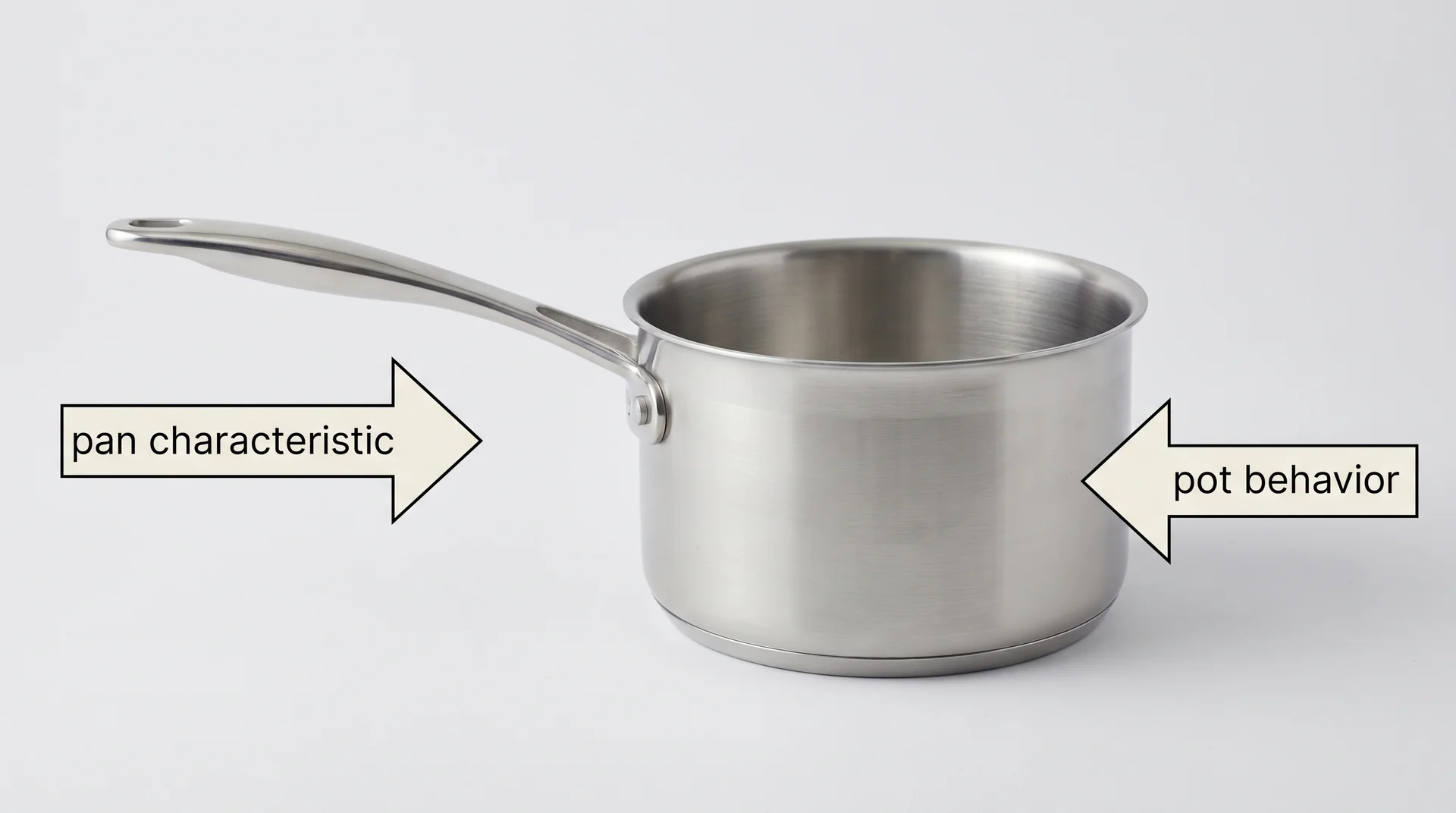
The saucepan is the most confusingly named vessel you own.
It has one long handle, tall sides, and is built for liquid cooking. That combination makes it feel like it belongs in two categories. For practical purposes, it belongs in one.
A saucepan shares more structural characteristics with a pot than its name suggests. Here’s what places it firmly in pot territory:
- Tall sides that slow evaporation
- Primary use for liquid-based cooking: simmering, reducing, reheating
- Lids that fit to retain heat and moisture
The long handle is the only pan-like characteristic. Everything else says pot.
The Oxford Companion to American Food and Drink classifies pots and pans primarily by depth, and a saucepan is consistently deep.
Treat it as a small pot with a convenient handle for steering and pouring. That framing resolves the confusion.
Saucepans run from 1 to 4 quarts. A 2-quart handles most everyday tasks. I think the saucepan works harder than any other single vessel most home cooks own.
When Does the Pot and Pan Distinction Actually Matter?
The pot-pan distinction matters most at the extremes of cooking technique.
The middle ground allows for reasonable substitutions. At the outer edges, the wrong vessel changes the dish in ways that can’t be corrected mid-cook.
Cooking with Liquid: Pot Territory
If the recipe involves substantial liquid and time, use a pot.
If you’ve ever watched a braise go dry before it was done, this is why. Boiling, simmering, and braising all rely on moisture staying in the vessel. A pot’s tall sides slow evaporation enough to make that possible over long cooking times.
In practice, “substantial liquid” means more than about a cup. Under that threshold, a saucepan handles it. Over it, especially over an extended time, you need a pot.
Cooking with Dry Heat: Pan Territory
If you need browning, you need a pan.
The same tall sides that make a pot excellent for simmering work against it for browning. Moisture has nowhere to go. Browning doesn’t work in that case.
You can heat a pot to very high temperatures and still get a poor sear on chicken. It’s a physics problem. The vessel shape is preventing the technique from working.
America’s Test Kitchen documents this pattern consistently in equipment testing. Their testing uses repeated trials with matched ingredients across different vessel types.
For any technique that needs rapid evaporation from the food surface, reach for a pan.
If you’re cooking eggs or searing a protein, you need a pan. Sautéing vegetables belongs here, too. The pan’s wide base and low sides create the conditions these techniques require.
What Goes Wrong When You Use the Wrong One
Using the wrong vessel for a technique changes the dish.
I tested this in my own kitchen, under residential conditions. After four minutes in the frying pan, a brown, lightly crisped surface. The same chicken, the same heat level, the same time in a pot came out gray and wet.
The wide pan with a long-simmering sauce is the most common failure I see in home kitchens. The wide base accelerates evaporation far beyond what the recipe accounts for. The sauce concentrates in a fraction of the intended time. You spend the rest of the cook chasing a balance that the vessel keeps disrupting.
Searing in a pot fails the same way. The tall sides trap the steam that the food releases on contact with heat. The surface never dries. Browning stalls entirely, and by the time the steam clears, the outside has already overcooked.
The pattern is consistent: the vessel creates conditions that conflict with what the technique requires.
The One-Question Decision Rule
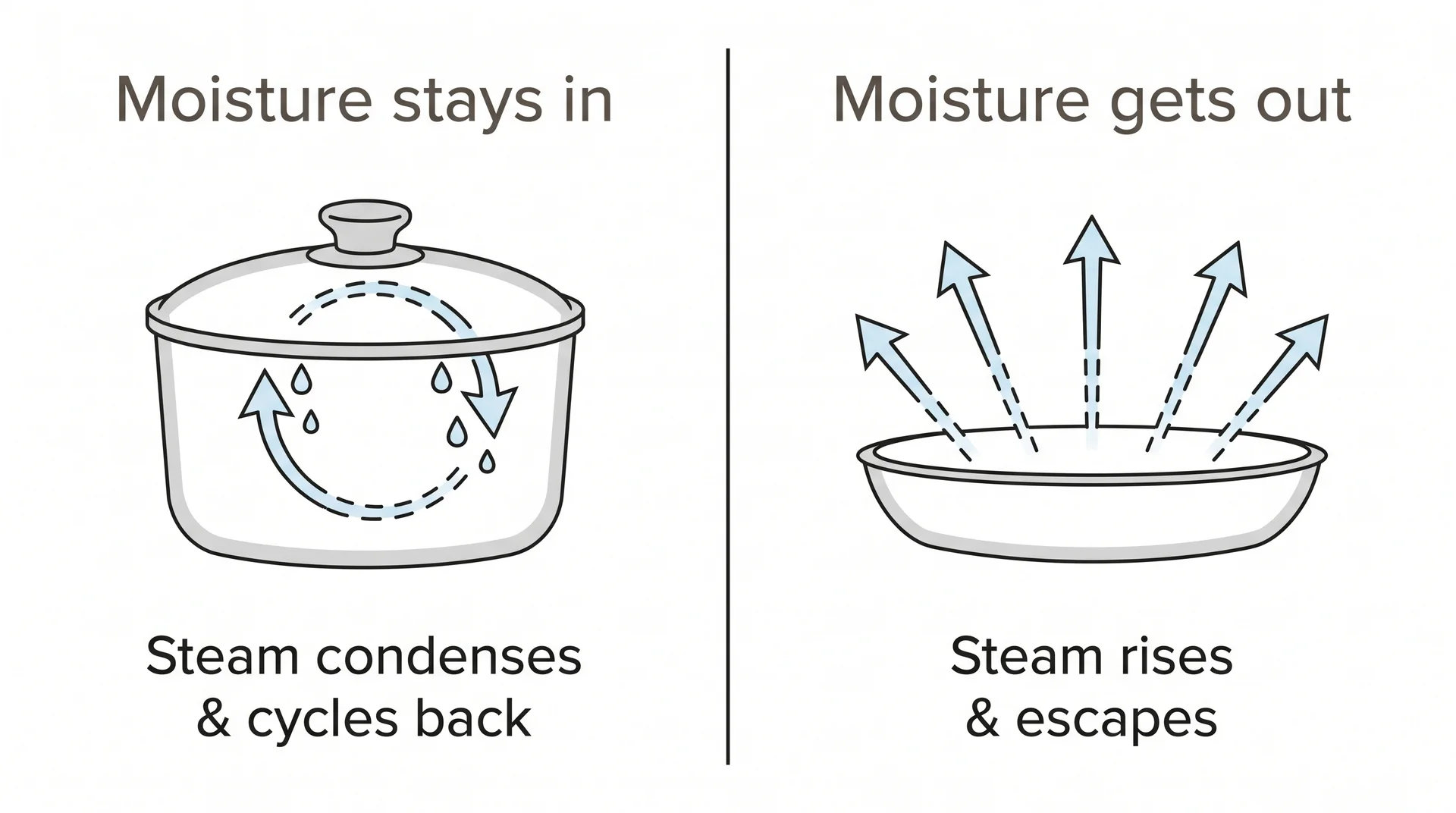
Whether moisture should stay in or get out determines which vessel to reach for.
Pot keeps it in. Pan lets it out. The table below applies that rule to the tasks most home cooks handle regularly.
| Task | Correct Vessel | Why |
|---|---|---|
| Boiling pasta | Large stockpot | Volume and stable water temperature |
| Making soup or stock | Stockpot or Dutch oven | Moisture retention, long cook time |
| Simmering a sauce (small batch) | Saucepan | Controlled reduction, compact volume |
| Searing a steak or chicken | Frying pan or skillet | Wide base, fast evaporation, browning |
| Scrambling eggs or pancakes | Frying pan | Low sides, direct heat, quick cook |
| Braising meat | Dutch oven | Even heat, tight lid, oven transfer |
| Sautéing vegetables | Frying pan or sauté pan | Wide base, high heat tolerance |
| Reheating soup or sauce | Saucepan | Small volume, controlled heat |
The saucepan earns its place on that table twice. Its hybrid character makes it useful across tasks that sit between pot and pan territory, which is exactly what we covered in the saucepan section above.
Can You Substitute Them?
Most substitutions work some of the time.
I’ve tested this pattern consistently. Substitution holds for short cooks and small batches. It breaks down with scale, high heat, or extended time.
When Substitution Usually Works
Reasonable substitutions are possible across a range of everyday tasks.
Here are the substitutions that hold up reliably. They all share one reason: the cooking environment stays similar enough.
- Sauté pan for a frying pan: A sauté pan used in place of a frying pan, which I reach for routinely in my own kitchen, works in almost every case. The taller sides contain splatter. The wide base still enables browning.
- Saucepan for a small pot: Works for small batches and short cook times. Reheating soup or cooking a portion of rice in a saucepan is fine. Volume is the only real constraint.
- Dutch oven for a stockpot: Works for soups and braises. Its heavier walls slow initial heating slightly. Cooking capability stays equivalent for most tasks.
These substitutions succeed because the cooking environments stay close enough. Scale is the variable to watch, not the technique itself.
When Substitution Fails
Some substitutions fail consistently.
Knowing which ones matter more than knowing what works. Each failure case below puts the vessel in a fundamentally different environment from what the technique requires.
- Frying pan for a saucepan in a long sauce: The wide base accelerates evaporation dramatically. A fifteen-minute sauce becomes a five-minute one. You’re fighting the vessel the whole time.
- Pot used for searing: Fails almost every time. Steam gets trapped by the tall sides. The food surface stays wet. Browning doesn’t start.
- Small saucepan for a large pasta batch: Fails on volume. Water temperature drops sharply when pasta goes in and doesn’t recover. The pasta cooks unevenly.
Some dishes genuinely fall into a grey zone.
A shallow braise or a quick pan sauce with added liquid can work in either a wide pan or a saucepot, depending on batch size. I don’t have a clean rule for those cases, and I’d be suspicious of anyone who claims they do.
What to Reach for First? Pot or Pan?
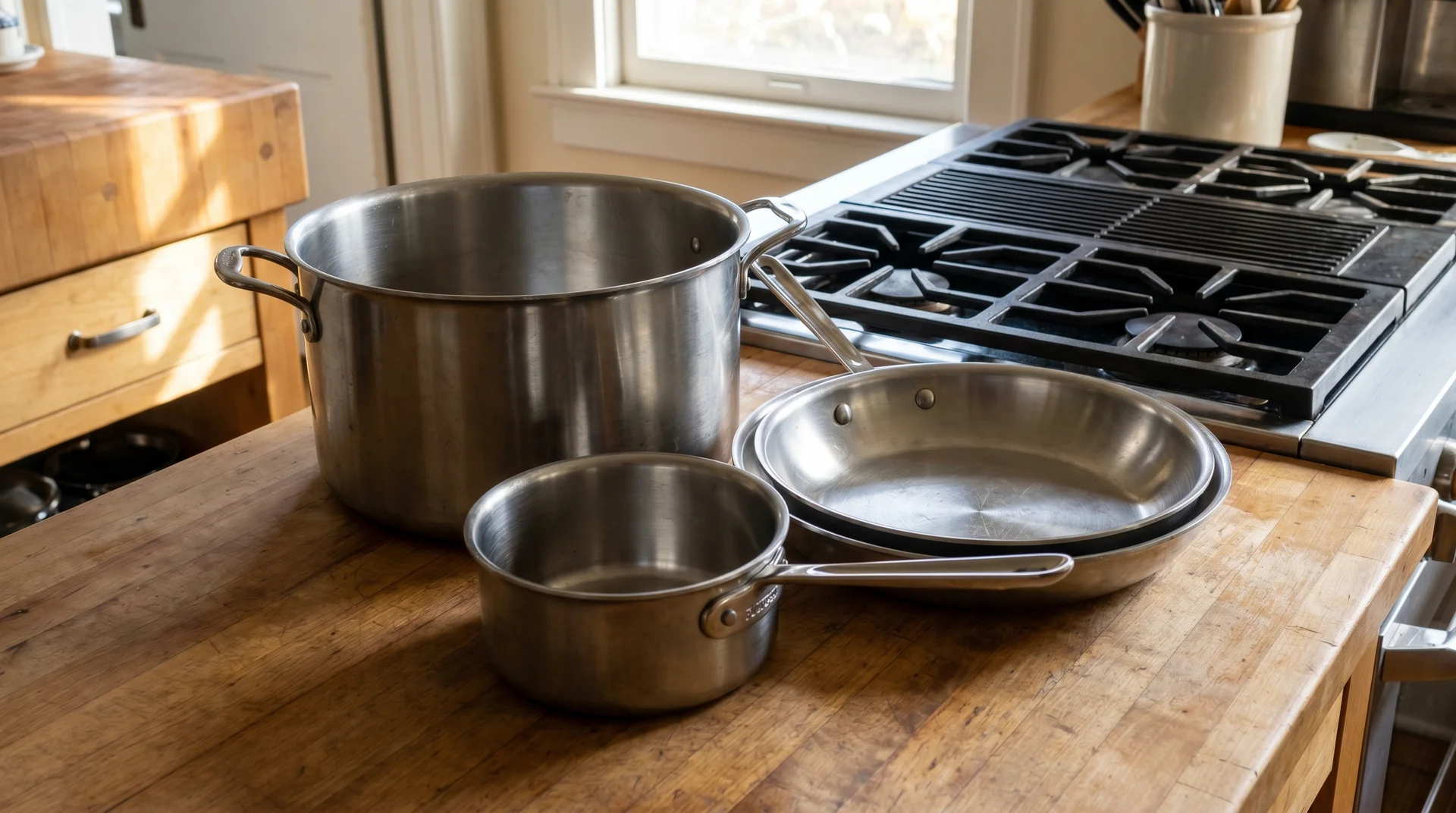
You don’t need every pot and pan type right away.
Three pieces cover the full range of what most home kitchens need.
- Large stockpot or Dutch oven: All liquid cooking, soups, stocks, braising
- 10- or 12-inch frying pan: All dry-heat cooking, searing, sautéing, eggs
- 2- or 3-quart saucepan: Small-batch liquid cooking and daily reheating
In my experience, those three vessels cover the vast majority of what most home cooks make in a regular week. The saucepan handles more daily tasks than any other single vessel in that set.
The sauté pan is the smart first addition beyond those three. It handles larger batches of dry-heat cooking and covers the gap between a frying pan and a saucepot.