

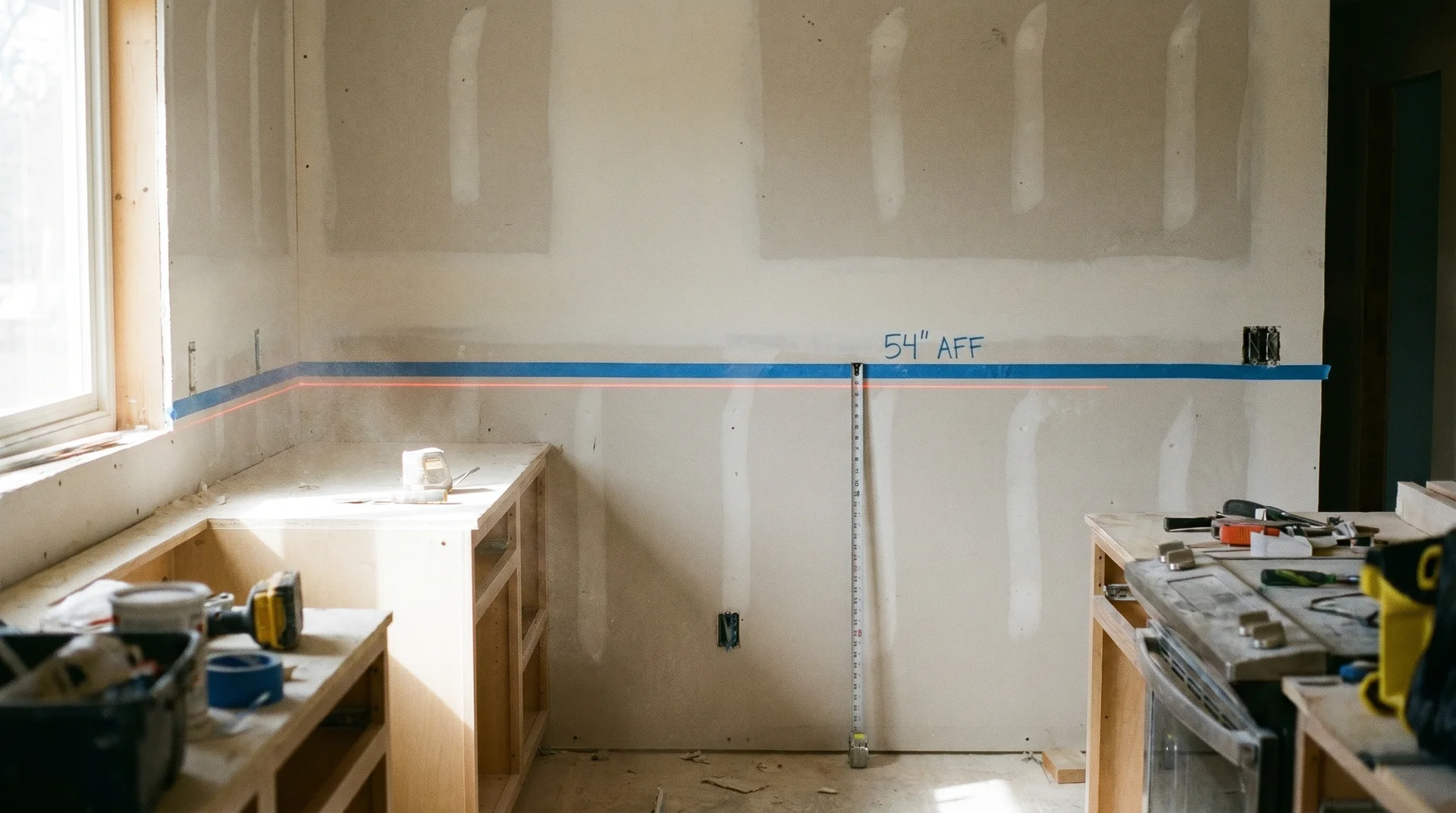
The standard kitchen cabinet height from the floor is 36 inches to the countertop surface, with upper cabinet bottoms at 54 inches. Both numbers come from a three-part chain.
Get any part of that chain wrong, and the room reads as off, even when the installer did everything right. This piece walks through each part.
| Cabinet or Surface | Standard Height |
|---|---|
| Base cabinet box (without countertop) | 34.5 inches |
| Finished countertop surface | 36 inches |
| Bottom of upper cabinets | 54 inches |
| Upper cabinet sizes (ceiling-dependent) | 30″, 36″, or 42″ |
| Minimum clearance above a range cooktop | 24 inches (gas requires more) |
| ADA countertop maximum | 34 inches |
| ADA upper cabinet reaches maximum | 48 inches from the floor |
How Base Cabinet Height Works?
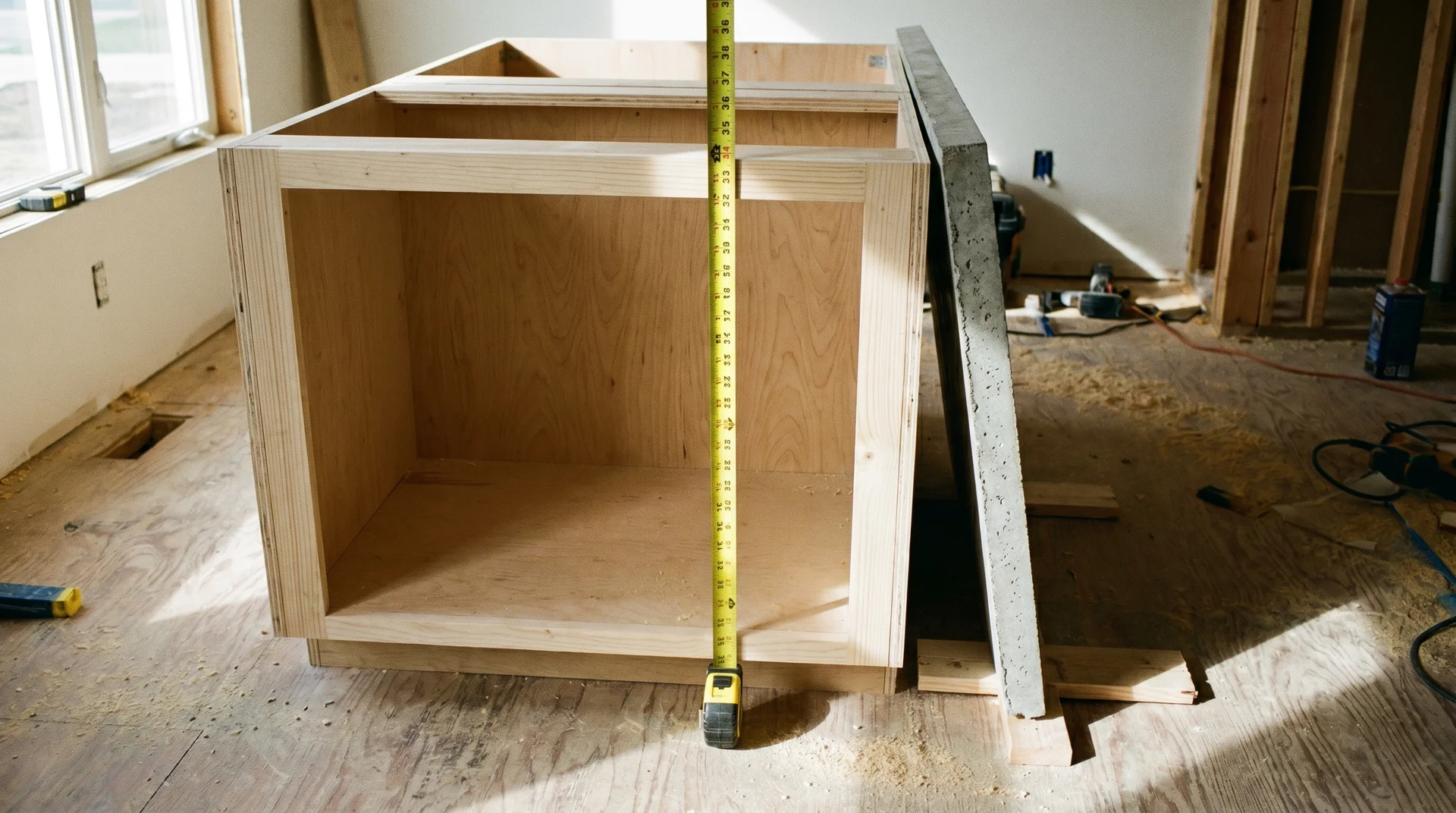
Base cabinet height is actually two different numbers.
The 34.5-Inch Cabinet and the 36-Inch Counter
The standard base cabinet box measures 34.5 inches high. That’s the cabinet sitting on the floor before any countertop goes on. When you install a standard countertop, the finished working surface lands between 36 and 36.5 inches from the floor.
Countertop material changes this. Quartz and granite typically run 1.25 to 1.5 inches thick. Butcher block varies by supplier, and decorative edge profiles can add more to the total stack.
A thicker slab pushes the finished counter height up, which shifts where your upper cabinets need to sit.
I’ve seen clients come back confused because their counter ended up taller than what they read online. In almost every case, the countertop material was the reason. Confirm the actual thickness with your supplier before marking anything on the wall.
The Toe Kick
The toe kick, the recessed strip at the base of every cabinet, runs 3.5 to 4.5 inches high and 3 inches deep.
That recess lets you stand close to the counter without your feet hitting the cabinet face. Without it, you’d stand further back, reach further forward, and tire faster during prep.
Some renovators convert the toe kick into a shallow pull-out drawer for extra storage. I find this genuinely useful in small kitchens where every inch counts.
But it alters the base cabinet height slightly, so talk to your installer before ordering.
Upper Cabinet Height from the Floor
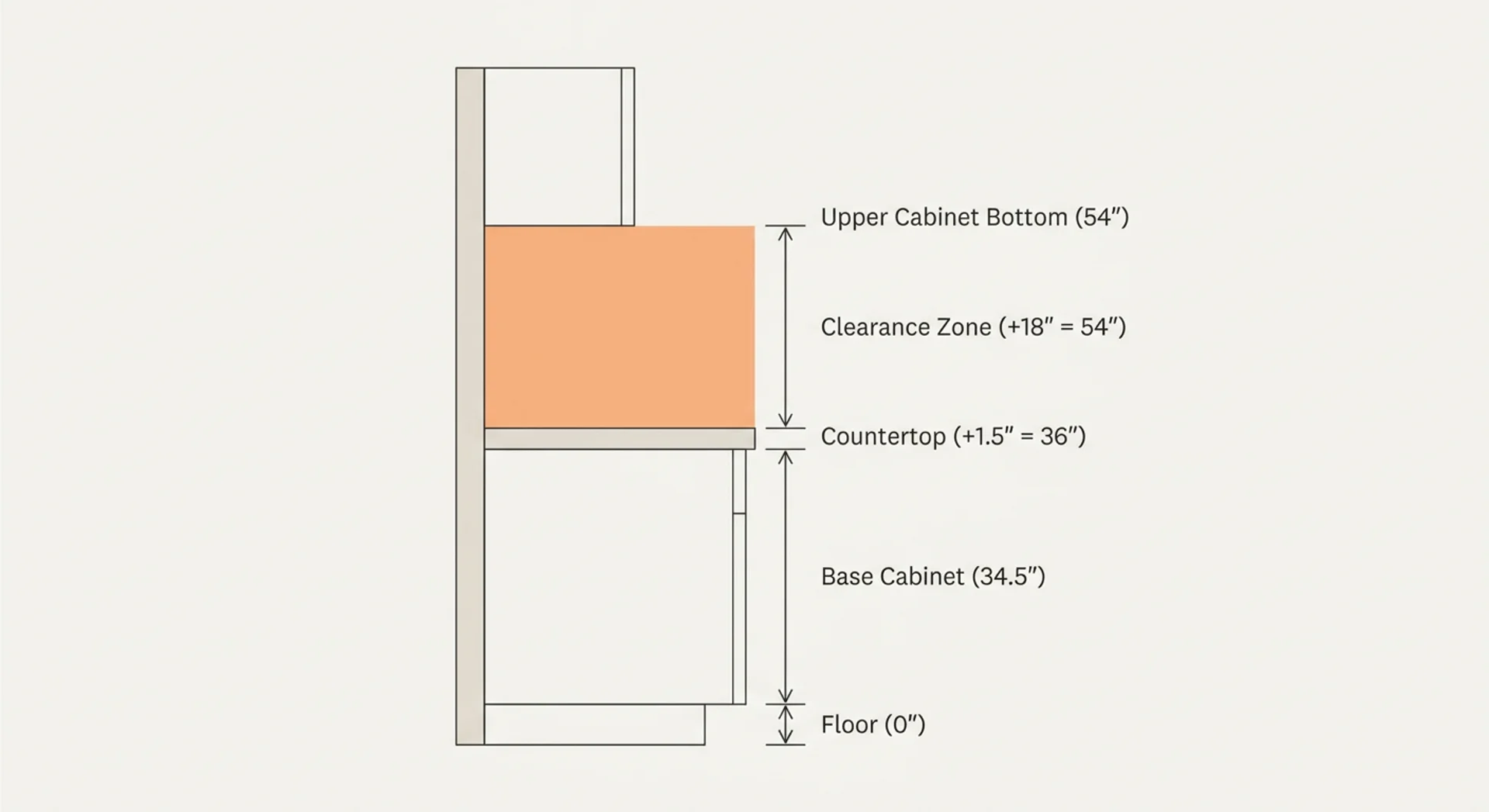
Upper cabinets sit at a standard starting height. Understanding where that number comes from matters.
The 54-Inch Standard
It goes like this:
= 34.5-inch base cabinet + 1.5-inch countertop = working surface at 36 inches.
= working surface at 36 inches + 18 inches of clearance above that surface = upper cabinet bottom lands at 54 inches
The 18-inch gap is the working zone of your kitchen. It’s where countertop appliances sit and where you see the counter surface while cooking.
The National Kitchen and Bath Association sets 18 inches as the recommended minimum for residential kitchens. It’s also the minimum clearance a standard stand mixer needs to operate with the head fully raised
Fifty-Four Inches Is a Convention
Fifty-four inches is what happens downstream when that anchor holds. It works for most kitchens and most users.
It emerged from decades of cabinet manufacturing practice, reinforced by NKBA ergonomic guidelines anchoring around a 36-inch finished counter height.
When 18 Inches Above the Counter Isn’t Right
- Fifteen inches is the practical minimum below upper cabinets.
- Twenty inches is the practical maximum before the backsplash zone starts to feel visually disconnected from the counter.
Go below 15 inches, and countertop appliances won’t fit. A standard stand mixer with the head fully raised needs clearance to operate upright.
Go above 20 inches, and the zone between the counter and the upper cabinet starts to look stretched. The top and bottom halves of the kitchen stop reading as a unit.
Taller primary cooks often prefer 20-inch clearance because it reduces the sense of enclosure. Shorter cooks sometimes stay at 18 because it keeps the upper shelves more reachable.
The honest answer is that the ideal clearance varies by person.
User height, countertop appliance depth, and how you move through meal prep all affect what feels right. 18 inches is the best starting point the industry has.
Test it in your current kitchen:
- stand at the counter,
- hold your hand 18 inches above it, and
- judge whether the space feels workable.
Adjusting Cabinet Height for Your Ceiling
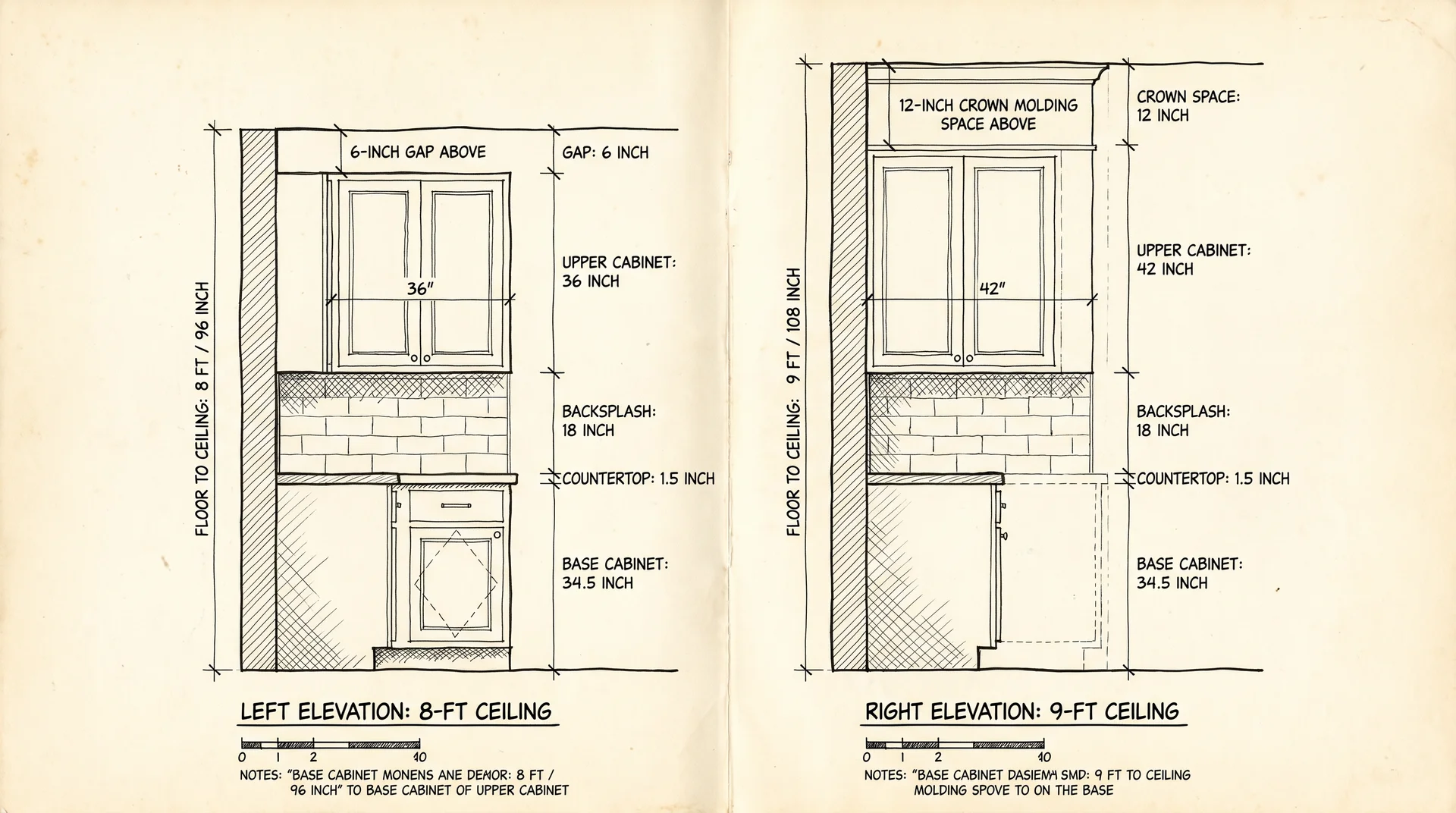
Ceiling height determines which upper cabinet size fits your kitchen.
8-Foot Ceilings: Which Upper Cabinet Size Fits
With an 8-foot ceiling, 30-inch or 36-inch upper cabinets work. A 42-inch cabinet will hit the ceiling with no room left for any trim detail.
A 36-inch upper cabinet, with its bottom at 54 inches, puts the top at 90 inches. An 8-foot ceiling is 96 inches. That leaves 6 inches of space above the cabinet, and those 6 inches need a plan before installation starts.
Soffits are almost always the wrong answer for that gap, in my experience. They’re permanent, they compress the ceiling height visually, and they add weight to a room that rarely needs it.
A crown molding detail or an open display ledge handles the transition more gracefully in most kitchens.
9-Foot and 10-Foot Ceilings
Taller ceilings open up 42-inch uppers and double-stacked configurations. Any shelf you cannot reach without a step stool is dead storage by definition, so plan it deliberately.
A 9-foot ceiling (108 inches) with 42-inch uppers at 54 inches puts the cabinet top at 96 inches, leaving 12 inches above. That’s enough for proper crown molding. Double-stacked cabinets are also a real option here: two rows of shorter upper cabinets arranged vertically.
The upper row in a stacked configuration needs to hit wall studs. Confirm stud placement before ordering.
The top shelf of a 42-inch upper sits roughly 90 to 94 inches from the floor. Plan what goes there before you commit.
That height is above comfortable reach for most adults without a step stool.
Plan what goes there before you order: seasonal serving pieces, overflow pantry goods, and things you rotate a few times a year.
A dead zone you planned for is storage.
Above the Range
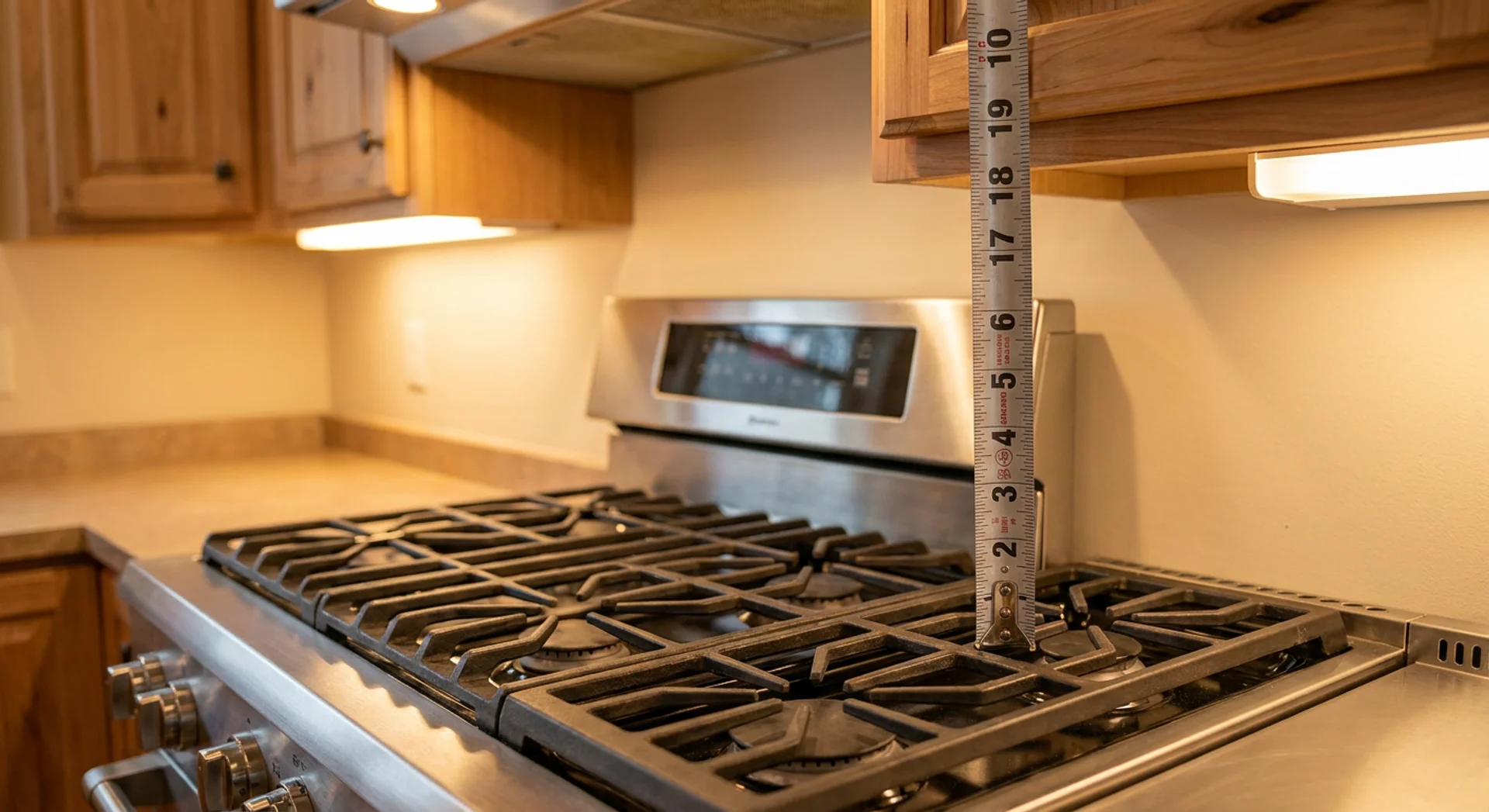
Upper cabinets directly above a cooktop require a minimum of 24 inches of clearance, not 18. Gas ranges typically require 30 inches or more.
This is one place where the standard 54-inch mounting height doesn’t apply. A range hood, a microwave-hood combination, or a cabinet positioned above the cooking surface all operate under different clearance rules.
Most range manufacturers specify the minimum clearance in their installation documentation. Check it before ordering the cabinet above the range, not after it arrives.
This clearance is a fire safety requirement, not a design preference. Treating it as adjustable creates a real hazard.
Installation Reality of Cabinet Heights
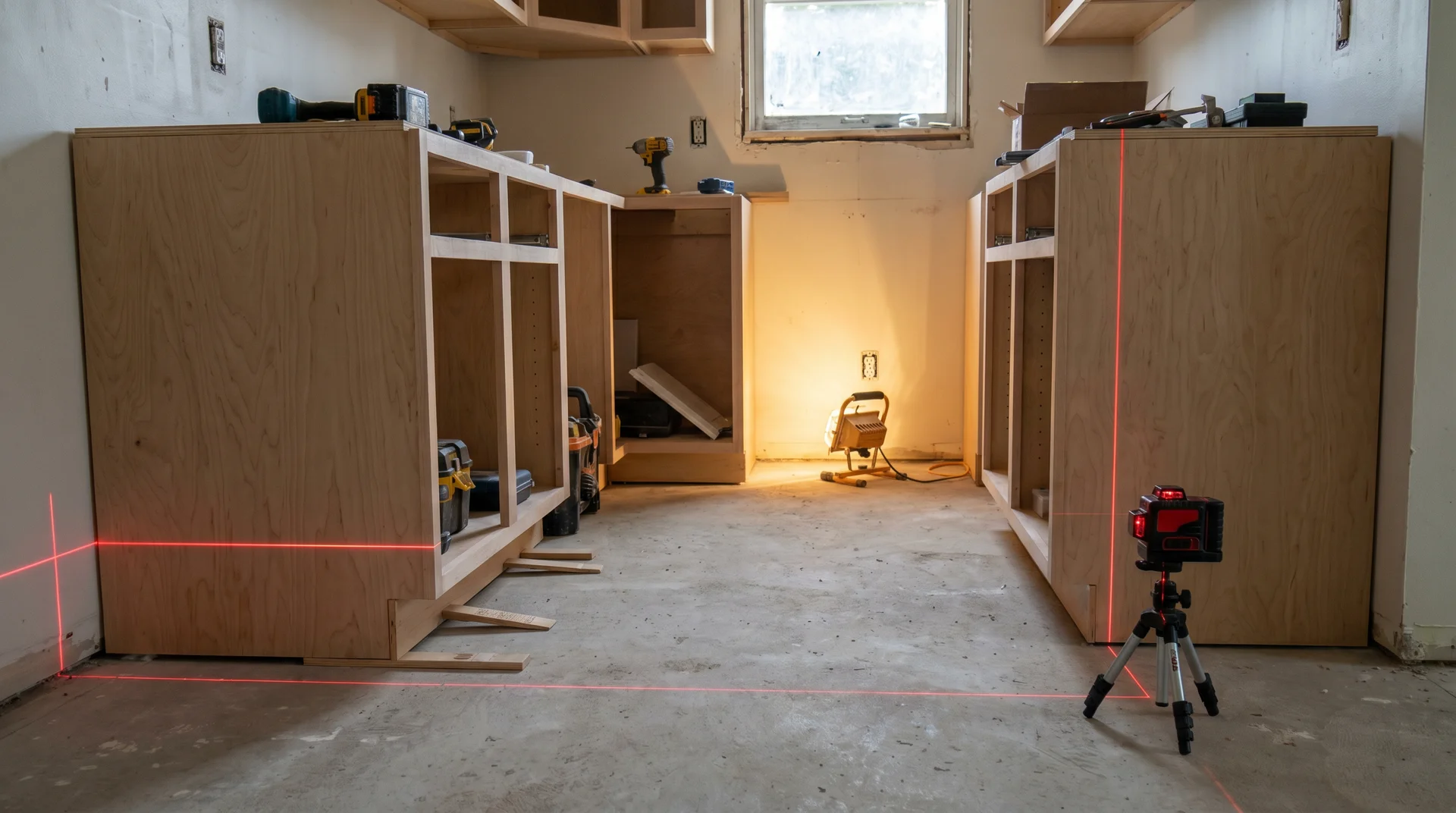
The numbers on a spec sheet assume a perfect room.
When Your Floor Is Not Level
Standard cabinet heights are measured from the highest point of the floor, never from an average.
Floors in most homes, especially older ones, are not level. They settle, they dip at corners, and they rise near walls. A floor that appears flat can run out half an inch across a kitchen.
Before installation starts, find the floor’s high point using a laser level or a 4-foot spirit level moved across the floor in a grid. Mark that point clearly.
The standard chain of measurements, base height plus countertop thickness plus upper clearance, starts from that mark and nowhere else.
Cabinets on the lower sections of the floor get shimmed up to meet the common level line.
On a severely uneven floor, those shims might be three-quarters of an inch or more. The installer works out from the high point, shimming as they go.
Measuring Before You Order the Kitchen Cabinets
Measure in this order: ceiling height first, then floor levelness, then base cabinet line, then upper cabinet placement.
- Find the highest point of the floor. Mark it clearly. This is your baseline for everything that follows.
- Mark the base cabinet top line. Measure 34.5 inches up from the high point. This is where the top of the cabinet box will sit.
- Add countertop thickness. Confirm the actual thickness with your countertop supplier before marking. Add that number to get your finished counter surface height.
- Mark the upper cabinet’s bottom line. Add 18 inches, or your adjusted clearance, to the finished surface height. This is where the bottom of the upper cabinets sits.
- Measure from the upper cabinet bottom line to the ceiling. This tells you which upper cabinet height fits and how much space, if any, remains above the cabinets.
If step five reveals less than 3 inches above your chosen upper cabinet size, you have two options.
- Select a shorter upper cabinet, or
- raise the base cabinet line slightly by shimming before installation.
The second choice changes your finished counter height, which means outlet placement, dishwasher rough-in, and range fit all need checking.
When Cabinet Height Standard Height Doesn’t Work
The 36-inch standard works for a broad range of users. It was calibrated for a specific one.
Adjusting for Tall and Short Cooks
The 36-inch standard countertop height was calibrated for a user between 5’4″ and 5’9″.
There’s a simple test for finding your personal ideal: stand upright, bend your elbows to 90 degrees, and drop your hands 4 to 5 inches.
That measurement is close to your ideal working surface height. If it differs from 36 by more than 2 inches, talk to your installer about adjusting the base height before you order.
Raising or lowering the base changes things downstream. Standard dishwashers, drop-in ranges, and under-counter refrigerators are all designed around the 36-inch counter height.
The right height for your kitchen is the one that fits the people who cook in it most often.
If two people of significantly different heights share the kitchen regularly, no single counter height works perfectly for both.
A kitchen designer can help find the best compromise or identify where a second work surface at a different height might be practical.
ADA-Compliant Kitchen Cabinet Heights
ADA guidelines set the maximum base cabinet countertop at 34 inches, and the maximum upper cabinet reach height at 48 inches from the floor. These apply in residential design when the kitchen needs to accommodate a wheelchair user.
The key structural requirement is knee clearance: at least 27 inches of vertical space under the counter, 30 inches wide, and 19 inches deep.
ADA base cabinets are typically shallower than standard. Some ADA kitchens use open base sections at the sink and primary prep areas to meet this requirement.
The full accessible kitchen planning framework, covering turning radius, sink depth, reach range, and pull-out hardware requirements, belongs in its own piece. It needs different criteria than what this article covers.
How to Make the Heights Work for Your Specific Room
The measurements tell you what fits & proportions tell you what’s right.
The Backsplash Zone Is the Visual Center of Your Kitchen
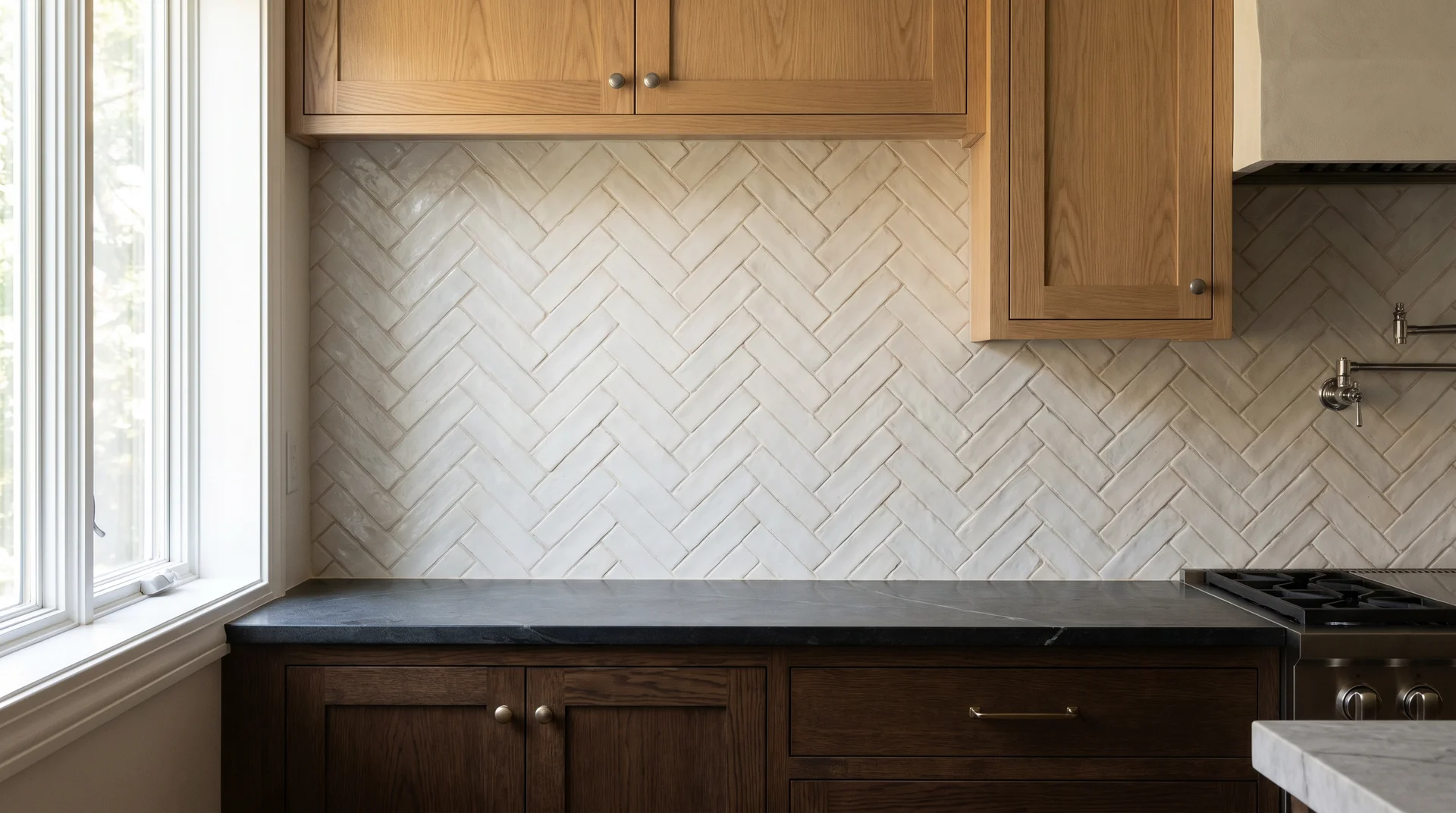
The strip between your countertop and upper cabinet bottoms is the first thing your eye finds when you walk into the kitchen.
I developed what I call the one-hero rule from a project that went badly wrong. I over-specified a kitchen: patterned backsplash, dark cabinet faces, brass hardware, open shelving with mismatched objects, all competing for attention at once.
I redesigned that kitchen at my own cost: $6,000 out of my pocket. The rule that came out of that afternoon is simple: every kitchen needs one dominant visual statement, and everything else submits to it. Cabinet height determines how much room the statement has to breathe.
A taller clearance, 20 inches instead of 18, gives the backsplash zone more presence. It makes sense when the tile or material is the design anchor. A tighter clearance suits kitchens where the cabinetry is the visual anchor, and the room should feel more enclosed and architectural.
Neither is wrong. Both require a choice made before installation, not a measurement accepted as the default.
What to Do with the Gap Above Your Cabinets
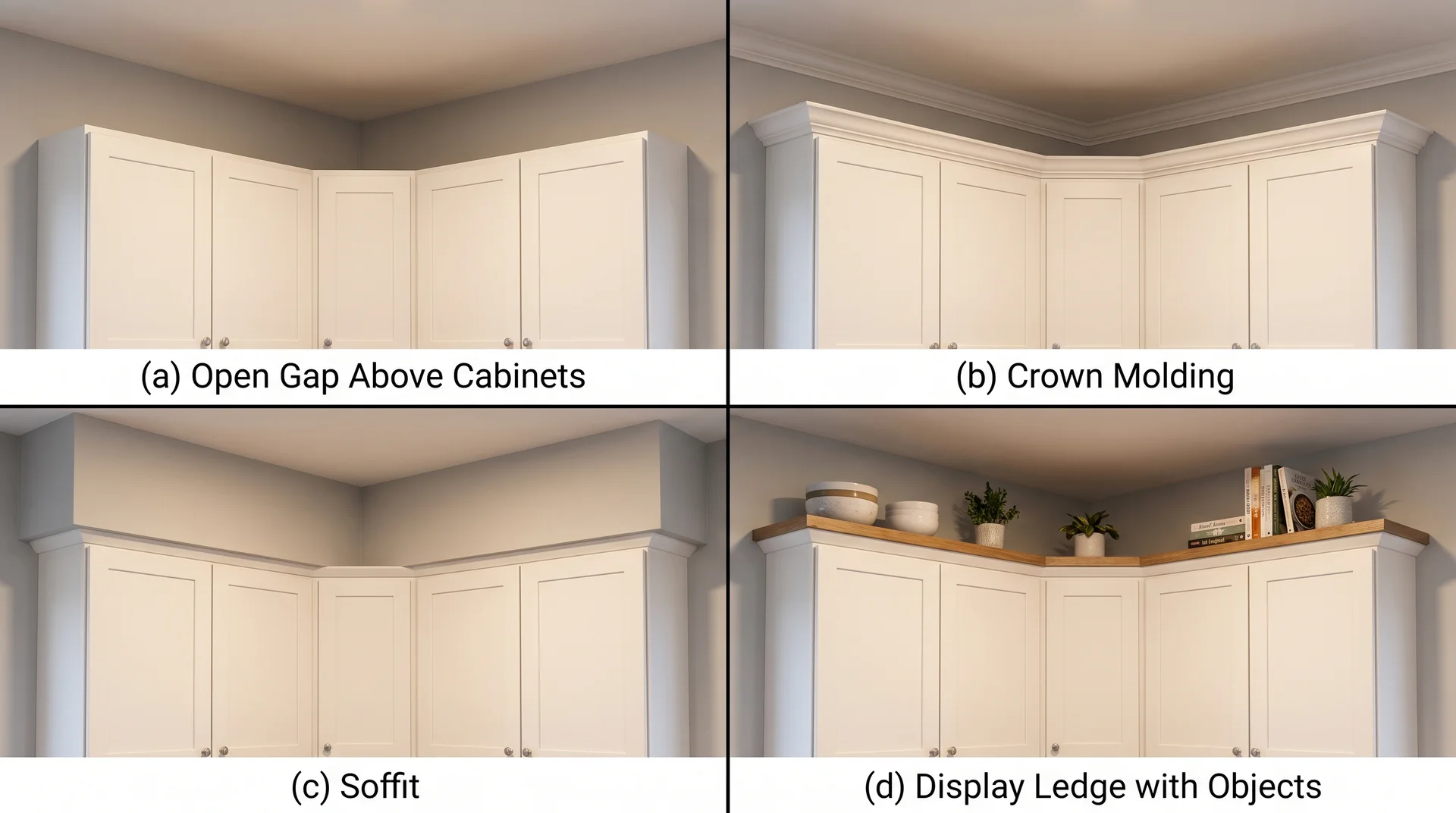
The space between the tops of your upper cabinets and the ceiling is a design decision. Treat it like one.
It’s going to be visible every day for the next 15 years. It deserves more than a shrug.
I have twelve years of photographs of real kitchen choices that went wrong. The gap above cabinets shows up in that archive more than any single tile choice. It is almost always something nobody planned for.
Here are the realistic options and what each one actually requires to execute:
| Option | Visual Effect | What It Actually Takes |
|---|---|---|
| Leave it open | Lighter, airier; cabinet tops visible | Intentional styling of the cabinet top surface; ongoing dust management |
| Crown molding | Finished, traditional transition to ceiling | Minimum 4 to 6 inches of clearance; finish carpentry skill or a hired trim carpenter |
| Soffit | Clean, continuous ceiling-to-cabinet line | Permanent framing work; lowers perceived ceiling height; not reversible without significant repair |
| Display ledge | Decorative break; semi-open shelf effect | Objects must be chosen deliberately; requires cleaning access; large items only |
Every aesthetic choice in that table carries an execution requirement. The constraint of your ceiling clearance is where the real design decision lives. If you have 4 inches of gap and no finish carpentry experience, crown molding is probably not the right call for your kitchen.
One more measurement worth making before any of this: the height of the people who cook in that kitchen every day. The standard is a starting point. It doesn’t have to be the answer.