

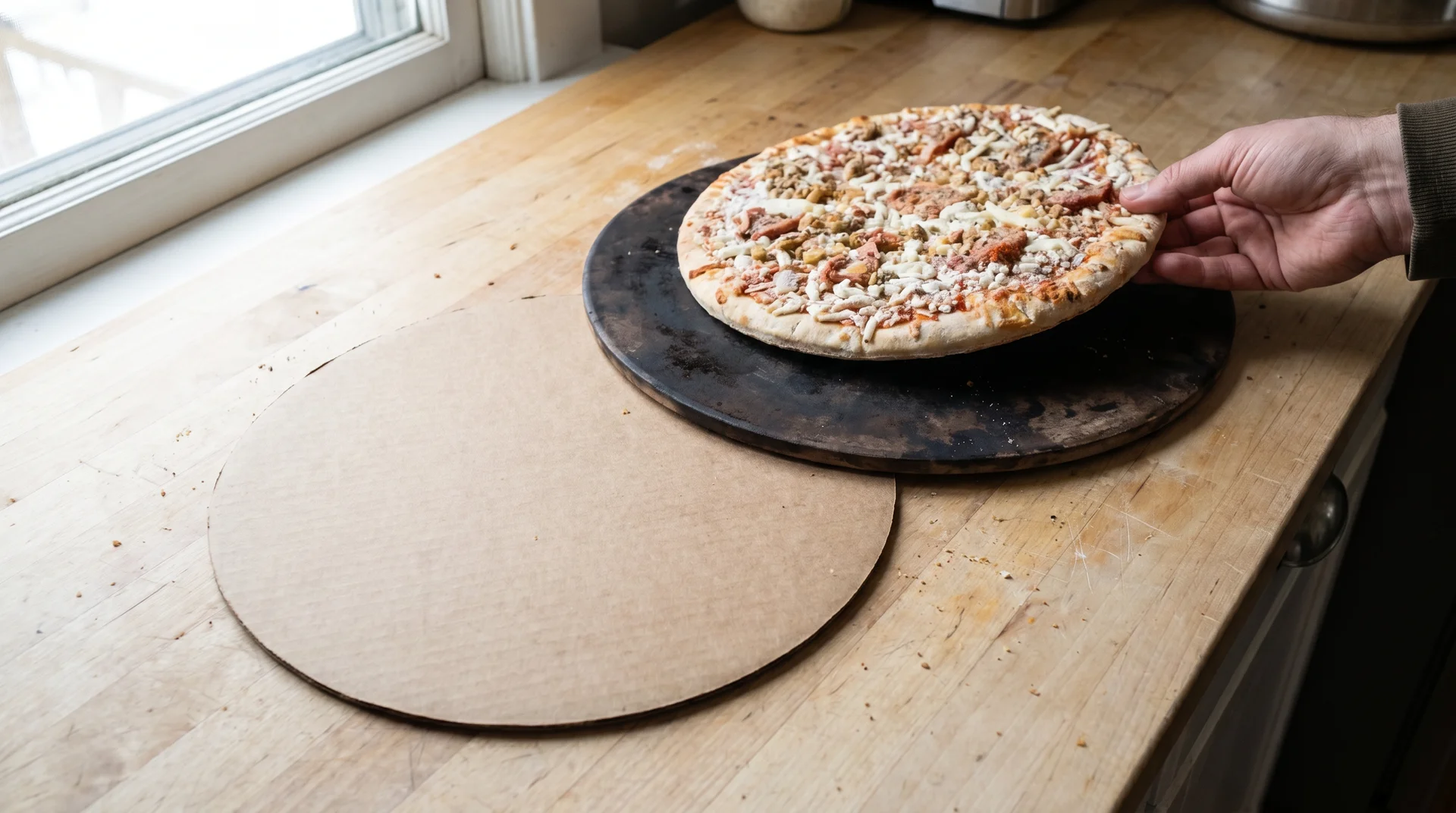
No. Cardboard does not belong in the oven. This covers the thin disc under your frozen pizza and the delivery box on your counter.
The reasons differ depending on which object you are asking about, and that difference matters enough to explain separately.
Cardboard Can’t Go in the Oven
Cardboard is not oven-safe. There is a genuine fire risk.
The absence of a fire does not mean the cardboard was safe. It means the conditions were not right for ignition at that time.
Temperature, cooking duration, and how dry the cardboard was all affect the outcome. Those conditions change every time.
Is it safe to reheat food in a cardboard container?
No. The FDA evaluates food-contact materials based on their intended use. Cardboard packaging rated for cold or ambient contact is not rated for oven temperatures. Using it as bakeware moves it outside the conditions it was designed and assessed for.
The next section explains the mechanism. If you have already left cardboard in your oven and want to know what to do now, skip to the last section.
What Cardboard Actually Does Inside a Hot Oven
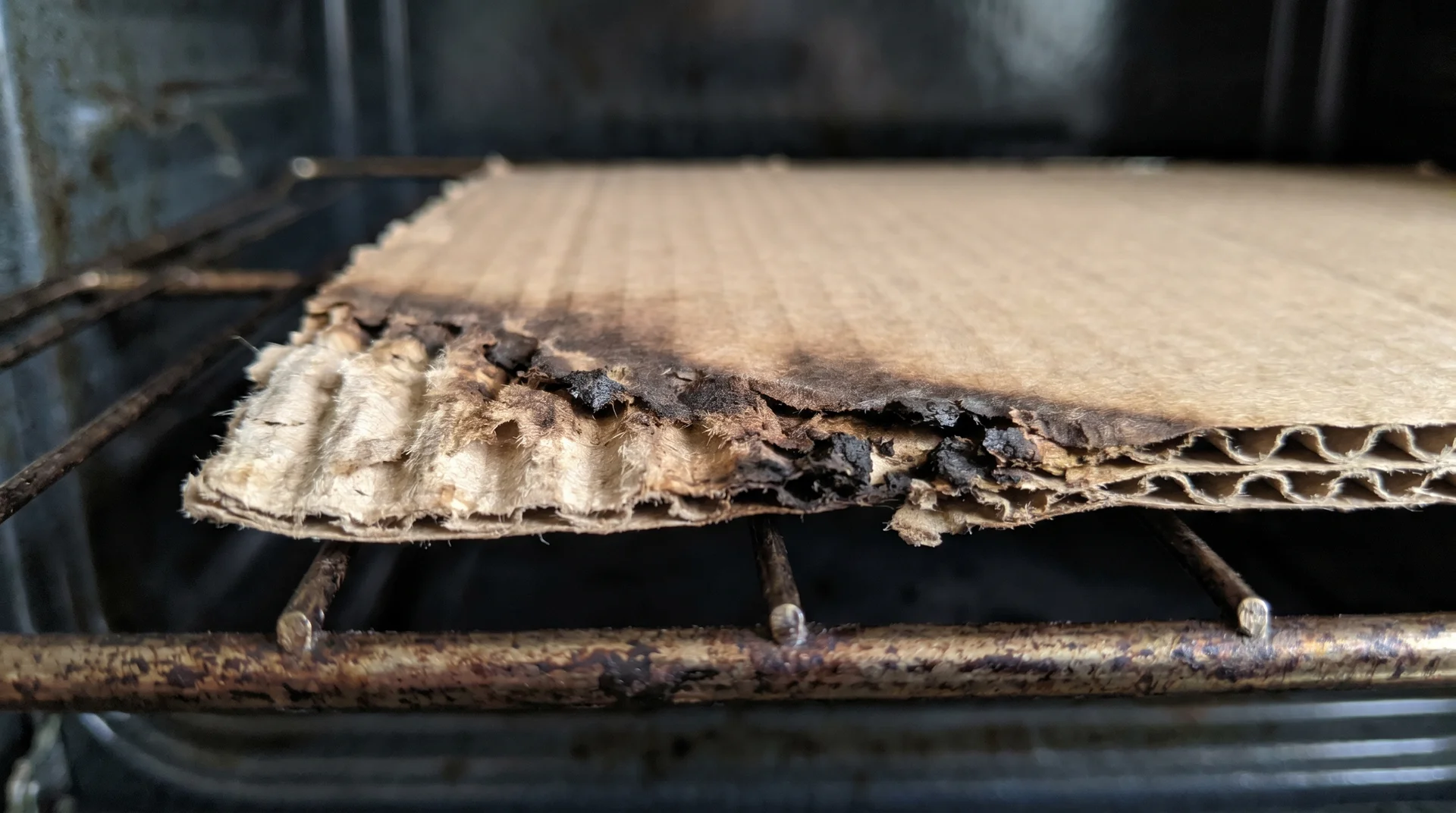
Cardboard does not wait for a critical temperature to become a problem.
Cardboard Begins to Degrade Before It Catches Fire
Scorching and drying start at low temperatures. Ignition is a separate threshold that comes later.
Standard untreated paperboard autoignites, meaning it catches fire on its own without a spark, at approximately 427°F (220°C).
You will see different numbers across the web: 400°F, 451°F, and an FAA fire safety figure of 1,000°F or higher. These are not contradictions. They describe different materials, different test methods, and different definitions of ignition.
None of those figures describes what happens at 350°F over 20 minutes, which is closer to what most oven reheating actually looks like.
At lower temperatures, cardboard does not burst into flames. It dries out, scorches, and begins releasing compounds from its surface treatments. That process starts well before any ignition threshold.
Moisture content is the main variable. Freshly arrived pizza box cardboard holds more moisture than the same box refrigerated overnight. Drier cardboard reaches combustion conditions faster. There is no single ignition temperature that applies to every piece of cardboard in every oven.
The Coatings Are the Less-Visible Problem
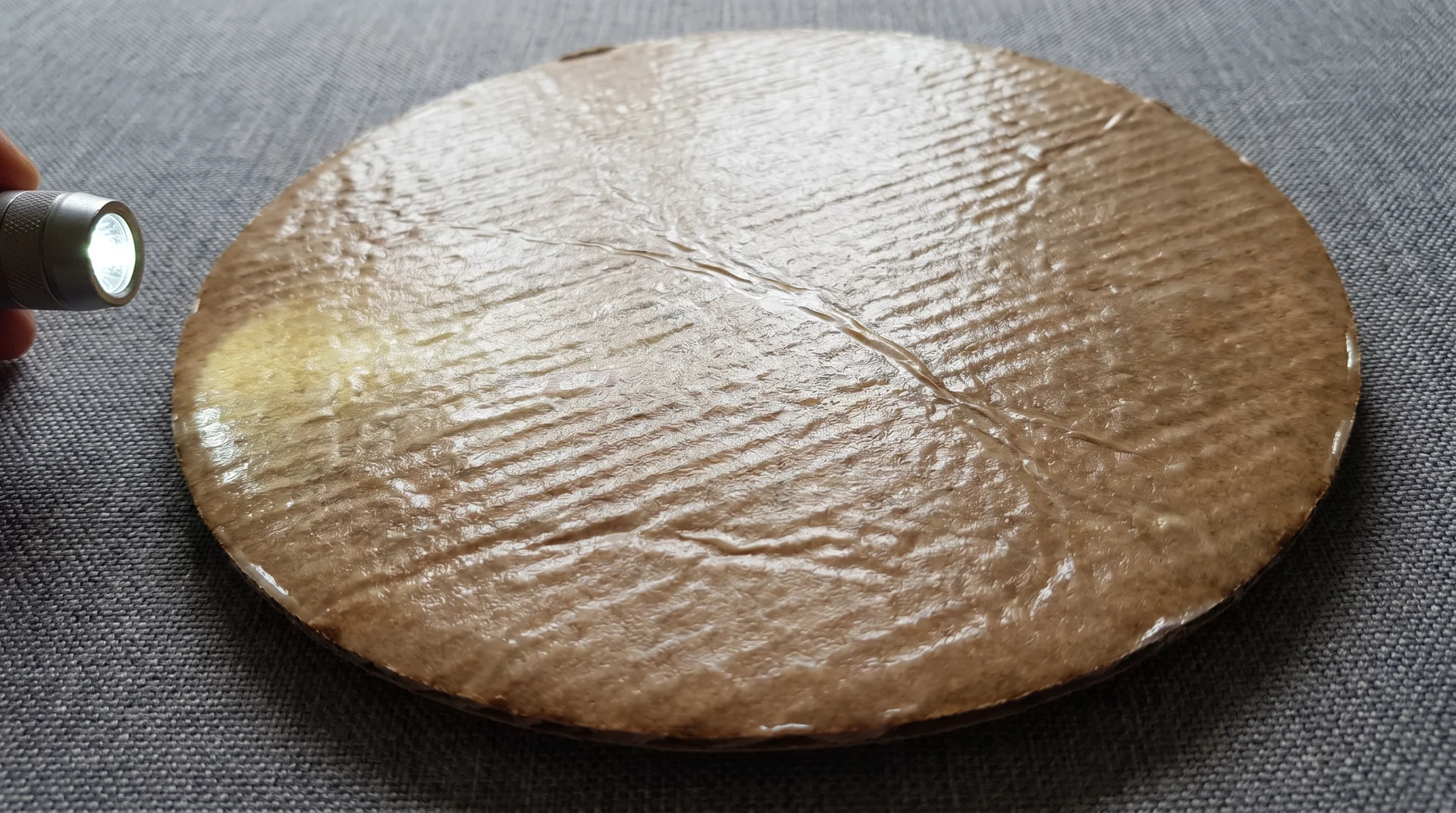
The cardboard touching your food carries surface treatments designed for packaging performance, not for baking.
Grease-resistant coatings, exterior printing inks, and structural adhesives are standard across pizza boxes and frozen food packaging. Some older packaging used PFAS-based compounds for grease resistance. Formulations vary by supplier and product line.
The FDA’s framework for food-contact materials is built around intended use. A coating assessed as safe in contact with cold food is not automatically safe under oven heat. The compound that gives packaging its grease-resistance was engineered for one set of conditions.
A 400°F oven is a different set of conditions entirely. The smell you notice when cardboard gets too warm is not just scorched paper. It is those surface treatments releasing. That smell is entering the food.
The Frozen Pizza Disc Is Not a Baking Surface
This is the question most people are actually asking.
What the Cardboard Disc Is Actually For
The disc under your frozen pizza is structural packaging. Its job ends when the pizza reaches your kitchen.
It keeps the pizza intact from the factory through the freezer aisle to your counter. Without it, frozen pizza cracks, shifts, and arrives with toppings displaced. The disc holds everything together during freezing and transport. It was engineered for cold, not heat.
Home Run Inn’s published baking instructions are explicit:
- Slide the pizza off the cardboard disc directly onto the middle rack of the preheated oven and
- Do not cook the pizza with the disc still attached.
That instruction is standard across most major frozen pizza brands. The manufacturer knows what the disc is made of. The instruction follows directly from that knowledge.
Why the Pizza Will Not Slide Off, and What to Do
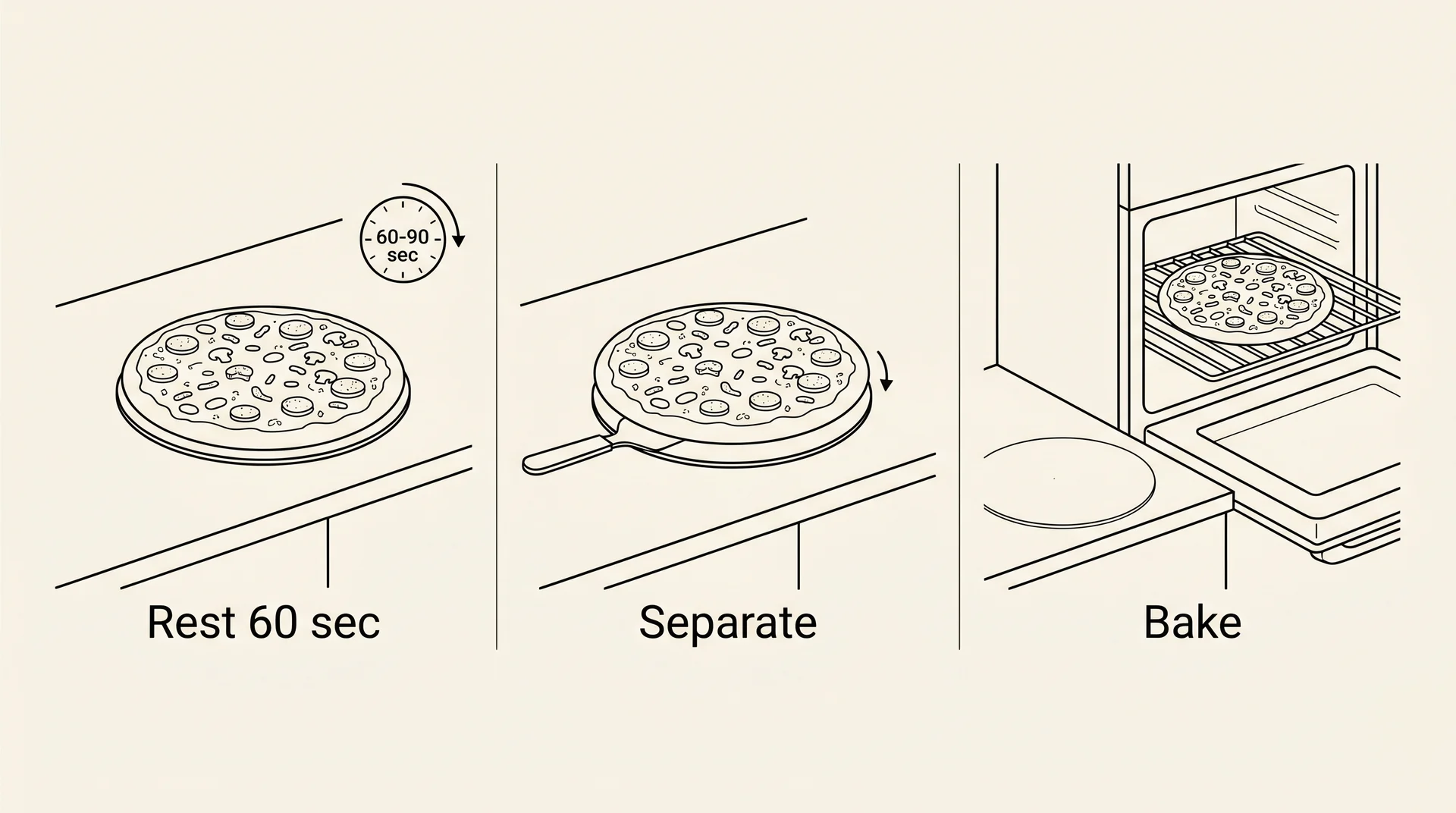
Most people leave the disc in because removing it is genuinely awkward.
A fully frozen pizza bonds to the cardboard during freezing. Trying to slide it off while still frozen risks cracking the crust and losing toppings before the oven is even open.
Three approaches work consistently:
- Rest the pizza for 60 to 90 seconds at room temperature first. The outer crust layer softens slightly. The bond between frozen dough and cardboard relaxes. Then slide a thin spatula or the edge of a sheet pan under the base and transfer it to the rack. The disc stays on the counter.
- Use the counter as your staging surface. Slide the whole assembly, disc and all, out of the box and onto the counter near the oven. Separate the pizza from the disc there, on a stable surface, then move the pizza to the rack or stone. The timing is easier to manage when you are not working over an open oven.
- Preheat a pizza stone and transfer it to the oven’s edge. Move the pizza from the disc directly onto the stone at the front of the open oven. The stone is already hot. The pizza starts cooking from the bottom the moment it lands. This method also produces the best crust of the three options.
The pizza cracks during removal because people try to move it while still fully frozen. Give it one minute at room temperature. The disc releases.
The Crust Is the Actual Reason to Remove It
Leaving the disc in produces a worse pizza. That is true regardless of whether anything catches fire.
Cardboard blocks the direct heat that would otherwise reach the bottom of the crust from the rack or stone. The disc absorbs it instead. The base stays soft while the top finishes cooking.
If you have had a frozen pizza with perfectly melted cheese and a crust that bends rather than snaps, the disc likely played a role.
Cook the same pizza without it. The difference in the base is noticeable within a single comparison. You are not avoiding a fire. You are making a better pizza.
The Pizza Delivery Box Is a Different Problem
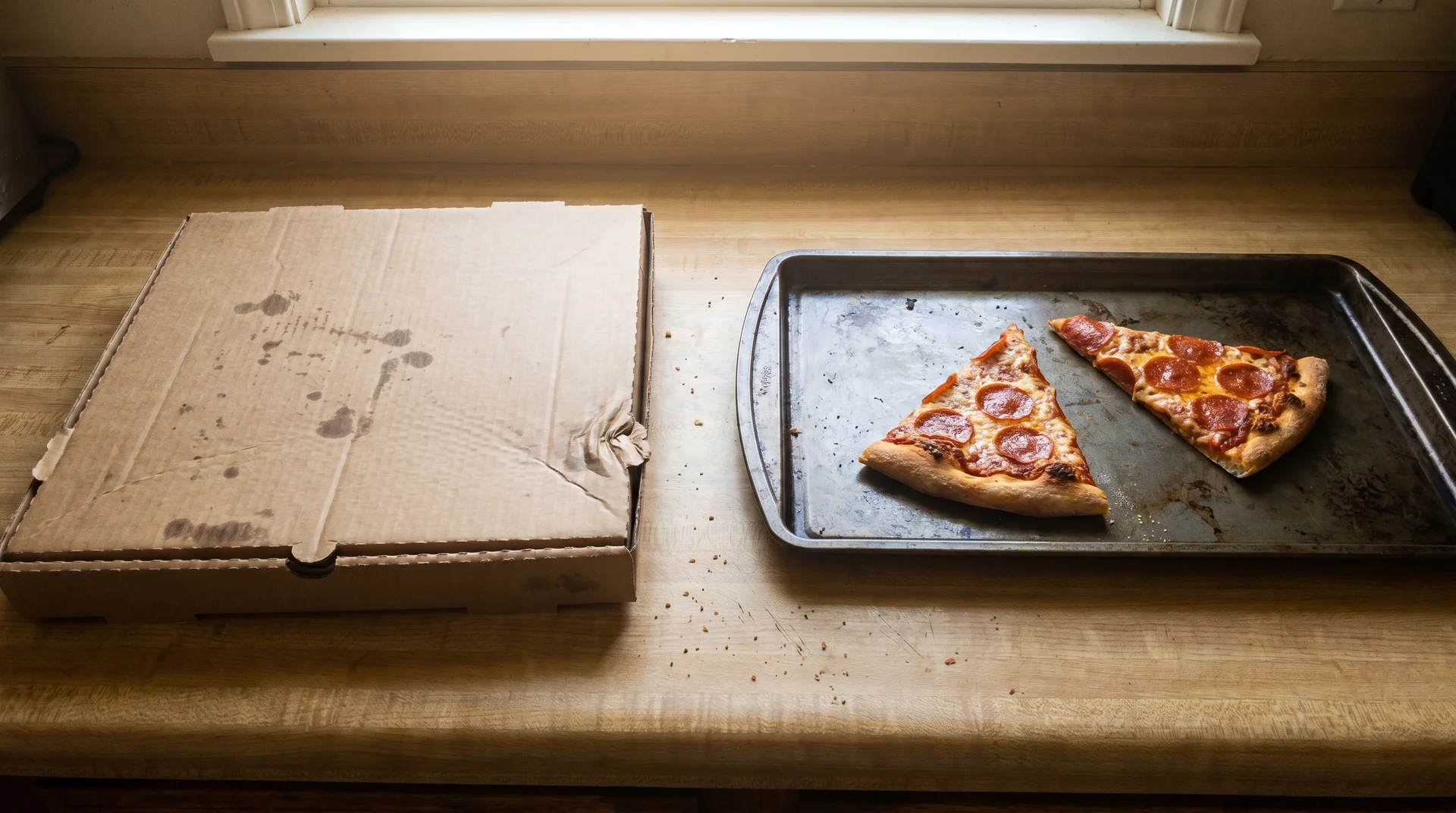
The delivery box that arrived with your pizza tonight is a different object from the thin disc under a frozen pizza, made differently and carrying different risks inside a hot oven.
A delivery box is corrugated cardboard with exterior ink printing, internal adhesives, and often a grease-absorbing liner on the bottom. More layers, more surface treatments, and more surface area than a simple disc.
The idea that you can keep pizza warm in the box on a low oven setting is one I have seen repeated constantly, and it does not hold up.
At a warm setting of 170°F to 200°F, a delivery box left in the oven for 15 to 20 minutes can scorch and release odors into the food. The flat profile of the box also places it close to the oven floor or lower heating element. There is no reliably safe version of this shortcut.
Can you put a pizza box in the oven to keep it warm?
No. Transfer the slices to a baking sheet or place them directly on the oven rack at 170°F. It takes one extra dish and 30 seconds. The food is better for it.
What to Use Instead of Cardboard in the Oven
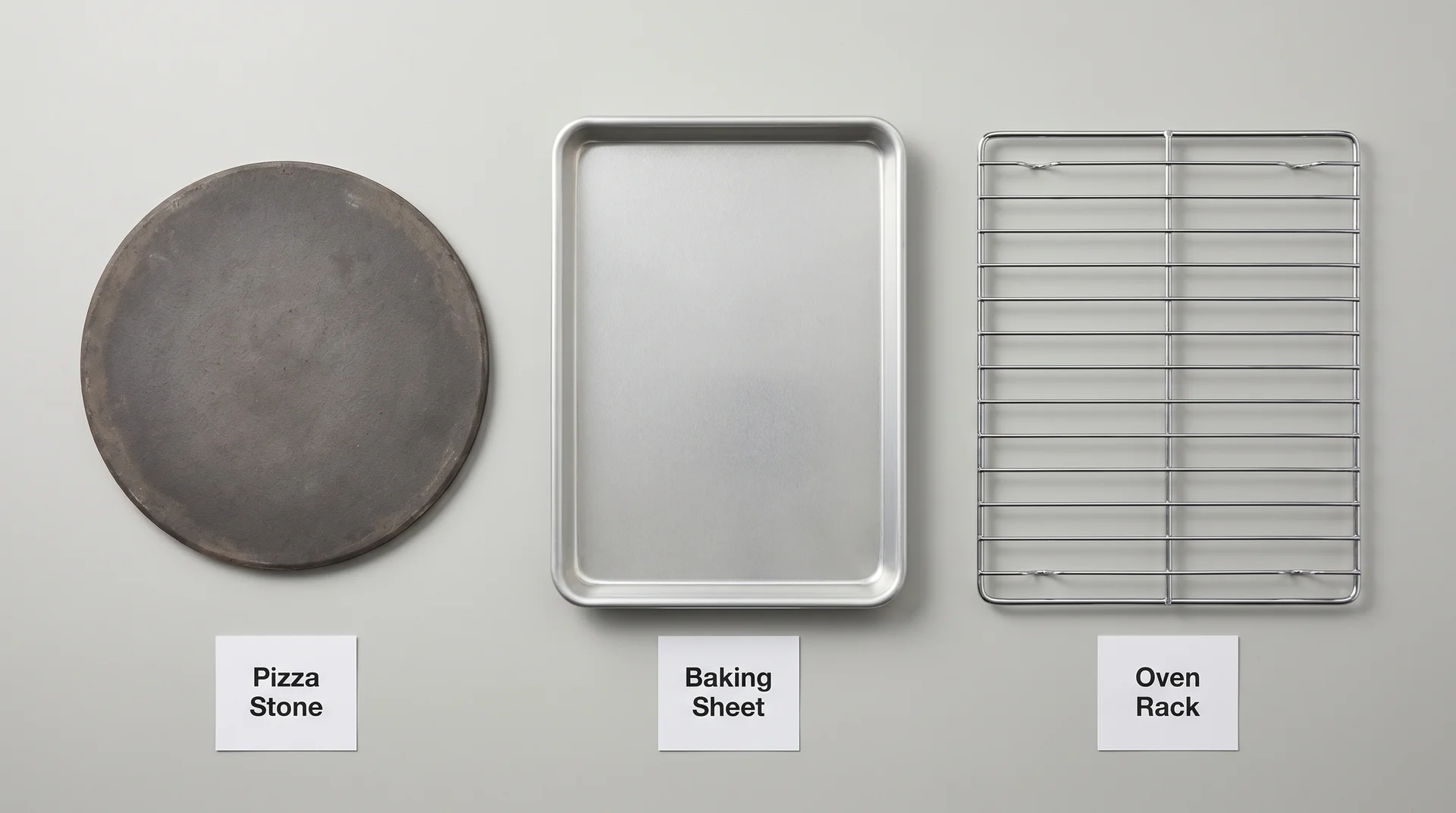
Every cardboard scenario has a direct, oven-safe substitute.
| Situation | Best Option | Notes |
|---|---|---|
| Frozen pizza, standard bake | Oven rack directly | Best crust texture. Direct heat from below. Most brands recommend this on the box. |
| Frozen pizza, cheese-heavy or fragile | Preheated baking sheet | Catches drips. Easier to retrieve. Slightly softer base than rack-only. |
| Frozen pizza, best crust result | Pizza stone | Preheat for at least 30 minutes. Significant improvement over both rack and sheet. |
| Reheating delivery pizza slices | Baking sheet or oven rack at 170°F | Five to eight minutes, depending on thickness. Check early. Skip the box entirely. |
| Any food in a cardboard container | Transfer to an oven-safe dish | No exceptions. The container is not bakeware under any circumstances. |
What can I use instead of cardboard in the oven?
A baking sheet, an oven rack, or a pizza stone. All three are oven-safe, none of them off-gas under heat, and all of them produce better food than cardboard.
Parchment paper works for lower-temperature reheating when placed on a baking sheet, but check the temperature rating on your specific brand before using it above 375°F.
What to Do If You Already Left Cardboard in the Oven
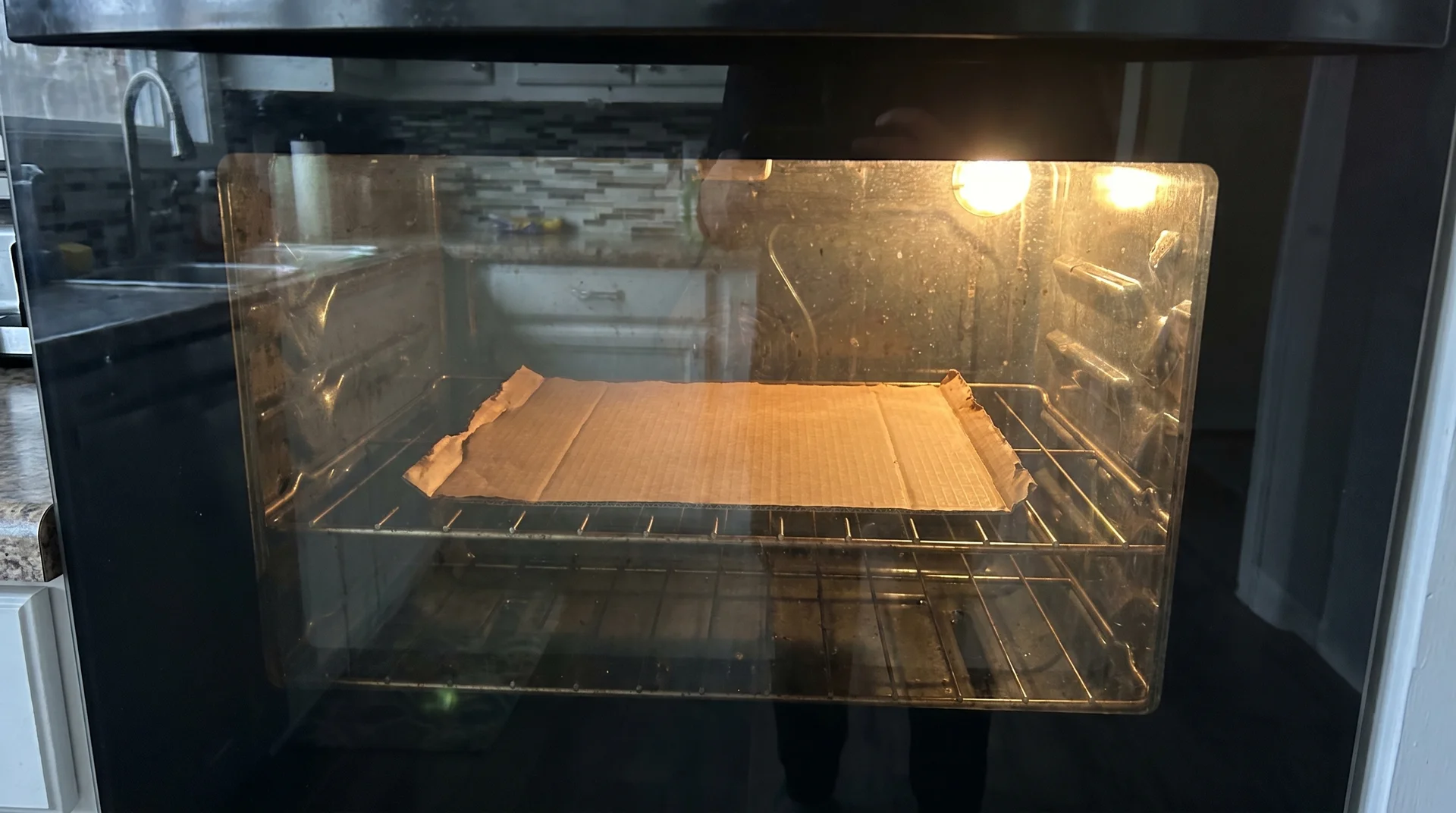
This situation comes in two versions, and they need different responses.
If the cardboard scorched but did not ignite: Check the food first. If it smells like burnt paper or carries any chemical odor, the surface treatments have transferred into the food. Discard it. If the food smells normal and the cardboard is only lightly discoloured at the edges, the immediate safety risk is lower.
The crust will have suffered for the reasons covered in the frozen pizza section above, but the food is likely edible.
If the cardboard caught fire or is actively smoking, work through this sequence in order:
- Turn the oven off immediately.
- Keep the oven door closed. A closed oven restricts oxygen. Opening the door feeds the fire.
- Watch through the oven window. Most small cardboard fires inside a sealed oven self-extinguish within 60 seconds.
- If the fire does not extinguish within 60 seconds, or if smoke is escaping through the door seals, leave the kitchen and call emergency services. Do not open the oven to pour water on an active fire inside it.
Cooking equipment is among the leading causes of home kitchen fires in the United States, according to the NFPA.
Combustible packaging materials near heat sources are a documented contributing factor. A small cardboard fire in a sealed oven is usually manageable if the door stays closed. That changes the moment the door opens.