

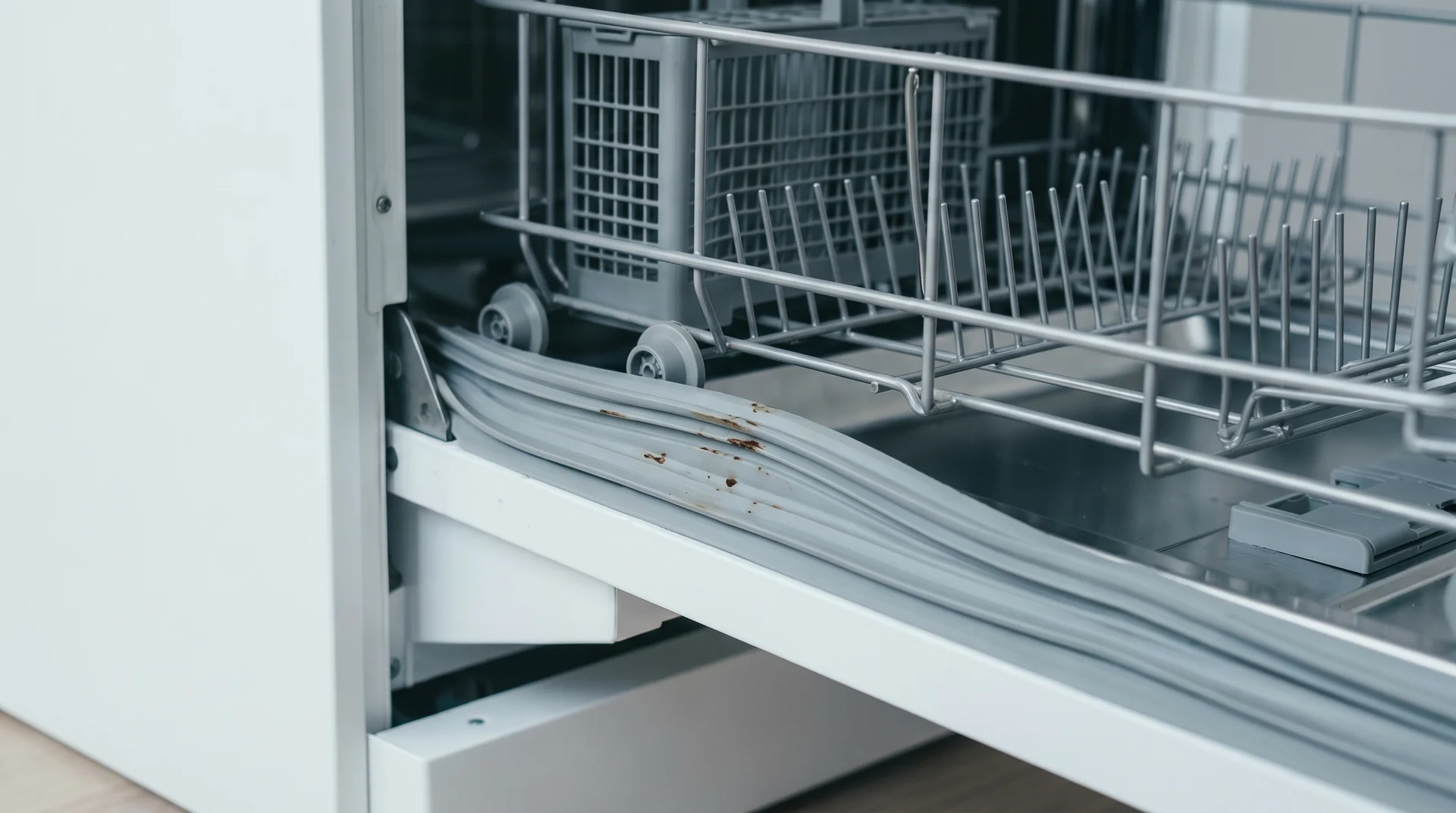
The mold in your dishwasher is not ordinary surface mold. The organisms that researchers have documented have evolved to survive the exact conditions your machine runs.
This piece covers mold on the surfaces you can reach and clean: the door gasket, the filter, the interior walls, and the racks. Mold inside the drain hose or pump housing is a different problem.
That location requires a service technician, not a cleaning protocol, and treating them as the same question sends people toward the wrong kind of answer.
Is Mold in a Dishwasher Dangerous?
For most healthy adults, dishwasher mold carries a manageable risk.
At normal household exposure levels, the fungi documented in residential dishwashers are unlikely to cause serious illness. The risk changes for specific populations, and understanding why requires knowing what the research actually found.
The Specific Fungi Research Has Identified in Dishwashers
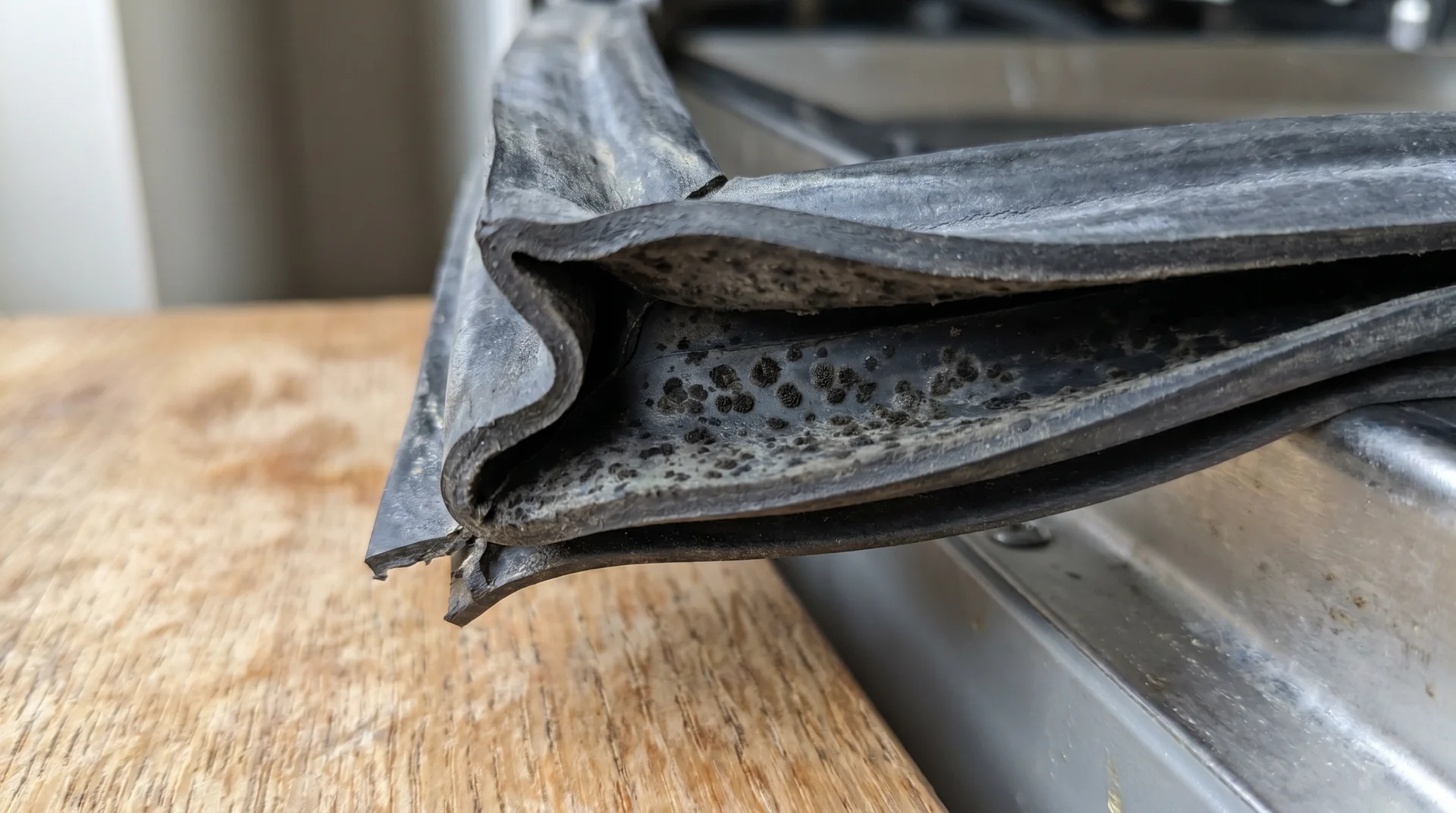
The black growth on a dishwasher door gasket is most likely Exophiala, a genus of black yeast, and not the common household mold you find in a bathroom grout line.
A 2011 study published in the journal Fungal Biology tested dishwashers in 189 homes across six continents. Fungi were present in 62% of them. The rubber door seal was the primary site of colonization in almost every positive case.
Of those positive machines, 56% contained Exophiala dermatitidis and Exophiala phaeomuriformis. Both are classified as polyextremotolerant, meaning they evolved to withstand heat, concentrated detergent, high and low pH, and salt together, not separately.
A 2016 study published in PLOS One expanded the picture further. Researchers tested nine interior sites in 30 residential dishwashers and found fungi in 83% of machines. E. dermatitidis appeared in 47% of them.
Colony counts on the rubber seal alone reached up to one million colony-forming units per square centimeter, which is a measure of how densely these organisms can establish on a single surface.
Your dishwasher did not fail to kill these organisms. The conditions inside a dishwasher are exactly the ones that select for organisms capable of surviving it.
The dishwasher mold problem gets misframed as an appliance failure or a cleaning lapse more often than almost any other kitchen sanitation issue I write about. It is neither. It is an environmental conditions problem, and that distinction changes what you actually do about it.
One distinction worth making explicitly: the pink or reddish growth that sometimes appears on gaskets and filter housings is usually Serratia marcescens, a bacterium and not a fungus.
It responds differently to cleaning agents and carries a different risk profile. The two frequently get conflated. That is not the same thing.
Who Faces a Higher Risk
The risk from dishwasher mold is not the same across all households, and the people for whom it matters most are rarely named in cleaning guides.
For healthy adults, the primary exposure routes are aerosolization when the dishwasher door is opened and direct skin contact with colonized surfaces. The immune system handles these exposures without incident in most cases.
The populations that should take this more seriously include people with cystic fibrosis.
Exophiala dermatitidis is a documented pulmonary colonizer in that group. People managing diabetes face an elevated risk of skin infections from this species. Anyone who is immunocompromised for any reason falls into the higher-risk group as well.
A 2024 study in Scientific Reports found E. dermatitidis in 70% of Swedish household dishwashers tested. The geographic consistency of these findings across multiple countries and decades of research suggests this is not a regional anomaly or an outlier result.
This section is not an instruction to panic about your dishwasher. It is an instruction to be specific about who in your household might be affected, and to clean accordingly.
How to Identify Mold in Your Dishwasher?
Distinguishing mold from other buildup takes about three minutes and determines which cleaning approach is actually needed.
Mold vs. Food Buildup vs. Hard Water Deposits
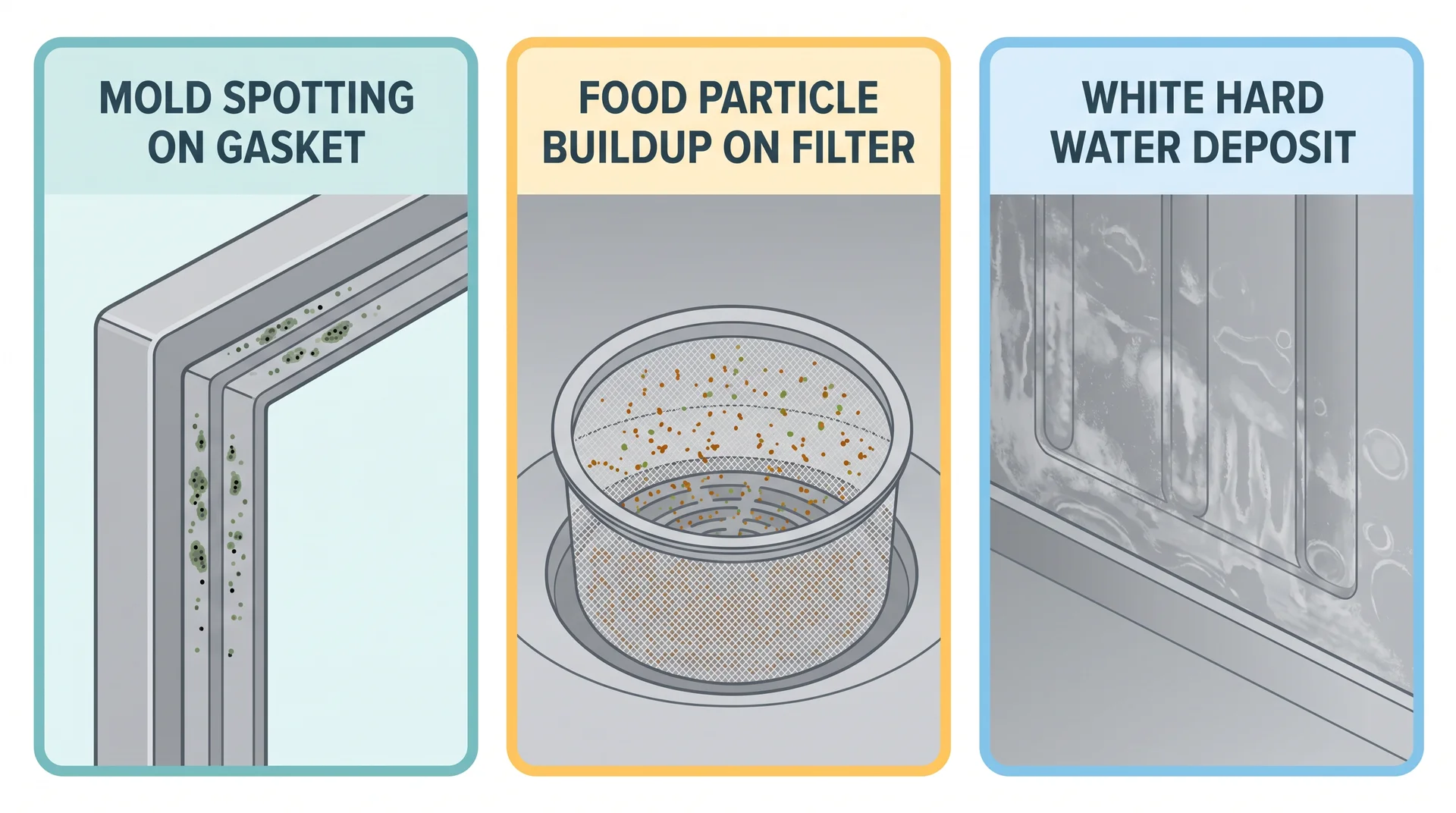
Most dark residue inside a dishwasher is one of three things, and they respond to different cleaning methods.
| What You See | Texture | Smell | What Happens When Wiped |
|---|---|---|---|
| Mold or mildew | Soft, sometimes slightly slimy | Musty, returns within days of a cleaning cycle | Smears across the surface |
| Food buildup | Gritty or crusty | Food odor that fades after a hot cycle | Flakes or crumbles off |
| Hard water deposits | Hard and calcified | No odor | Resists wiping; leaves chalky residue |
A musty smell that returns within a few days of running a cleaning cycle is the strongest single indicator of mold.
Hard water deposits have no odor at all. Food odor fades after a hot wash. Mold odor does not.
The 4 Places Mold Concentrates in a Dishwasher
Across nearly every machine and every study, mold concentrates in the same four locations.
- Door gasket folds. The inner channel of the rubber seal retains both moisture and food film after every cycle. The 2011 Fungal Biology study and the 2016 PLOS One study both identified this as the primary colonization site.
- Filter and filter housing. The filter traps food particles, which are the food source that mold requires. The plastic housing that the filter sits inside is typically cleaned less thoroughly than the filter itself and is often colonized separately.
- Side nozzles and spray arm joints. The 2016 PLOS One study identified these as heavily colonized. Food film accumulates in the joints, and they stay wet after each cycle.
- Drain perimeter and lower door interior. This is where water pools when the wash cycle finishes. Slow evaporation from this area leaves residual moisture that mold spores can use.
How to Remove Mold from Your Dishwasher
Removing dishwasher mold requires four steps, completed in a specific order.
Before starting, put on rubber gloves. Direct contact with mold colonies during cleaning is the primary exposure route, and gloves cost less than a medical visit.
If you are using any cleaning agent stronger than dish soap, open a window or turn on the kitchen ventilation fan. Work in a space with airflow.
One practical limit worth naming: if the visible mold growth covers a large area of the interior, or if the mold returns within a few days of completing this full protocol consistently, that is a signal that the colonization has reached areas you cannot access through routine cleaning.
At that point, a professional appliance technician or mold assessment service is the appropriate next step, not a stronger cleaning agent.
Step 1: The Gasket Requires Direct Contact and Dwell Time
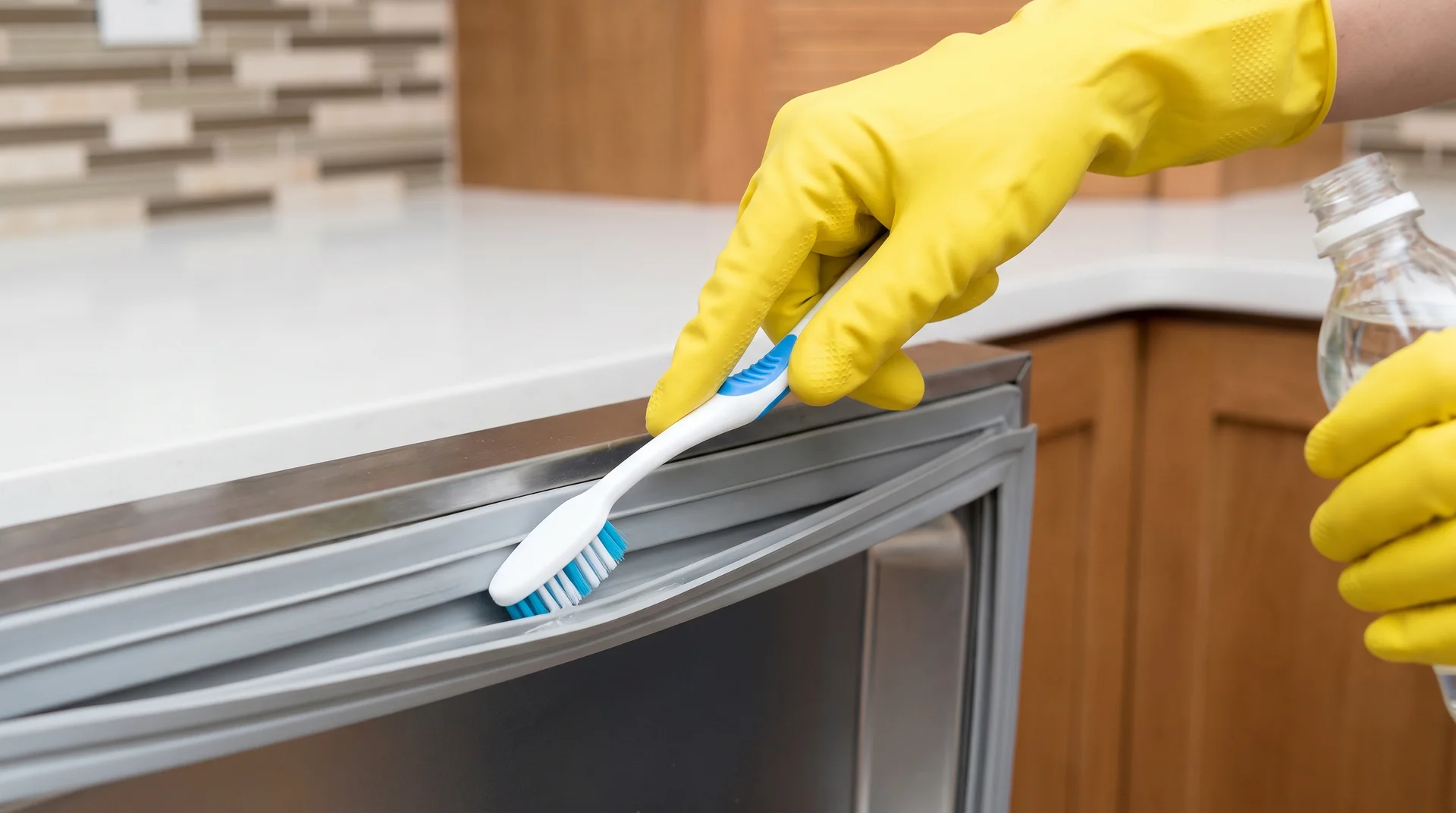
The door gasket is where the cleaning protocol matters most and where most cleaning attempts fail, because a dishwasher cycle cannot substitute for manual scrubbing with adequate dwell time.
Pull the gasket lip back slightly and look into the inner fold. This is where Exophiala colonies establish at the highest densities, and it is the surface most people clean least effectively because it requires working into the fold rather than wiping across the face.
Apply undiluted white vinegar to a soft cloth or an old toothbrush. Work it into the gasket fold and the inner channel. Let it sit in contact for several minutes before wiping. This is the operative variable: contact time. Applying a cleaning agent and wiping immediately is not a protocol.
The sequence matters: application first, dwell time second, mechanical scrubbing third, then wiping. Reversing any of these steps reduces the effectiveness of the ones that follow.
What happens when you skip the dwell time: the visible surface looks cleaner. The colonies in the fold are not disrupted. Regrowth within a week is the consistent outcome, and it is the reason the same person runs vinegar cycle after vinegar cycle without lasting results.
After wiping, dry the gasket with a clean cloth. Leaving it wet after cleaning immediately restores the moisture condition the growth requires.
Step 2: The Filter and Its Housing
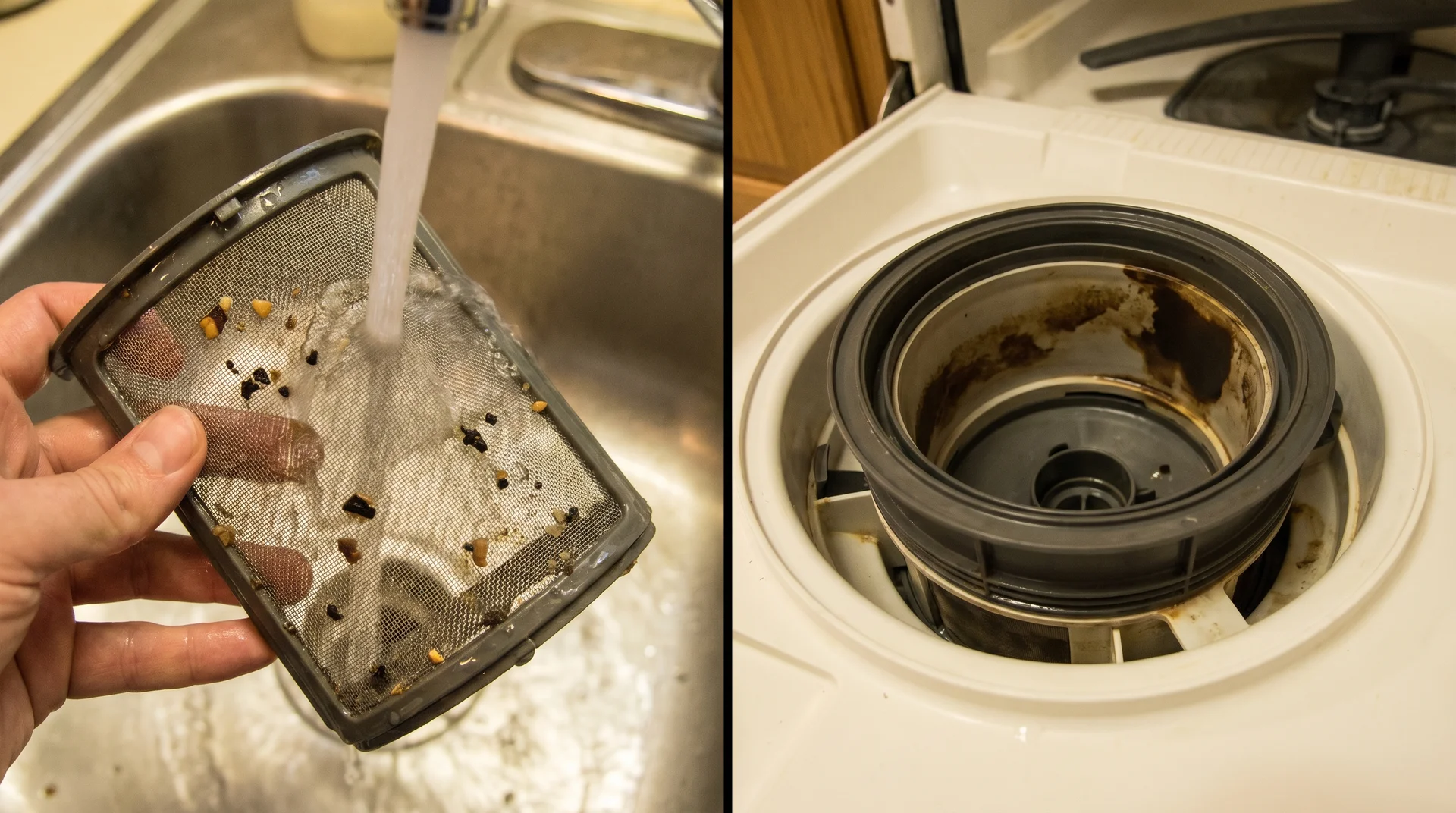
A dirty filter and a colonized filter look similar, and cleaning one without inspecting the other resets the problem within days.
Remove the filter. It typically twists and lifts out from the bottom of the machine.
Rinse it under hot running water, then scrub with dish soap and a soft brush. Mechanical action on the mesh removes biofilm that rinsing alone cannot reach.
Now inspect the filter housing, which is the plastic sleeve that the filter sits inside. If it shows black discoloration or smells musty after the filter is removed, the housing itself is colonized. Apply vinegar with a brush, hold the same contact time, then scrub and dry.
What happens when you skip the housing: you reseat a clean filter into a colonized sleeve. The filter picks up contamination again within days. The cleaning accomplished less than it appeared to.
Reassemble only after both the filter and the housing are fully dry.
Step 3: Interior Walls and Spray Arms
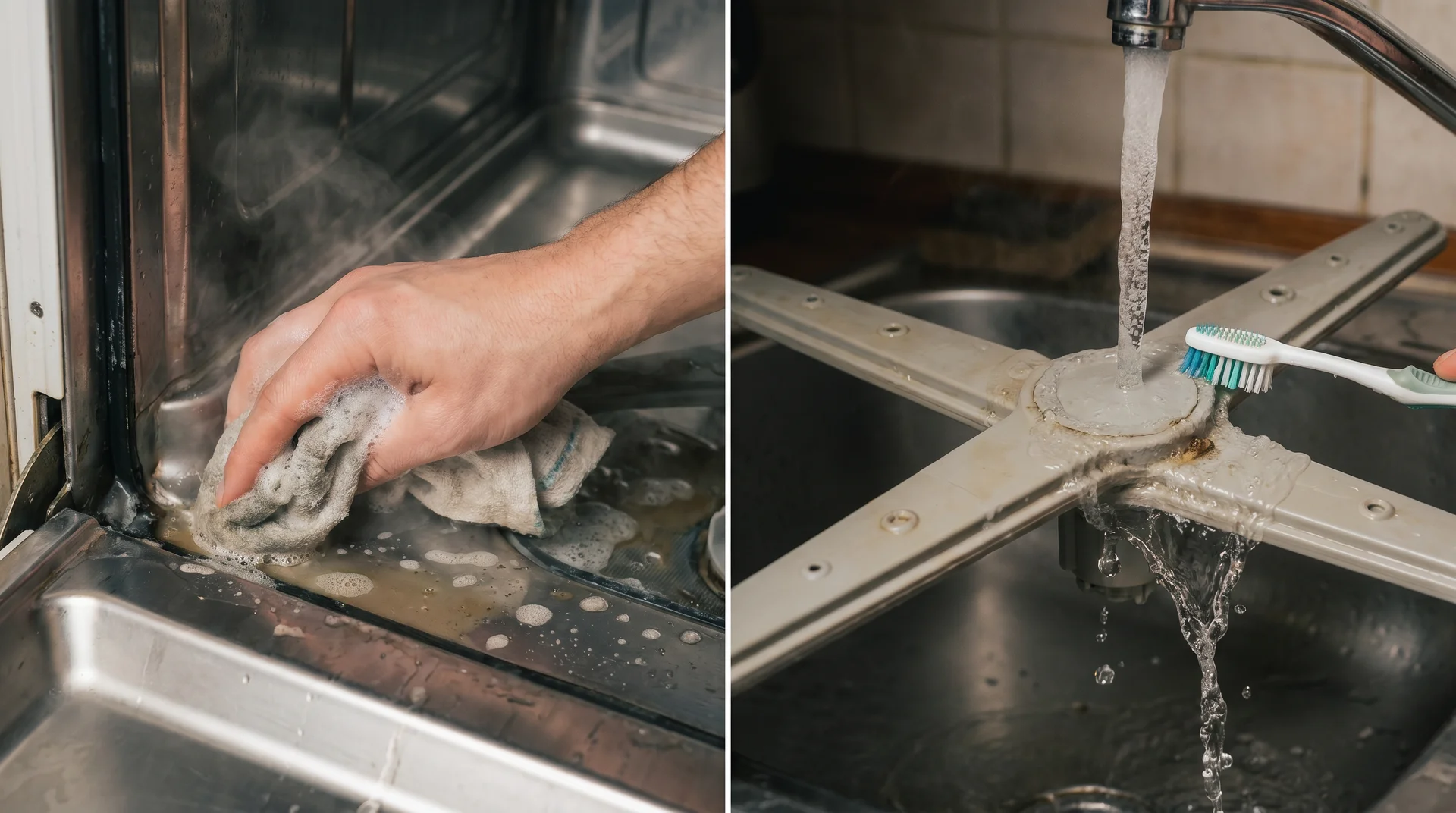
Interior walls and spray arms are a secondary colonization risk, but they need attention before the cleaning cycle runs.
Wipe the interior walls with a hot, soapy cloth. Focus on the lower door interior and the corners, where water pools after cycles finish.
If the spray arms are removable, take them out and rinse under hot water. A toothbrush clears food film from the joints effectively.
One constraint worth naming: if the rack coating is significantly cracked or chipped, the exposed metal is a rough, porous surface where mold can establish and is difficult to remove by cleaning alone. Cleaning addresses the symptom. Rack replacement addresses the cause. That is a different article, and it needs different criteria.
Step 4: The Cleaning Cycle
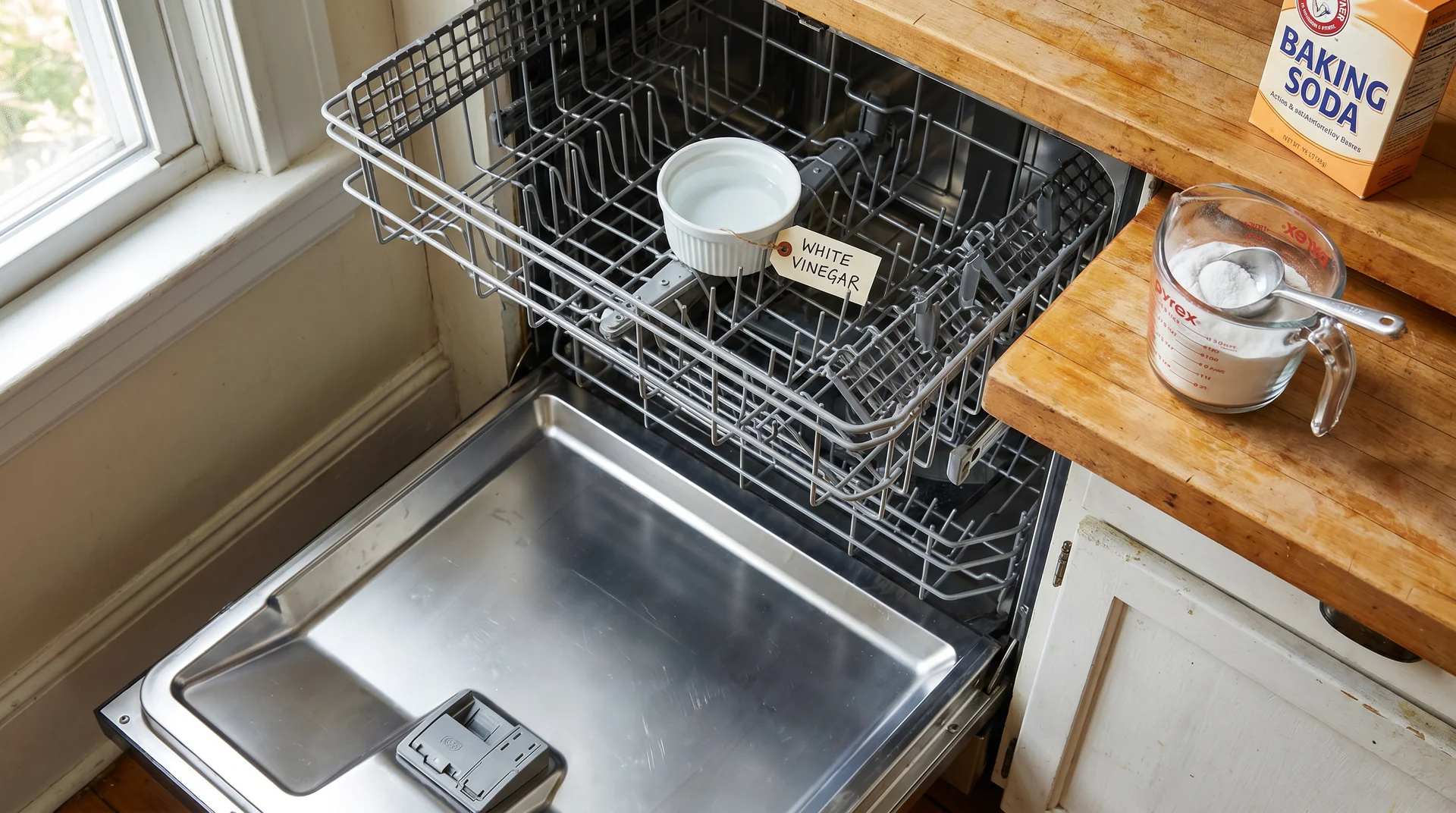
The cleaning cycle is the final step of the removal protocol, not a substitute for the manual steps above.
After completing all three manual steps, place a dishwasher-safe container with one cup of white vinegar on the top rack. Run the machine empty on the hottest available cycle.
When that cycle finishes, sprinkle one cup of baking soda across the bottom of the machine and run a short hot cycle. Baking soda deodorizes and provides mild abrasive assistance. Its role here is odor control, not mold removal.
Leave the door ajar when the final cycle ends. The steam trapped in a sealed machine is the growth environment you just spent time eliminating. Open the door and let it escape.
Bleach, Vinegar, or Baking Soda: What Each One Actually Does
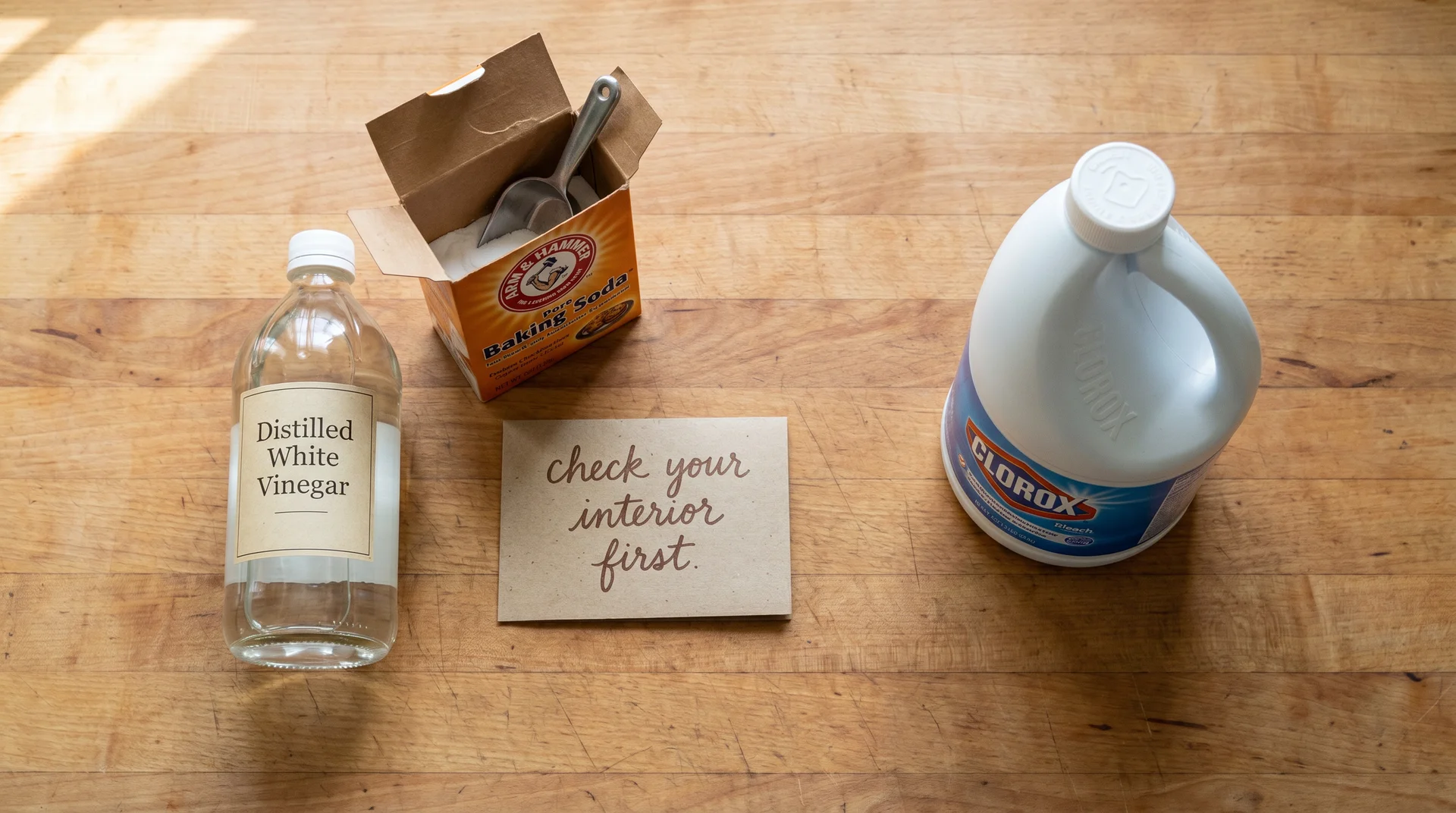
All three cleaning agents appear in dishwasher mold guides, usually without the information needed to use them correctly.
| Agent | What It Does | Use When | Do Not Use When |
|---|---|---|---|
| White vinegar | Dissolves mineral deposits, deodorizes, mild antimicrobial on accessible surfaces with adequate contact time | Gasket cleaning with dwell time; hot cleaning cycle after manual scrubbing | Used as the only step; relied upon alone as a confirmed fungicide against Exophiala |
| Baking soda | Deodorizes; mild abrasive assist | Final cycle after vinegar cycle, for odor control | Used as a primary mold-removal agent |
| Bleach | Strong disinfectant on hard, non-porous surfaces | Dishwasher has a plastic interior only and no vulnerable heating element; manufacturer guidelines confirm it is safe | Stainless steel interior present; near the heating element, as primary treatment for the rubber gasket mold |
Why Bleach Is the Wrong Default for a Dishwasher
Bleach is effective against mold on hard, non-porous surfaces. A rubber dishwasher gasket is not a hard, non-porous surface.
The EPA registration for household bleach specifies efficacy against surface mold on non-porous materials like tile, sealed countertops, and porcelain. The label says it kills mold. What the registration data specifies is the surface type on which that claim holds.
The colonies in a gasket fold are not sitting on the surface face. They are inside the fold and within the material structure. Bleach applied to the gasket face may reduce the visible layer. It does not reach where the colonization is actually occurring.
Bleach also degrades the dishwasher’s heating element with repeated use. A degraded heating element dries dishes less effectively. Less effective drying means more residual moisture after every cycle. More residual moisture means a worse mold environment, created by the same product that appeared to address it.
One additional point: never mix bleach with vinegar or any ammonia-based cleaner. Combining bleach with vinegar releases chlorine gas. Even at low concentrations, this causes respiratory irritation.
In an enclosed space like a dishwasher, the concentration builds quickly. Use one or the other, never both in sequence without rinsing thoroughly in between.
My father spent thirty years as a commercial kitchen inspector in Baltimore. He still reaches for bleach first at Sunday dinner when this comes up, and we have had this disagreement more times than I can count.
He is not entirely wrong. Bleach is effective against surface mold on the hard, non-porous surfaces that his inspection work covered.
He is also not entirely right about how a residential rubber gasket differs from a commercial stainless prep surface, and the gap between those two positions is exactly where the real answer lives.
What Vinegar and Baking Soda Do and Don’t Do
Vinegar is a useful cleaning and deodorizing step with real limits against the specific organisms documented in dishwashers.
The label on white vinegar makes cleaning and deodorizing claims. What it does not specify is anything about Exophiala dermatitidis. There is no EPA registration data establishing vinegar’s efficacy against this specific black yeast.
The peer-reviewed literature shows these organisms survived temperatures up to 60 degrees Celsius, concentrated detergents, and extreme pH in both directions.
Acetic acid, the active component in vinegar, is useful against common household molds on accessible surfaces with adequate contact time. That claim does not extend to organisms that evolved to withstand conditions far more extreme than any household vinegar solution produces.
I want to be direct about a limit in the current research: the literature identifies these organisms clearly and documents their resilience in detail. It does not conclude with a household cleaning agent that reliably eliminates established Exophiala colonization from rubber gasket folds.
Mechanical removal of the growth substrate, thorough and consistent gasket cleaning with adequate contact time, is the most evidence-consistent approach currently available for someone cleaning their own machine.
Baking soda deodorizes and provides a mild abrasive assist in a cleaning cycle. It has no meaningful antifungal mechanism. Use it in sequence after vinegar. Do not use it as a standalone treatment.
What makes the cleaning approach in this piece different from most is not the products. It is the contact time, the surface sequence, and the structural habit changes in the prevention section below.
Why Mold Keeps Coming Back in Your Dishwasher
Recurring dishwasher mold is almost always a structural condition problem, not a cleaning frequency problem.
Frequency Without Method Is Not a Protocol
Most households with recurring dishwasher mold are already cleaning their dishwasher regularly.
They run a vinegar cycle. They may wipe the visible face of the gasket. The mold returns within a week. The cleaning is real. The method is incomplete.
Running a cycle addresses the interior tub. It does not address the gasket folds, the filter housing, or the residual moisture that persists after every cycle. Cleaning the wrong surfaces on a consistent schedule produces consistent, incomplete results.
I spent eight years building and running kitchen sanitation training programs at a hospital network before moving into freelance work.
The single most consistent error in every training context was exactly this: treating frequency as a substitute for correct method. Doing the incomplete thing more often does not fix what the method misses. It just means you do the incomplete thing more often.
The Two Conditions That Have to Change
Recurring mold in a regularly cleaned dishwasher points to two structural conditions that no cleaning cycle addresses on its own.
The first is residual moisture. Closing the dishwasher door immediately after a cycle traps steam inside a warm, dark enclosure. For the next several hours, the interior holds the moisture and heat that these organisms require.
Leaving the door ajar by a few inches after every cycle changes this condition structurally, not temporarily.
The second is a food film on the gasket. Dishes transfer food particles to the gasket edge during loading and unloading. After the load is removed, those particles sit in the rubber folds with residual warmth and moisture.
A thirty-second wipe with a dry cloth when unloading removes the food source before it can establish itself as a growth substrate. Almost no one does this. It is the step that makes everything else more durable.
Earlier in this piece, the gasket protocol required direct contact time and mechanical scrubbing. That protocol works when it is applied. The condition that defeats it is food film re-establishing in the folds between cleaning sessions. The two habits below are what prevent that from happening.
How to Prevent Mold in Your Dishwasher Long-Term

Prevention reduces to two daily habits and a maintenance schedule.
After Every Cycle: Two Habits That Take Under a Minute
These two steps do more to prevent dishwasher mold than any cleaning product, because they address the conditions that allow it to establish.
- Leave the door ajar by 4 to 6 inches after the cycle finishes. This allows steam to escape and interior surfaces to dry before the next use. Propping it open with a folded cloth works on machines whose doors do not hold a partially open position.
- Wipe the door gasket edge with a dry cloth when you unload dishes. This takes thirty seconds and removes the food film that transfers from dishes to rubber during loading, before it can establish in the folds.
Neither step requires a product. Both address the structural conditions that make the cleaning protocol above necessary in the first place.
The Weekly and Monthly Maintenance Schedule
Weekly gasket cleaning combined with a monthly full protocol is the maintenance schedule, not monthly deep cleaning alone.
Weekly:
- Apply undiluted white vinegar to the gasket folds with a soft brush
- Hold contact time for several minutes before wiping
- Dry the gasket completely after wiping
Monthly:
- Remove, clean, and inspect the filter and filter housing
- Wipe interior walls with a hot, soapy cloth, focusing on the lower door and corners
- Complete the full four-step removal protocol above
Final Thoughts
A household running the dishwasher twice a day will need more frequent filter attention than one running it three times a week.
Water hardness affects how quickly mineral deposits accumulate in the filter and spray arm joints. There is no single schedule that accounts for both variables. Pull the filter, look at what has actually accumulated, and adjust from there.
I keep a whiteboard in my kitchen that tracks which surfaces were cleaned and when, and what I used. What it reveals consistently is that the gasket wipe is the step that gets skipped. It is also the step that matters most for keeping the full protocol from becoming necessary every two weeks instead of once a month.