
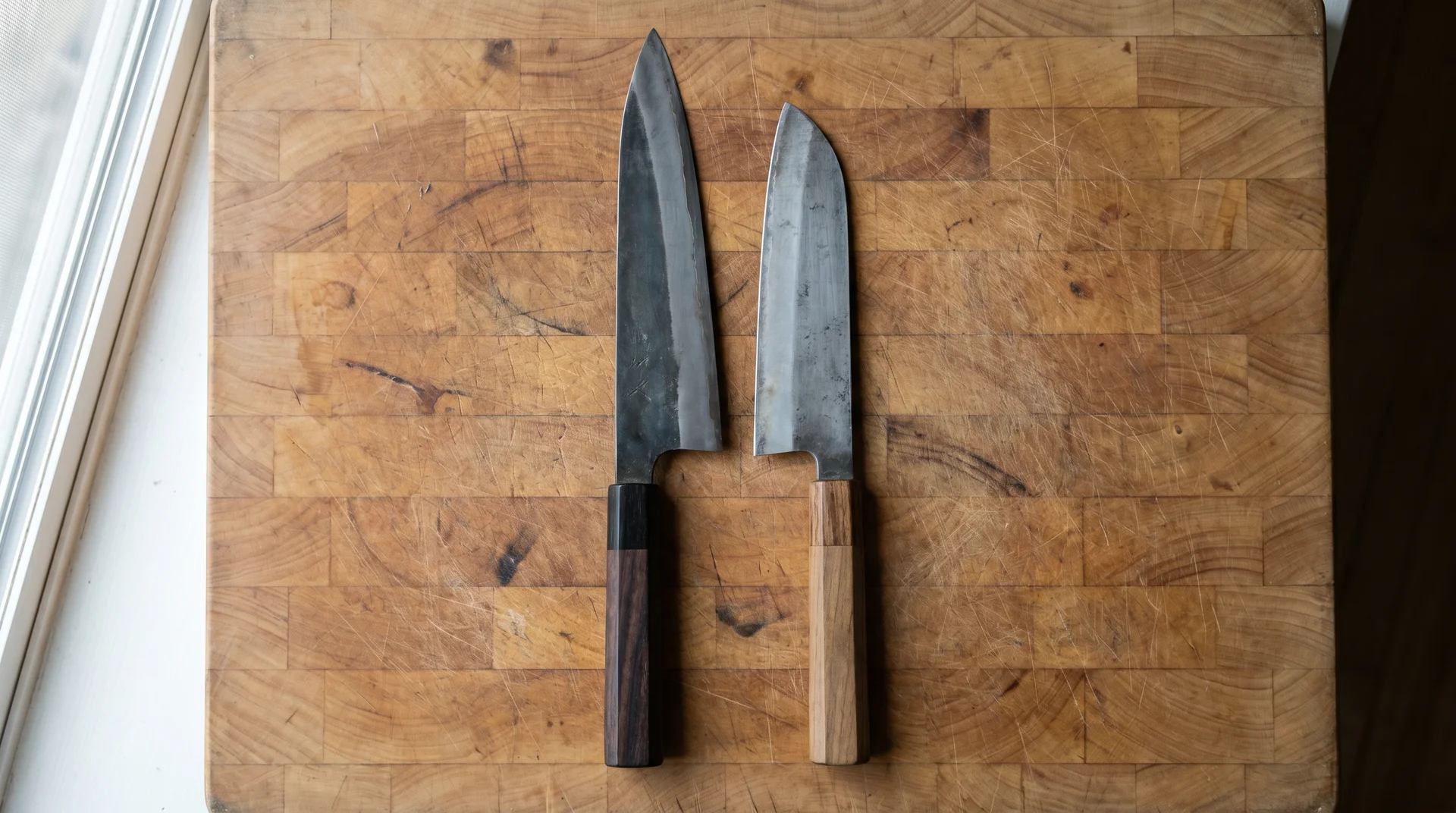
Most gyuto vs. santoku comparisons end with “it depends on your cooking style.”
Both knives are Japanese, all-purpose, and double-beveled. Either one will outperform the Western chef’s knife in most kitchen drawers.
What separates them is blade geometry, and blade geometry rewards specific cutting motions. The motion you already use, probably without knowing it, has a name and is the most important variable in this decision.
I will talk about identifying your dominant cutting motion in thirty seconds using the knife you already own.
What a Gyuto and a Santoku Actually Are
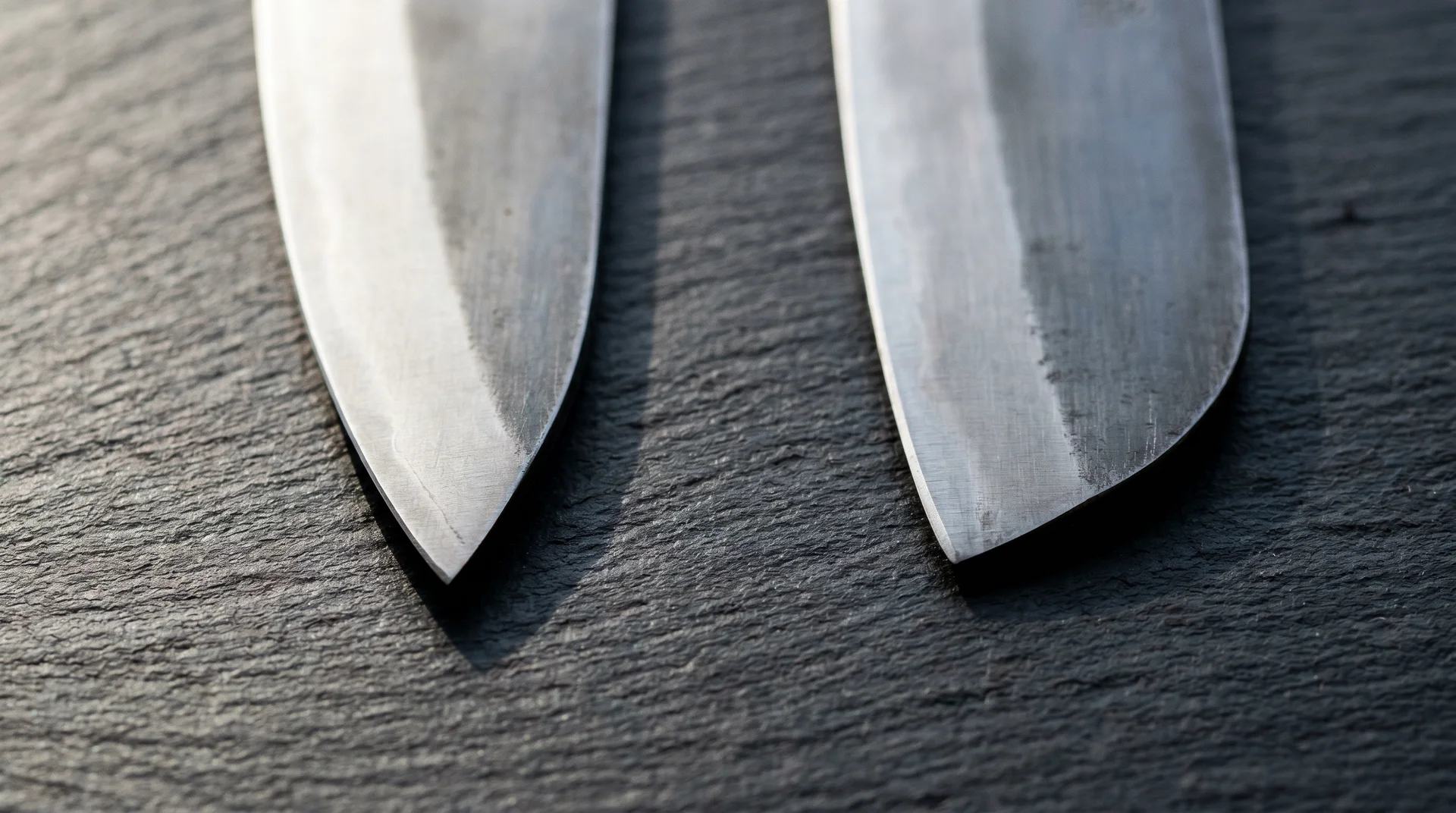
Both knives are Japanese, double-beveled, and genuinely all-purpose.
The two knives were designed for different cutting contexts, and those origins still show up in how they feel and perform on a real cutting board.
The Gyuto
A gyuto is Japan’s adaptation of the Western chef’s knife, built lighter and thinner, with harder steel.
The name translates loosely as “beef sword.” These knives arrived in Japan during the Meiji era, adapted from European blade designs.
A gyuto keeps the pointed tip and curved belly of a Western chef’s knife.
The grind is thinner and the steel harder. That produces a sharper edge with better retention than a typical German knife.
It also means the edge is more brittle and needs more careful storage, a trade-off that catches people coming from a Wüsthof or Victorinox.
Is a gyuto the same as a chef’s knife? Similar in shape. Meaningfully different in geometry and steel hardness.
The Santoku
A santoku is a postwar Japanese invention, designed to give home cooks one knife for everything.
The name means “three virtues,” a reference to its broad versatility across ingredients and techniques. Sakai Ichimonji, one of Japan’s oldest knife houses, traces the santoku’s lineage to the nakiri, a traditional vegetable cleaver designed exclusively for plant-based prep.
Knife makers kept the nakiri’s flat edge and wider blade, then rounded off the tip to create something less specialized and less intimidating. The result was a shorter, lighter knife that rewarded a different cutting motion than the gyuto.
That difference in motion is what this decision is actually about.
The One Variable That Decides This
This decision comes down to one thing: your cutting motion.
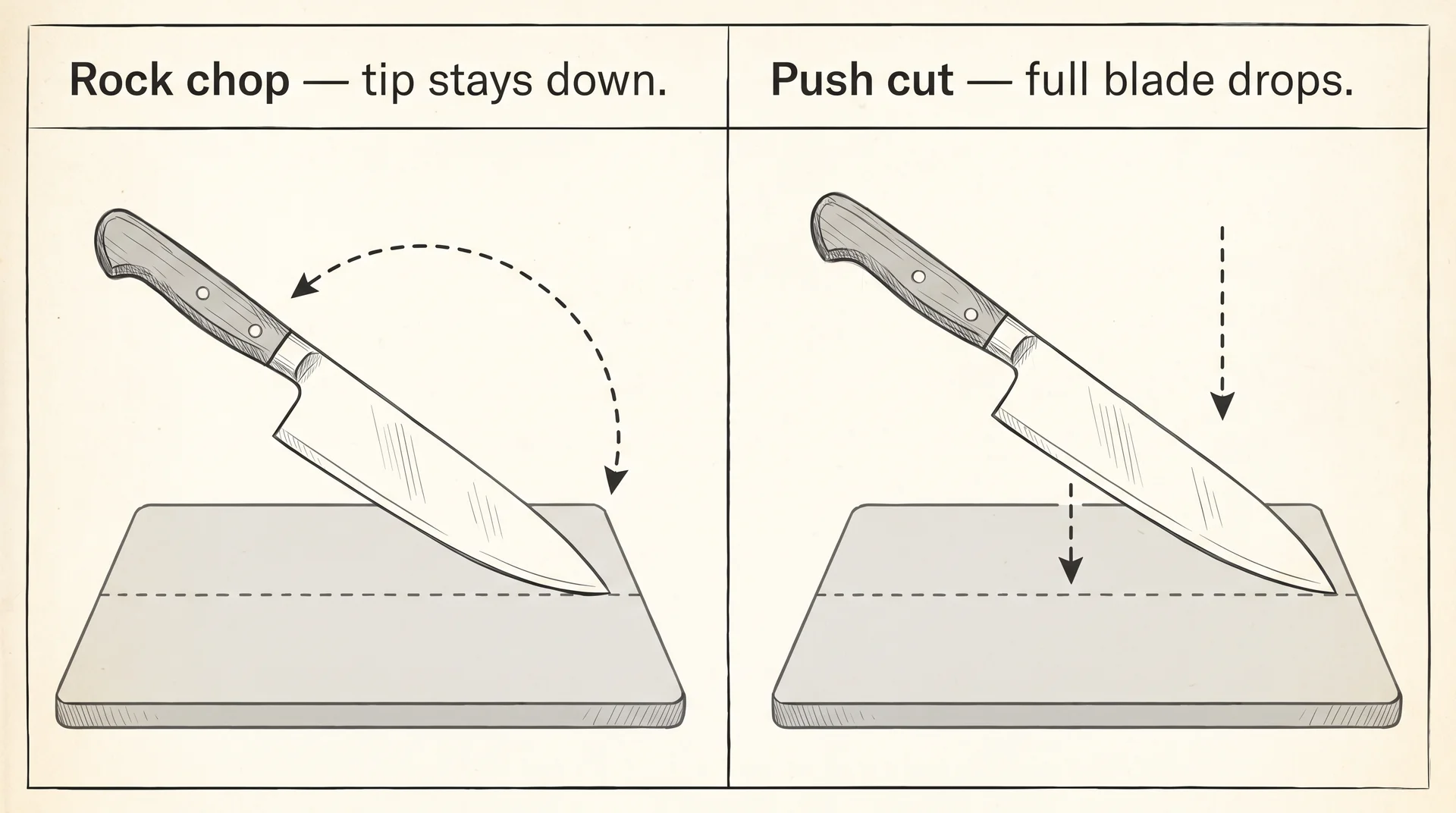
- The gyuto suits cooks who rock chop. In a rocking motion, the tip stays on the board while the heel rises and falls in an arc.
- The santoku suits cooks who push cut, where the blade drops straight down in a single stroke, heel to tip, all at once.
Most home cooks use one motion predominantly and don’t know it has a name. Identifying which one you use takes thirty seconds and determines more than any blade length comparison.
How to Figure Out Which Motion You Already Use
Pick up your current knife and watch what the tip does during a normal cut.
- Set a half onion flat side down on your cutting board.
- Chop through it naturally, without adjusting your grip or thinking about technique.
- Watch where the tip goes during the cut.
- If the tip stays in contact with the board while the heel rises and falls in an arc, you rock chop.
- If the whole blade drops straight down in a single stroke without the tip anchoring, you push cut.
Most home cooks have learned to rock chop with Western knives.
A curved-belly German knife trains you into that motion over years of use. If you’ve used a Victorinox or Wüsthof for any significant time, rocking is probably your default.
You can technically rock chop with a santoku. The flat blade profile means the tip kicks up instead of gliding through the stroke, which interrupts the motion mid-cut.
That’s not a defect. That’s the sheepsfoot tip, where the spine curves down to meet the edge rather than tapering to a point, doing exactly what it was designed to do.
What Your Motion Means for Each Knife
Your cutting motion determines which blade geometry works with you and which works against you.
The gyuto’s curved belly creates a natural arc on the cutting board. In a rocking motion, the blade follows that arc without resistance. The result is smooth, continuous cutting through herbs, garlic, or whatever you’re working through in volume.
The santoku’s flat edge is optimized for a different contact pattern. When you push cut, the entire edge meets the board in a single stroke. That full, flat contact is what makes the santoku fast on vegetables and efficient on anything that benefits from a clean, committed downward motion.
I tested both knives in my own kitchen for more than a year each, not in controlled conditions. The cutting-motion variable was the only one that consistently predicted which knife felt right to each cook I observed during that period.
How the Gyuto & Santoku Blades Are Actually Different?
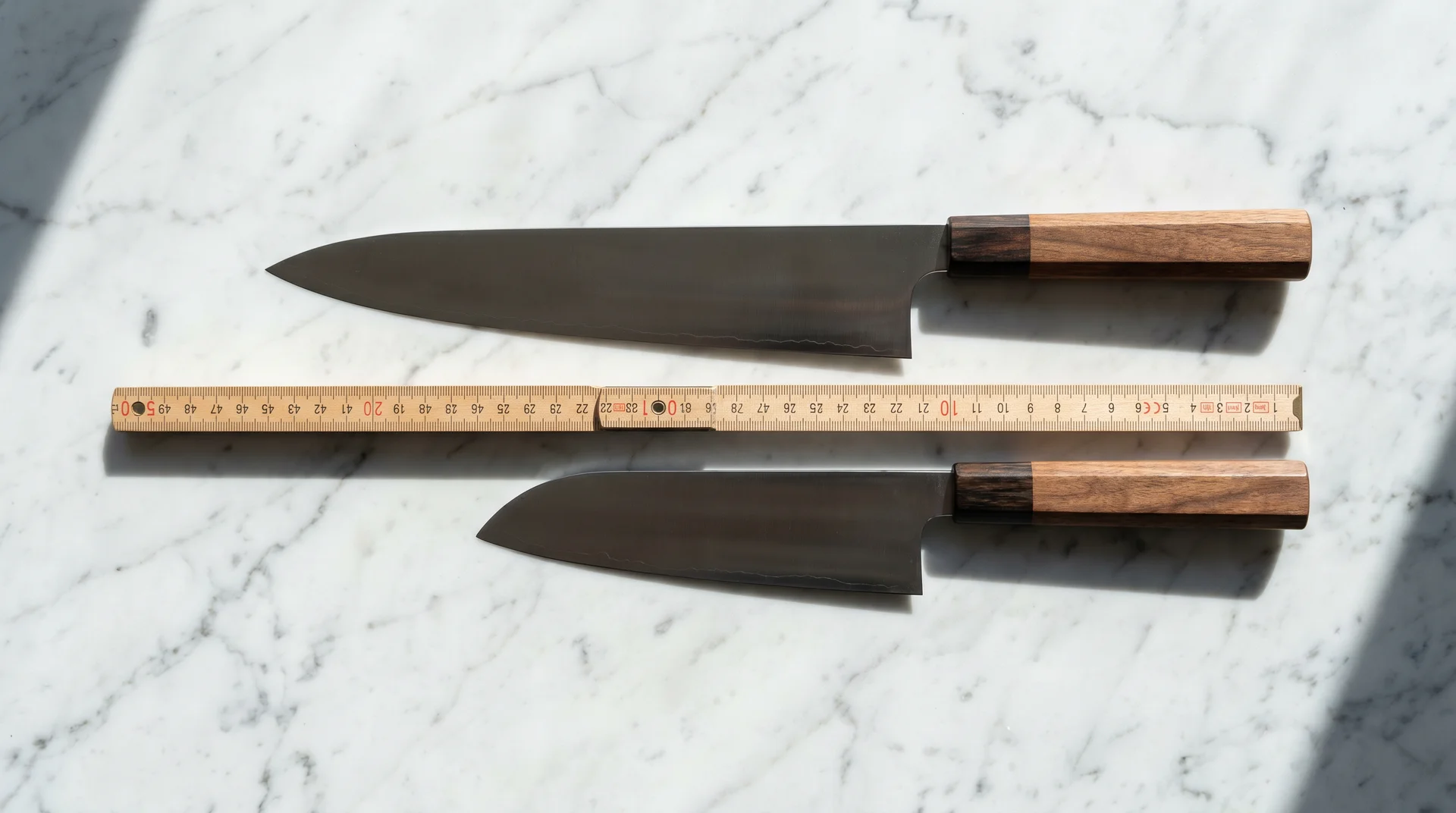
Both knives handle the same broad range of tasks. The geometry determines how efficiently they do it and which techniques they reward. Here’s what the blade profile comparison looks like across the five variables that actually matter in practice:
| Feature | Gyuto | Santoku |
|---|---|---|
| Typical blade length | 210–270mm (8.3–10.6 in) | 165–180mm (6.5–7.1 in) |
| Tip shape | Pointed | Sheepsfoot (spine curves down to the edge) |
| Edge profile (blade profile) | Curved belly | Mostly flat |
| Primary cutting motion | Rocking, long slicing strokes | Push cutting, straight-down chop |
| Heel height (at the same length) | Lower | Taller, more knuckle clearance |
These specs only mean something when you’re comparing knives from the same maker and the same series.
A $70 santoku from one brand and a $200 gyuto from another tells you nothing useful about the knives themselves.
Steel quality, grind geometry, and handle construction vary more between brands than the gyuto-to-santoku difference ever will.
Blade Length and What It Means for You
Every piece of advice will tell you to choose the shorter santoku for a small kitchen. That’s not wrong, but it leaves out something more important: your reach and hand size.
A 210mm gyuto on a cook with a short reach feels quite different than the same knife in larger hands. Control suffers when the blade extends past your natural grip point. Cooks with smaller hands often find a 180mm gyuto more accurate than any santoku for the same tasks.
I own a 240mm gyuto. I reach for the 210mm on almost everything. The extra length only earns its place on large proteins and high-volume batch prep. For daily cooking at home, it’s enough.
There’s also a real overlap zone to know about. A 180mm gyuto and a 180mm santoku are working in the same length range. At that point, the decision is entirely about blade profile and cutting motion, not size.
Tip Shape and What It Does in Practice
- The gyuto’s pointed tip lets you start cuts on dense proteins and work close to the bone.
- The santoku’s sheepsfoot tip removes that precision option. In exchange, it reduces the risk of unintentional piercing on the down stroke.
That’s why the santoku became the recommended first knife for Western home cooks. The rounded tip reads as safer. Whether it actually is depends on how you handle a knife, which is a separate conversation.
Heel Height and Knuckle Clearance
The santoku runs taller at the heel than a gyuto of the same blade length.
That extra height gives more clearance between your knuckles and the cutting board during a full stroke.
For cooks who use a full pinch grip and take complete strokes, this is a real ergonomic consideration. It’s a small difference in millimeters.
For most people, it won’t decide anything. But if you have large hands and find standard chef’s knives cramped at the board, this is worth factoring in before you buy.
Those three geometry differences, tip shape, blade profile, and heel height, feed directly into the task comparison that follows.
Which Tasks Each Knife Handles Better
The overlap between these two knives is larger than most reviews say.
There are real differences, and they matter in specific situations. There are also tasks where the gap between a gyuto and a santoku is small enough that technique and sharpness will outweigh blade geometry.
Where the Gyuto Has the Edge
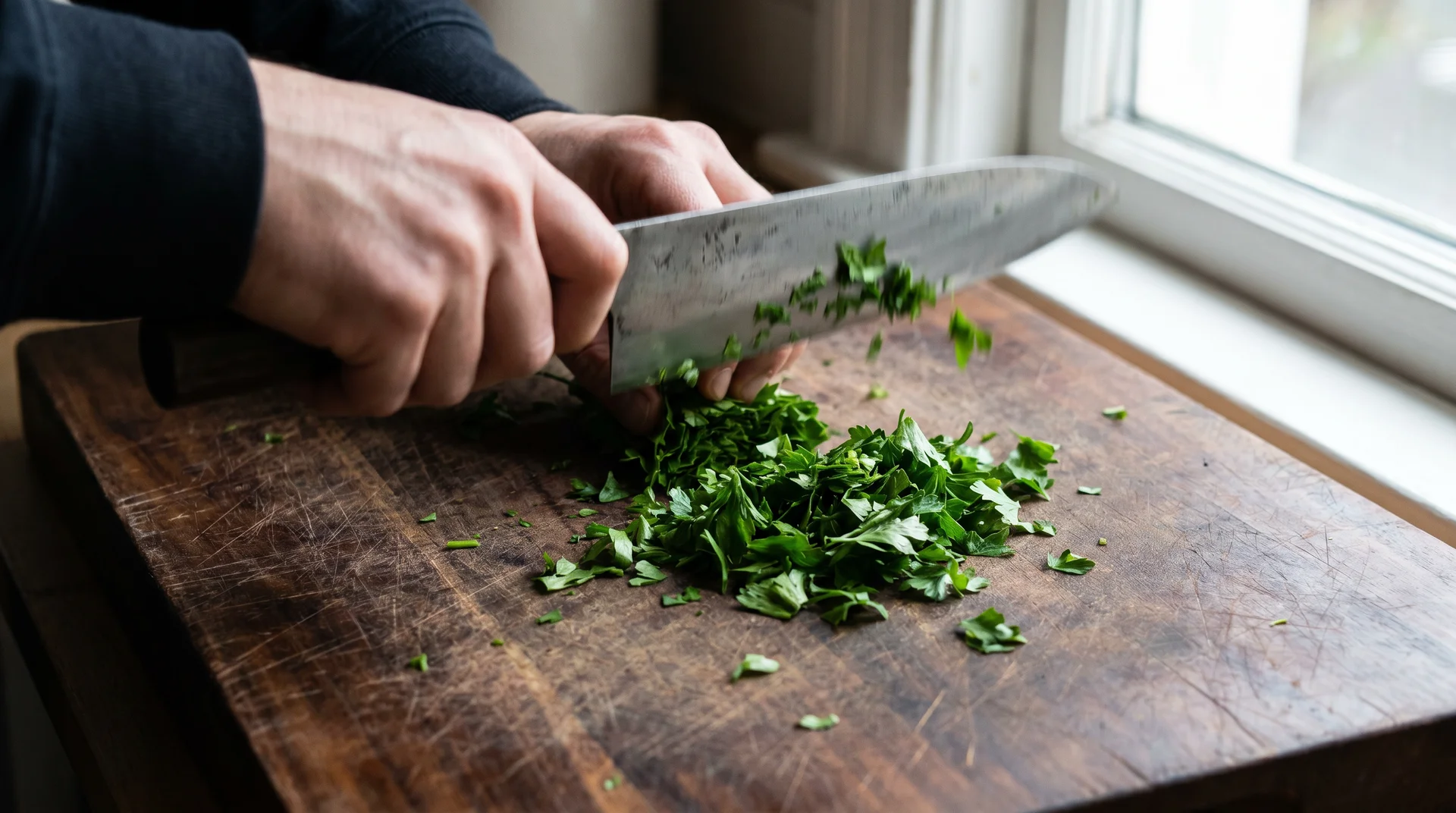
The gyuto is the more capable knife for large proteins, long slicing strokes, and high-volume mixed prep.
The longer blade completes a slice in fewer strokes. On a full chicken breast or a roast, that matters. You’re using the blade length rather than fighting it.
The rocking motion the gyuto enables is also faster for herb work. Mincing a large pile of parsley goes quicker on a curved blade. The tip stays anchored while your wrist pivots, giving you speed and control at the same time.
In professional kitchens, the gyuto is almost always the primary working knife. I watched this for eight years on the line. The santoku appeared at specific stations for specific tasks, and it was rarely the first reach.
That hierarchy exists because rocking motion dominates high-volume prep, and the gyuto enables it cleanly.
Where the Santoku Has the Edge
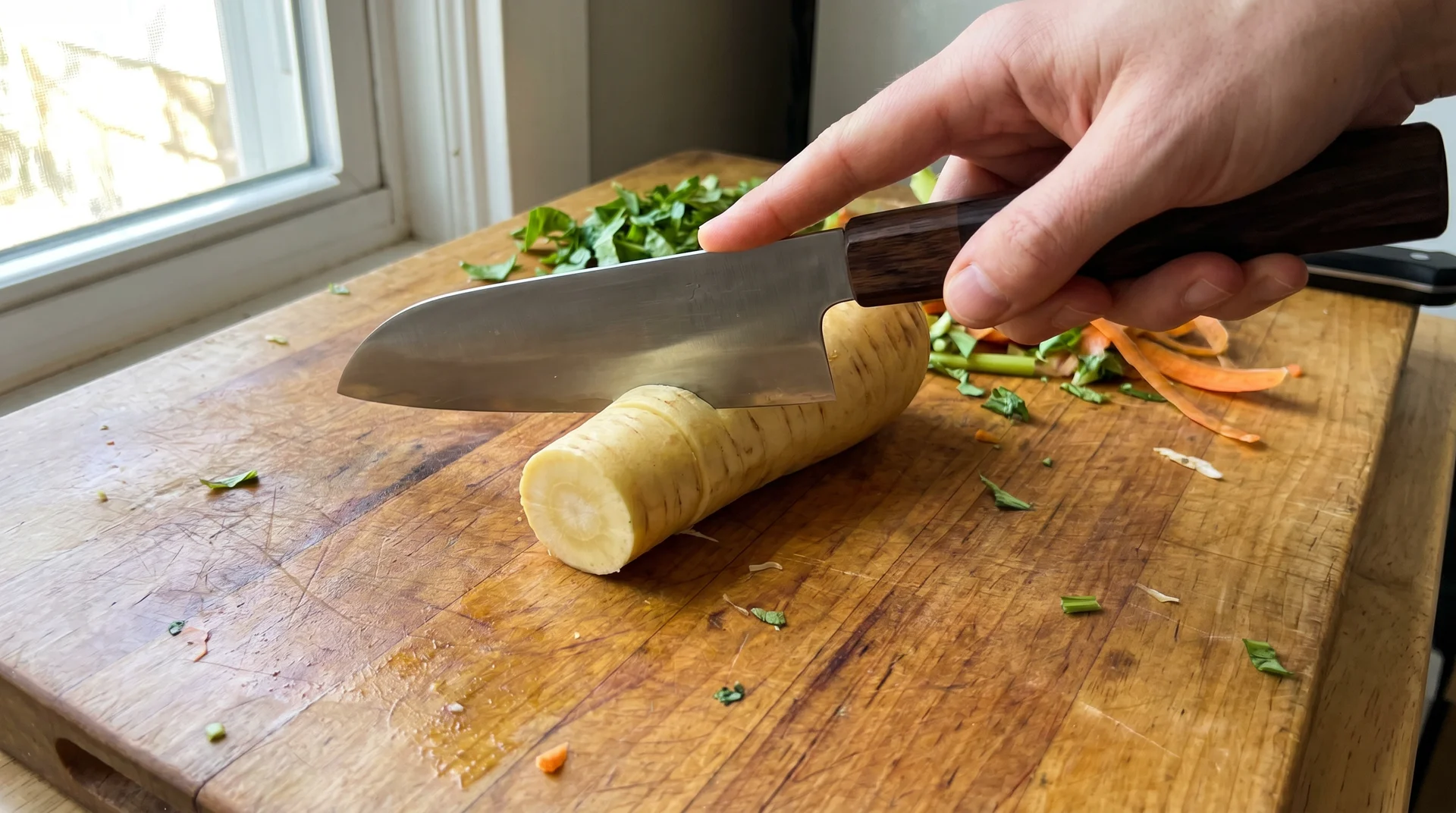
The santoku is faster on vegetables, especially when working through large quantities with a committed push cut.
The flat edge makes full contact with the cutting board on each stroke. There’s no belly to compensate for and no tip to manage. For prep-heavy cooking that skews heavily toward vegetables, the santoku gets through that work efficiently.
The shorter blade is also easier to maneuver in a tight kitchen or on a small cutting board. Counter space is a real constraint, and the santoku fits where a 240mm gyuto won’t.
Knifewear, a Canadian specialty retailer with strong editorial standing in Japanese cutlery, describes the santoku as biased toward vegetable push cutting. That framing is more useful than any origin story. It tells you what the knife prefers without overstating its limits.
Where They’re Basically Equal
On most everyday household cutting tasks, a competent cook produces the same result with either knife.
The outcome is the same when you are dicing onions, mincing garlic, or slicing boneless protein.
Don’t let the equal-overlap zone be the reason you agonize over this decision. It won’t be the knife that limits you on dicing an onion.
If You Already Own a Western Chef’s Knife

Most people searching this comparison own a Wüsthof, a Victorinox, or something similar.
The transition to a gyuto is nearly frictionless for those cooks. The blade shape is familiar, the rocking motion is familiar, and the handle orientation is close to what you already know. The main adjustments are:
- Lighter pressure. The harder steel does more of the work. Pressing down the way you would with a German knife will dull the edge faster than you expect.
- No scrubbing. Lateral motion against the board damages a thinner edge. This is the habit I see trip people up most often.
- Careful storage. Harder steel chips more easily against other metals. A magnetic strip or a blade guard is not optional, it’s just part of owning a Japanese knife.
The transition to a santoku from a Western chef’s knife is a bigger shift. The flat profile asks you to change your motion, and if you’ve been rocking for years, that adjustment can feel unnatural for months.
Cooks who switch to a santoku and find it disappointing often simply have the wrong motion for the blade. The santoku rewards committed push cutting. If you rock chop, you will fight it.
Which to Buy First: Gyuto or Santoku
If you ran the cutting-motion diagnostic earlier in this piece, that five-step onion test, you already have the most important input for this decision. Buy the gyuto first.
The gyuto handles more cutting techniques, transitions more naturally from a Western chef’s knife, and covers more ground across a typical week of home cooking. I’ve cooked with both for more than a year each.
The gyuto earned a more consistent place in my rotation. That’s a tested observation, not a ranking I found in a comparison chart.
At equivalent quality levels, santokus are often priced lower than gyutos from the same maker. That’s worth knowing, but it’s not a reason to buy the wrong knife for your motion. A well-fitting $100 gyuto is a better investment than a wrong-fit $70 santoku.
That verdict has real exceptions:
- Small kitchen, primarily for vegetable prep. The santoku case is genuinely strong here. A shorter blade in a tight space, optimized for push cutting, handles that work efficiently, and without the wasted motion a longer blade introduces.
- Small hands or a short reach. Try a 180mm gyuto before defaulting to a santoku. The overlap between a short gyuto and a full-length santoku is real. In that length range, blade profile and motion are the only variables that separate them.
- You push cut consistently and already know it. Go back to the motion diagnostic. Confirm your result. If you’re a committed push cutter, the santoku is a legitimate first choice, and you don’t need the gyuto to tell you that.
There is one situation where I genuinely don’t have a default answer. If you cook primarily vegetable-forward Asian cuisines and process large quantities of leafy and root vegetables, the santoku’s push-cutting bias may serve you better than the gyuto. I can describe the geometry of both knives in detail. Watching you cook would tell me more.
Do You Need Both a Gyuto and a Santoku?
Probably not, and certainly not yet.
The case for owning both knives is real, but it applies to a narrow situation. If you regularly do high-volume vegetable prep and also cook large proteins frequently, the two blades serve genuinely distinct roles in the same kitchen.
If you’ve just bought your first Japanese knife, give it six months before adding a second blade. What you reach for and what you notice missing will tell you more than any comparison article. That’s the only honest framing I can give on this question.