

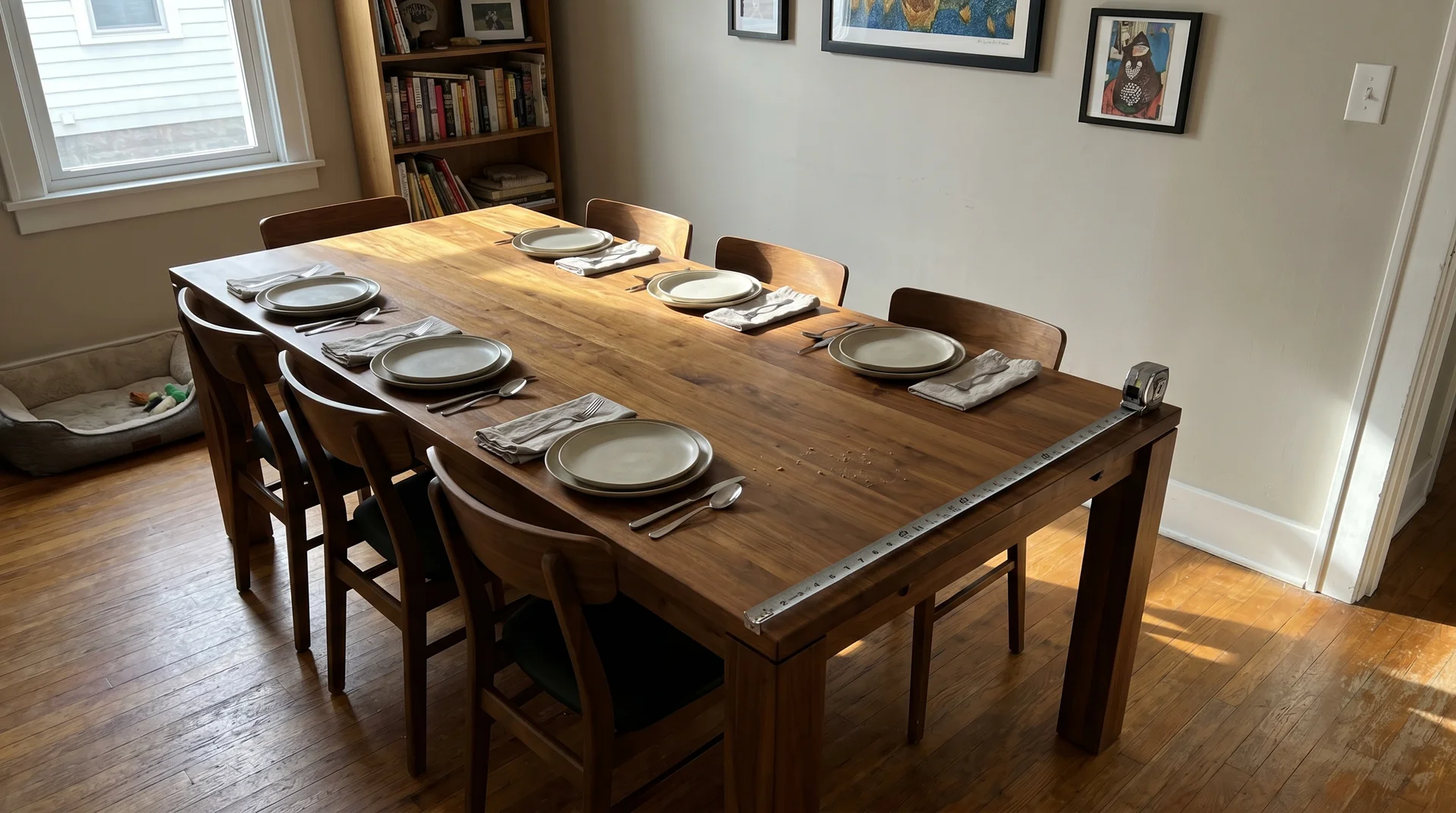
You’re standing in your dining room, tape measure in one hand, product page open on your phone.
For 8 people, a rectangular table should be 78 to 96 inches long and 36 to 42 inches wide. Which number applies depends on how you arrange those 8 seats.
Lengths for a Rectangular Table That Seats 8
A rectangular table that seats 8 needs to be 78 to 96 inches long.
The 24-inch-per-person allowance is the home dining industry standard.
Countryside Amish Furniture and Bassett Furniture both document it in their sizing guides. The right total length depends on which seating configuration you choose.
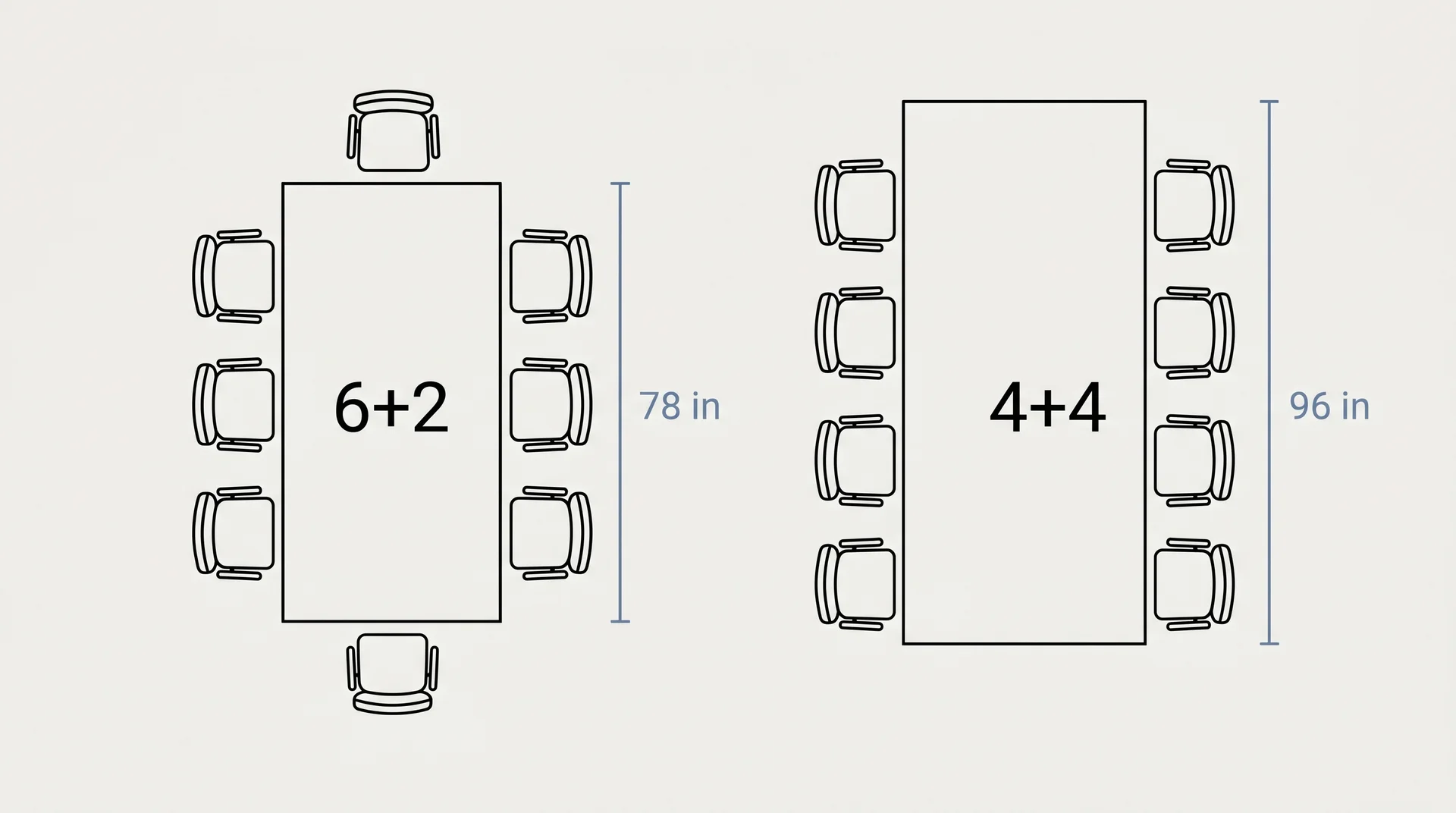
- Three per side plus two end seats (6+2): 78 inches minimum, 84 to 90 inches comfortable. End seats sit at the short ends of the table. The corner seats need enough buffer to avoid crowding whoever sits at the head.
- Four per side, no end seats (4+4): 96 inches minimum, 108 inches comfortable. This configuration needs more total length but removes end-seat trade-offs entirely.
Width matters as much as length. A table for 8 should be 36 to 42 inches wide.
The Configuration Decision That Determines Your Length
Your seating arrangement changes the minimum table length you need by up to 24 inches.
Two configurations seat 8 at a rectangular table. Each one works in a different kind of room.
Three Per Side Plus Two End Seats (6+2)
Three people on each long side, one at each head. This configuration seats 8 with the shortest possible table length.
Three seats at 24 inches each take up 72 inches along each long side. On a 78-inch table, that leaves 3 inches of clearance at each end of the seat rows. On an 84-inch table, it’s 6 inches.
The end seats fit at any of those lengths. What changes is how much room the corner seats have relative to whoever sits at the head. At 84 to 90 inches, that tension disappears.
Four Per Side, No End Seats (4+4)
Four people on each long side, no one at the ends. This configuration seats 8 without the end-seat trade-offs.
Four seats at 24 inches each require 96 inches of table length. Everyone sits along the long sides with a full 24-inch allowance. Nobody is at a corner position.
Most buyers default to the 6+2 arrangement without considering whether they actually want those end seats. The 4+4 configuration is underused. It’s often the better choice for rooms that are wider than they are long.
Which Configuration Is Right for Your Room
Walk your dining room before you choose a configuration, not after the table arrives.
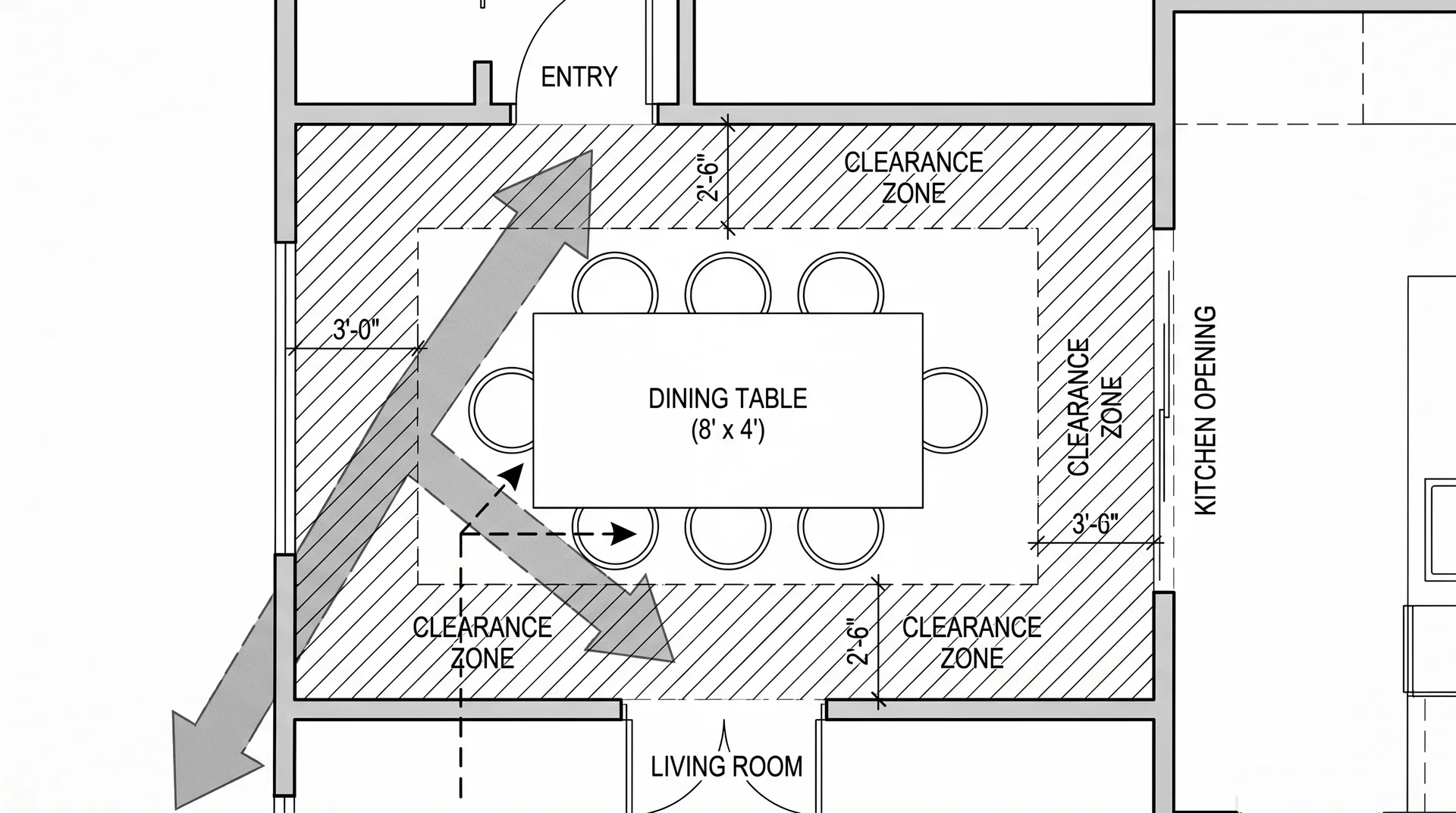
Walk the room and check two things. The first is how much clear floor space your room has along the longest wall. The second is where doorways or traffic paths cut through the dining area.
A 4+4 arrangement with a doorway at one end puts chairs directly in that path. A 6+2 arrangement crossing a kitchen traffic path puts end-seat occupants in everyone’s way. Configuration drives the length, and length drives the room calculation.
Can 8 People Sit at a 72-Inch Table?
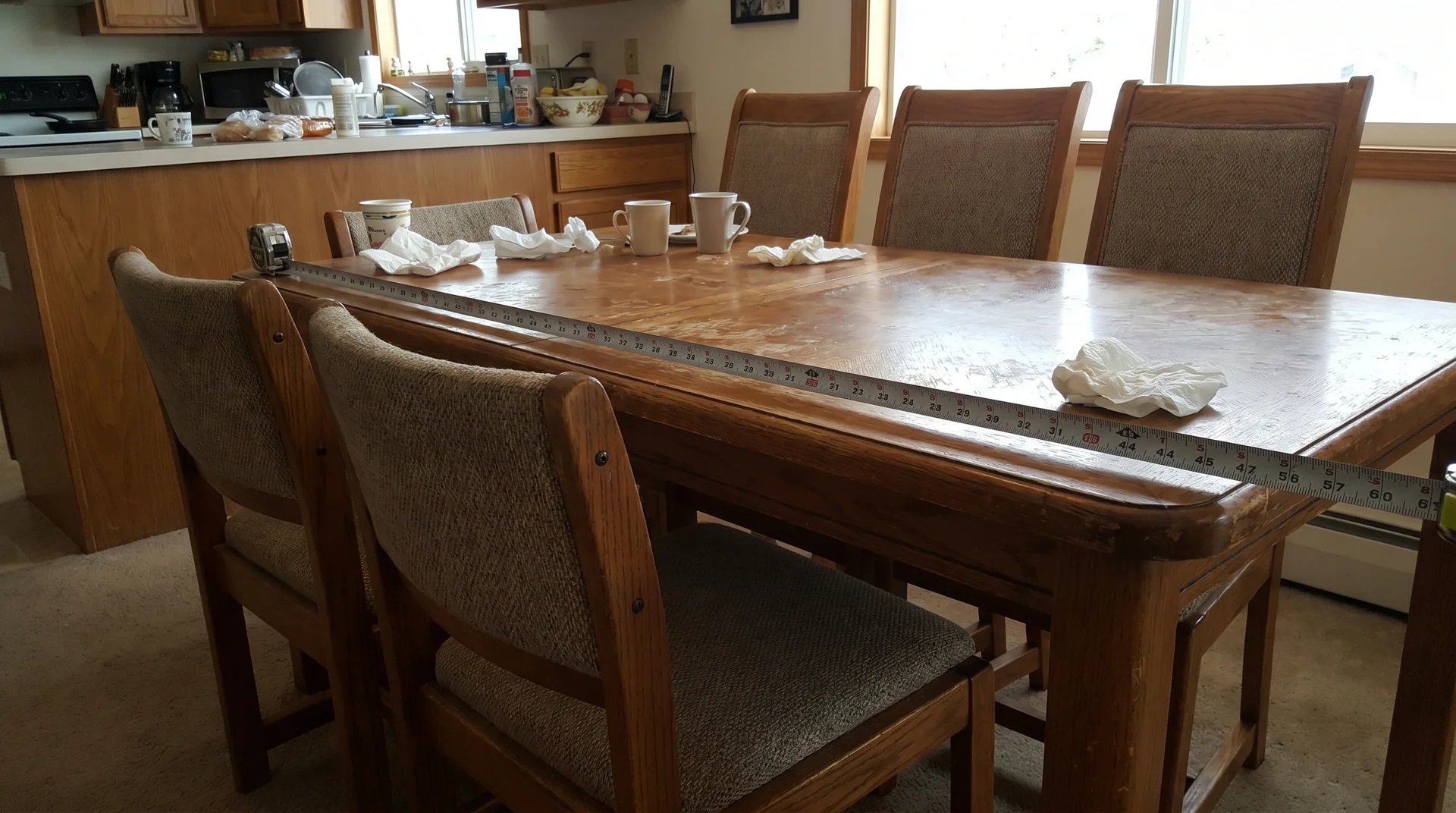
A 72-inch table can technically seat 8 people using the 6+2 configuration.
At 72 inches, three people per long side sit at exactly 24 inches each. That’s the industry minimum, not a comfortable target. Chair width is the honest variable here.
Standard chairs run 18 to 22 inches wide. At 22-inch chairs, three per side use 66 inches of the long side. You’ll feel the remaining 6 inches of collective elbow room at your first holiday dinner.
Width Is the Dimension Most Buyers Forget
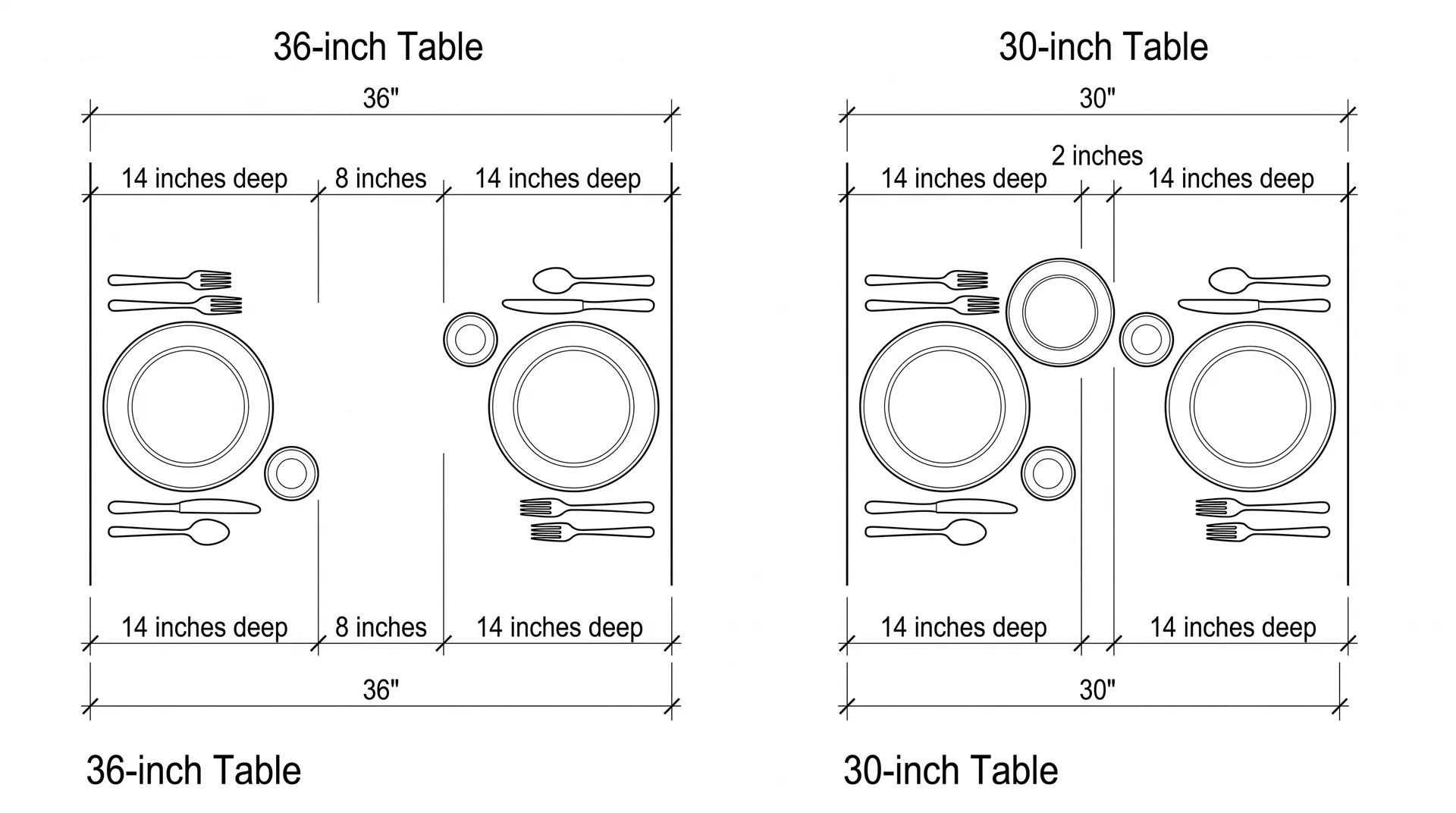
A home dining table for 8 should be 36 to 42 inches wide.
Width tells you how much center surface you actually have. A standard home place setting runs about 14 inches deep. Two facing settings consume 28 inches of your table width.
On a 36-inch table, 8 inches of center surface remains for serving dishes. On a 30-inch table, that drops to 2 inches. That’s a bread plate, and it tells you something about where that dimension came from.
Why the Banquet Table Standard Misleads Home Buyers
The 8-foot folding table common in event rentals is 30 inches wide and built for temporary use.
At events, guests often sit along one side only. Place settings are smaller. Event spacing at 18 inches per person works because nobody is at that table for three hours.
Party rental companies and linen sizing charts give accurate dimensions for their context. That context is not a home dining room. A 30-inch-wide home dining table is undersized for any seating count.
What Size Room Do You Need for a Table That Seats 8?
The room calculation is where most table purchases go wrong.
You need at least 36 inches of clear floor space on every side of the table. The NKBA (National Kitchen and Bath Association) sets 36 inches as the minimum dining clearance. Rooms where people move between the table and the kitchen work better with 42 to 48 inches.
After more than 220 kitchen and dining renovations, this pattern holds. The design decision and the execution reality need to happen in the same conversation.
Picking a table length without running the room calculation is choosing hardware before you know what you’re drilling into.
The Minimum Room Calculation
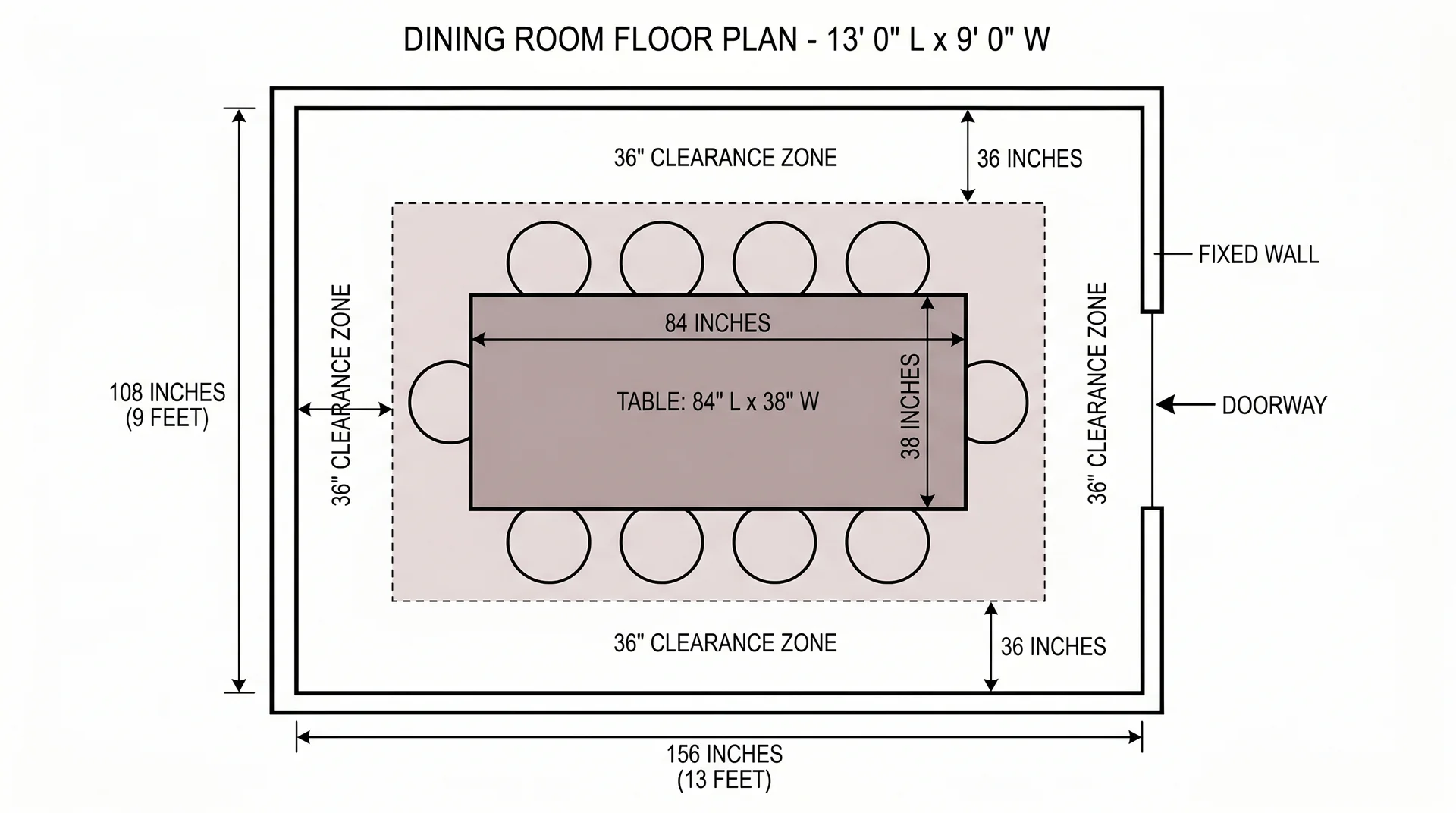
Add 72 total inches to each table dimension, 36 on each side, to find your minimum room size.
Run this before you do anything else. Here’s how it works for common table sizes:
- Take your table length. Add 36 inches at each end. An 84-inch table needs 156 inches (13 feet) of minimum room length.
- Take your table width. Add 36 inches on each side. A 38-inch table needs 110 inches (just over 9 feet) of minimum room width.
- Measure your actual dining room. Both numbers need to clear the minimums before you order.
For a 96-inch table, the length calculation becomes 168 inches, or 14 feet of minimum room length. Width clearance stays the same regardless of which configuration you choose.
A table that meets these numbers will be usable. A table that falls short will feel crowded within the first few dinners.
When Your Room Is Smaller Than the Minimum
A tighter room often means reconsidering the configuration, not automatically buying a shorter table.
If your room falls short of the minimum, don’t automatically settle for a shorter table. Two options are worth considering first:
- Keep the configuration, shorten the table: A 78-inch table in the 6+2 arrangement needs 150 inches of room length, just over 12.5 feet. This works if the short-end walls have no doorways or traffic paths.
- Remove the end seats: A 72-inch table without end positions seats 6 people comfortably. That outcome is often better than cramming 8 into a room that can’t hold them well.
The constraint is where the real decision lives. Most buyers resist removing end seats because the count drops. A 6-person table that works beats an 8-person table that everybody avoids.
The Chair Pull Problem
The 36-inch clearance standard assumes a chair at rest, not a chair being pulled out.
Thirty-six inches of clearance sounds like a lot of space. It is not. Pulling a dining chair out to sit takes 18 to 24 more inches beyond its resting position.
I keep a folder of photographs from real client dining rooms that failed exactly this test. The clearance numbers checked out. The chairs still couldn’t open without hitting the buffet or the wall.
The End Seats: What They Cost You and When They’re Worth It
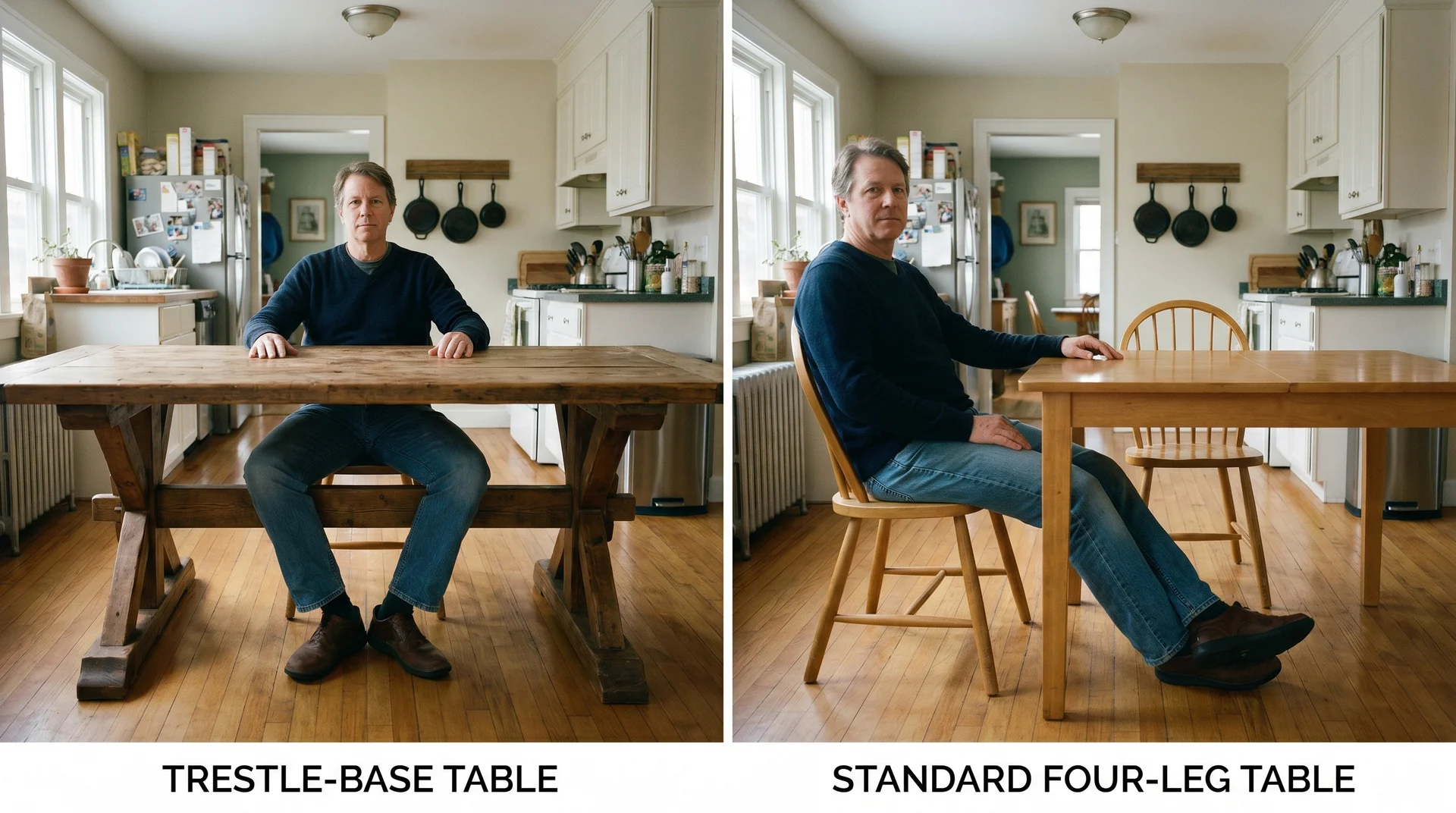
End seats change the seating count by 2.
They also change the experience for whoever sits there. Almost every buying guide counts end seats without explaining what those two positions actually involve.
Before you count the end seats in your seating total, check for two things. Both are worth knowing before you order.
- Base clearance at the head position: On trestle-base tables, the crossbar connecting the two legs runs directly below the head seat. Its position varies by model. Taller people regularly run into leg room problems here. Product listings rarely mention it. What your specific table does at that position depends on the model.
- Room traffic at the ends: In a narrow dining room with one kitchen traffic path, end seats sit directly in that path. The person there pushes their chair in every time someone gets up. In a compact dining space, this happens at every meal.
When both of those check out, end seats are worth having. When either one is a problem, the table serves you better as a 6-person setup. Keep the ends available for when you genuinely need them.
Quick Reference: Rectangular Table Dimensions for 8 People
These are the key dimensions for a rectangular table that seats 8, by configuration.
The range between minimum and comfortable matters more than most buyers expect.
| Configuration | Minimum Length | Comfortable Length | Width | Minimum Room Size (L x W) |
|---|---|---|---|---|
| 6+2 (three per side, two end seats) | 78 in / 6.5 ft | 84-90 in / 7-7.5 ft | 36-42 in | 13 ft x 9 ft |
| 4+4 (four per side, no end seats) | 96 in / 8 ft | 108 in / 9 ft | 36-42 in | 14 ft x 9 ft |
Standard dining height is 28 to 30 inches. See how high a counter height table is if you’re also weighing height styles. Round tables and extension tables need different starting points.
Measure the Room Before You Choose the Table
Measure the room first.
Most buyers find a table they like, check the dimensions, and order it. The room calculation comes later, usually when the chairs won’t open.
For rectangular tables, ten minutes with a tape measure is cheaper than returning a 200-pound table.