

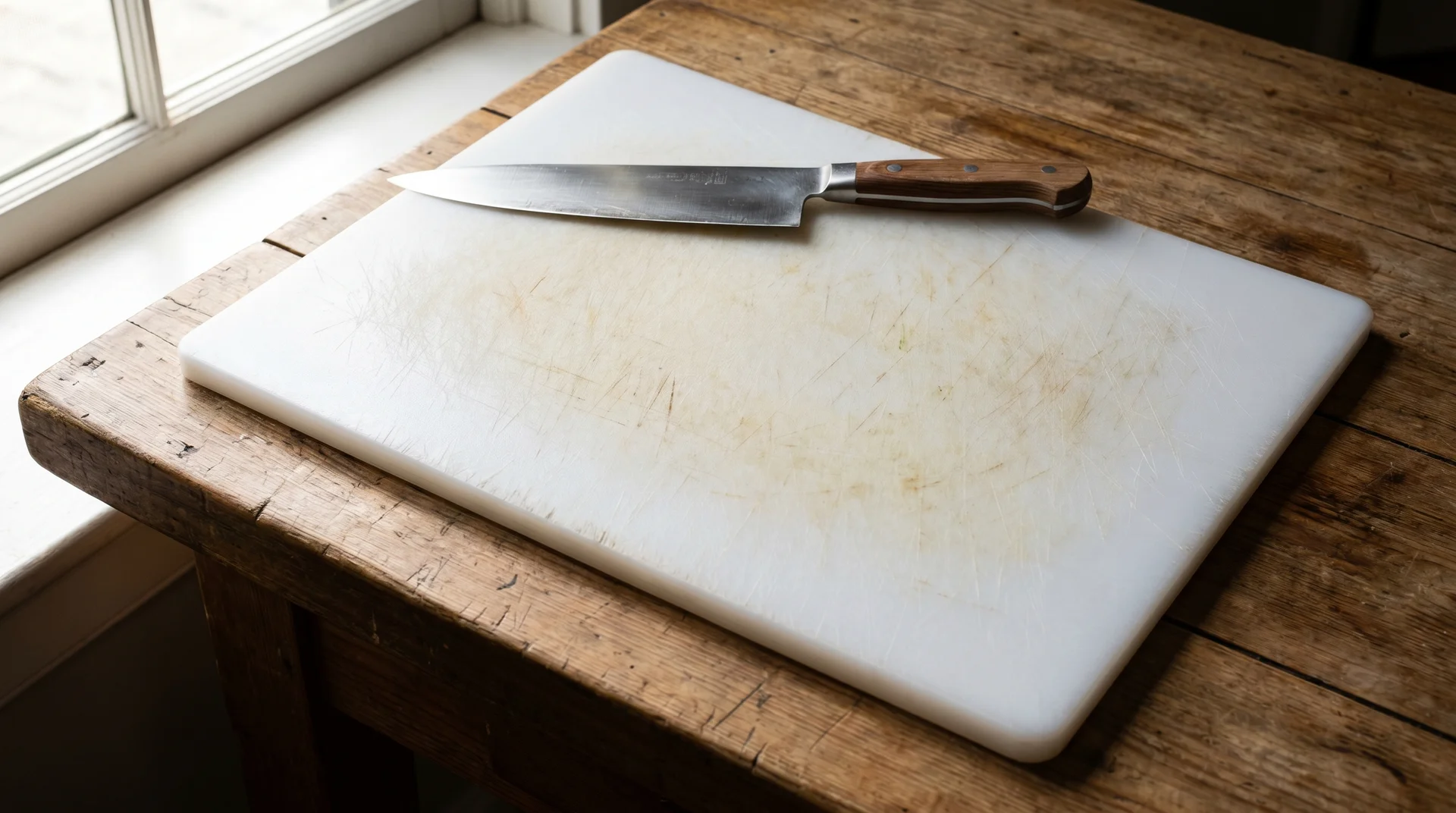
Plastic cutting boards are safe to use. What makes them unsafe has almost nothing to do with the fact that they’re plastic.
Two concerns are driving this question right now: microplastics and bacteria. They have different evidence bases and different practical implications for what you need to do.
What the Microplastics Research Actually Shows
The current alarm traces largely to one study published in 2023. Here is what that research found, and where the evidence currently stops.
Surface Condition
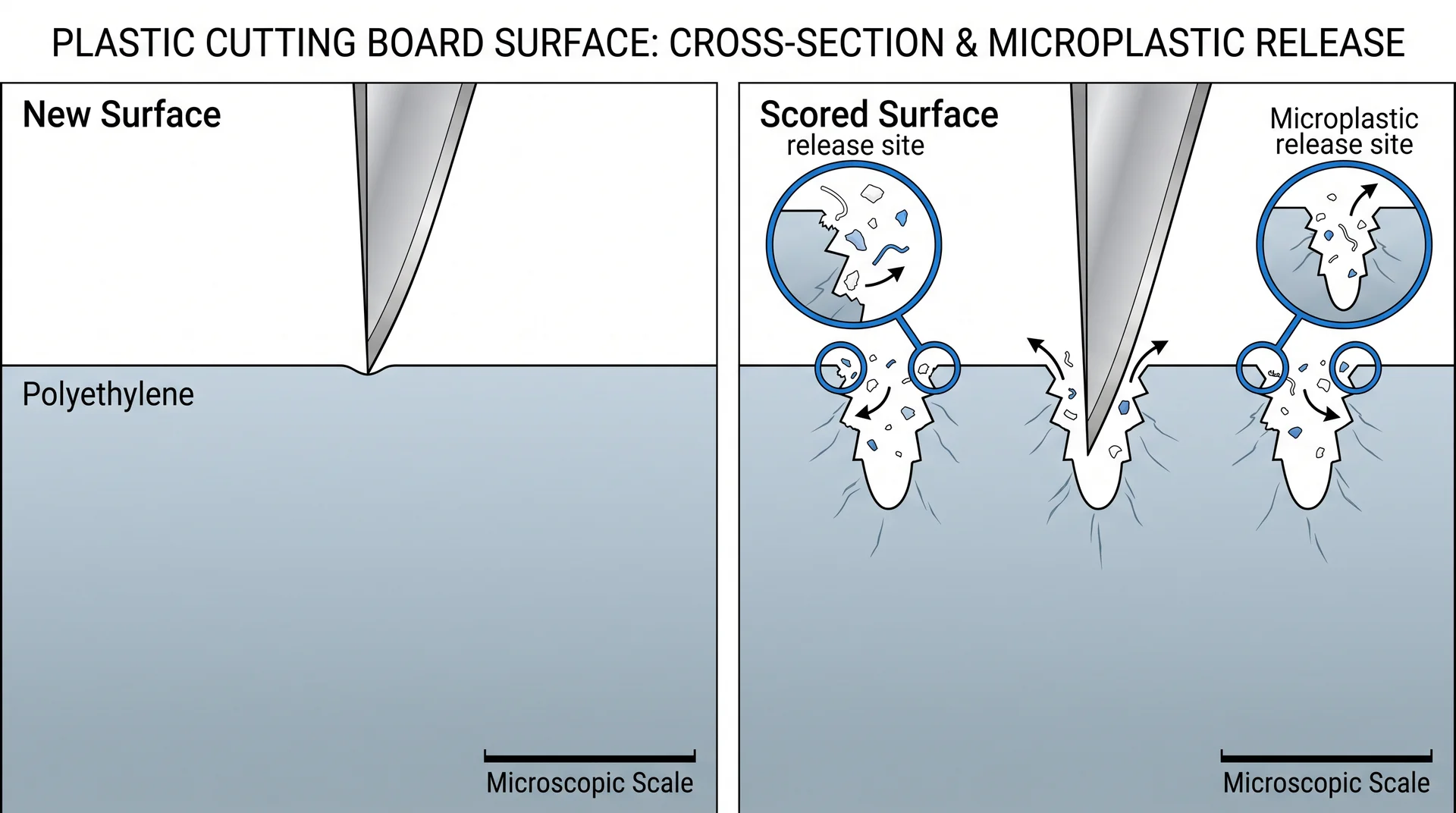
Microplastic shedding from cutting boards is real and measurable. Surface condition is the main driver of how much occurs.
The University of Surrey study identified surface condition as the key variable in terms of safety.
Researchers at the University of Surrey published findings in Environmental Science and Technology in 2023.
They measured how many microplastic particles boards release during food preparation. Microplastics are tiny plastic fragments that break away from a surface under friction.
- Older boards with significant surface damage produced the most shedding.
- Heavily scored boards shed far more particles than new or lightly used ones.
Surface condition is the variable that matters here, not the plastic type.
A new board shed far fewer particles than a deteriorated one. That is the finding you can actually act on.
What We Don’t Know About Cutting Boards and Human Health
The link between cutting board microplastics and human health outcomes is not yet established in humans.
A 2025 NIH/PMC commentary by Castillo reviewed studies on microplastics and intestinal inflammation. Those studies used animal models, not human subjects. That distinction matters for how much the findings can be applied to people.
Microplastics have been found in human blood, tissue, and organs. How much of that comes from cutting boards is not established. Neither is the threshold at which that exposure causes harm.
The Bacteria Problem in Plastic Cutting Boards is Better Documented
Bacteria in knife-scored plastic boards is a more established risk than microplastics, with thirty years of research behind it.
The evidence base is larger and more settled, and it points more directly at what to do.
Knife Grooves Are the Risk
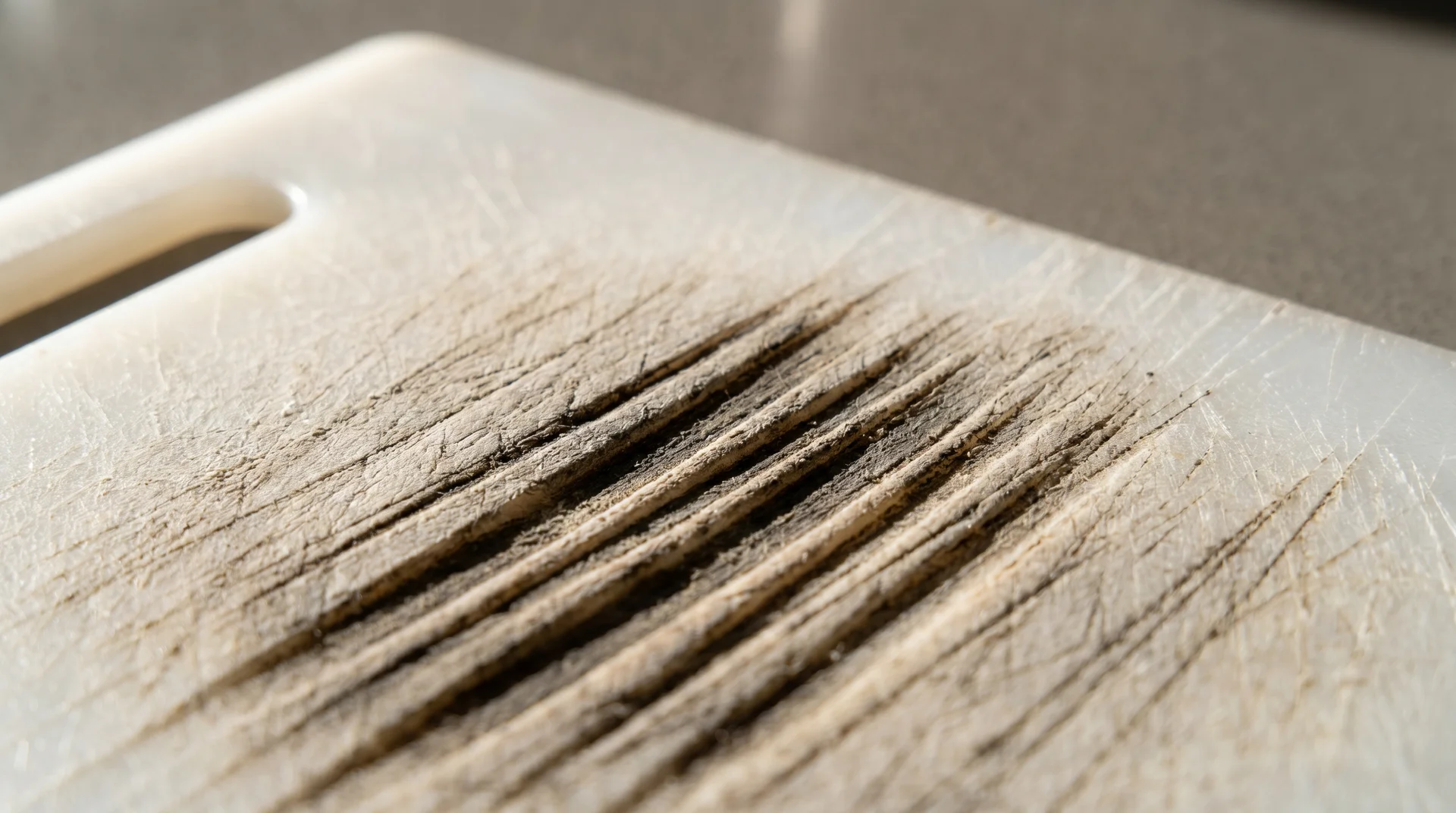
A new plastic board is non-porous. Knife scoring changes that, and the risk sits in the groove.
Non-porous means water and bacteria cannot penetrate the surface. Cleaning agents reach every part of a new board without absorption. That gives plastic a genuine advantage over wood early in its life.
That advantage disappears when knife work scores through the surface. Grooves trap food residue and moisture. They create spaces that cleaning agents cannot reliably reach without a specific technique.
I’m building a surface-specific cleaning guide right now, photographing board condition at different stages of use. The difference between a board at six months and one at three years isn’t subtle.
A Board That Looks Clean Can Still Carry Bacteria
Visual cleanliness and actual cleanliness are not the same thing on a scored surface.
Bacteria, including Salmonella and E. coli, can survive in knife grooves after standard soap-and-water washing. Soap reaches the groove opening. It doesn’t reliably reach the base of a deep groove.
In 2013, I contracted a gastrointestinal illness traced to my own cutting board. I need to be precise about what that means. I had spent eight years developing and running a hospital network’s kitchen sanitation training program, and I was cleaning the board the way I believed was correct.
The board had deteriorated past the point where my cleaning method was adequate.
When a Plastic Cutting Board Is Safe to Use
A plastic cutting board is safe when it’s in good condition and cleaned with the right protocol. Surface condition is one variable. Maintenance method is the other.
New and Lightly Scored Boards Carry Low Risk
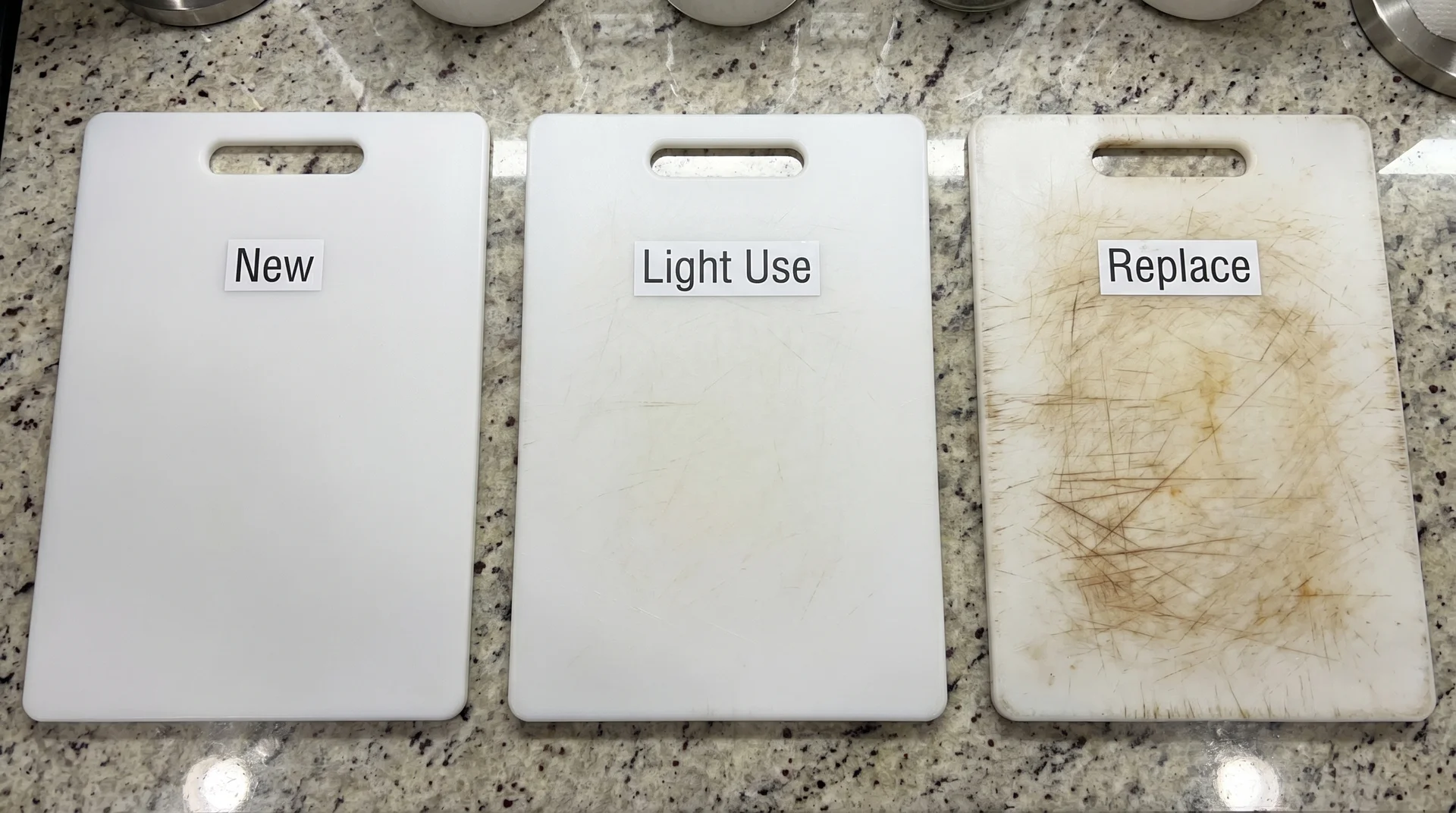
A new plastic board is one of the more manageable surfaces in a kitchen to keep clean.
It’s non-porous, straightforward to sanitize with standard food-safe solutions, and inexpensive enough to replace at end-of-life. Light surface marking from regular prep work doesn’t automatically change the risk picture.
The risk scales with groove depth, not with the first hairline marks on a new board. I’d put most boards in active home kitchen use somewhere in the light-to-moderate scoring range, which means the maintenance protocol matters more than the material for most people’s specific situation.
Color-coded boards for raw protein separation are standard in professional kitchens. One color for raw meat, another for produce, another for poultry.
That cross-contamination control is real and works. Commercial operations replace boards on a strict schedule and run them through high-temperature sanitation equipment. Home kitchens rarely match either practice, which is the part worth carrying over from the professional comparison.
The Dishwasher Is More Effective
A dishwasher sanitizing cycle running at 150°F or above provides sanitation that sink washing doesn’t match.
Temperature is the mechanism. Water pressure and soap contact time are not the main variables doing the work here.
The limit is board construction. Thin plastic boards warp under repeated high-heat cycles. Warping creates edge gaps that collect food residue in spots you’re not reaching during cleaning.
If you run thin boards through a high-heat cycle regularly, check for early warping at the edges.
When to Replace Your Plastic Cutting Board
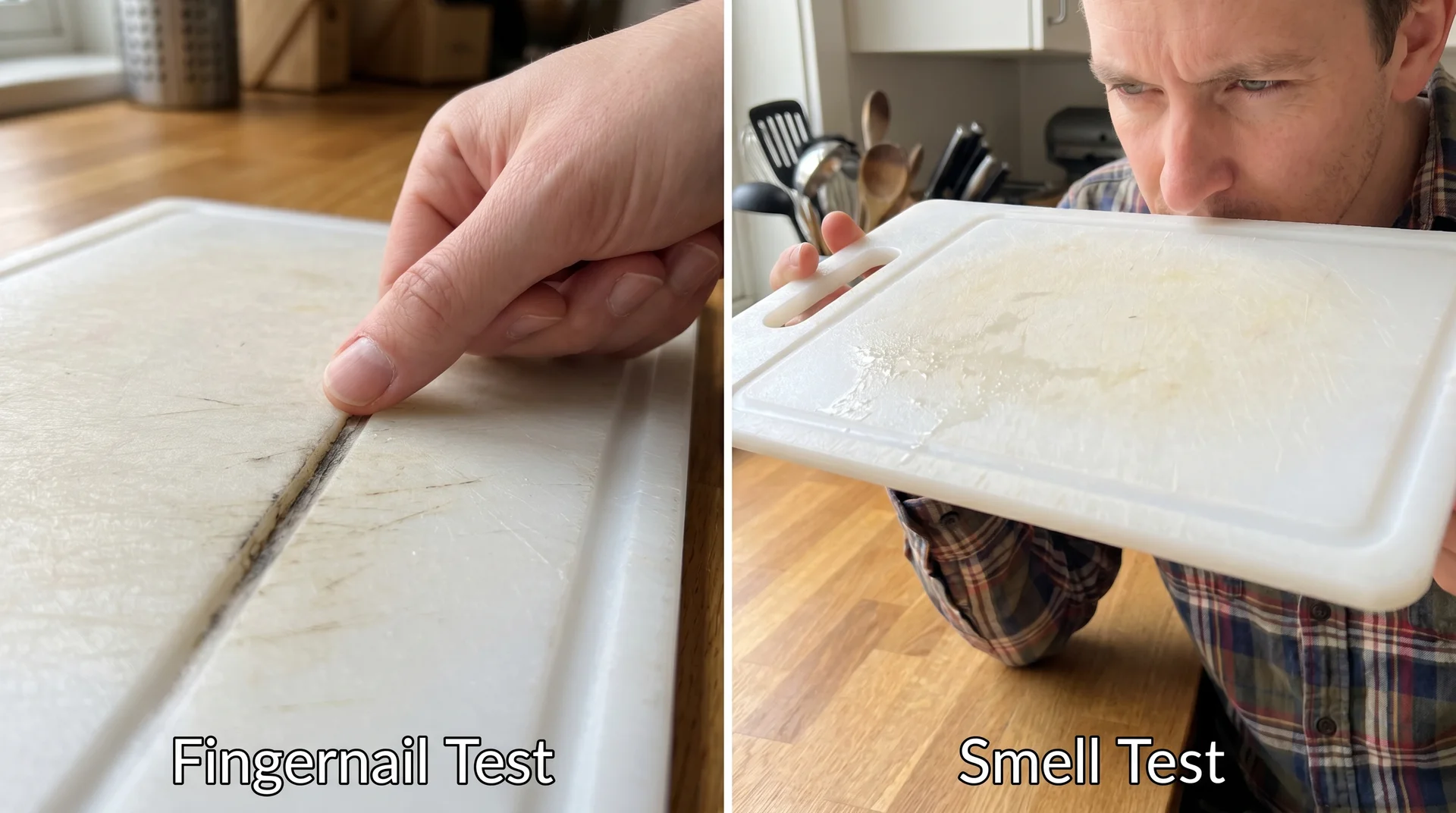
The USDA says to discard boards that are worn or develop hard-to-clean grooves.
That guidance is correct. These are the signals that tell you when you’ve reached that point.
- The fingernail test. Run a fingernail across the surface. A groove that catches the nail tip is deep enough to shelter bacteria from standard cleaning. At that depth, the board is past its useful life for raw protein prep.
- The smell test. Wash the board and smell it while it’s still damp. A clean board smells like soap or like nothing at all. A persistent organic smell after washing means the surface isn’t clean. Most people skip this check, and it’s the most reliable one available.
- Staining that won’t scrub out. Dark discoloration deep in grooves that remains after scrubbing indicates trapped organic matter. That groove is past what standard cleaning can recover.
- A board that no longer lies flat. Warping creates gaps along the board’s edges. Those gaps collect residue in spots you can’t reach during cleaning, and a warped board sanitizes differently than a flat one.
The smell test catches what your eyes miss. If a board you just washed still smells like food, that is your answer.
How to Sanitize a Plastic Cutting Board Correctly
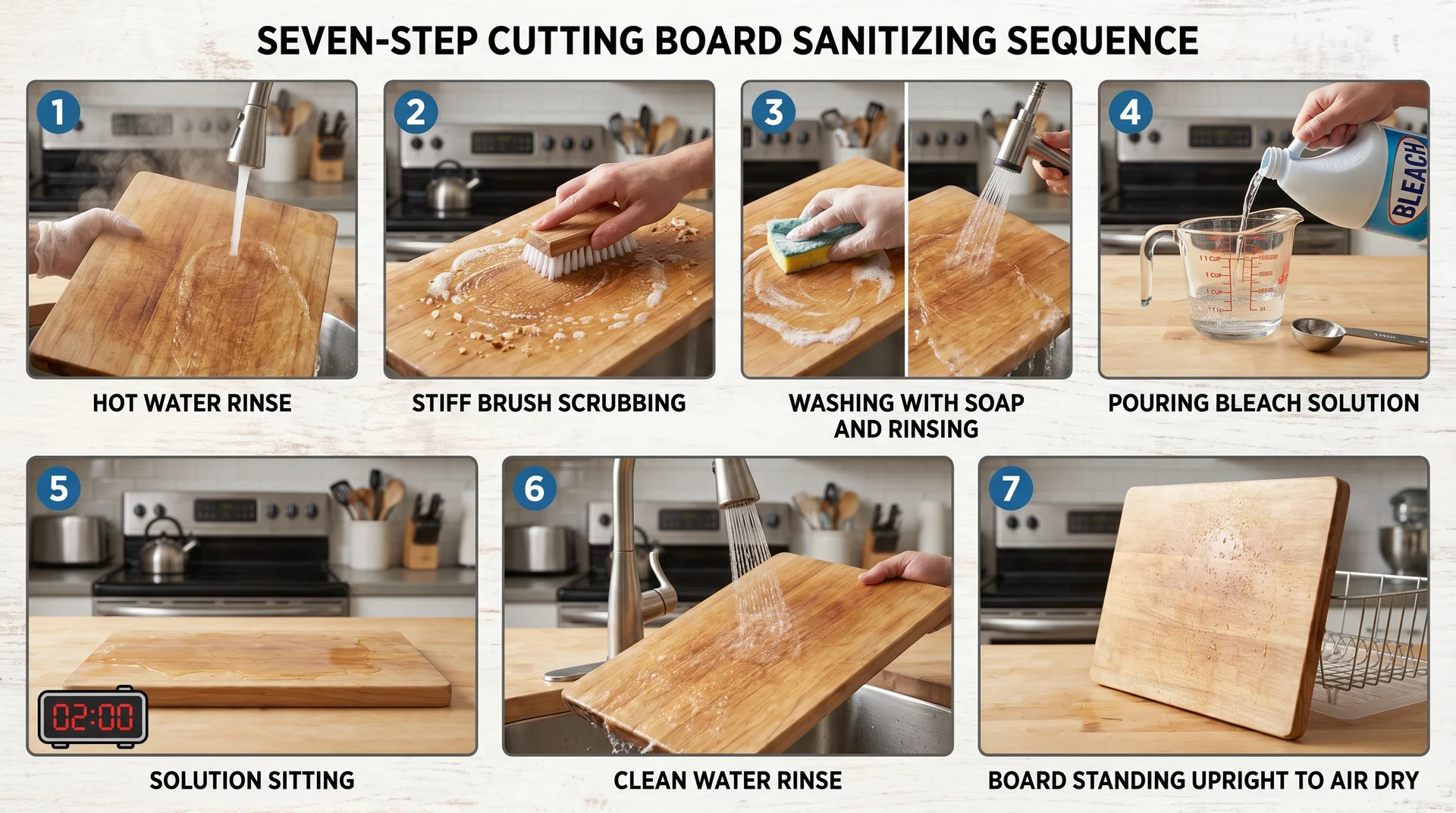
Most coverage says “properly maintained” and never defines what that means.
Contact time, surface type, and sequence are the three variables that determine whether sanitization works on a plastic surface. Run the steps below in order. They are not interchangeable.
- Rinse with hot water before applying soap. Hot water loosens food residue before detergent contacts it. Applying soap to a cold surface with dried residue on it puts the detergent at a disadvantage from the start. Thirty seconds of hot water first, then soap.
- Scrub with a stiff brush, not a sponge. Brush bristles reach into the knife scoring, where a sponge only contacts the groove surface. I prefer a stiff brush over anything else on cutting boards, and that preference has peer-reviewed support. Skip the brush, and this step does less than you think it does.
- Wash the board fully before applying any sanitizer. The sequence is wash, rinse, then sanitize. Applying sanitizer to a dirty surface is the most common error in home kitchen cleaning, and it compromises everything that follows.
- Prepare the sanitizing solution: 1 tablespoon of unscented liquid chlorine bleach per gallon of water. This dilution applies to plastic surfaces only. Do not use this solution on wood or bamboo boards. Apply it to the clean, rinsed plastic surface.
- Leave the solution on the surface for two full minutes. Do not wipe it off immediately.
My father has been cleaning cutting boards with bleach for forty years. He applies the solution and rinses it off within seconds. He is not entirely wrong. He is also not entirely right.
The label says the solution sanitizes. The EPA registration data specifies a minimum contact time at this dilution. Two minutes is the threshold for reliable kill performance against Salmonella and E. coli on non-porous surfaces. That time is not a suggestion.
- Rinse the surface thoroughly with clean water. Residual bleach at this dilution is low, but rinse before the board contacts food again.
- Air-dry the board. Do not towel-dry it. A used dish towel can recontaminate a surface you just sanitized. Air drying takes longer. It doesn’t undo what you just completed.
Run the full protocol after every use with raw meat, poultry, or fish. For boards used with produce only, weekly is the right minimum. Frequency without method is not a protocol.
Plastic vs. Wood Cutting Board: What the Evidence Shows
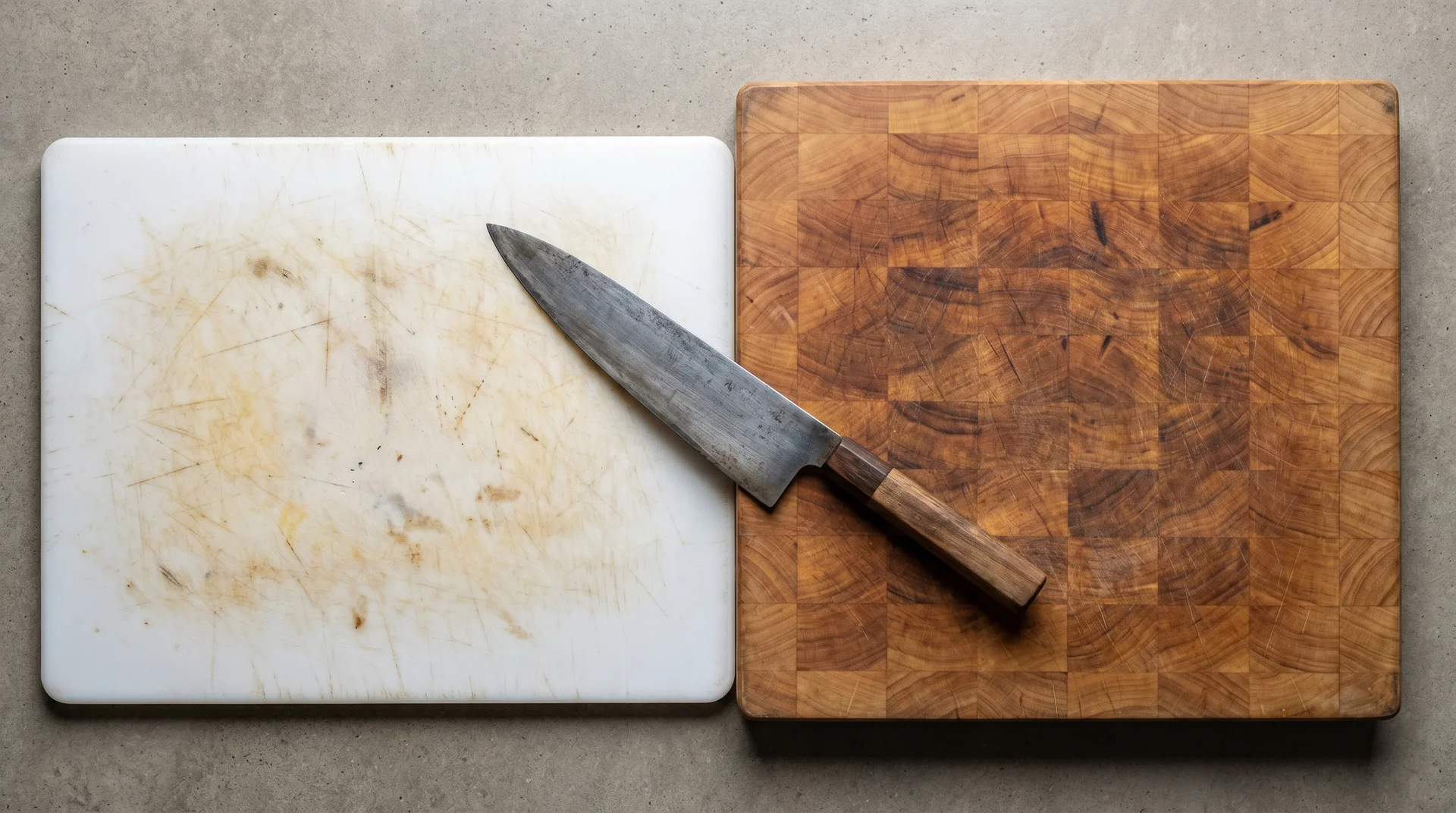
The online debate frames this as a material competition with a clear winner.
The research doesn’t reach that conclusion. It identifies what actually determines risk, and that finding applies across all materials.
For a full comparison of every major cutting board material, including food-grade rubber boards used in professional kitchens:
Read: guide to the safest cutting boards
The UC Davis Research
The foundational cutting board safety research identifies surface condition as the deciding variable, not material type.
Researcher Dean Cliver at UC Davis found that bacteria on wood surfaces died rapidly.
Bacteria on plastic survived in knife grooves and transferred to food on subsequent cuts. New plastic outperformed new wood for ease of sanitization in the same research.
The risk difference emerged as plastic boards accumulated knife scoring.
I build maple and walnut boards in my garage workshop, end-grain and long-grain. End-grain construction compresses under knife pressure rather than splitting. That creates a different groove geometry than you get in plastic or long-grain wood.
The UC Davis research doesn’t always specify board construction type, and that distinction changes the contamination picture in ways the aggregate data doesn’t fully capture.
Where Plastic Has a Genuine Advantage
Color-coding for cross-contamination separation is the strongest practical argument for plastic in a home kitchen.
One board for raw meat, another for produce, another for poultry. No other material can replicate that system. The color distinction is the control, and it’s inexpensive to maintain.
Plastic is also cheaply recycled at the end of its life. A board that costs $12 to replace gets replaced when it needs to be. That frictionless replacement matters more than it sounds.
Bamboo, Glass, Titanium, & Marble Cutting Boards
Glass and marble boards don’t harbor bacteria or shed microplastics. They systematically damage knife edges.
A surface that keeps your food safe but destroys your knives isn’t a practical choice in a working kitchen. The effect on knife-edge geometry is covered in detail:
Read: knife-sharpening guide
Bamboo boards in laminated construction often use adhesives with potential chemical concerns. That’s a separate safety question from bacteria and microplastics, and it belongs in its own piece.
Titanium boards have entered the home market recently with a different safety profile from any material discussed here. That question has its own piece.
Read: Are Titanium Cutting Boards Safe?
Here is how the main materials compare across the safety variables covered in this article.
| Material | Bacteria Risk | Microplastic Concern | Knife Edge Impact | Key Condition |
|---|---|---|---|---|
| New plastic | Low | Low | Neutral | Non-porous when unscored |
| Scored/worn plastic | High | Higher | Neutral | Replace when grooves trap odor |
| End-grain hardwood | Low with oiling | None | Gentle | Requires regular conditioning |
| Long-grain hardwood | Moderate | None | Gentle | More groove accumulation over time |
| Glass/marble | Very low | None | Destructive | Not recommended for daily use |
| Bamboo (laminated) | Moderate | Possible | Abrasive | Adhesive concerns |
If you washed your cutting board a few minutes ago and it still smells, you have your answer. The material didn’t tell you that. The board did.