

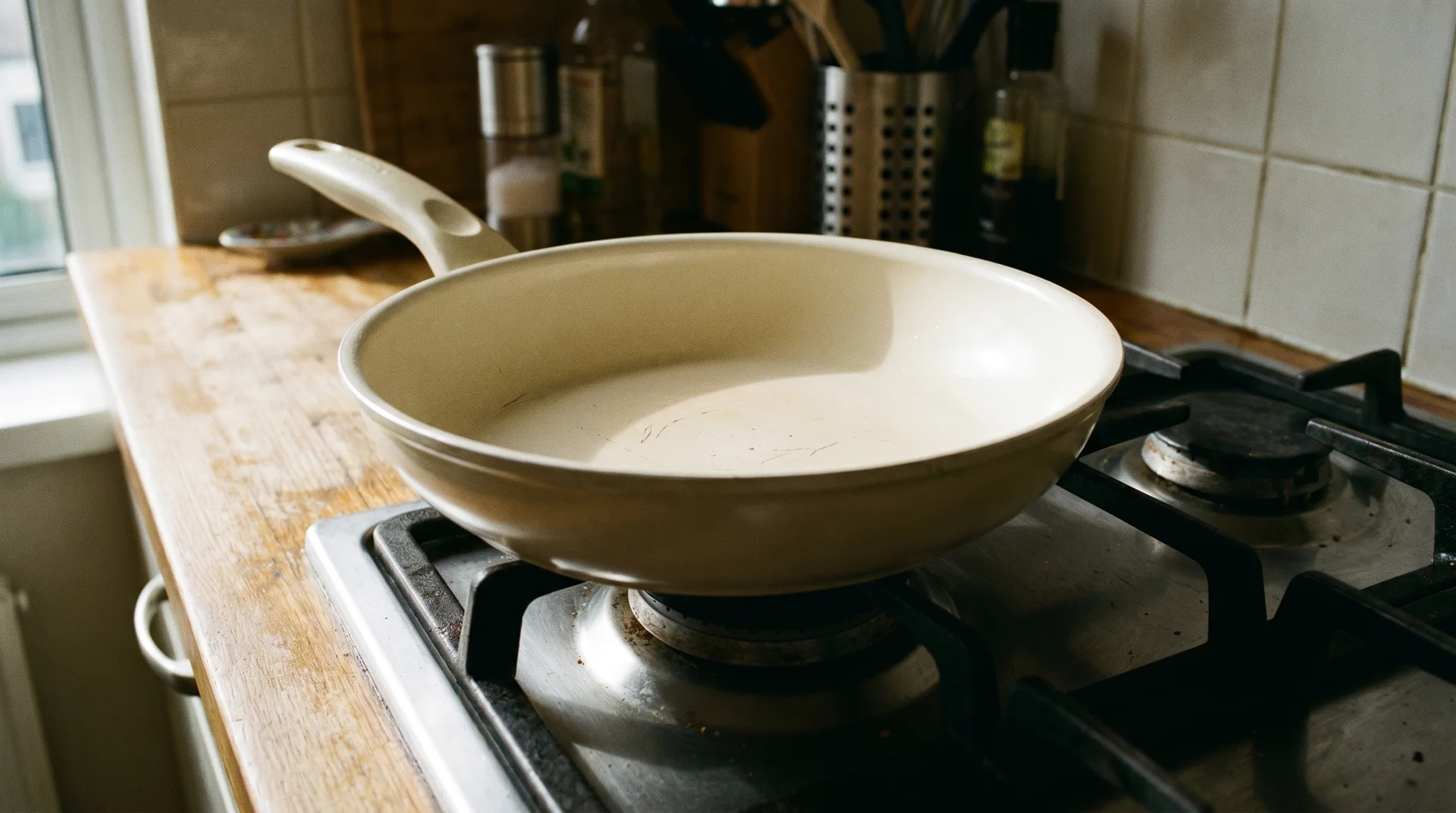
Ceramic cookware is safe to use when the coating is intact, and the pan stays within its heat range. Both of those conditions carry more weight than the marketing copy on the box suggests.
Most pans sold as ceramic cookware aren’t made of ceramic in any traditional sense. They’re aluminum pans with a thin coating applied through a process called sol-gel, composed primarily of silicon dioxide and, in many formulations, titanium dioxide.
The word “ceramic” on the label describes the coating’s surface properties. It says nothing about the underlying chemistry.
That’s not a niche technical point. It’s the whole frame for the safety question, because the real question isn’t about ceramic. It’s about the coating, what’s in it, how long it holds, and what’s underneath it when it doesn’t.
What “Ceramic Cookware” Actually Means?
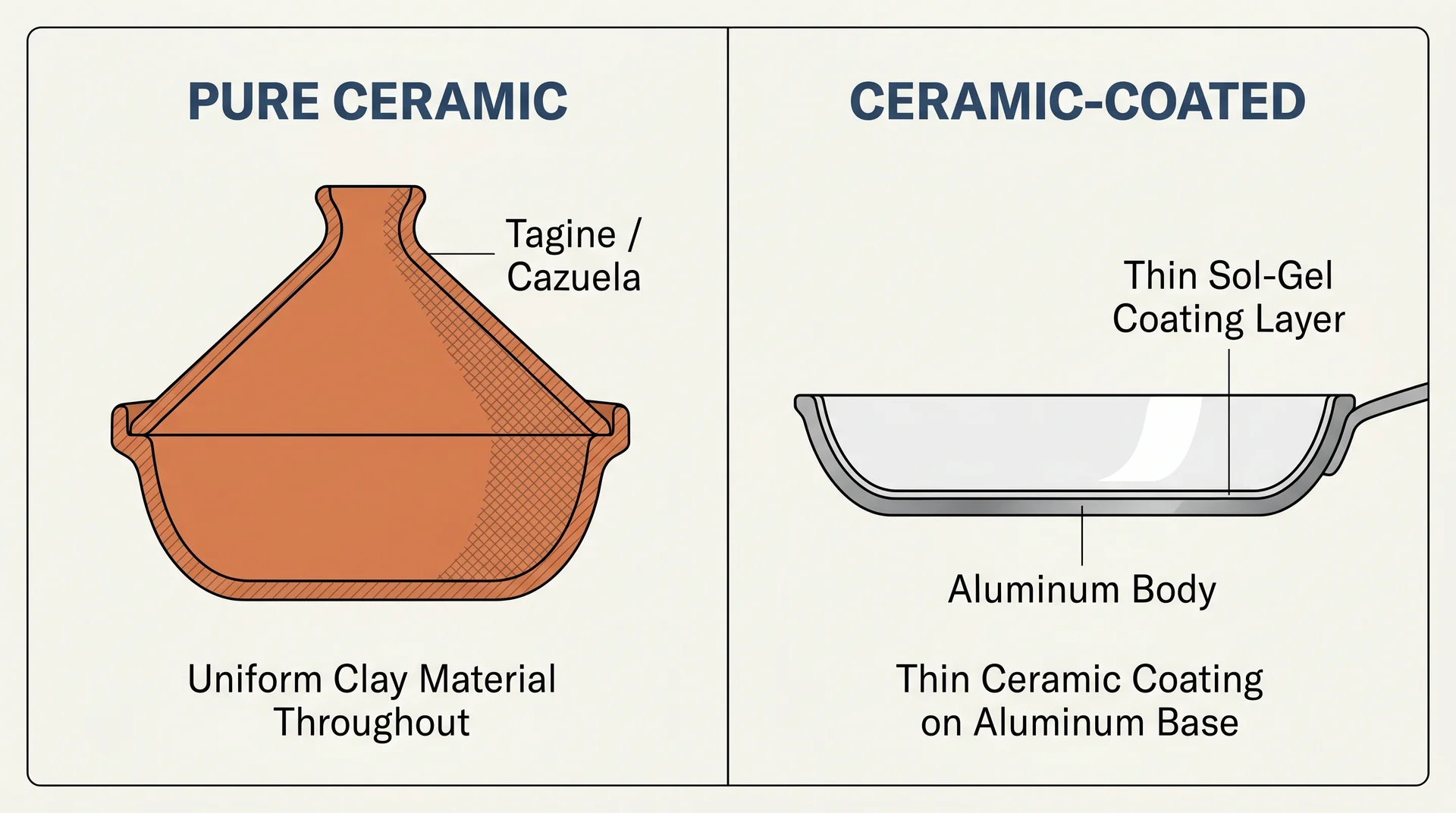
Ceramic cookware is not a single product category. It covers two distinct types of cookware with different materials, different safety profiles, and different durability expectations, and most people buying the second type think they’re buying the first.
Pure Ceramic vs. Ceramic-Coated: Two Different Things
Pure ceramic cookware is made from clay-based materials fired at high temperatures. Tagines, cazuelas, and some specialty baking vessels fall into this category. It’s heavy, slow to heat, and composed of ceramic throughout.
Ceramic-coated cookware is almost always an aluminum pan with a thin coating bonded to the cooking surface. The aluminum conducts the heat conduction. The coating handles food contact and provides nonstick performance.
This is the product this article is about, and it represents the vast majority of what the cookware market means when it says “ceramic.”
What the Coating Is Actually Made Of
The coating on most ceramic-coated pans is applied using a sol-gel process, which bonds silicon dioxide to the pan’s surface under heat.
Some formulations include titanium dioxide, which hardens the surface and improves scratch resistance.
The American Ceramic Society has documented that these coatings are chemically stable at normal cooking temperatures and don’t release compounds at levels considered hazardous under standard food-contact conditions.
This is not the same as traditional ceramic. The sol-gel process produces a coating with ceramic-like properties: hard, relatively inert, and resistant to corrosion. Its relationship to a fired clay pot is distant.
Think of it as a mineral-derived surface layer, not ceramic in any intuitive sense of the word.
Why the Label Says “Ceramic” When the Chemistry Doesn’t
The terminology got loose because “ceramic” reads as natural and safe to consumers who were already worried about synthetic coatings, and manufacturers recognized it. The term isn’t technically false.
Sol-gel coatings do share properties with ceramics. But “ceramic coating” carries no regulatory definition in cookware labeling, which means two pans with that label can have meaningfully different formulations, and neither manufacturer is required to say which.
That doesn’t make either pan unsafe. It does mean the label tells you less than you’d think, and the safety question has to go deeper than what’s printed on the box.
Is Ceramic Cookware Safe to Use?
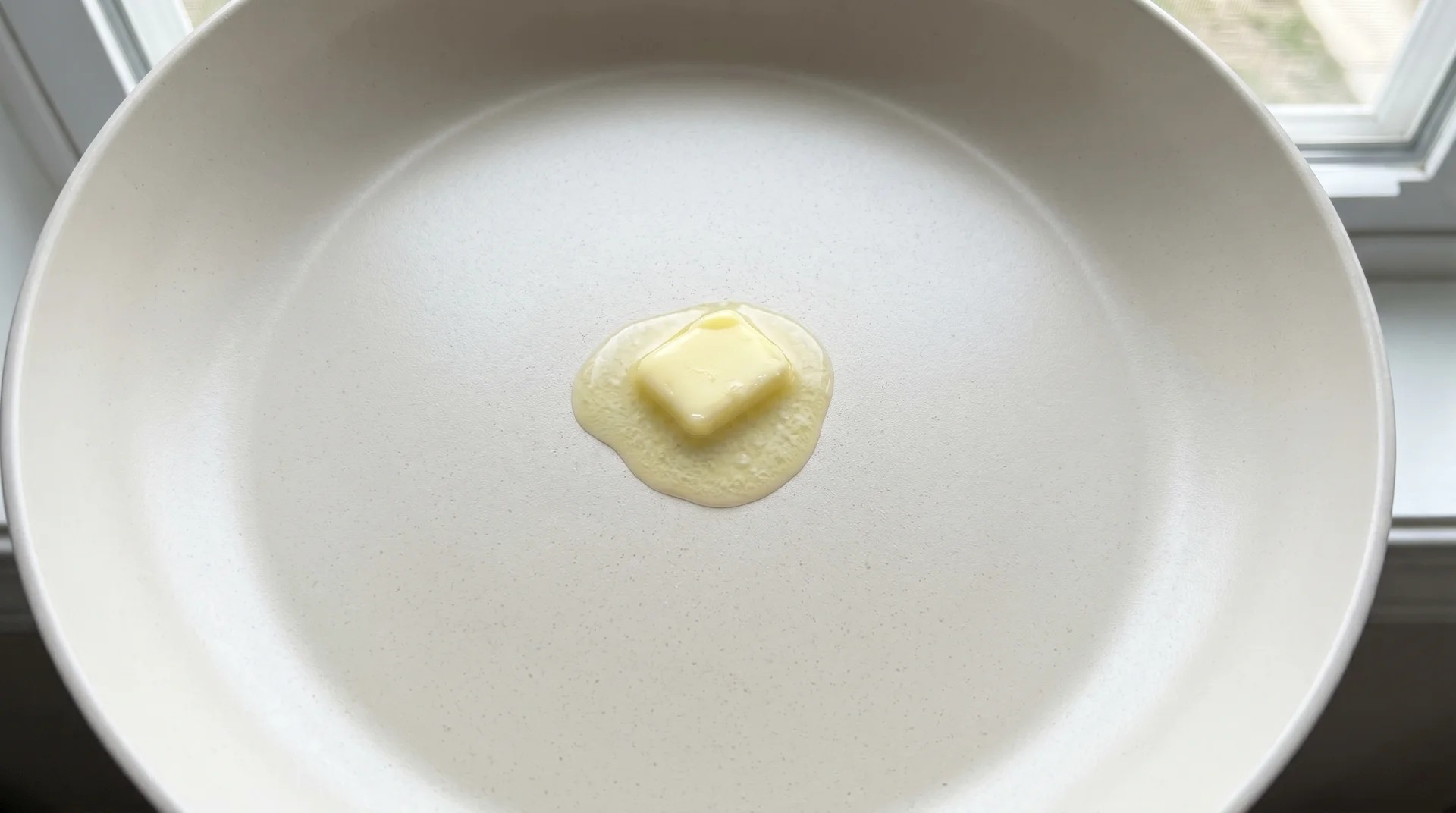
Yes. Ceramic cookware is safe to cook with when the coating is undamaged, and the pan is used within its specified heat range.
The FDA classifies silicon dioxide, the primary component of sol-gel ceramic coatings, as generally recognized as safe (GRAS) for food contact. No credible evidence exists that a new, undamaged ceramic-coated pan poses a health risk under normal cooking conditions.
What the Research Shows, and Where It Stops
Research documented by the American Ceramic Society finds that sol-gel coatings are chemically stable at cooking temperatures up to approximately 450°F and don’t release detectable levels of silicon dioxide into food under those conditions.
Above that threshold, the coating begins to degrade structurally. The relevant research doesn’t identify a single high-heat incident as acutely dangerous. It identifies sustained or repeated overheating as the mechanism that shortens a coating’s reliable lifespan.
The safety case for ceramic cookware rests on coating integrity, temperature management, and maintenance without abrasive tools or cleaning methods that accelerate surface wear.
Read: How to Clean Ceramic Cookware?
They’re the practical definition of what “safe” means for this category of cookware, and they change over time in ways most users don’t notice until the surface is visibly degraded. That timeline is covered below.
Is Ceramic Cookware Non-Toxic?
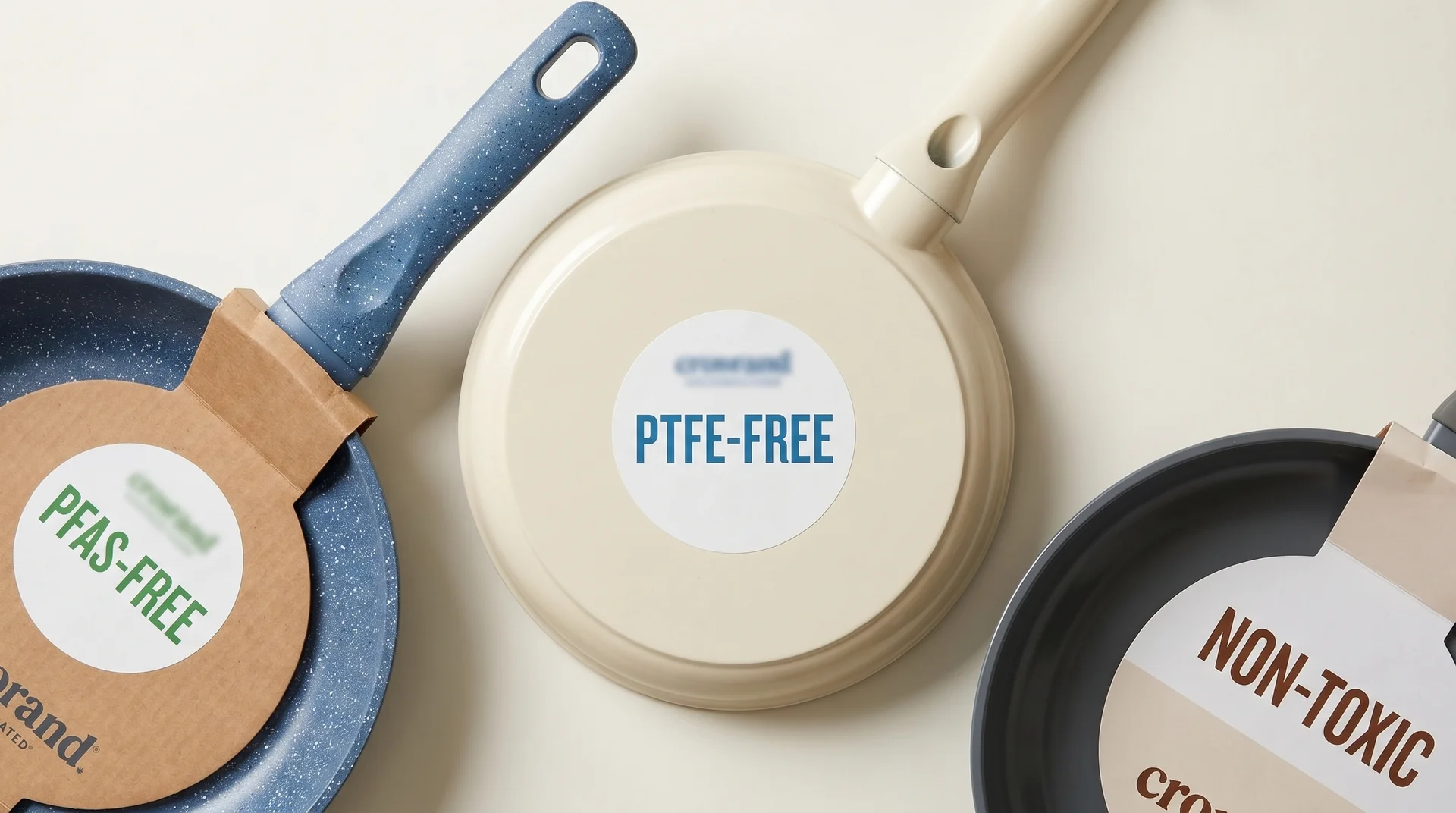
Ceramic cookware is generally non-toxic, but that claim requires more precision than most product marketing provides. The gap between “generally non-toxic” and “independently verified non-toxic” is where most of the consumer confusion lives, and it’s worth closing carefully.
PTFE-Free Is Not the Same as PFAS-Free
- PTFE (polytetrafluoroethylene) is the specific compound used in traditional Teflon-style nonstick coatings.
- PFAS, or per- and polyfluoroalkyl substances, is a broader class of thousands of synthetic chemicals, some of which may appear as processing aids in the manufacture of certain coatings, including some marketed as ceramic. “PTFE-free” is a narrower claim than “PFAS-free.” The two are not interchangeable, and most marketing copy treats them as though they are.
The EPA has documented the persistence and potential health effects of PFAS compounds as a class. For cookware buyers, a “PFAS-free” claim on the box should be backed by third-party testing from an accredited lab, not marketing language alone.
Some manufacturers, including GreenPan, have pursued third-party verification. Many have not, and there’s no federal requirement that they do.
The “PFAS-free” claim in cookware has gotten ahead of the testing infrastructure that would make it reliably verifiable. That doesn’t mean the claim is false. It means it deserves more scrutiny than most people apply when they’re picking a pan off the shelf.
What “No PFOA, No PFAS” on the Label Actually Means
PFOA (perfluorooctanoic acid) was phased out of US cookware manufacturing by 2013 through an EPA voluntary stewardship program.
A pan labeled “PFOA-free” is meeting a standard that virtually all cookware sold in the US already meets, including current Teflon. That claim, in isolation, is not a meaningful safety differentiator. It’s just baseline.
“PFAS-free” is a stronger claim. If a manufacturer is making it, ask what’s behind it. Third-party test results from an independent lab are what that claim should rest on. A line on the packaging is not documentation.
Titanium Dioxide in Ceramic Coatings: What It Is and Whether It Matters
Titanium dioxide (TiO2) appears in some ceramic coating formulations as a hardening and opacifying agent. It’s also used in paints, sunscreens, and certain food products.
At normal cooking temperatures, titanium dioxide in a sol-gel ceramic coating is chemically stable and is not considered a health concern in food-contact applications by US or EU regulatory bodies.
The concern that shows up in scientific literature involves inhalation of nano-scale TiO2 particles in occupational manufacturing environments, not ingestion from a cooked pan surface in a home kitchen. Those are different exposure contexts.
Titanium dioxide in your pan’s coating is not the variable on which your cooking safety depends.
What’s Under the Coating: The Aluminum Core Question
Ceramic-coated cookware is marketed primarily on the safety of its surface layer.
That layer sits on top of an aluminum base, and understanding what that means is worth the two minutes it takes before accepting the marketing narrative at face value.
Why Almost All Ceramic-Coated Pans Have an Aluminum Base
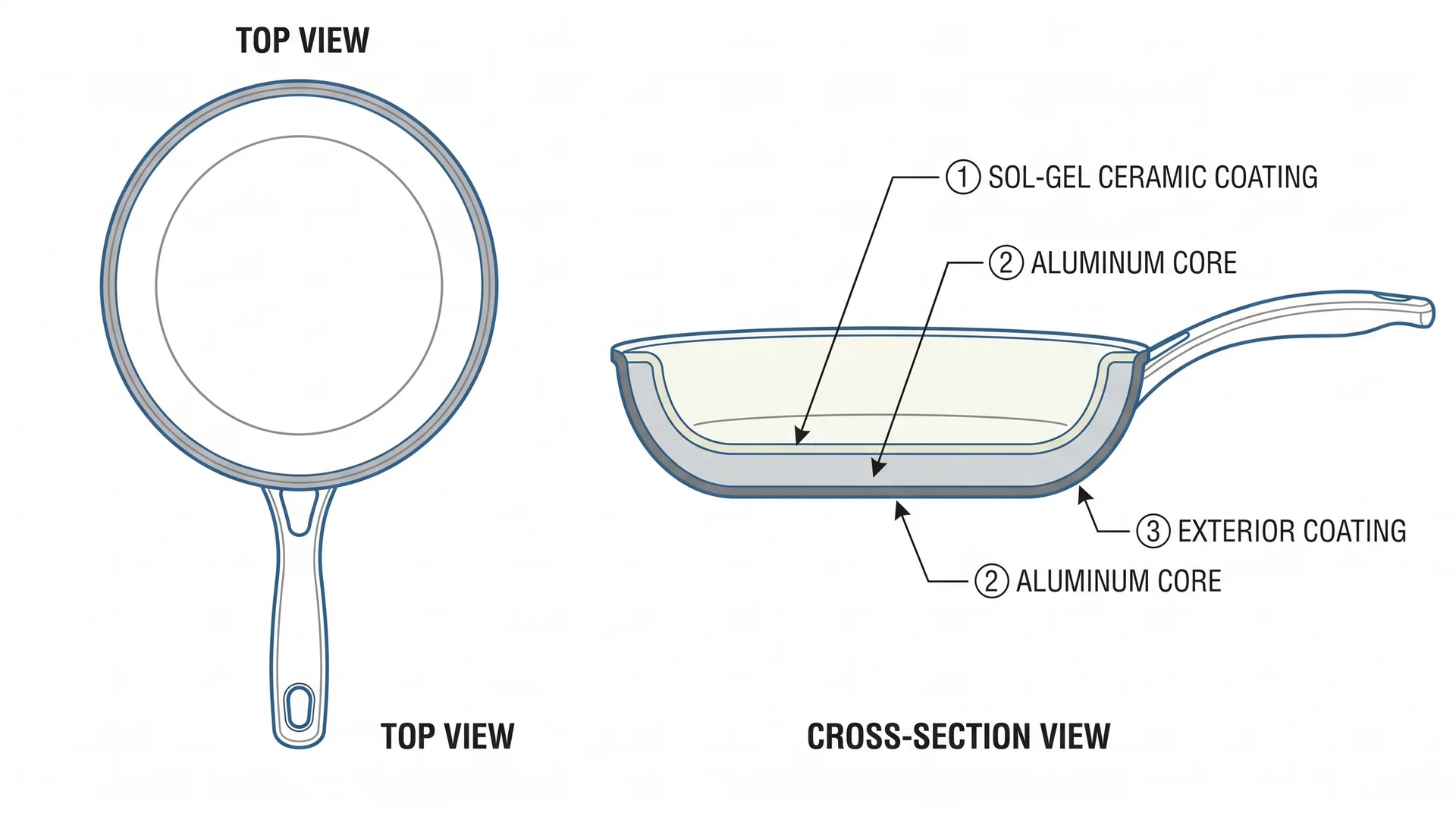
Aluminum is lightweight, conducts heat quickly and evenly, and is inexpensive to form into cookware. It’s what makes a ceramic-coated pan practical as a consumer product. The coating handles food contact.
The aluminum handles everything else. Most consumers buying a pan for its “natural” or “non-toxic” properties don’t realize they’re buying an aluminum pan with a coating on top.
Does Aluminum Leach Through a Ceramic Coating?
An intact ceramic coating acts as a barrier between food and the aluminum base, and aluminum migration through an undamaged coating is not considered a meaningful risk under normal cooking conditions.
Aluminum cookware without any coating is widely used and considered safe at cooking temperatures, so this isn’t an acute risk scenario even in the event of coating wear.
But the “the coating protects you” argument holds cleanly only when the coating is actually doing its job.
What Happens When the Coating Is Compromised
A scratched or flaking coating means the aluminum beneath is more directly exposed to food and heat. The risk from that level of aluminum exposure is low.
A compromised coating is primarily a performance problem before it becomes a safety problem.
The two categories converge as degradation progresses, which is why a visibly degrading pan is a pan that needs to be replaced rather than maintained.
Ceramic Cookware vs. Teflon: What’s Actually Different
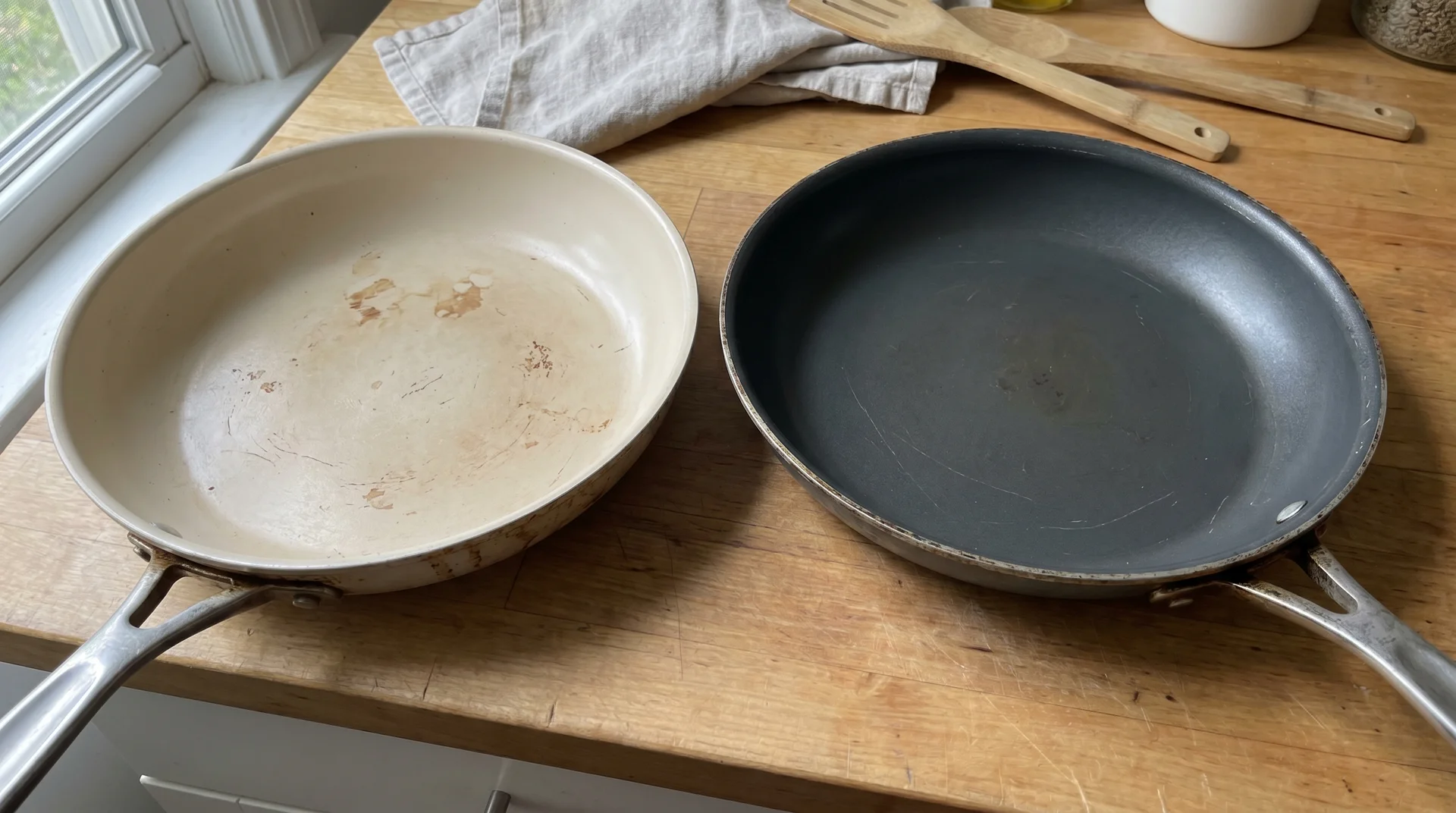
Current PTFE coatings and ceramic coatings have different chemical compositions, different safety histories, and different durability profiles.
The comparison matters because most people arrive at this safety question having already formed an opinion about one of them.
The Historical Problem with Traditional Teflon
Traditional Teflon and generic PTFE-based nonstick coatings were manufactured using PFOA as a processing aid. PFOA is a persistent synthetic compound associated with thyroid disruption, certain cancers, and adverse developmental effects.
It was present in trace amounts in the final product and released during manufacturing, accumulating in workers’ blood and in communities near production facilities.
The EPA’s voluntary phase-out was completed by 2013.
PTFE coatings sold today no longer contain PFOA. The “Teflon is poison” narrative, driving many people toward ceramic cookware, describes a product that’s largely been reformulated.
The PFOA problem was real and serious. Current PTFE coatings without PFOA are not the same product as what was being sold in 2003, and treating them as equivalent isn’t accurate.
Where Ceramic Coatings Have a Genuine Advantage
Ceramic coatings don’t contain PTFE at all, which sidesteps the debate about polymer fume fever and PTFE degradation products above 570°F. They’re also manufactured without PFOA by design, not as a later reformulation.
For consumers who want to avoid fluoropolymers entirely, ceramic coating is a genuine alternative, and that choice is reasonable on its own terms.
Where Ceramic Falls Short Compared to PTFE
PTFE is more durable than ceramic coating. A good PTFE pan treated reasonably well will outlast most ceramic-coated pans by a significant margin. Both materials, used correctly, are safe.
The tradeoff is chemical composition versus longevity, and that’s a genuine values decision, not a settled safety one.
| Ceramic Coating | PTFE (Modern, PFOA-Free) | |
|---|---|---|
| PTFE-free | Yes | No |
| PFOA-free | Yes | Yes (post-2013) |
| Typical lifespan | 1–3 years | 3–5+ years |
| Max recommended heat | ~450°F | ~500°F safe; degrades above 570°F |
| Polymer fume risk | No | Low; only above 570°F |
| Third-party PFAS testing common | Variable by brand | Not applicable |
The durability gap in that table is where the ceramic category’s weakest point lives, and it connects directly to the safety question in ways the next section makes plain.
How Long Does Ceramic Coating Last, and What Happens When It Fails
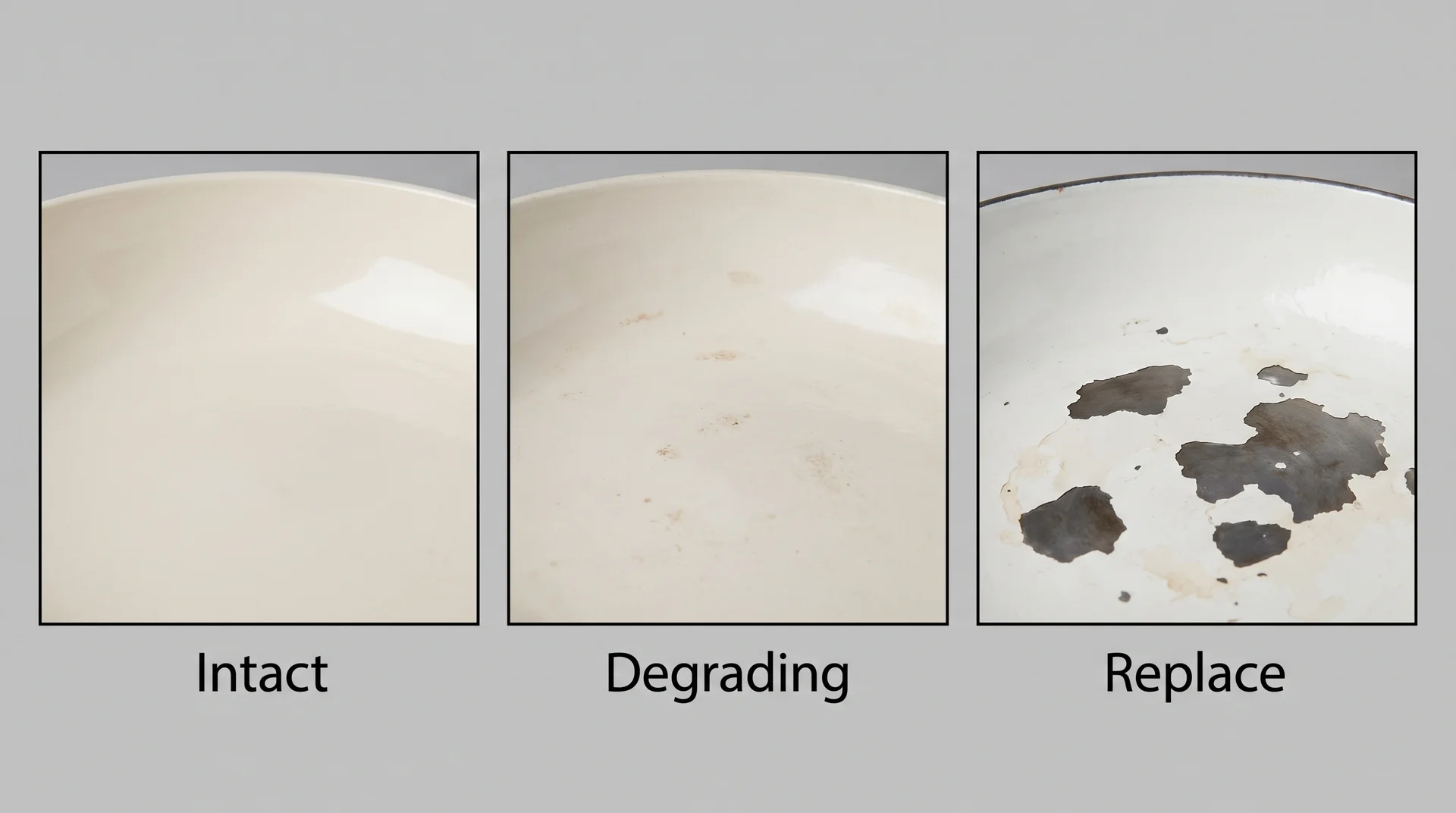
Ceramic coatings typically last one to three years under regular home use. That range is where the safety question and the performance question start to overlap, and it’s the part of the ceramic cookware story that manufacturers have the least incentive to explain clearly.
Realistic Coating Lifespan Under Normal Home Use
Premium brands with thicker, multi-layer coatings can exceed three years. Budget options often fall short of eighteen months. “Lifetime warranty” language, where it appears, typically covers manufacturing defects rather than coating wear and is narrower than it sounds.
I keep a running list of pans I’ve tested and moved off my active recommendation set. A disproportionate number of them are ceramic-coated pans that performed well for about a year before declining faster than their price suggested they should.
Read: Best Ceramic Cookware Brands in 2026
Durability is the weakest part of ceramic cookware’s case, and it’s where the marketing works hardest to obscure that weakness.
A pan that’s been degrading quietly for fourteen months is a different safety question than the pan you unboxed last week. The coating on a new pan earns the safety claims on the box.
The same coating after sustained high-heat use, aerosol spray buildup, and a few dishwasher cycles is a different story.
What Causes Ceramic Coatings to Degrade Faster
Ceramic coatings fail faster under these specific conditions:
- Sustained cooking temperatures above 450°F are the most common cause, and the least visible one, because the damage accumulates before it’s apparent at the surface
- Metal utensils, which cut through the coating layer regardless of “scratch-resistant” labeling
- Thermal shock, including moving a hot pan directly under cold water or onto a cold surface
- Aerosol cooking sprays, which leave a polymeric residue that builds up on the surface and progressively degrades nonstick performance
- Dishwasher use, which accelerates surface degradation through alkaline detergent chemistry and heat cycling
Of these, sustained high heat is the one I see most consistently under-discussed. Cooks who learned on stainless steel or cast iron are accustomed to preheating on high and adjusting down.
That habit will shorten a ceramic pan’s useful life significantly, often within the first year, and the pan won’t announce it until the damage is done.
If the Coating Is Chipping, Is It Dangerous?
Ingesting flaked ceramic coating particles is not considered acutely dangerous, but the chipping pan should be retired. Sol-gel coating is chemically inert and doesn’t dissolve in food or stomach acid.
But when the coating is physically failing, the aluminum base is more directly exposed to food and heat, and the pan is no longer performing as designed or tested.
“Is swallowing a chip dangerous?” and “Should I keep using this pan?” are different questions with different answers. The first answer is probably not acute. The second answer is no.
When to Replace a Ceramic Pan
Replace the pan when you notice any of the following:
- Visible chips or flaking anywhere on the cooking surface
- Dark spots or discoloration that don’t clean off after normal washing
- Food is sticking consistently in areas where it previously didn’t, with no improvement after gentle cleaning
- Scratches that expose the metal layer beneath the coating
From there, the next question is what to replace it with, and that decision is worth making deliberately rather than defaulting to the same category.
How to Use Ceramic Cookware Safely
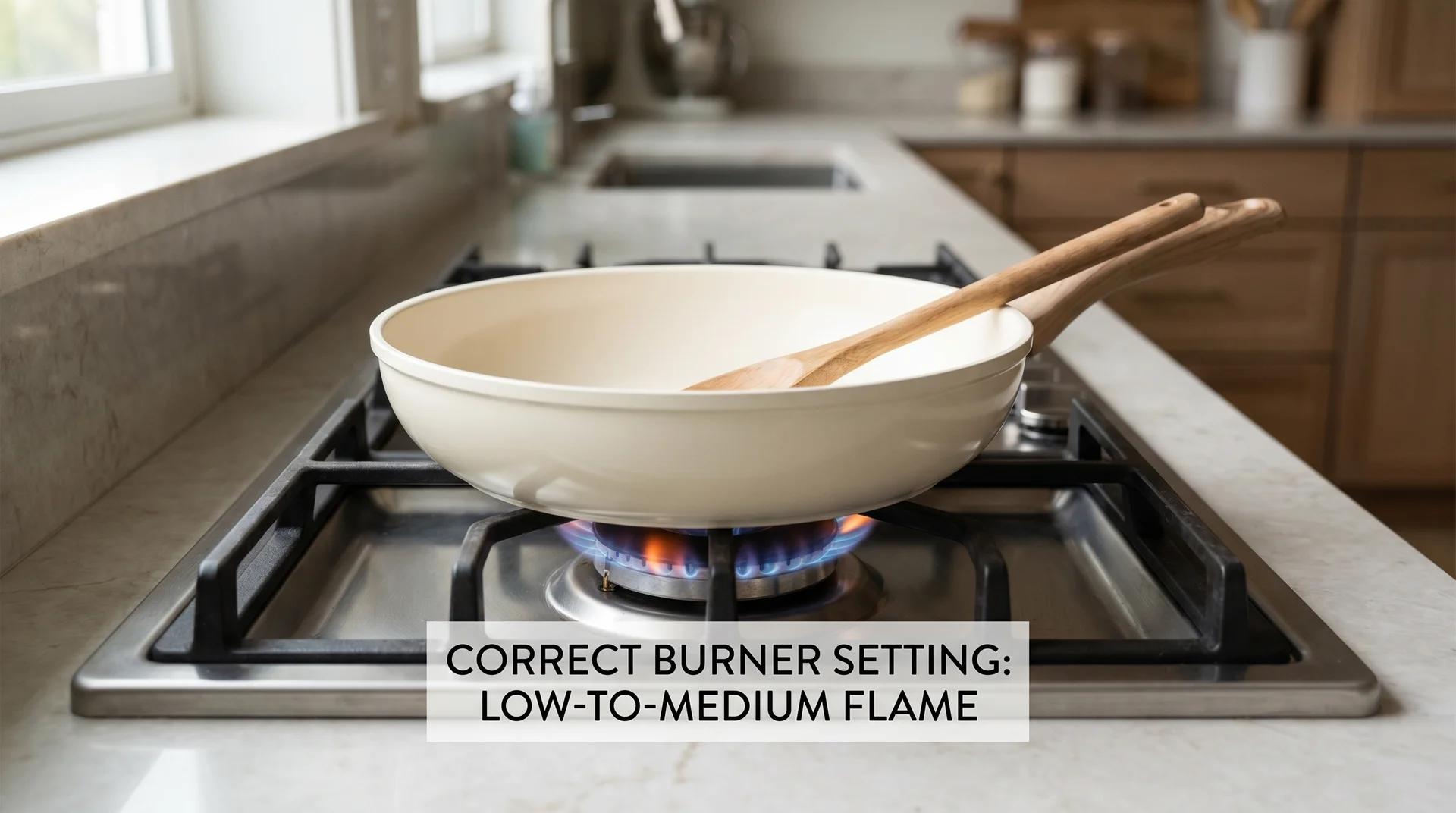
How you use a ceramic-coated pan determines whether it holds up for three years or starts declining at twelve months. Most of the variables are simple, and most of them are habits that home cooks bring from other cookware and never think to adjust.
Temperature: The Most Important Variable
Keep ceramic-coated pans on medium or medium-low heat. That’s the thermal range the coating is designed for, and treating it as a hard ceiling rather than a suggestion is the single most effective thing you can do to extend the pan’s lifespan.
As talked in the degradation section, sustained heat above approximately 450°F is the primary mechanism behind coating failure, and a home burner on high can reach that threshold at the pan surface faster than most people expect.
Most home recipes that call for medium-high heat can be executed on medium with a few extra minutes. The pan is significantly better off for it.
Use this sequence:
- Preheat the pan on medium heat, not high.
- Add a small amount of butter or liquid oil before the pan reaches full temperature.
- Add food, then adjust the heat downward as needed, not upward.
- If the recipe genuinely requires searing at high heat, use a cast-iron or stainless steel pan instead. That’s not a limitation of ceramic cookware. It’s a correct tool assignment.
Is Ceramic Cookware Dishwasher Safe?
Most manufacturers label ceramic cookware as dishwasher-safe, but hand washing extends the coating’s life meaningfully.
Dishwasher detergent is alkaline and more abrasive than hand soap, and the heat cycling in a dishwasher accelerates the surface degradation that shortens coating lifespan.
A pan that goes through the dishwasher isn’t ruined immediately. It’s accumulating wear faster than it otherwise would.
If you’re spending real money on a ceramic pan and want it to last more than eighteen months, hand-wash it with warm water and a soft sponge. That’s the complete maintenance protocol.
Is Ceramic Cookware Oven Safe?
Most ceramic-coated pans are oven-safe to somewhere between 350°F and 450°F, depending on the brand and coating formulation. The coating’s heat tolerance is the limiting factor.
Check the temperature rating for your specific pan in the product manual or on the manufacturer’s website, and treat it as a ceiling rather than a target.
Honestly, oven-safe ratings vary more across ceramic cookware brands than I’d like, and the data on what repeated oven use near the rated maximum does to coating integrity over two or three years is thinner than I’d want before making a strong recommendation.
This is an area where the research hasn’t kept pace with the number of products making oven-safe claims.
Oils and Sprays: What to Use and What to Skip
Use butter or liquid cooking oil. Skip aerosol cooking sprays entirely.
Aerosol sprays like PAM contain propellants and emulsifiers that leave a residue on ceramic surfaces at cooking temperatures. That residue builds up and bonds to the coating in ways that are difficult to remove and that progressively degrade nonstick performance.
It’s the reason a ceramic pan that performed well for six months is suddenly sticky with no visible damage: the spray buildup has been accumulating at the surface level the whole time.
Ceramic Cookware vs. Stainless Steel, Cast Iron, and Carbon Steel
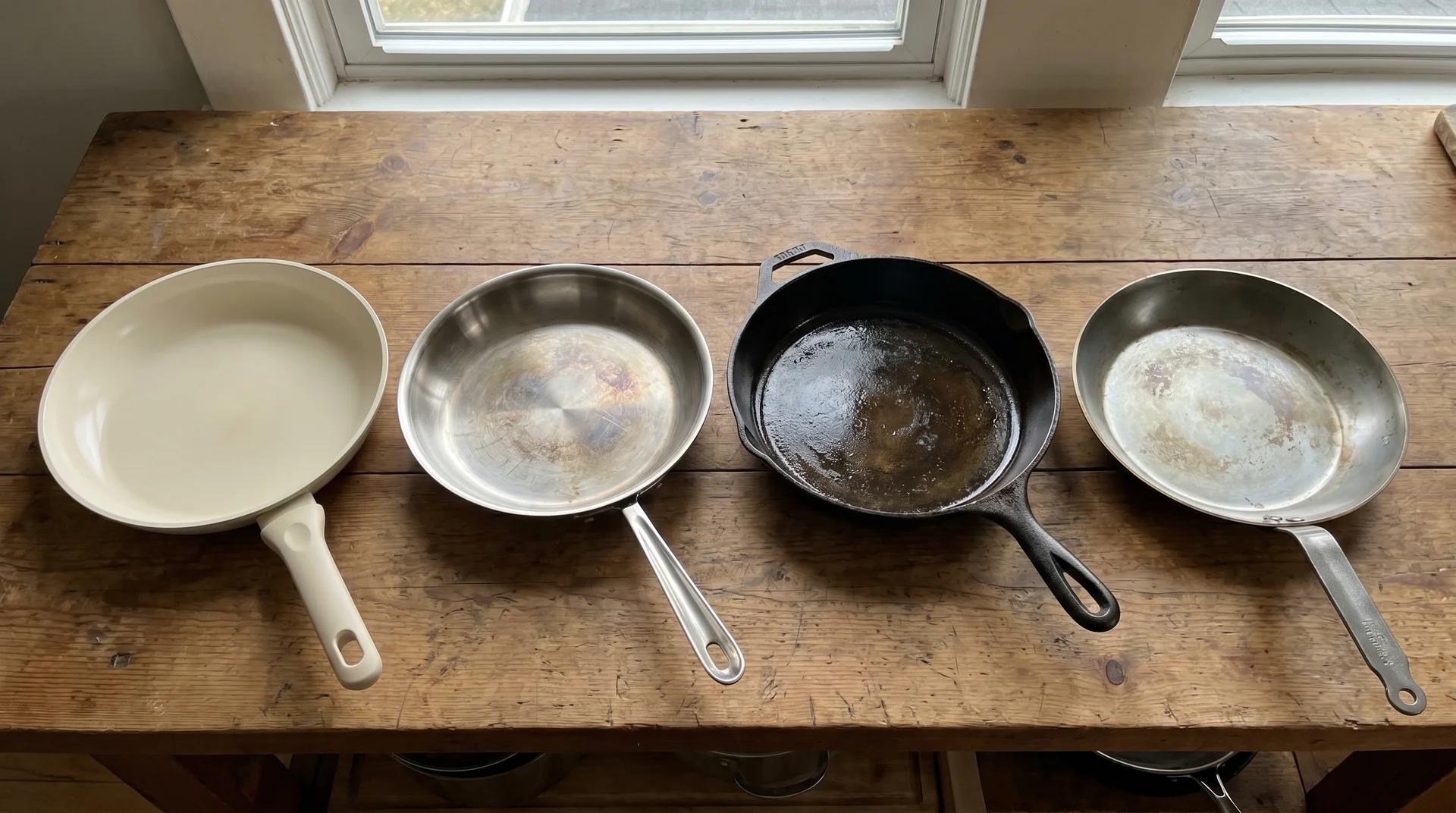
Stainless steel, cast iron, and carbon steel solve most of ceramic cookware’s durability limitations, at the cost of a higher technique threshold and, in some cases, more active maintenance.
| Ceramic-Coated | Stainless Steel | Cast Iron | Carbon Steel | |
|---|---|---|---|---|
| Nonstick when new | High | Low without technique | High when seasoned | High when seasoned |
| Durability | 1–3 years (coating) | Decades | Decades | Decades |
| High-heat capability | Limited (~450°F) | Excellent | Excellent | Excellent |
| Coating degradation risk | Yes | None | None | None |
| Maintenance required | Low | Low to moderate | Moderate | Moderate |
None of these alternatives is more virtuous than ceramic. They’re different tradeoffs, and which tradeoff makes sense depends on what you’re actually cooking and how much technique you’re willing to apply.
The Bottom Line on Ceramic Cookware Safety
Ceramic cookware is safe. That answer holds when the coating is intact, when the pan stays below 450°F, and when it’s maintained without the habits that accelerate degradation: metal utensils, aerosol sprays, dishwasher use, and sustained high heat.
The safety question and the durability question are the same conversation, and the industry has no particular interest in making that connection obvious.
A ceramic pan from a manufacturer that provides third-party PFAS testing is a meaningfully different product from one that prints “PFAS-free” on the box without documentation. That distinction is worth applying before you buy.
If ceramic cookware’s durability limitations concern you, stainless steel, cast iron, and carbon steel solve the longevity problem at the cost of a higher technique threshold. None of those materials carries coating degradation as a variable.
Their safety profiles are settled, and their lifespan is measured in decades rather than years.