

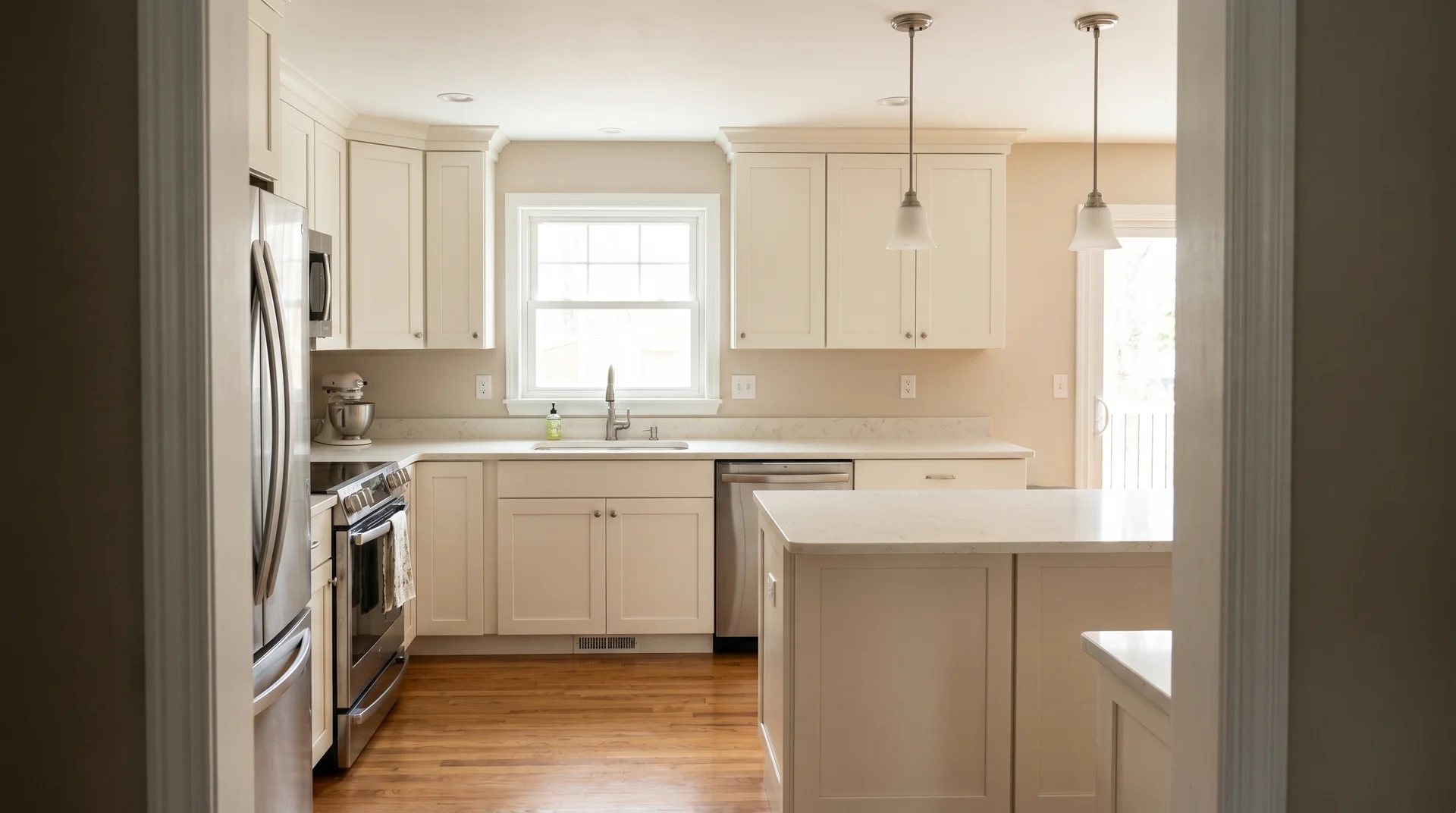
Three budget tiers cover most kitchen remodels.
- The first is $15,000 to $20,000 for a cosmetic refresh.
- The second is $25,000 to $45,000 for a real transformation.
- The third is $45,000 to $60,000 for a full replacement with no structural changes.
Which tier you’re in matters. What matters more is where your money lands within it.
I’ve overseen more than 220 mid-budget kitchen renovations. The kitchens that look most deliberate are rarely the most expensive ones.
They’re the ones where someone chose a clear direction before a single material was ordered.
What Kitchen Remodel Costs Look Like in 2026

Most kitchen remodels in the US fall between $14,000 and $42,000.
That’s the range from Angi and HomeAdvisor’s national cost database, with an average of roughly $27,000. It gives you a starting point for budgeting, not a finished picture of what your project will cost, because that depends on your local contractors as well.
The National Kitchen and Bath Association tracks a different scale of projects in its 2025 Kitchen Trends Study. Their average for a medium kitchen renovation is $71,159, materials and labor together.
That figure includes projects with custom elements and significant scope. Most homeowners renovating a standard home kitchen are working well below it.
There’s one 2026 cost factor worth noting before you lock in a number.
Tariffs on imported cabinets are currently at 25%, with a potential increase to 50% planned for January 2027.
Domestic cabinet brands haven’t dropped prices to compensate. The gap between imported and domestic lines has just gotten smaller.
The Three Budget Tiers
A cosmetic refresh, a real transformation, and a full replacement are three different projects, each with a different scope and a different set of decisions.
The table below shows what each tier typically includes, based on national contractor data from 2025 and 2026.
| Budget Tier | Typical Range | What’s Usually Included | What’s Not |
|---|---|---|---|
| Cosmetic Refresh | $12,000-$20,000 | Cabinet painting or refacing, new hardware, countertop replacement, updated lighting | New cabinets, appliances, flooring, and layout changes |
| Mid-Range Transformation | $20,000-$45,000 | Semi-custom cabinets, stone countertop, backsplash, mid-range appliances, and flooring | Custom cabinetry, structural changes, and premium appliance packages |
| Full Replacement | $45,000-$75,000+ | Custom cabinetry, premium countertops, full appliance package, complete lighting redesign | Structural changes, moving walls, and room additions |
Please note that none of these tiers assumes you’re moving plumbing, knocking down a wall, or adding square footage.
Those projects sit in a different cost category entirely, with different trades, different timelines, and different permitting requirements.
Before and After Kitchen Remodel Cost: Three Real Budget Scenarios
This is where cost ranges become real kitchens. Mostly costing shows you what things cost in categories: cabinets, countertops, and appliances.
What they don’t show you is what those choices add up to visually. Two kitchens at similar prices can look completely different depending on how the money was allocated.
What a $15,000–$20,000 Kitchen Remodel Looks Like
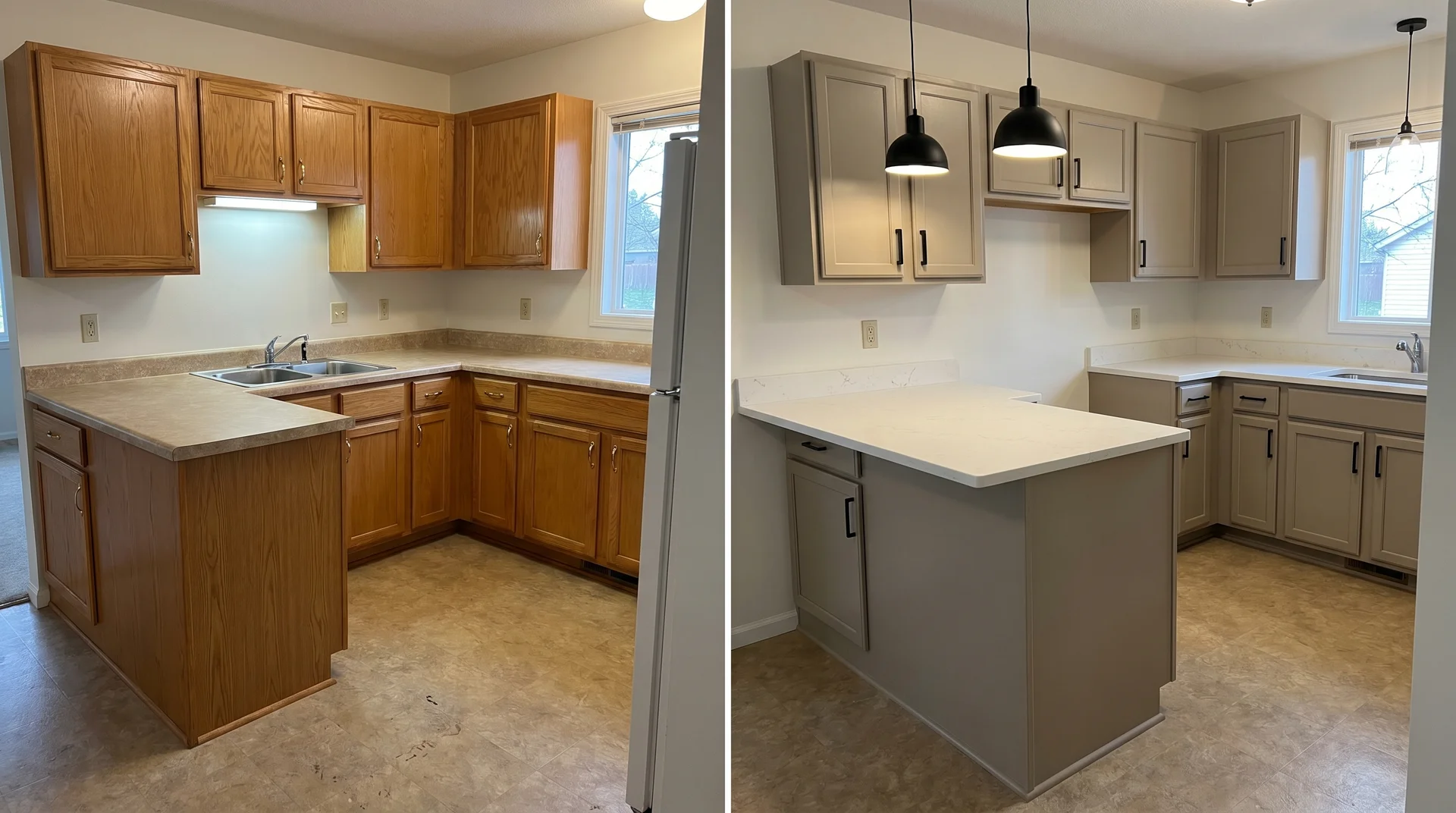
With this budget, you can produce a genuinely different kitchen. One element has to lead, though!
Before: Original oak-stained cabinets, laminate countertops in a dated pattern, a fluorescent strip under the upper cabinets, and vinyl flooring from the 1990s. The kitchen works. It just looks like it was last updated when dial-up was still impressive.
After: Painted cabinets in a single warm neutral, a quartz countertop as the visual anchor, pendant lighting over the peninsula, and new hardware throughout. The floor stays. The room reads as completely new.
The countertop is doing most of the work in this scenario. A clean quartz run at $3,500 to $5,500 changes how the entire room reads. That’s especially true when the cabinets are a quiet backdrop rather than a competing statement.
| Component | Estimated Cost Range |
|---|---|
| Cabinet painting (full kitchen) | $1,500–$3,500 |
| Quartz countertop (existing footprint) | $3,500–$5,500 |
| Pendant or under-cabinet lighting | $800–$1,500 |
| Hardware (pulls and knobs) | $300–$600 |
| Simple tile backsplash | $1,200–$2,500 |
| Labor (installation) | $4,000–$6,000 |
| Contingency (15%) | $1,700–$3,000 |
| Total Estimate | $13,000–$22,600 |
What this tier cannot do: new cabinets, a full appliance replacement, updated flooring throughout, and a statement backsplash all at once. Trying to hit all of those at $18,000 means none of them land properly.
The execution requirement at this tier is keeping the existing layout intact. Moving the sink, even slightly, means hiring a plumber. A plumber changes the math on a $15,000 project in a way that’s hard to recover from.
What a $25,000–$35,000 Kitchen Remodel Looks Like
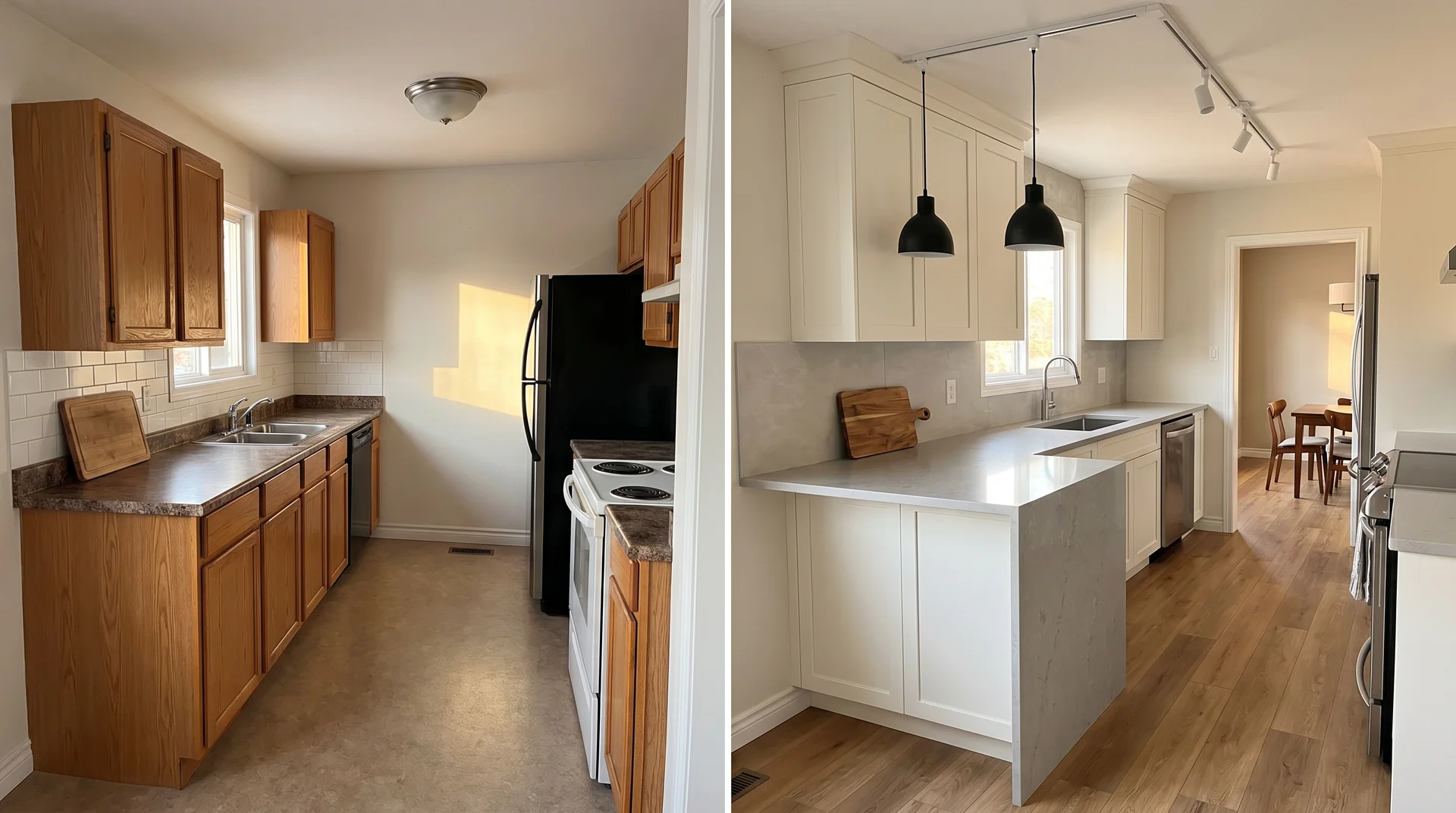
This is the tier where real transformation is possible. It’s also the tier where most homeowners lose money by trying to do too much.
Before: Flat-front builder-grade cabinets, a laminate countertop, a basic tile backsplash that was there when the house was purchased, and standard overhead lighting. Everything functional. Nothing interesting.
After: Semi-custom Shaker cabinets in a warm white, a quartz countertop with a waterfall edge on one side, new mid-range appliances, and pendant lighting above the island. LVP flooring ties the kitchen to the adjacent dining area.
The cabinets are the hero here, and everything else responds to them. The backsplash is a simple, large-format tile, not a statement. That restraint is what makes the cabinets read as a deliberate choice rather than background noise.
| Component | Estimated Cost Range |
|---|---|
| Semi-custom Shaker cabinets | $8,000–$14,000 |
| Quartz countertop | $4,000–$7,000 |
| Large-format tile backsplash | $1,500–$3,000 |
| Mid-range appliance package | $4,000–$7,000 |
| Pendant and recessed lighting | $1,000–$2,500 |
| LVP flooring | $2,000–$4,000 |
| Labor (full installation) | $6,000–$10,000 |
| Contingency (15%) | $4,000–$7,000 |
| Total Estimate | $30,500–$54,500 |
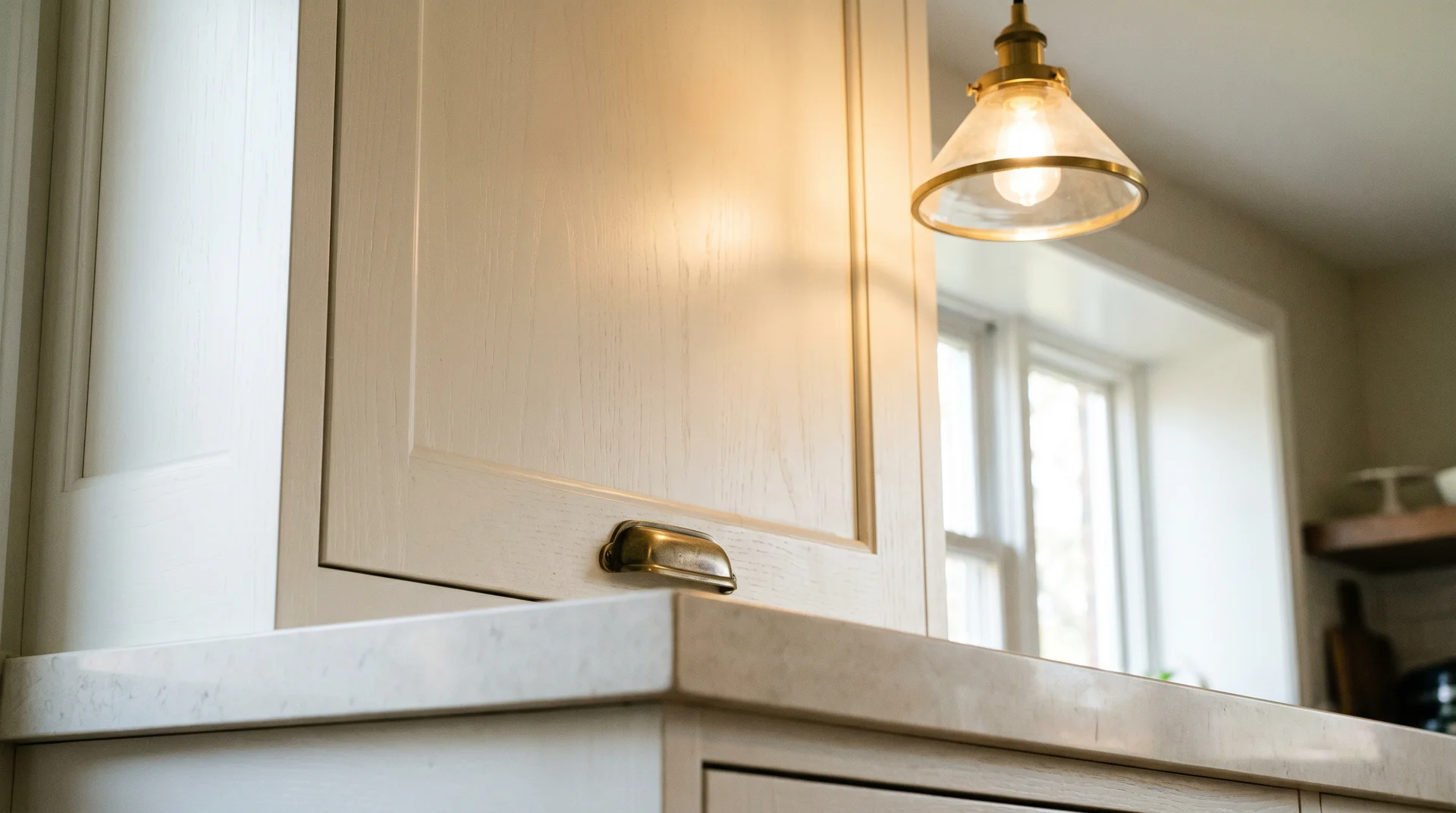
I’ve watched homeowners in this budget tier try to add patterned cement tile, custom open shelving, brass hardware, and a statement island all at once. Every individual choice is beautiful. Together, they compete with each other, and the kitchen ends up looking busy in a way that’s hard to diagnose.
It doesn’t feel cheap. It just doesn’t feel finished. That’s what over-specification looks like when you’re up close to it.
Warm white Shaker cabinets may not be an original choice. It remains the right one at this budget tier, because it gives you a clean background that holds every other decision without competing with it.
What a $45,000–$60,000 Kitchen Remodel Looks Like
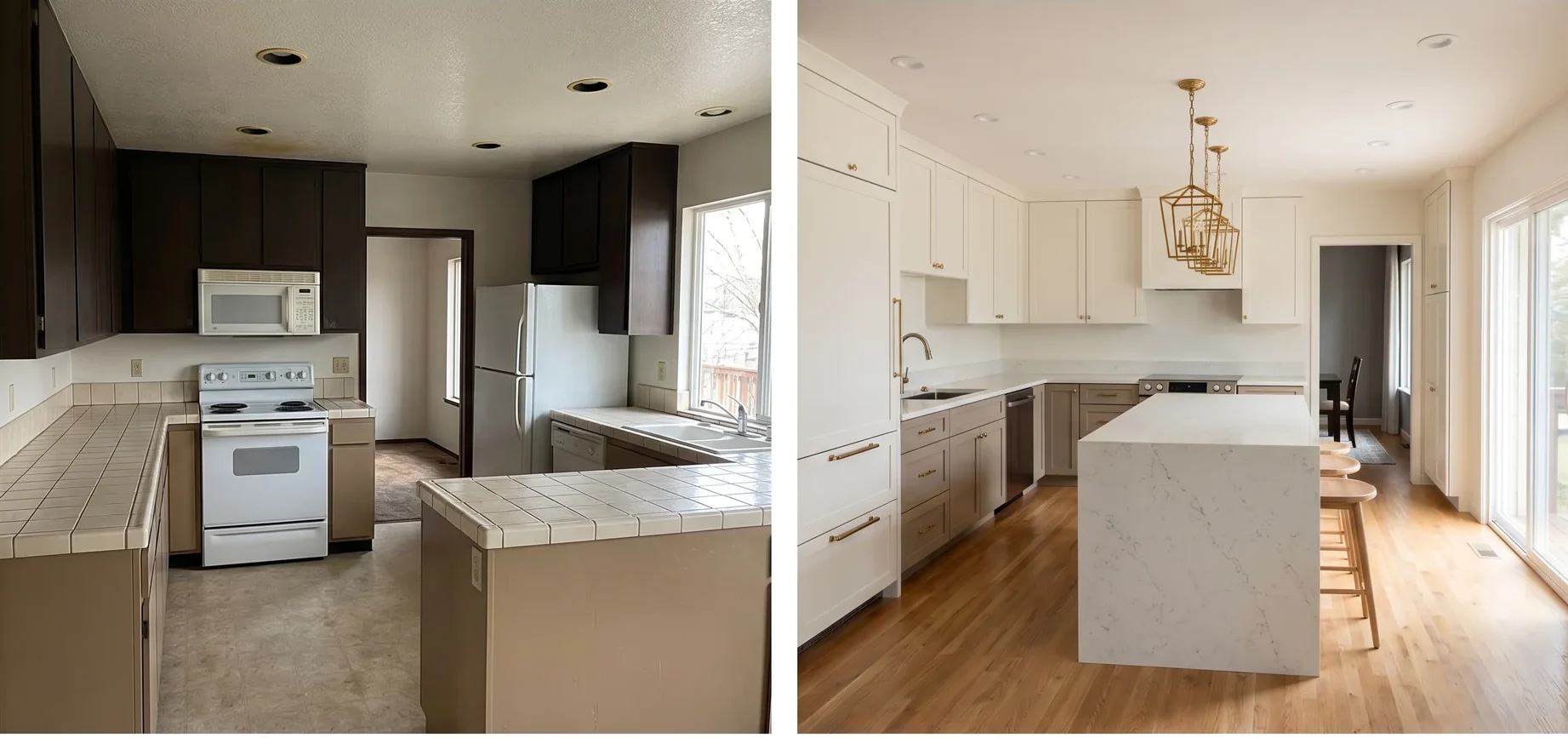
At this budget, you can replace everything essentially in the kitchen without touching the walls.
You’re standing in the kitchen, looking at dark upper cabinets and a dated tile countertop. Grout lines run through every visual field. The appliances came with the house. The room works. It has never felt like it belongs to you.
The space has potential. It’s just been invisible for ten years.
After: Custom two-tone cabinetry, a quartz countertop running the full perimeter, and integrated appliances. Hardwood flooring continues from the adjacent room. Pendant lighting on dimmers sits above an island that finally has room to function.
This tier gives you room to make multiple strong decisions. One principle still applies: every kitchen needs one dominant visual statement, and everything else responds to it. Here, the island is the visual lead. The perimeter cabinetry, the countertop, and the lighting exist to support that one choice.
What this tier does not include: moving walls, changing the room’s footprint, or adding square footage. Those are structural changes. They require a different contractor conversation, different permits, and a different budget category.
The execution requirement at this tier is getting the cabinet spec right before anything else is ordered.
Custom cabinets carry lead times of eight to fourteen weeks. They set every other dimension in the room. Changing the spec after fabrication starts is expensive in a way that isn’t easy to recover from.
How Much Should a 10×10 Kitchen Remodel Cost?
A 10×10 kitchen remodel costs between $15,000 and $45,000 for most mid-range projects.
It’s also the benchmark most kitchen renovation cost guides use when they publish national averages.
A 10×10 kitchen at $15,000 and a 10×10 kitchen at $40,000 are not the same project.
Why 10×10 Is the Industry Pricing Benchmark
10×10 refers to a 100-square-foot kitchen layout. It’s the measurement cabinet manufacturers, retailers, and contractors use as a standard base unit for pricing.
When a cabinet company quotes your kitchen, they’re typically starting from a 10×10 layout. That means ten linear feet of base cabinets and ten linear feet of upper cabinets arranged in an L.
It’s a standardized starting point, the same way a twin mattress is a standardized size, even though most bedrooms aren’t built around it.
Most real kitchens aren’t exactly 10×10. The benchmark is a comparison tool, not a measurement you need to match.
If your kitchen is 8×12 or 12×14, use the per-linear-foot breakdown to adjust the estimate for your actual layout.
10×10 Cost Ranges by Tier (2026)
At $15,000 to $18,000, you’re buying a functional update. At $25,000 to $35,000, you’re buying a transformation.
Cost per square foot for a 10×10 kitchen typically runs $150 to $450, depending on materials and the local labor market. Urban and coastal markets typically add 20 to 30 percent to these figures.
| Scope | Cost Range | What’s Included | What’s Not |
|---|---|---|---|
| Budget | $12,000–$18,000 | Stock cabinets, laminate countertop, basic lighting, hardware | New appliances, stone countertop, flooring, and layout changes |
| Mid-Range | $20,000–$35,000 | Semi-custom cabinets, quartz countertop, mid-range appliances, backsplash | Flooring often separate, custom features, and structural changes |
| High-End | $40,000–$65,000+ | Custom cabinets, stone countertop, premium appliances, full finish package | Structural changes, room additions, and moving plumbing |
One 2026-specific note worth planning around: a tariff on imported cabinets raised prices for many stock and semi-custom lines earlier this year.
Domestic manufacturers have not significantly undercut those prices. If you’re comparing bids that reference imported brands, ask your contractor whether their pricing reflects current lead times.
Inventory bought ahead of the tariff increase is now mostly depleted.
The One Decision That Controls Your Entire Budget
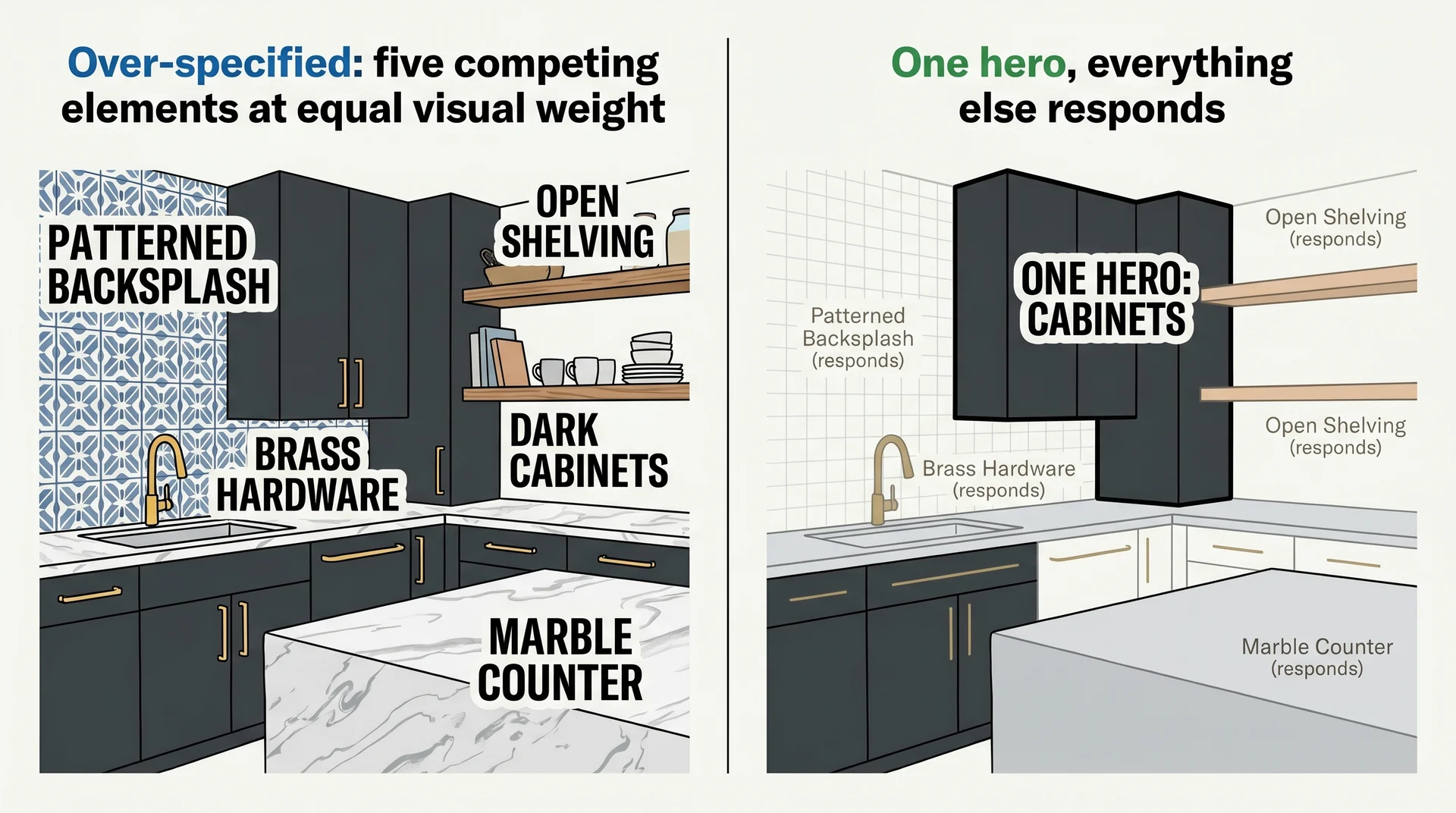
The most consequential budget decision is where your money leads, not how much there is.
A focused $18,000 kitchen beats an unfocused $28,000 kitchen almost every time. I’ve seen it happen in project after project.
I call this the one-hero rule. Every kitchen needs one dominant visual statement, and everything else submits to it. I built the rule from a $6,000 mistake: a kitchen I over-specified early in my career. Patterned backsplash, brass hardware, marble counters, dark cabinets, and open shelving all competed at equal volume.
My client cried at the reveal. Not happy tears. I redesigned the kitchen at my own cost, and the framework I built from that experience has shaped every project since.
Cabinets First
Cabinets cover more visual real estate than anything else in the room. They are the decision that everything else responds to.
The standard guidance is to allocate 30 to 40 percent of your kitchen renovation budget to cabinetry. Most people hear that rule and nod, then ignore it when the countertop sample catches their eye.
The rule is correct. Here’s why it’s correct.
Stand at the entrance to your kitchen. Everything visible from that position is mostly the cabinet. The countertop is a horizontal line. The backsplash is the strip between.
If the cabinets are flat, cheap-looking, or the wrong proportion for the room, no countertop will fix it. If the cabinets are strong, everything else can be restrained, and the room will look considered.
Follow these rules:
- Decide on your cabinet spec before you look at countertop or backsplash samples.
- Choose hardware only after the cabinet color and door style are locked in.
- Let the countertop respond to the cabinets, not the other way around.
- Pick one hardware finish. Matte black and unlacquered brass are both strong choices. They are not strong choices together.
I’ve watched homeowners reverse this sequence repeatedly. They fall in love with a countertop, order the cabinets to match it, and realize the cabinets aren’t strong enough to anchor the room.
When to Reface and When to Replace
Reface when the cabinet boxes are solid, and the layout works. Replace when either of those is not true.
Cabinet refacing means putting new doors, drawer fronts, and veneer on your existing cabinet boxes. It costs roughly $4,000 to $9,000 for a standard kitchen. Full semi-custom replacement runs $8,000 to $20,000 or more. The savings are real and worth pursuing, but only when the conditions are right.
Refacing only makes sense when two things are true:
- First, the existing cabinet boxes need to be structurally sound, with no warping, water damage, or failing drawer joints.
- Second, the layout needs to work for how you actually use the kitchen.
Signs that full replacement is the better call:
- Cabinet boxes show warping, delamination, or soft spots from water exposure
- Drawer slides are failing, and the boxes are no longer square
- The layout doesn’t serve how you cook or move through the space
- You want to add, remove, or relocate cabinets
If you’ve been fighting the layout for years, refacing gives you a prettier version of the same problem. Full replacement is the only way to change where things go.
Have your contractor open every cabinet door, check the box condition, and give you a written assessment. A refacing quote built on a visual inspection only is not a reliable quote.
The Costs Nobody Warns You About Before Demo Day
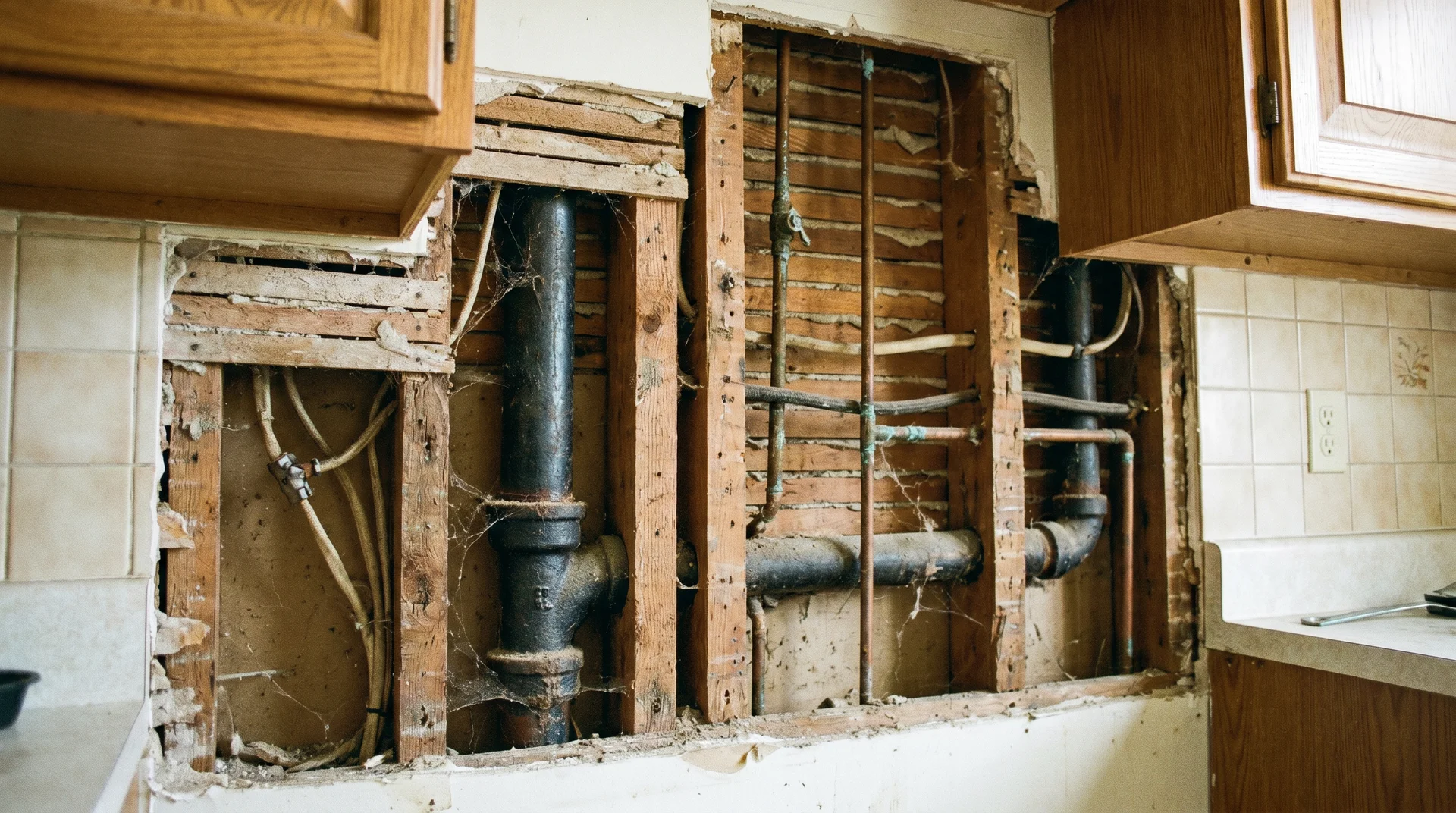
Every kitchen remodel has a visible budget and a hidden one.
The visible budget is the one you planned: cabinets, countertops, appliances, and labor. The hidden one opens up once demo starts.
I can’t tell you exactly what’s behind your walls. Neither can your contractor until they open them. What you can do is plan for what typically shows up.
Moving the Layout Costs More Than Everything Else Combined
If you want to move your sink, your island connection, or your stove, you are not doing a cosmetic remodel anymore.
Changing the layout means:
- moving plumbing, which means a licensed plumber
- Often means upgrading the electrical system to handle new appliance placement. In most jurisdictions, it means permits.
- If your stove runs on gas, moving it requires a licensed gas fitter. That’s a separate trade from standard plumbing and adds another line item.
Typical add-on costs when layout changes are involved:
- Plumbing relocation: $1,500 to $5,000, depending on distance and local rates
- Electrical upgrades for new appliance positioning: $800 to $3,500
- Building permits: $450 to $2,400, depending on municipality and scope
- Gas line relocation (if applicable): $500 to $2,500, depending on complexity
- Additional labor and project time: adds one to three weeks to the timeline in most cases
That’s $3,000 to $13,000 before a single cabinet is hung. Keep the existing footprint, and that money stays in the project.
My honest opinion on layout changes: If the layout is genuinely making the kitchen difficult to use, change it. If you’re considering moving the sink primarily because the island would photograph better, think hard before adding that cost to a mid-range budget.
The 15% Contingency Rule
Budget 15 to 20 percent contingency on a newer home. On a home built before 1980, budget 20 to 25 percent.
Older homes carry a higher risk behind the walls. Common findings during kitchen demo include:
- Outdated knob-and-tube or aluminum wiring that requires a panel upgrade before the kitchen can proceed
- Galvanized plumbing that is corroded from the inside and needs full replacement to pass inspection
- Subfloor damage from years of minor leaks under the sink or dishwasher, discovered only after the floor covering comes up
- Asbestos in old vinyl floor tile or pipe insulation. In homes built before 1980, request a professional asbestos test before any demo work begins. Abatement is required before contractors can proceed, and it adds a high cost.
None of these findings is unusual. A good contractor will tell you what’s likely before demo starts, based on the age and construction type of your home. They still can’t confirm what’s there until the walls are open.
Permits are worth a separate note. Skipping them to save $800 is a false economy. Fine structures for unpermitted work vary widely by jurisdiction but can be significant.
More practically, unpermitted work creates complications at resale and can affect your homeowner’s insurance coverage.
Does a Kitchen Remodel Increase Home Value?
Yes, and the size of the return depends heavily on how much you spend.
According to the 2025 Zonda Cost vs. Value Report, which tracks remodeling returns across 119 US markets, a minor kitchen remodel returns an average of 113 percent nationally.
That means a focused cosmetic refresh, the kind outlined in the first budget scenario above, adds more value than it costs in most markets.
- A major midrange remodel returns roughly 38 percent of the cost.
- An upscale renovation returns approximately 36 percent.
The gap between spending $28,000 well and spending $85,000 on a full gut renovation is not a small one when you’re calculating what comes back.
That ROI picture changes if you’re staying in the home for ten or more years. A kitchen you use every day is not a pure financial instrument. The personal return on a kitchen that actually works the way you work is real. It doesn’t appear in the Cost vs. Value report.
Also, returns vary by local market and by home price tier. Let me explain, a $45,000 remodel on a $200,000 home will not recover at the same rate as it would on a $600,000 home. Local comparables set the ceiling.
A kitchen upgrade that pushes your home well above nearby comparables is unlikely to recoup that premium at resale. If you’re renovating primarily to sell, that’s worth knowing before you finalize that.
How to Read a Contractor Quote Before You Sign
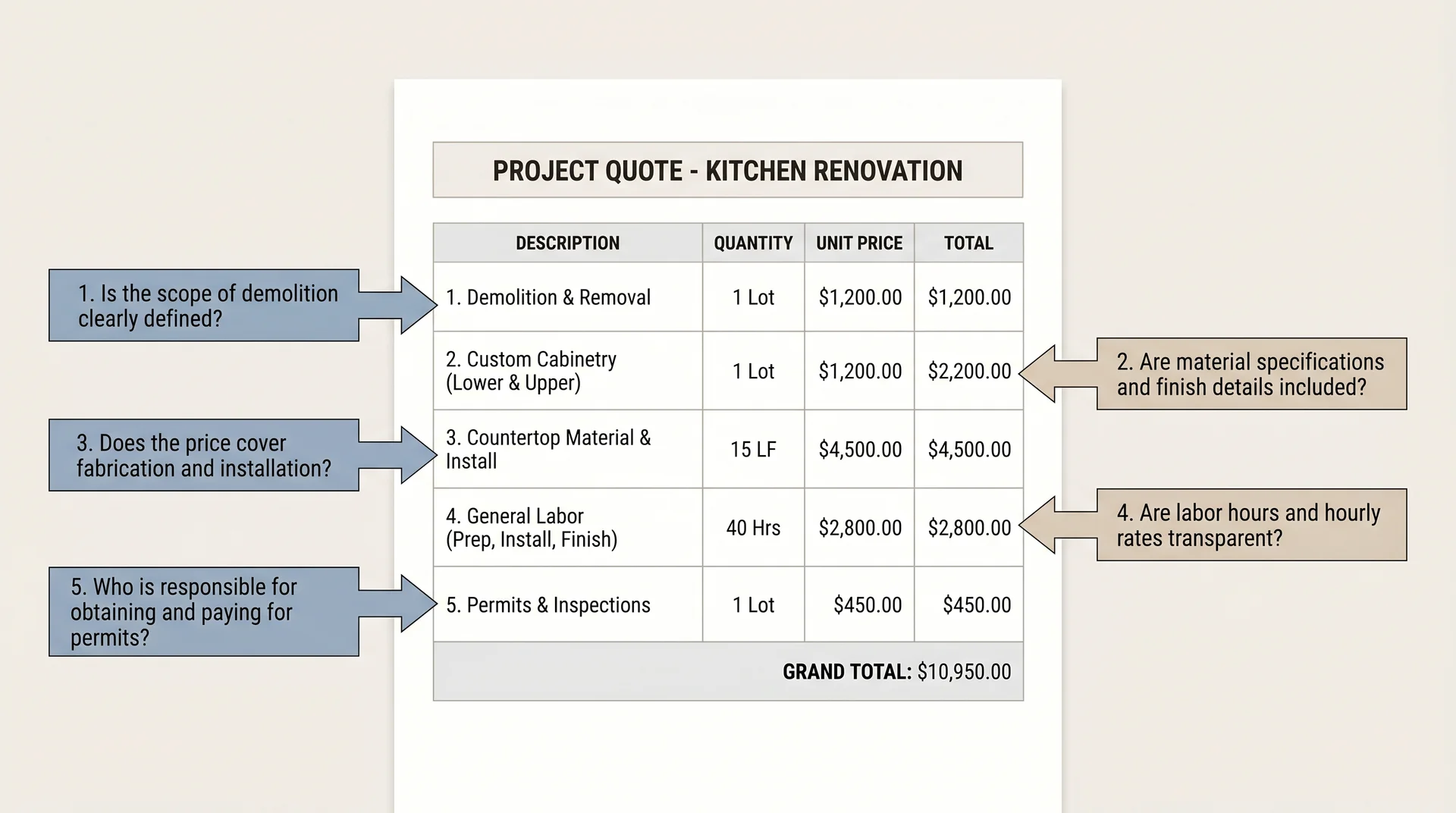
Three quotes for the same kitchen often come back $17,000 apart.
This happens regularly, and it’s rarely because one contractor is trying to overcharge you. It’s because they’re not quoting the same scope. Understanding what’s in each line item is the only way to compare bids accurately.
When you go back to the budget tiers we looked at earlier in this piece, the ranges were wide for a reason. Two contractors can walk through the same kitchen and build quotes with different assumptions about what belongs in the total.
Before you compare three bids, make sure each one answers these questions explicitly:
- Does the quote include demolition and debris removal, or are those charged separately?
- Are appliances included in the number, or is this installation labor only?
- Are countertops and backsplash materials in the quote, or does it cover installation only?
- Are permits included, and who is responsible for pulling them?
- Is there a written change-order process, and what is the payment schedule?
A quote that includes materials will look higher than one that covers labor only. They are not comparable numbers until you know what’s in each one.
On timeline: most mid-range kitchen remodels take six to twelve weeks from demolition to completion. That doesn’t include lead time for cabinets or appliances ordered before work starts. Layout changes and permit delays extend this.
End Note
The middle quote is not automatically the right one. The right quote is the one that most completely describes the scope for a realistic price. Sometimes that’s the lowest bid. Sometimes it’s the highest.