
There are two answers to how long a mini fridge takes to get cold. Which one matters depends on what you’re planning to put inside.
Your fridge will start feeling cold within a few hours of being plugged in. But “feels cold” and “safe for perishables” are not the same thing. There’s a gap between the two, and that gap is exactly where most people make the mistake that puts their food at risk.
Today, I’ll cover both timelines, explain what’s actually happening inside the fridge during each phase, and tell you what to check if nothing seems to be working after a full day.
Do You Have to Wait Before Plugging In a New Mini Fridge?
Whether you can plug in right away or need to wait, has nothing to do with the fridge being new. It has everything to do with how it got to you.
If It Was Shipped or Transported on Its Side
When a fridge travels on its side, the oil inside the compressor moves out of where it belongs and into the cooling lines.
If you plug it in before that oil drains back, the compressor runs without enough lubrication. That either hurts cooling performance right away or leads to early compressor failure, the kind that shows up weeks later and looks unrelated.
The rule is simple: fridge transported upright; wait 30 minutes before plugging in. Fridge transported on its side; stand it upright and wait 12 hours. I’ve seen people skip this and then spend two days convinced their new fridge was broken. It wasn’t. It just needed time.
Setting the Dial Before You Switch It On
Before you plug it in, set the temperature dial to the middle position.
On a 1–7 scale, that’s position 4. On a 1–5 scale, that’s position 3. This gives the compressor a defined target to work toward.
If you leave it at the highest setting, it runs flat out from the start and takes longer to settle into a regular rhythm. Middle position is the better starting point.
How Long Does a Mini Fridge Take to Get Cold?
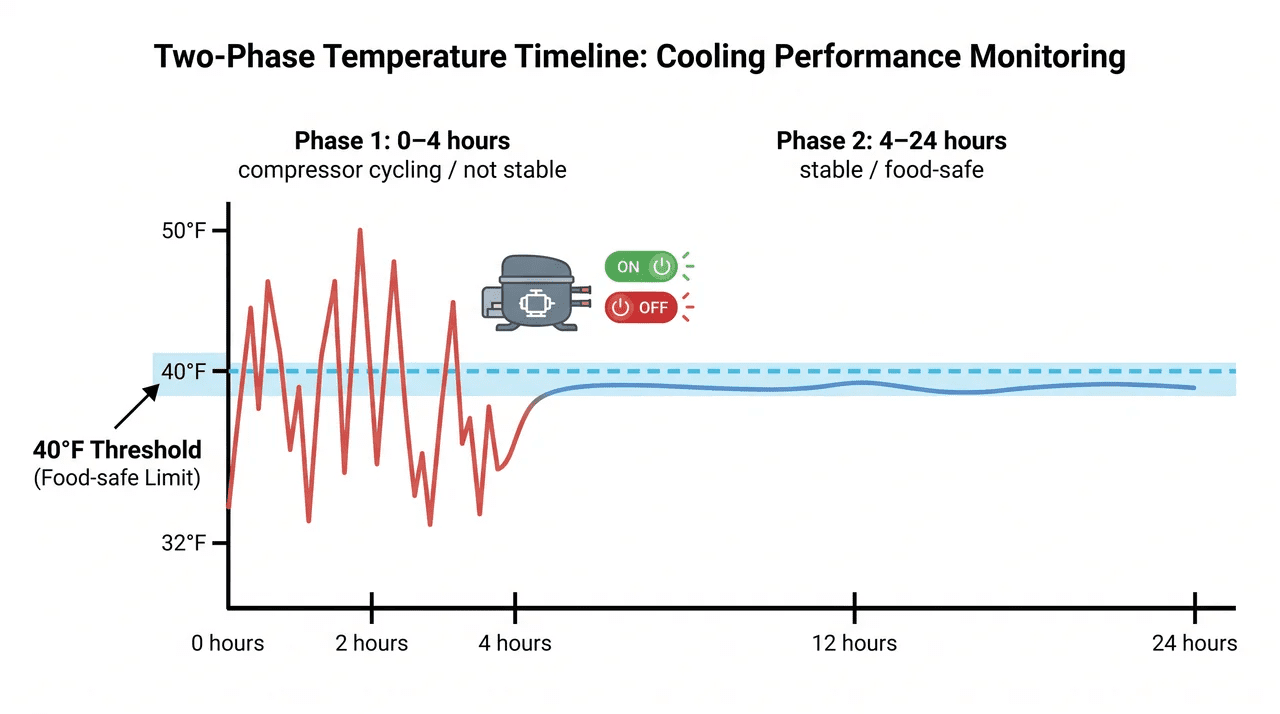
The short answer: it feels cold within 2–4 hours, but it’s not ready for your eggs and leftovers until 12–24 hours have passed. Here’s exactly why those two numbers are so different.
The First 2–4 Hours
When you plug in the fridge, the compressor kicks on and the air inside starts to drop in temperature.
Within a couple of hours, the walls feel cold and a thermometer would read below room temperature. It looks like the fridge is doing its job, and it is. But it’s not done yet.
During this window, the compressor is still cycling unevenly. It runs, hits the target temperature briefly, shuts off, and then the interior warms back up before the next cycle starts.
The temperature inside is still swinging up and down. You might open the door and feel cold air, but ten minutes later the inside could be several degrees warmer.
Hours 4–24: When It Actually Stabilises
This is the phase most people don’t know about, and it’s the one that actually matters for food safety. As the hours pass, the compressor cycles settle into a steady rhythm. The swings get smaller. The interior temperature stops bouncing and starts holding. That’s when the fridge is truly ready.
Here’s what many people don’t know: during those early off-cycles, the interior can climb from 40°F back up to 46°F or higher before the next cycle kicks in. Perishables need consistent exposure to 40°F or below, the FDA’s threshold for safe food storage, not occasional dips to it.
Putting food in too early doesn’t just mean it takes longer to get cold. It means your food is sitting in an unsafe temperature range in cycles you can’t see.
In a moderate room, say, mid-60s to low-70s Fahrenheit, 12 hours is enough. In a warm room or after delivery on a hot day, give it the full 24. The most reliable method isn’t counting hours at all: it’s using a fridge thermometer and only loading food once it reads a steady 40°F or below.
What Makes a Mini Fridge Cool Down Faster or Slower?
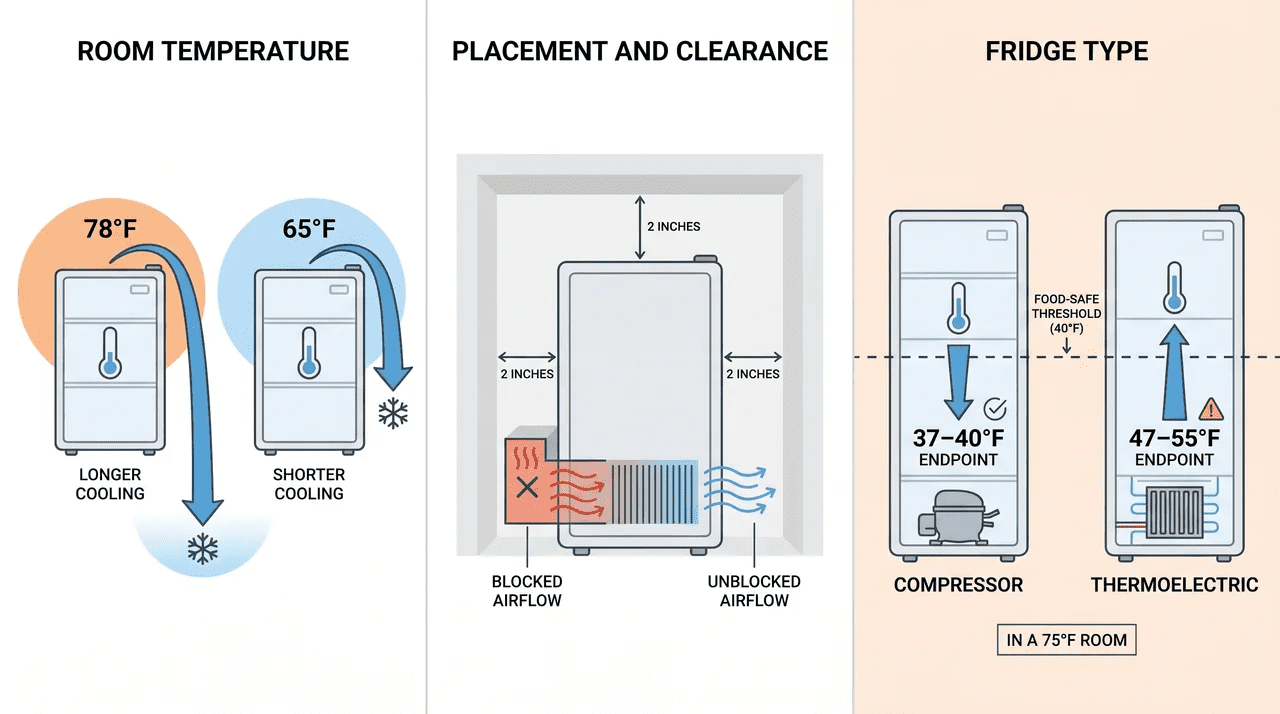 Three things control how quickly your fridge stabilises: the room temperature, where you’ve placed the fridge, and what type of unit it is. Get any of these wrong and the timeline stretches significantly.
Room temperature is the biggest factor. A fridge in a 65°F room has far less work to do than one in a 78°F room. The compressor reaches its target faster simply because the gap between room temperature and target temperature is smaller.
Placement amplifies this. If the back of the unit is pushed flush against a wall or tucked inside a cabinet, the heat the compressor expels has nowhere to go. It builds up behind the unit and forces the compressor to work harder. Keep at least 2 inches of clearance on all sides.
The Water Bottle Advice Gets This Backwards
You’ve probably heard that pre-loading a few bottles of water helps the fridge cool down faster. I want to correct this directly because it’s repeated everywhere and it’s wrong in an important way.
Room-temperature water bottles add thermal load, which means the compressor now has to cool the water too, not just the air. That slows down the initial cool-down, not speeds it up.
What the water bottles actually do is act as thermal mass once the fridge reaches its target temperature. They hold the cold and reduce how far the interior warms up during each compressor-off cycle. They shorten the stabilisation window. That’s genuinely useful, but it’s a different thing from what most people think they’re doing.
Compressor vs. Thermoelectric: This Changes Everything
The type of fridge you have matters more than almost anything else here. Compressor-based mini fridges work the same way a regular fridge does. They can reach and hold 37–40°F regardless of room temperature.
Thermoelectric mini fridges work differently. They cool to roughly 20–28°F below the ambient temperature, and that’s their limit. In a 75°F room, the coolest they’ll ever get is around 47–55°F. That’s above the food-safe threshold of 40°F.
If you have a thermoelectric unit and it never seems to get cold enough, it’s probably not broken. It’s just not designed for food safety in a warm room. Check which type you have before deciding what to store in it.
What If Your Mini Fridge Still Isn’t Getting Cold After 24 Hours?
If your fridge hasn’t cooled down after a full day, there’s almost always a straightforward explanation. Work through these three checks before you assume something is broken.
Check placement first. The back of the unit pressed against a wall blocks heat exhaust and kills cooling efficiency. A tightly packed interior blocks the airflow the fridge needs to circulate cold air. And if the dial is turned to a low number, check the scale; on most mini fridges, a lower number means warmer, not colder. I’ve watched this confuse more people than any other single issue. Confirm which direction on your dial means colder before anything else.
Check the fridge type next. If you have a thermoelectric model and the room is above 75–80°F, not reaching 40°F isn’t a fault. It’s a design ceiling. The fridge is working exactly as it should, it simply isn’t built for perishables in warm conditions.
If neither of those applies, and your fridge is compressor-based, and it still hasn’t cooled after 24–48 hours; the compressor or coolant circuit is likely the problem. Don’t use it for perishables until it’s been serviced or replaced.
Wrapping Up
A mini fridge starts feeling cold within 2–4 hours. It’s ready for perishables after 12–24. How quickly it gets there depends on the setup steps before it was plugged in, where it’s sitting, and what type of unit it is.
If it’s still not cold after a full day, run the three checks; placement, dial setting, and fridge type before assuming anything is wrong with the unit itself. In most cases, one of those three is the answer.
Frequently Asked Questions
How long after plugging in a mini fridge can you put food in it?
Wait at least 4 hours before placing non-perishables inside, and 12–24 hours before adding perishables. The fridge feels cold within a few hours, but interior temperature is still fluctuating during that window. Perishables require a stable temperature at or below 40°F, which takes 12–24 hours for most mini fridges to achieve consistently.
How long does a mini fridge take to get cold after being unplugged?
A mini fridge that was unplugged and left at room temperature follows the same timeline as a new unit: roughly 2–4 hours to begin cooling and 12–24 hours to fully stabilise. If it was moved while unplugged, apply the same transport rules, stand it upright for at least 30 minutes before plugging in, or 12 hours if it was laid on its side.
Does a mini fridge get cold enough to safely store perishables?
Compressor-based mini fridges reach 37–40°F and are safe for perishables when working correctly. Thermoelectric models cool only 20–28°F below room temperature, which may not reach 40°F in a warm room. Check which type you have before storing dairy, raw meat, or leftovers; the type determines the fridge’s safe-use ceiling.
How long does the freezer compartment in a mini fridge take to get cold?
The freezer section typically takes longer than the main compartment, often the full 24 hours to reach 0°F. Because it shares the same compressor as the fridge section, the freezer stabilises only after the main compartment has settled. Wait the full 24 hours before using the freezer for ice or frozen items.