

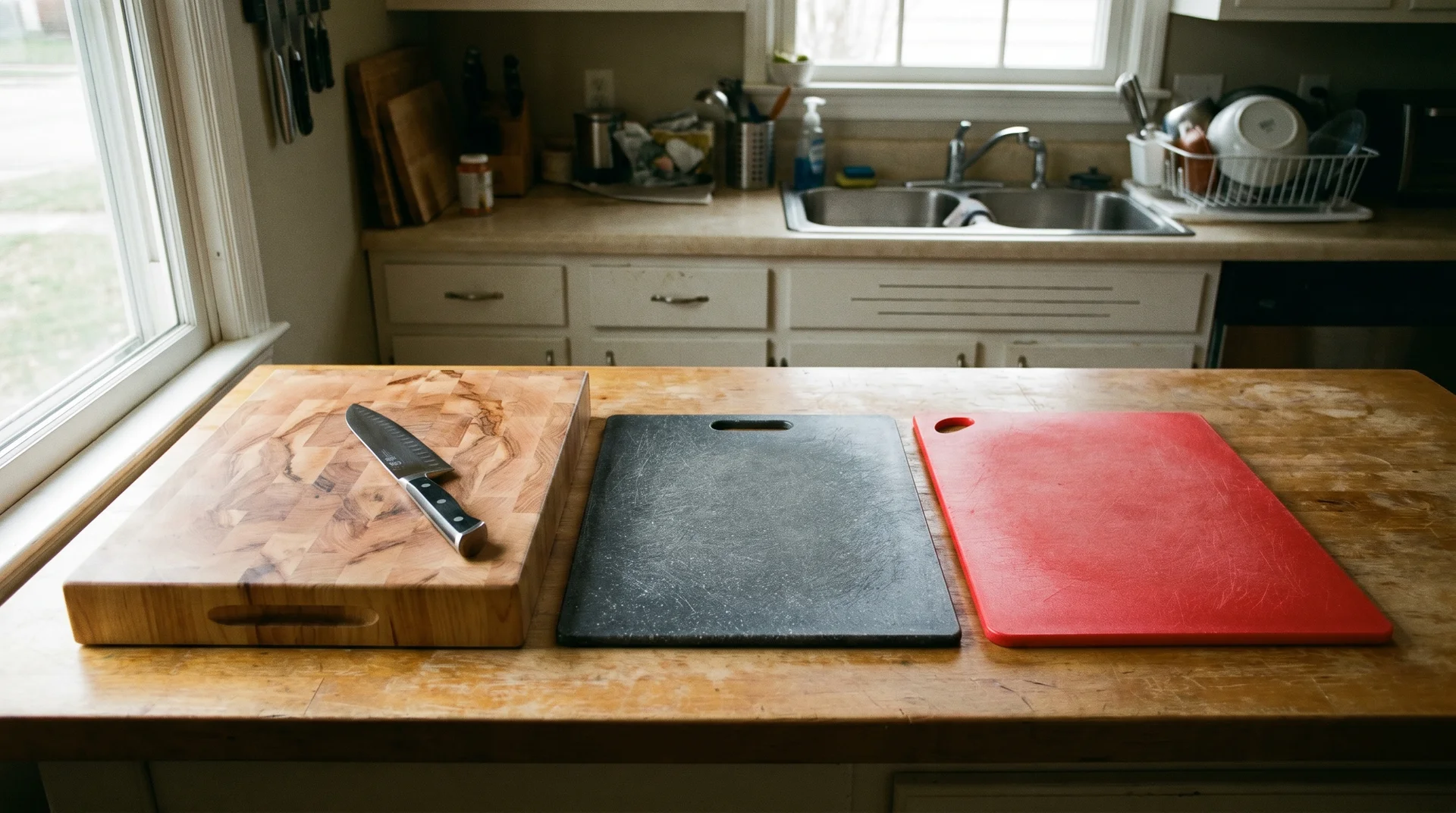
The short answer: an end-grain hardwood board, finished with food-grade mineral oil, is the most defensible choice for most home kitchens. The longer answer is that “non-toxic” is not a property a cutting board either has or doesn’t have permanently.
It’s a condition that changes based on material, maintenance, and how you sanitize it.
This guide covers both. The picks come first, because that’s what most readers need. The material reasoning follows, because buying the right board and then using it wrong doesn’t solve anything.
What “Non-Toxic” Actually Means for a Cutting Board
A non-toxic cutting board does two things:
- It doesn’t introduce chemical contaminants into your food through its material, finish, or adhesive, and
- It can be kept genuinely sanitary through normal home kitchen cleaning.
Those are two separate requirements, and a board can pass the first while failing the second.
That gap is how most “non-toxic” bamboo boards score poorly once you look at the adhesive formulation, and it’s why a well-maintained food-grade composite often outperforms a neglected end-grain board that costs three times as much.
The USDA acknowledges both plastic and wood as acceptable cutting board materials. What the USDA guidance actually emphasizes is the cleaning method and surface condition, not the material category alone.
The PAA question “what is the safest thing to use as a cutting board” is better answered as: the safest material you will actually maintain correctly.
The Best Non-Toxic Cutting Boards
A $30 board matched to how you actually cook is a better answer than a $150 board you’ll use incorrectly. Here’s where each material fits.
These picks are organized by use case and not price.
1. End-Grain Hardwood (Maple or Walnut)
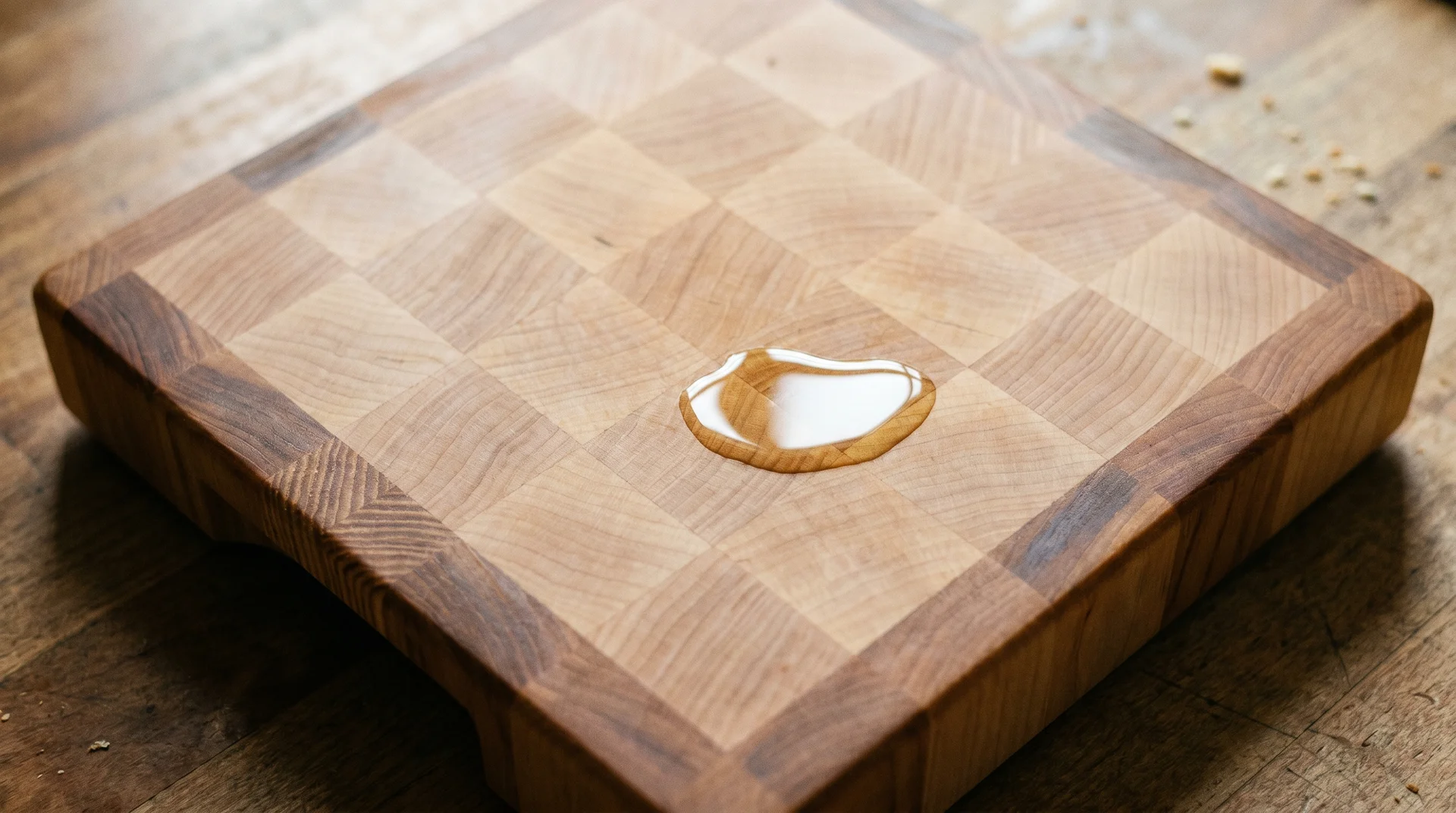
An end-grain hardwood cutting board is the most defensible all-purpose choice for a non-toxic cutting board.
When a knife cuts across end-grain maple or walnut, the wood fibers open briefly and then close around the blade. They don’t carve a permanent groove the way edge-grain does under the same force.
I’ve built end-grain boards from maple and walnut blanks in my own shop, and the difference in how the surface responds to a knife is visible at the material level, not just in a spec sheet.
Research from food microbiologist Dean O. Cliver at the University of California found that bacteria drawn into intact hardwood surfaces die and don’t reliably transfer back to food.
That finding holds on a well-maintained surface with no deep scoring. It does not hold on an abused board with visible knife channels.
The UC Davis research also found that bacteria trapped inside plastic board grooves can survive and multiply, which is what makes surface condition more important than material choice alone.
What to look for: maple, walnut, or cherry (all dense domestic hardwoods), finished with food-grade USP-grade mineral oil.
John Boos produces boards to this standard and labels their finishing oil clearly. Look for boards that carry NSF/ANSI 2 certification, which means the food-contact surface has been evaluated for contamination resistance, not just the material’s chemistry in isolation.
The real-world constraint: end-grain boards warp if they go in the dishwasher or sit wet. They need re-oiling every one to three months, depending on use and climate.
If that maintenance isn’t realistic in your kitchen, read the composite option before deciding.
2. Dedicated HDPE Plastic Board
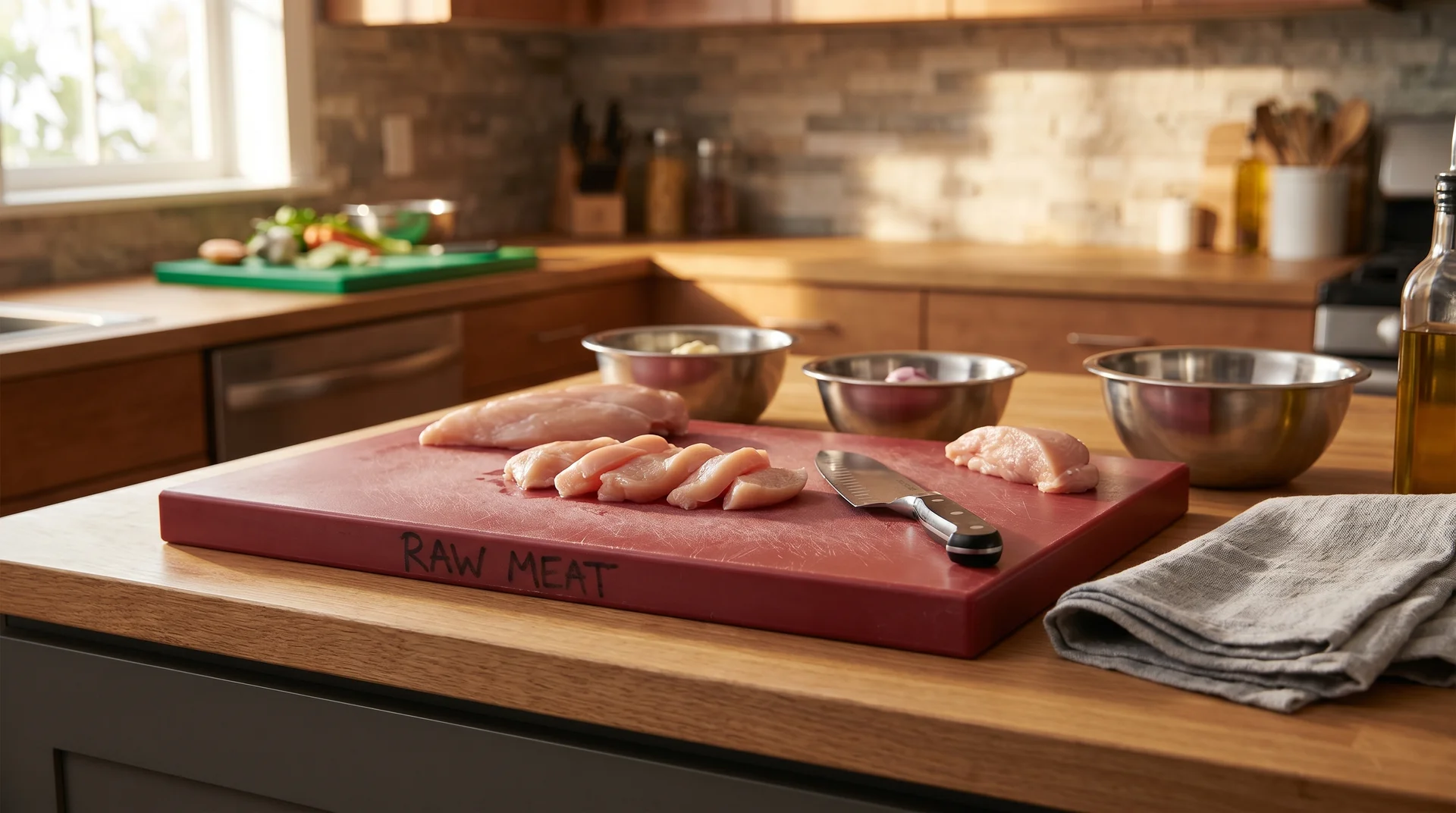
For raw meat and poultry, a dedicated HDPE plastic cutting board used while the surface is still smooth is the correct answer.
USDA food safety guidance recommends separate boards for raw meat and produce. The reason isn’t the board material. It’s a cross-contamination risk from whatever the last thing cut on that surface was.
Color-coded HDPE boards, like red for raw meat, green for produce, and yellow for poultry, are the commercial kitchen standard. That system is the right idea.
I’ll say more below about why it’s the right idea attached to the wrong material assumptions, but for raw meat specifically, the color-coding discipline is the correct call.
Any NSF-certified HDPE board from a restaurant supply brand will do the job here. Replace it when the scoring gets deep.
I’ll give you a specific test for “deep enough” in the maintenance section below.
3. Composite Boards
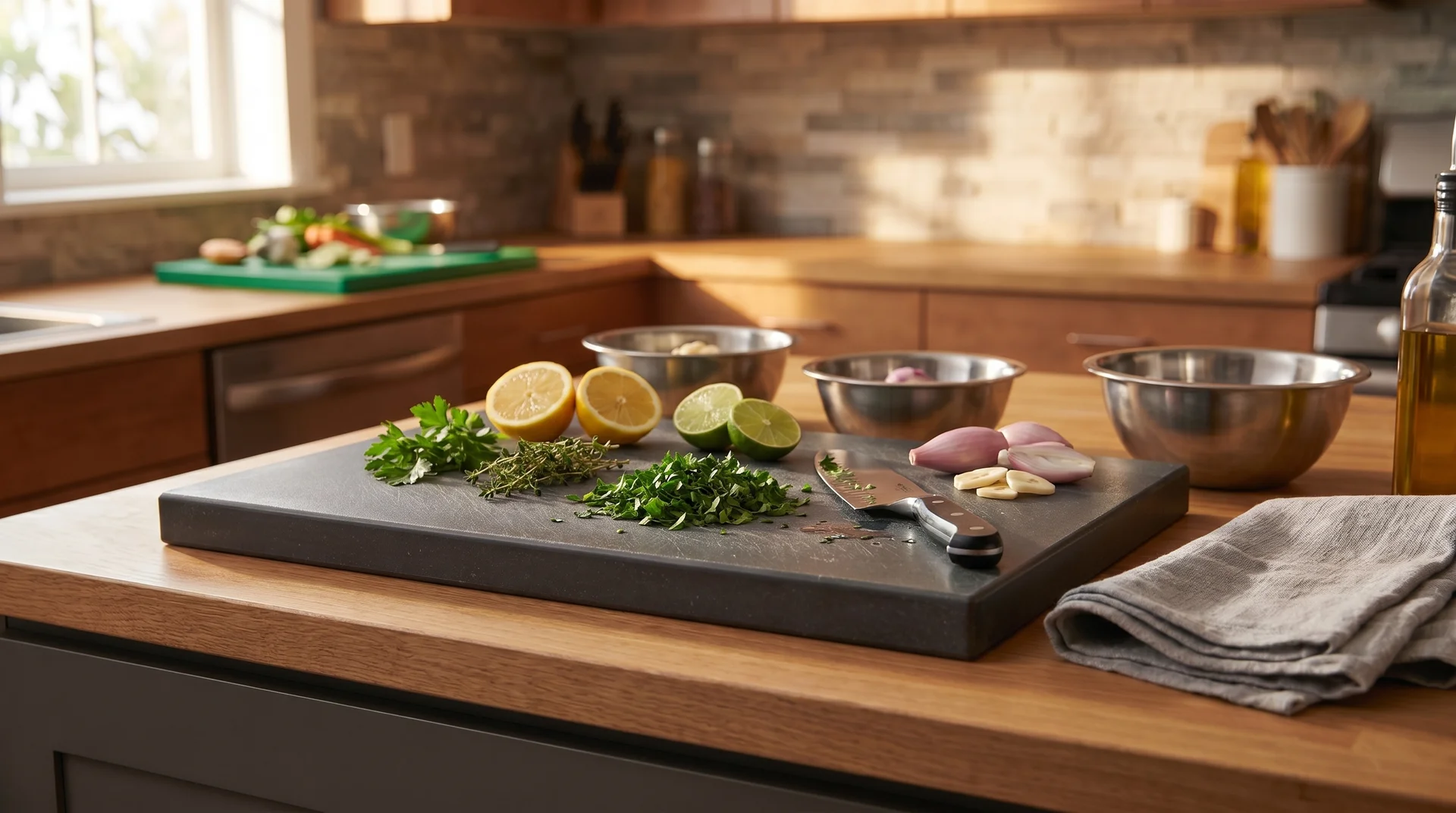
Composite cutting boards made from compressed wood fiber and phenolic resin are the correct answer to this topic.
Epicurean’s Kitchen Series is the most accessible brand in this category. The material is NSF-certified for food contact, dishwasher-safe, free of formaldehyde-based adhesives, resistant to warping, and gentler on knife edges than bamboo.
It’s been used in commercial kitchens for years. The category doesn’t have the marketing budget that bamboo does, which is probably why it’s rarely mentioned in roundups like this one.
Honest limitation: composite boards are not ideal for very heavy cleaver work. They also cost more than a basic plastic board. For most home kitchen prep tasks, they’re a stronger material choice than plastic and require less maintenance than solid wood.
4. Edge-Grain Maple Board
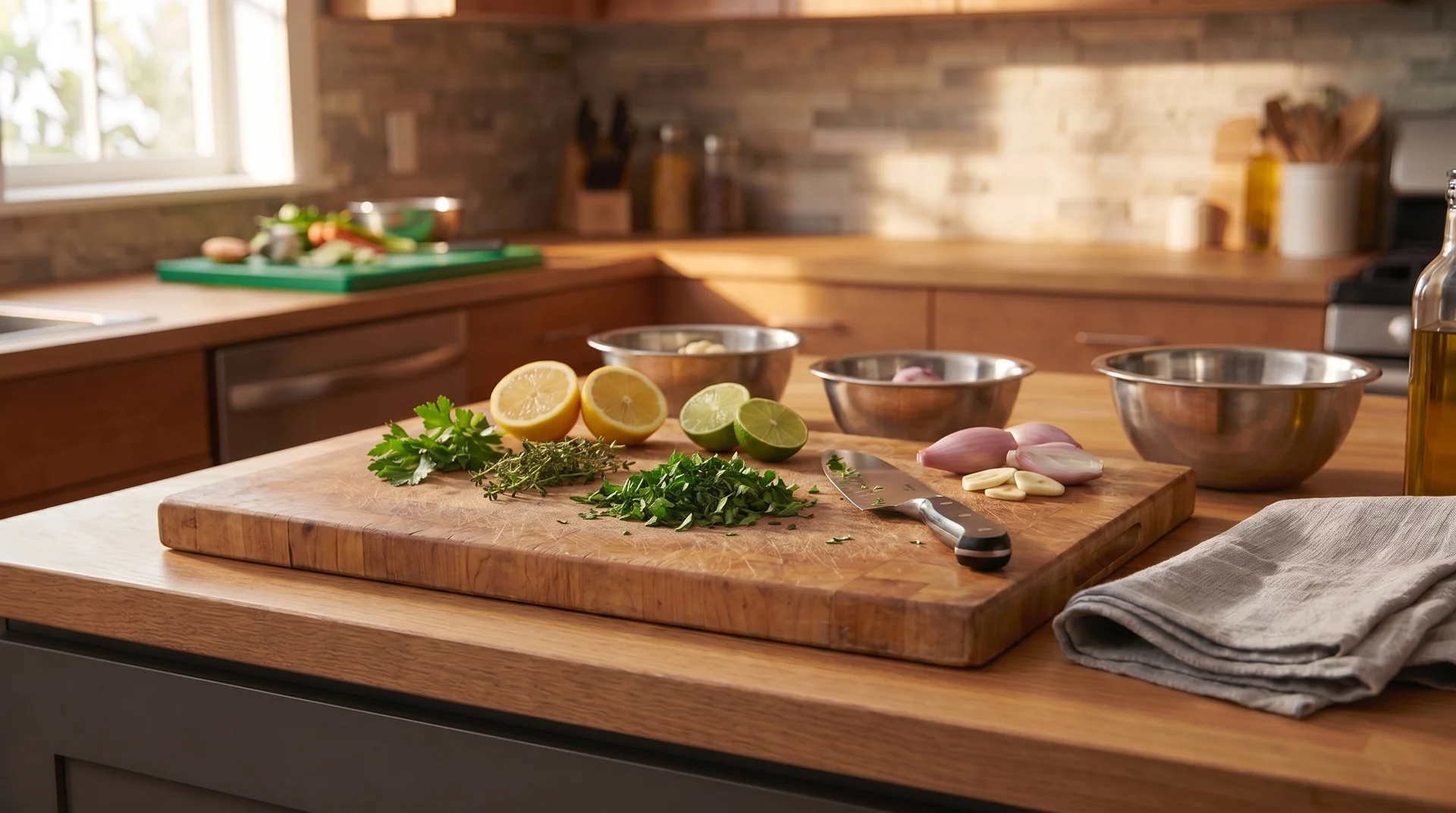
An edge-grain maple cutting board from a restaurant supply company is the most honest budget recommendation.
Edge-grain boards are less self-healing than end-grain and score more readily under sustained use, but they’re safe from a material standpoint and significantly cheaper.
A 12×18-inch maple edge-grain board from Webstaurant Store or any local restaurant supply house costs $15 to $25. That’s a more defensible purchase than a $40 bamboo board with unverified adhesives.
5. Bamboo Board
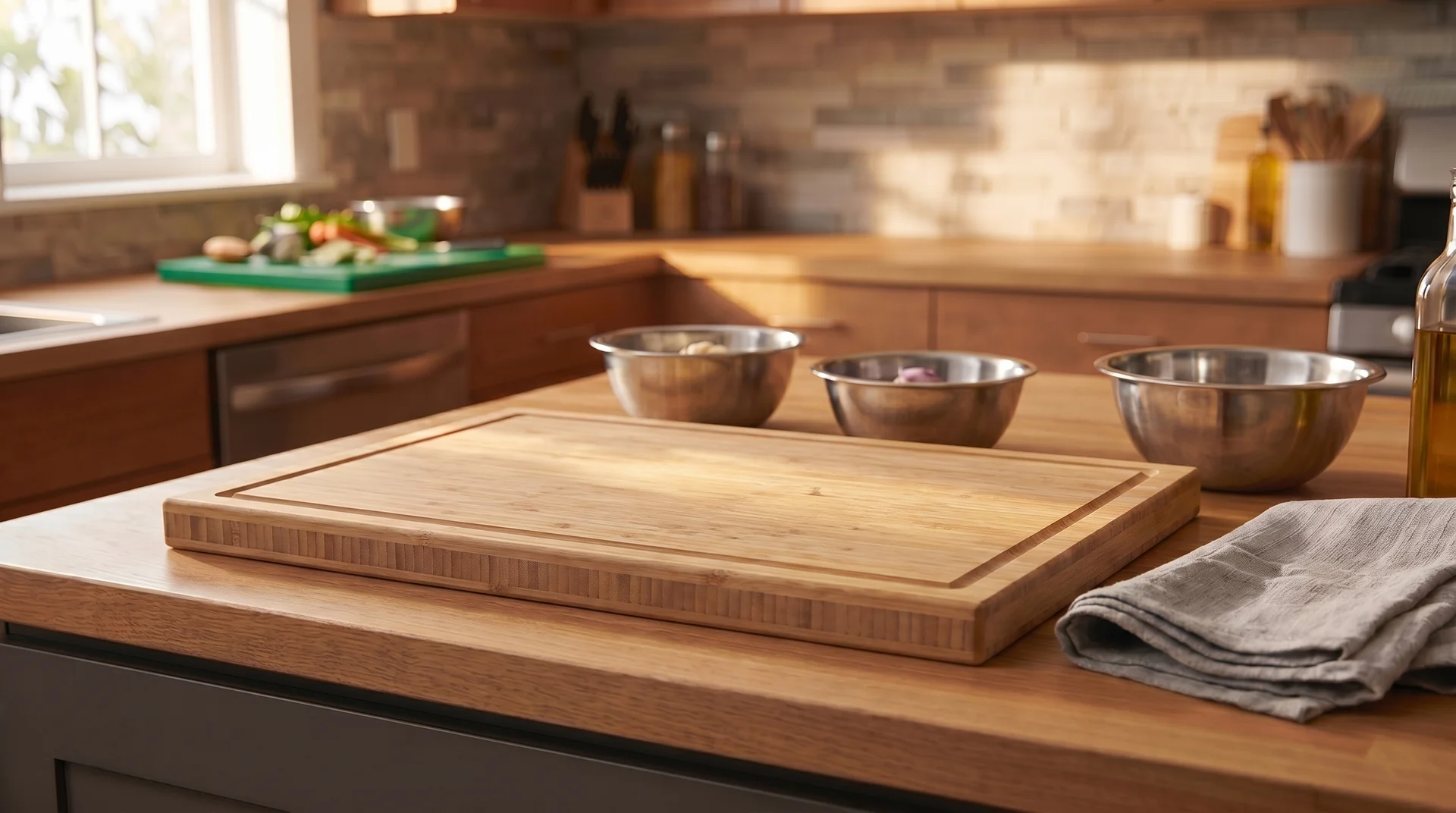
Before buying a bamboo cutting board, find the adhesive specification, that’s where the non-toxicity question actually lives.
Bamboo boards are not solid bamboo. They’re strips glued together. The adhesive in most bamboo boards is urea-formaldehyde resin.
Look for California Air Resources Board (CARB) Phase 2 compliance labeling, or a “formaldehyde-free adhesive” claim with a traceable third-party certification. If the product page says nothing about adhesives, the manufacturer hasn’t thought about it.
I’ll go into the bamboo adhesive question in depth in the material breakdown below, because the marketing around bamboo boards is genuinely misleading.
The Material Breakdown: Safe, Overstated, & Problem
Solid Hardwood: Maple, Walnut, Cherry
Solid hardwood is safe, well-researched, and the subject of more myths than any other cutting board material.
The porosity of a clean, maintained end-grain maple surface is a completely different condition from the porosity of a scored plastic board’s knife grooves. Conflating them produces advice that sounds careful and is actually useless.
The Cliver research at UC Davis specified the mechanism: bacteria on intact hardwood surfaces are drawn into the wood matrix and die in that environment.
They don’t establish biofilm the way they do in plastic grooves, and they don’t reliably transfer back to food surfaces in contact.
That finding applies to hardwoods, not softwoods like pine or cedar, which score too easily. Maple, walnut, and cherry are all appropriate.
Teak is water-resistant due to its natural oil content, which is accurate and useful, but it costs considerably more than maple without a proportional safety advantage.
Note: Many wood boards are sold with instructions to “oil occasionally” without specifying the grade. Food-grade mineral oil is USP-grade petroleum mineral oil that has been refined for incidental food contact.
Standard petroleum mineral oil, aka “mineral oil” on the label, is not the same thing. Most board manufacturers who are paying attention specify food-grade; if a board’s care instructions skip the grade designation, that’s worth noticing before you buy a bottle of oil from the hardware store.
Bamboo: The Adhesive Question Nobody Answers Directly
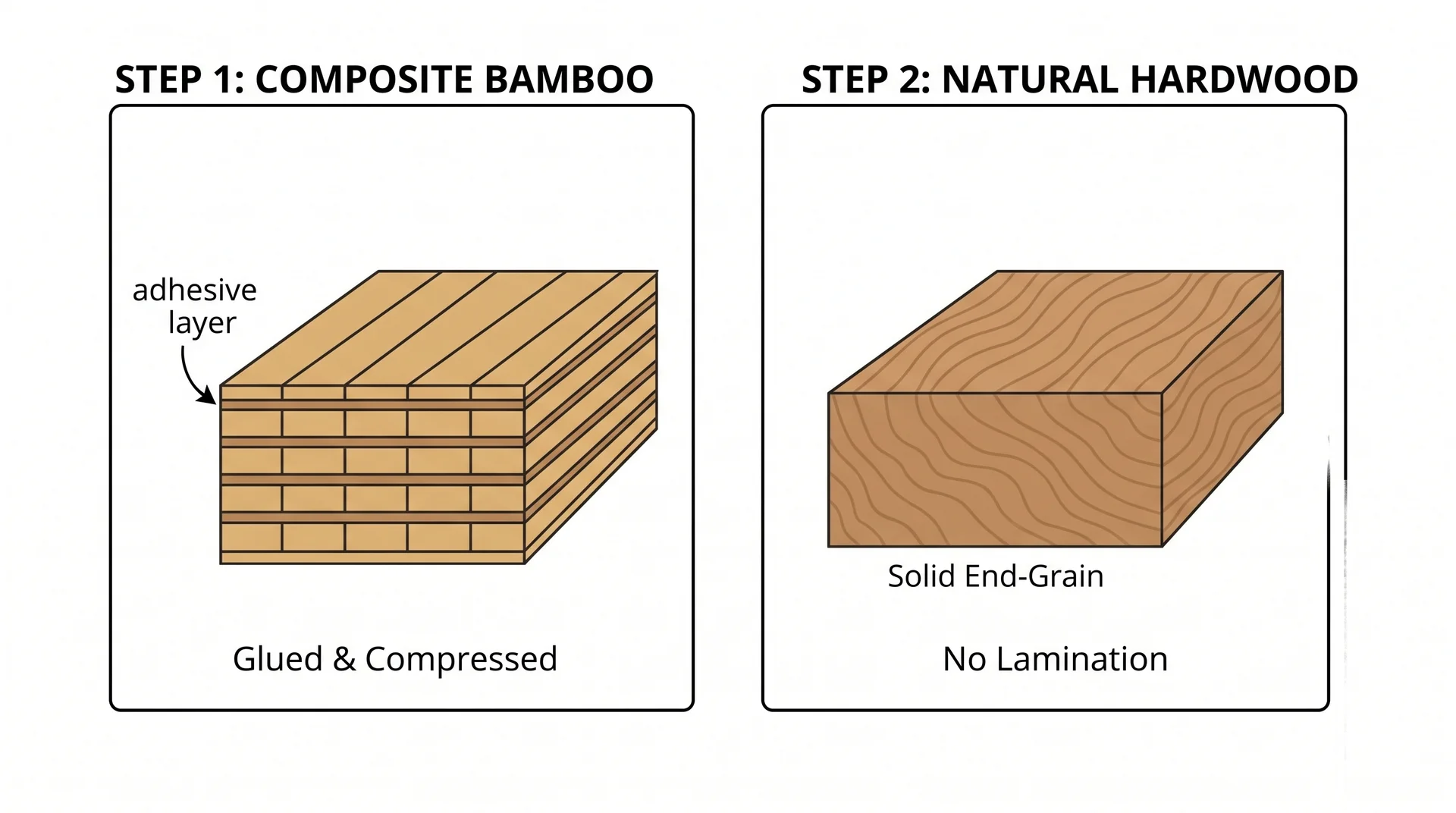
The toxicity concern with bamboo cutting boards is not the bamboo — it’s the adhesive used to laminate the strips together.
Bamboo is technically a grass, not wood. Bamboo boards are manufactured by gluing strips of compressed bamboo together. Most use urea-formaldehyde (UF) resin adhesive.
That’s the same adhesive class regulated by CARB (California Air Resources Board) under Phase 2 standards for composite wood products, including particleboard and engineered hardwood flooring.
CARB Phase 2 sets formaldehyde emissions limits at 0.05 parts per million for hardwood plywood products.
The label says “eco-friendly bamboo cutting board.” What that tells you about the adhesive formulation is nothing.
Here’s what I’ll say clearly: I don’t have a reliable number for actual dietary exposure from a typical bamboo board used in a home kitchen. The emissions data that exists covers off-gassing in indoor air environments, not leaching into food under cutting conditions.
I’m not confident anyone publishing on this topic has that number either. The honest position is that the formaldehyde concern is chemically real, the magnitude in a specific home kitchen context is genuinely uncertain, and the workaround is straightforward: require CARB Phase 2 compliance or formaldehyde-free adhesive certification before purchasing.
There’s a secondary issue. Bamboo is harder than maple. That hardness is marketed as a feature, and it dulls knife edges faster than any domestic hardwood. It also creates finer surface microgrooves under cutting pressure over time.
Whether those grooves present a meaningful contamination risk depends on the cleaning protocol, but harder surfaces that resist cleaning penetration are not automatically safer than softer ones that clean fully.
| Bamboo Claim | What to Actually Verify |
|---|---|
| “Eco-friendly” | Bamboo grows fast; the adhesive is a separate question |
| “Non-toxic” | Ask for CARB Phase 2 compliance or formaldehyde-free adhesive certification |
| “Naturally antimicrobial” | No peer-reviewed evidence supports this claim for manufactured bamboo boards |
| “Hard and durable.” | Accurate – and it dulls knife edges faster than maple |
Plastic: When It’s Safe and When the Board Should Go
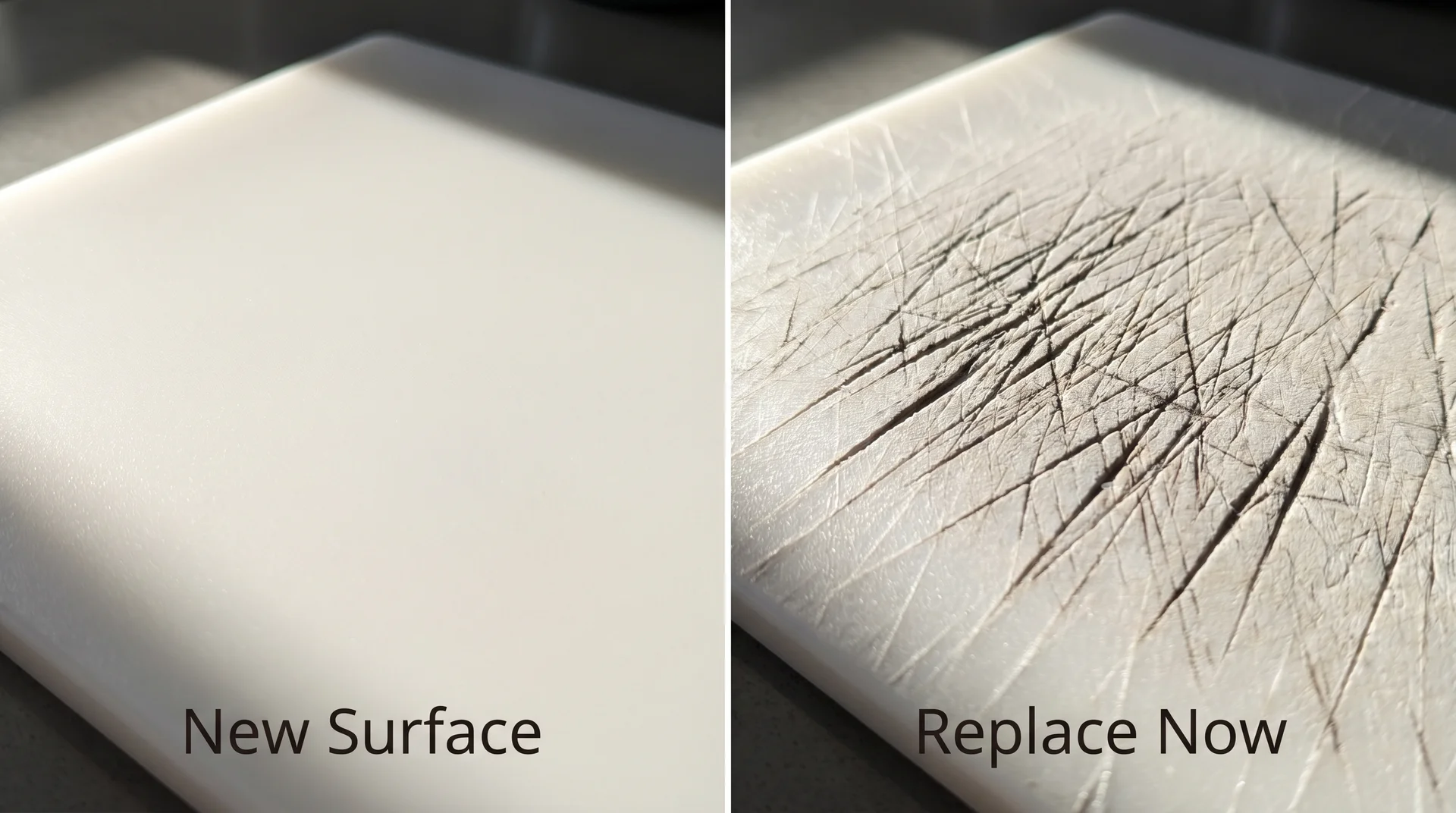
Plastic cutting boards are safe when the surface is smooth, and they are a contamination risk once the surface is deeply scored.
HDPE (high-density polyethylene) is the most common plastic cutting board material. “Food-safe HDPE” means the material itself won’t leach significant chemicals into food under normal use. That is not the same thing as saying the board is safe indefinitely.
Published research on microplastic particle shedding from plastic cutting boards has found that cutting on a scored polyethylene surface releases measurable quantities of microplastic particles into food. The number varies significantly based on the degree of surface scoring.
A new, smooth board releases substantially fewer particles than one with deep knife grooves. The scored board is not the same object as the new board.
- The label says “food-safe plastic.” What the surface condition on a two-year-old board shows is something the label was never designed to address.
- HDPE plastic’s real advantage is sanitizability on a smooth surface and dishwasher tolerance.
- Once deep knife grooves form, bacterial biofilm can establish in them and survive dishwasher cycles because water penetration into the groove depth is incomplete.
What happens if you don’t retire a scored plastic board?
the surface that looks clean after washing harbors bacteria in the groove channels. Sanitizer applied to the surface doesn’t penetrate the groove depth reliably. Whatever you cut next on that board is in contact with those channels.
Frequency of washing without attention to surface condition is not a cleaning protocol. That distinction drove most of what I built into sanitation training programs over eight years, and it applies directly here.
Composite Boards: The Quietest Correct Answer
Composite food-contact boards made from wood fiber and phenolic resin have the strongest safety profile of any category on this list.
NSF-certified, no formaldehyde adhesives, dishwasher-safe, dimensionally stable. The commercial kitchen record is long. They’re not ideal for very heavy work and they lack the aesthetic warmth of a maple board.
For the majority of home kitchen prep tasks, the material case is straightforward.
How Maintenance Affects the Safety of Cutting Boards?
The safest cutting board is the one you will actually maintain correctly, and that sentence answers more questions than any material comparison chart.
The material you buy is the starting condition. Maintenance determines what the board actually is six months later. The two are not separable when you’re assessing real-world safety.
What Actually Matters When Oiling a Wood Board
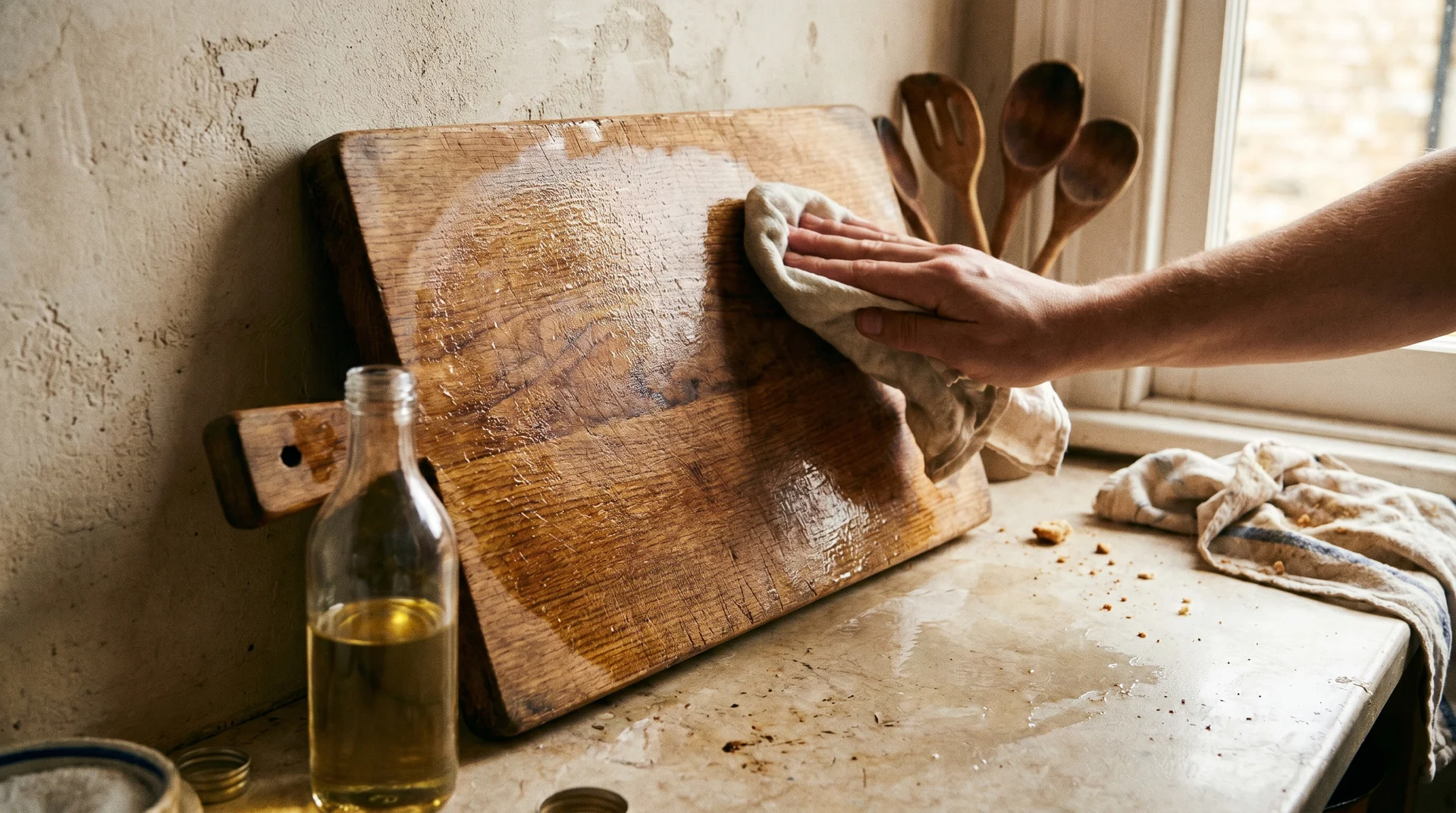
Oil a wood board when the surface feels dry or looks lighter than the wood’s natural color, not on a fixed calendar schedule.
- Apply food-grade USP mineral oil generously to all surfaces: the top, the underside, and the edges.
- Let it absorb for at least 20 minutes, then wipe off the excess. An under-oiled board dries, contracts, and cracks along the grain. A properly oiled board resists moisture absorption and slows the formation of surface grooves.
Two things worth being precise about: the oil grade (food-grade USP, not hardware store mineral oil — this is the distinction I raised in the hardwood section above) and the underside.
Boards warp when one surface dries faster than the other. Oil the whole board, not just the cutting face.
When to Retire a Plastic Board?
Replace a plastic cutting board when you can feel the knife grooves by dragging your fingernail across the grain of the cuts.
A board used for bread and vegetables might pass that test for two to three years. A board used daily for raw meat might reach it in six months.
As for what the most sanitary cutting board for meat actually is: a new or lightly used HDPE board, sanitized with an EPA-registered sanitizer at the correct concentration and contact time, used only for raw meat and protein, and replaced when the surface test above is met.
How to Sanitize Cutting Boards Correctly?
Cleaning a cutting board and sanitizing it are not the same step. Sanitizer applied to a surface that hasn’t been washed first works on the physical debris, not on the pathogens underneath it.
For all surface types, the sequence is: hot soapy water first to remove physical debris, then sanitizer.
For wood and composite surfaces:
- Surface condition: dry or lightly damp after washing, not actively wet
- Sanitizer: 1 tablespoon of unscented liquid chlorine bleach per gallon of water (approximately 200 ppm sodium hypochlorite – this is the concentration in the EPA’s registration data for sodium hypochlorite as a food-contact surface sanitizer)
- Contact time: 30 to 60 seconds of surface contact before rinsing
The contact time step is the one most people skip. My father spent thirty years as a commercial kitchen inspector, and he will tell you that bleach solves everything.
He is not entirely wrong. He is also not entirely right because concentration below the threshold doesn’t reliably produce the kill rate the label claims, and rinsing before the contact time is complete undoes the sanitizing step entirely.
For plastic boards that are dishwasher-safe: the dishwasher is adequate for sanitizing on a smooth, unscored surface. On a scored surface, water penetration into the groove depth is incomplete. The board’s surface condition, not the appliance, determines whether the step works.
A note that rarely appears in cutting board articles: quaternary ammonium compounds (quats) are the sanitizer class used in most commercial kitchens on food-contact surfaces.
Food-safe quat sanitizers are available at restaurant supply stores, effective on all surface types, and worth knowing about if bleach is a concern in your kitchen.
Questions Worth Answering Directly
What Is the Healthiest Non-Toxic Cutting Board?
An end-grain maple or walnut board, maintained with food-grade USP mineral oil, is the healthiest choice for most home kitchens. No adhesive concerns, no microplastics, no synthetic surface coatings. The wood maintenance requirement is real but not demanding once it’s routine.
What Do Professional Chefs Use for Cutting Boards?
Professional kitchens use color-coded HDPE plastic boards, inspected regularly and replaced when surface scoring reaches the threshold. That system works in a restaurant because boards are sanitized on a protocol schedule and swapped out before they become a problem.
The professional kitchen answer is a system recommendation, not a material endorsement. Most home kitchens have two boards they keep for years, which is exactly the condition that makes surface condition monitoring more important, not less.
Is Bamboo Safer Than Wood for Cutting Boards?
No, and the adhesive issue I described in the material breakdown above is why. The bamboo itself is safe. The glue used to manufacture most bamboo boards introduces a formaldehyde concern that solid hardwood does not. The “eco-friendly” positioning of bamboo boards is accurate in the sense that bamboo is a fast-growing crop.
What Is the Safest Thing to Use as a Cutting Board?
An NSF-certified composite board or an end-grain hardwood board from an NSF-certified manufacturer, maintained correctly. “Safest material” and “safest choice for your kitchen” are different questions. The material matters. The maintenance protocol and surface condition matter at least as much.