

Ceramic pans don’t contain PFAS in their coating chemistry. The coating is silica-based, made through a process called sol-gel, and that chemistry has no fluorine in it. So the short answer is no.
The longer answer is that “PFAS-free” labels on ceramic pans aren’t standardized, the coating formulations are proprietary, and the coating itself degrades in ways that most coverage never addresses.
This piece works through all three of those things. It’s not a buying guide, so recommending specific brands requires testing across a full use cycle, and that’s a different article with different criteria.
What Ceramic Pan Coatings Are Actually Made Of?
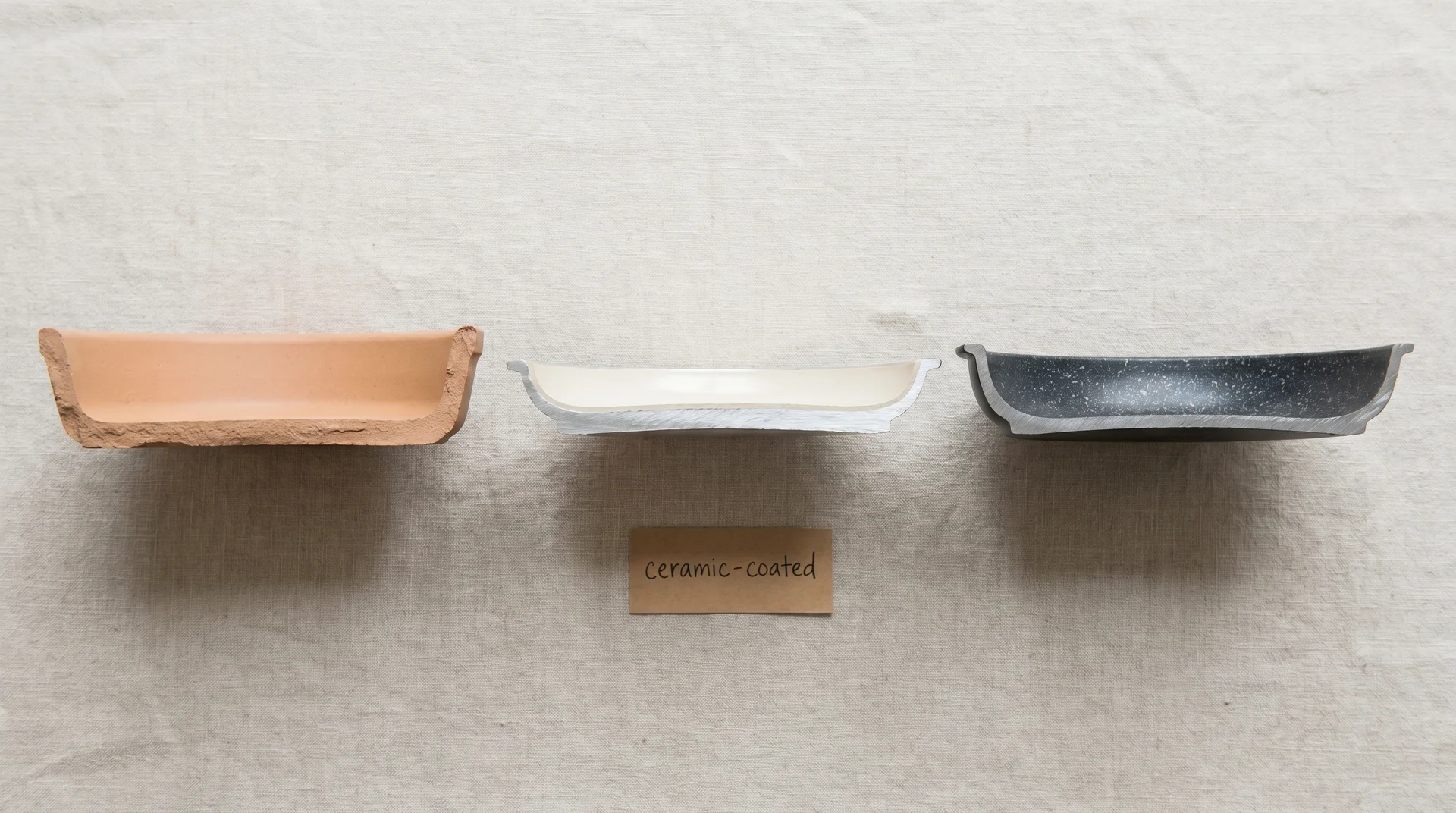
Most ceramic pans are not ceramic in any traditional sense of the word.
The Term “Ceramic” Is Not Regulated
The word “ceramic” on cookware describes a coating method, not a certified material standard. Any manufacturer can use it. No federal definition restricts it to a specific chemistry, ingredient list, or production process.
True ceramic starts from clay and silica, gets fired above 2,000°F, and becomes a chemically stable, inert material. That’s what your dinner plates are made of. The coating on a nonstick pan carries the same word and an entirely different composition.
Pure Ceramic vs Ceramic-Coated Cookware
These are two different products, and the distinction matters.
- Pure ceramic cookware is made entirely from clay and minerals fired at high temperatures. You’ll find it in specialty bakeware and traditional clay pots. It contains no synthetic coatings.
- Ceramic-coated cookware is aluminum, stainless steel, or cast iron with a thin synthetic layer applied to the cooking surface. That layer is what the marketing refers to when it says “ceramic nonstick.”
Nearly every pan sold as ceramic nonstick in a mainstream US retailer falls into this second category.
The PFAS question applies to ceramic-coated pans. Pure ceramic bakeware doesn’t have a nonstick coating to evaluate.
How the Sol-Gel Process Works
The coating on most ceramic-coated pans comes from a process called sol-gel, applied as a liquid and cured at relatively low temperatures.
A mixture of silica, metal oxides, and binders is sprayed onto the pan base, then cured at temperatures between 400°F and 800°F, according to the American Ceramic Society.
That’s well below the 2,000°F-plus threshold where true ceramic forms its crystalline structure.
The base material is usually hard-anodized aluminum, chosen for its heat conductivity. The sol-gel layer sits on top of it, typically just a few micrometers thick. Its nonstick properties come from the silica matrix plus additional compounds that the manufacturer adds to reduce surface friction.
Those additional compounds are proprietary. The full ingredient list for any major ceramic coating brand isn’t publicly available, and manufacturers aren’t required to disclose it.
Why Sol-Gel Coatings Don’t Contain PFAS
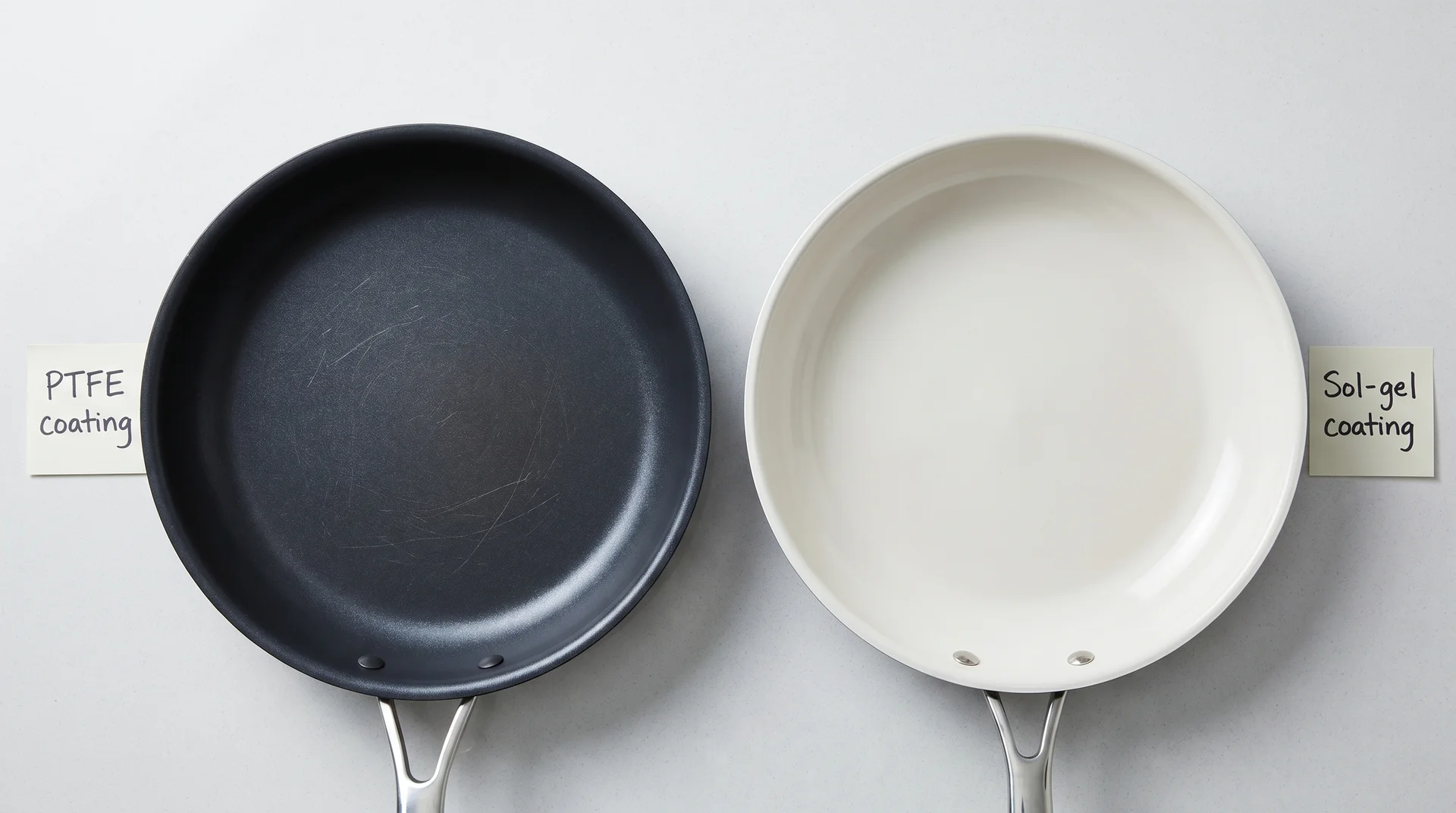
Sol-gel coatings are chemically incompatible with PTFE (polytetrafluoroethylene), the fluoropolymer at the center of the PFAS concern in traditional nonstick pans.
PFAS is the umbrella term for per- and polyfluoroalkyl substances, a family of over 12,000 synthetic compounds defined by their carbon-fluorine bonds. Sol-gel chemistry is silicon-based. Fluorine is not part of the structure.
PFOA, the specific compound most associated with Teflon contamination, was a manufacturing aid used specifically in PTFE production. It was never part of sol-gel processing, because sol-gel doesn’t use PTFE.
Why PFAS in Cookware Became a Problem
PFAS didn’t become a kitchen concern until Teflon’s underlying chemistry came under regulatory scrutiny.
PTFE, PFOA, and How We Got Here
PTFE, the polymer in traditional nonstick coatings, is itself a member of the PFAS family. It’s a long-chain fluoropolymer, and its durability comes from the same carbon-fluorine bonds that make PFAS compounds so resistant to breaking down in the body and environment. Manufacturers used PFOA as a processing aid during PTFE production for decades.
Significant legal action followed after PFOA exposure was linked to kidney and testicular cancers in affected communities. The EPA completed a US phase-out by 2015 following those settlements.
Most manufacturers then pivoted to labeling their PTFE pans as “PFOA-free.” Consumer Reports tested PTFE-coated pans carrying that label and found detectable PFOA in some of them, likely from manufacturing contamination. They stopped displaying “PFOA-free” in their cookware ratings as a result.
That’s why “PFOA-free” on any pan, be it ceramic or otherwise, tells you less than the label implies.
What Health Concerns Are Documented
The EPA links certain PFAS compounds, primarily long-chain ones like PFOA, to specific documented health effects. These include increased risk of kidney and testicular cancer, thyroid disruption, reduced immune function, and developmental effects in children.
The concern is real, and the evidence is solid for those specific compounds.
The important qualifier: these associations are established for a subset of PFAS, not for all 12,000-plus compounds in the family equally. That distinction matters when evaluating a label claim, because “PFAS-free” as a marketing phrase can mean different things depending on what the manufacturer actually tested for.
What “PFAS-Free” Actually Means on a Ceramic Pan Label
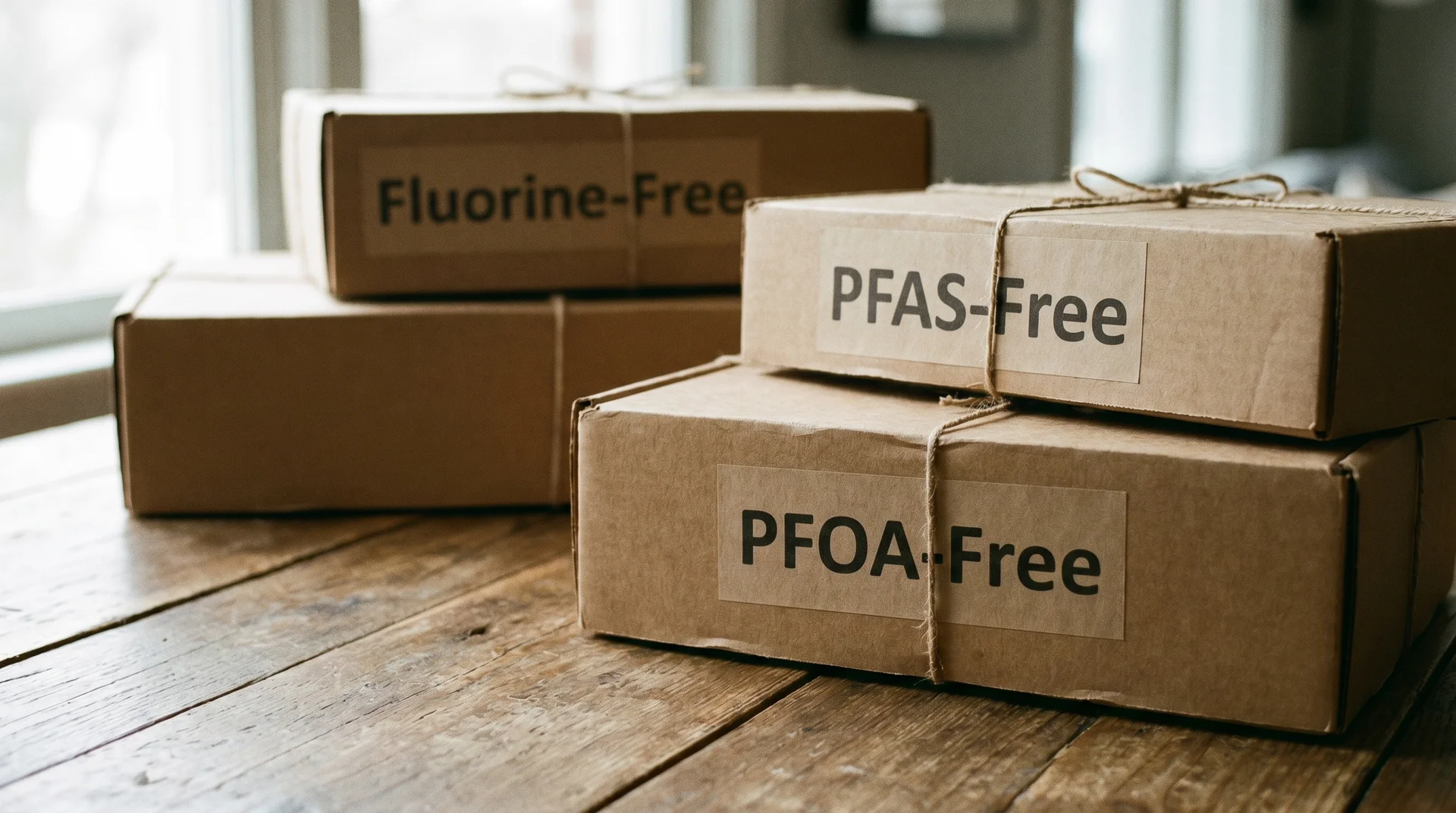
The three most common label claims are not interchangeable, and the difference matters.
The Hierarchy of Claims
Three phrases appear on ceramic cookware packaging, and they describe three meaningfully different levels of assurance.
| Label Claim | What It Means | What It Doesn’t Cover |
|---|---|---|
| PFOA-free | One specific compound was excluded from the coating | All other PFAS are largely irrelevant for ceramic pans, which never used PFOA to begin with |
| PFAS-free | Intentionally added PFAS excluded, per the manufacturer’s claim | Trace contamination from manufacturing environments; the claim isn’t independently verified across all 12,000+ PFAS compounds |
| Fluorine-free | The element fluorine is absent from the coating chemistry | This is the most comprehensive claim currently available on cookware packaging |
- “PFOA-free” on a ceramic pan is close to meaningless.
- Ceramic coatings never use PFOA. Seeing that claim on a ceramic pan is accurate, the way labeling orange juice gluten-free is accurate: technically true and entirely beside the point.
“PFAS-free” carries more weight, but it arrives with conditions that most labels don’t spell out.
Why “Intentionally Added” Is Doing a Lot of Work
Every US state PFAS cookware ban applies to “intentionally added” PFAS, not to all possible PFAS contact during manufacturing.
- Minnesota enacted the first state cookware PFAS ban in January 2025.
- Colorado and Maine followed in January 2026.
- Connecticut and Illinois have bans taking effect later in 2026. All use intentionally added as the operative phrase.
Trace contamination from shared manufacturing environments, packaging, or supply chain contact isn’t necessarily covered by these laws.
Manufacturers aren’t required to test for or disclose incidental PFAS contact under any current state framework.
What Third-Party Testing Actually Covers
Consumer Reports’ 2025 testing found no PFAS across 96 tested compounds in ceramic-coated pans, and that result is meaningful.
Ninety-six is also a fraction of the 12,000-plus known PFAS compounds.
NSF International offers a voluntary certification covering specific chemical classes, but it isn’t required. Brands routinely sell pans without it.
Sol-gel coating formulations are proprietary, so the full ingredient list, including precursors, solvents, and friction-reducing additives, isn’t publicly available for any major brand.
LeafScore asked Caraway directly for their full coating formulation and didn’t receive one. I find that unsatisfying, though it’s the industry standard rather than a Caraway-specific position.
Ninety-six out of 12,000 is a real result and a real limitation at the same time. The distinction is worth holding onto before reading the degradation section, because the two concerns are connected.
What Happens When the Coating Degrades
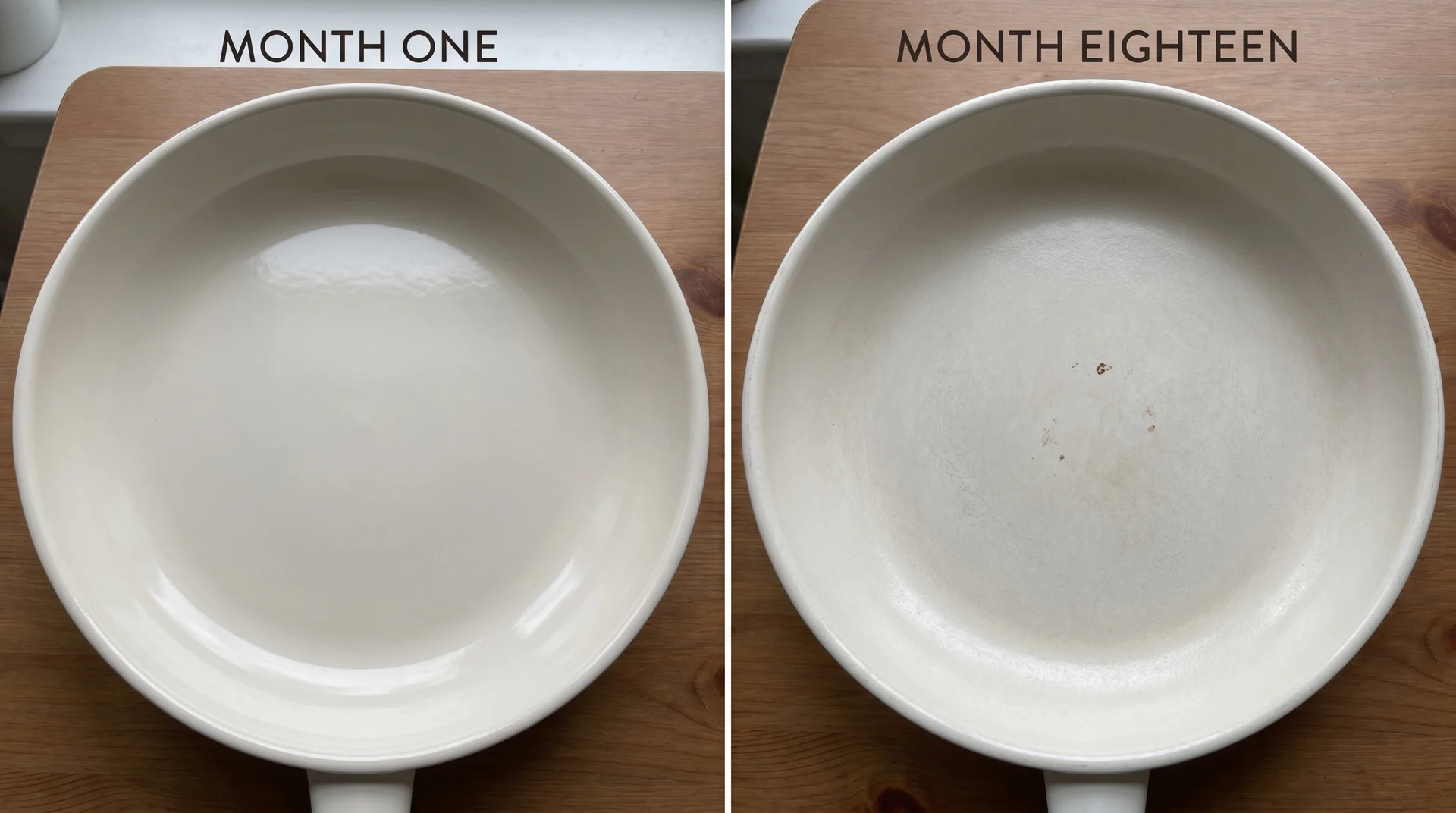
The coating chemistry and the coating timeline are the same safety conversation.
How Ceramic Coatings Break Down
A pan that passes a PFAS test on day one is not the same pan at month fourteen, and those are not two separate safety questions.
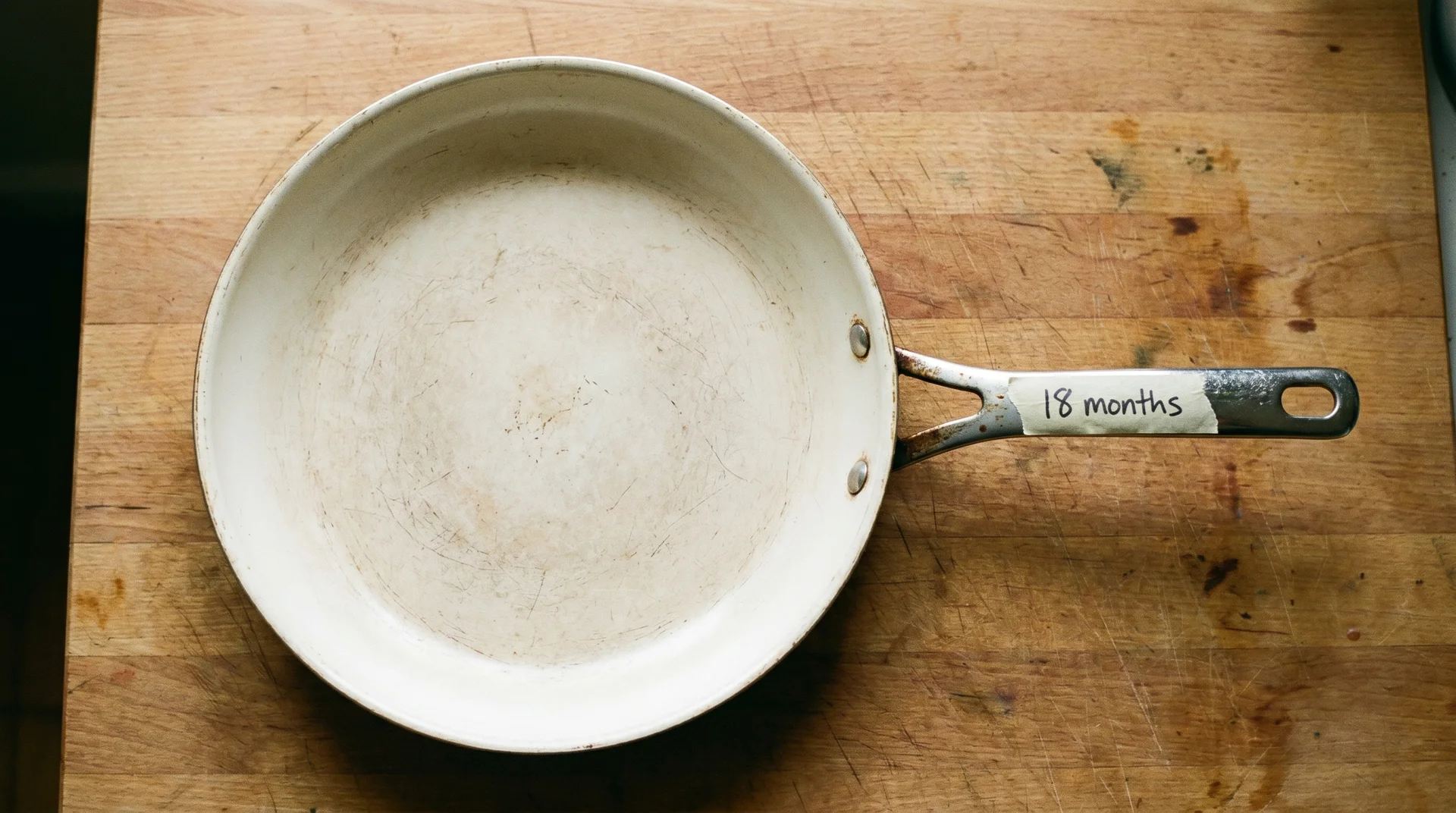
Ceramic coatings typically begin losing effective nonstick performance within a year or two of regular home kitchen use.
Sol-gel coatings are cured at 400°F to 800°F during manufacture. When cooking temperatures consistently push above that threshold, the coating chemistry begins to change.
The American Ceramic Society has noted that overheating can cause these coatings to decompose, potentially releasing organic polymer compounds whose toxicity varies by formulation.
The degradation usually isn’t sudden. The surface roughens gradually, food starts sticking at temperatures where it used to release cleanly, and the cook compensates by applying more heat or force. That compensation accelerates the breakdown.
I’ve tracked ceramic pans across 18-month cycles in my own kitchen, not in controlled conditions.
The pattern is consistent: first signs typically appear between months eight and twelve. Most people don’t notice until the pan is well past the point where it’s performing as designed.
The Question Nobody Answers Directly
What releases from a ceramic coating as it degrades is genuinely uncertain, and that uncertainty comes from proprietary formulation practices, not from missing research.
Every major brand uses its own sol-gel formulation. We know the base chemistry doesn’t contain PFAS. We don’t know precisely what binders, activators, or friction-reducing additives do under sustained heat and physical stress over time.
What we do know: once the coating is compromised, the hard-anodized aluminum base underneath is exposed to food contact.
Researchers have raised concerns that aluminum migration into food may increase with heat, acidity, and salt content.
That’s a separate concern from PFAS, and it belongs in this conversation rather than a different one.
I can describe what I observe in ceramic pans at 18 months. I can’t tell you what’s happening chemically as the surface roughens, because the ingredient list that would answer that question isn’t public. That’s a real limitation, and it’s worth knowing it exists before assuming the problem was fully solved when you switched away from traditional nonstick.
When to Stop Using a Ceramic Pan
The signals that a ceramic coating needs replacing are visible, specific, and worth knowing before you’re looking at a scratched pan and wondering. Watch for these:
- Visible scratching, chipping, or flaking anywhere on the cooking surface
- Food sticks consistently at medium-low heat, where it is used to release cleanly
- Dark patches or discoloration that doesn’t wash off with normal cleaning
- Roughness when you run a finger across the dry cooking surface
When any of these appear, replace the pan. The safety case for ceramic over traditional nonstick depends on the coating staying intact. Once it isn’t, the pan isn’t doing what you bought it to do.
If You Want to Avoid PFAS Entirely
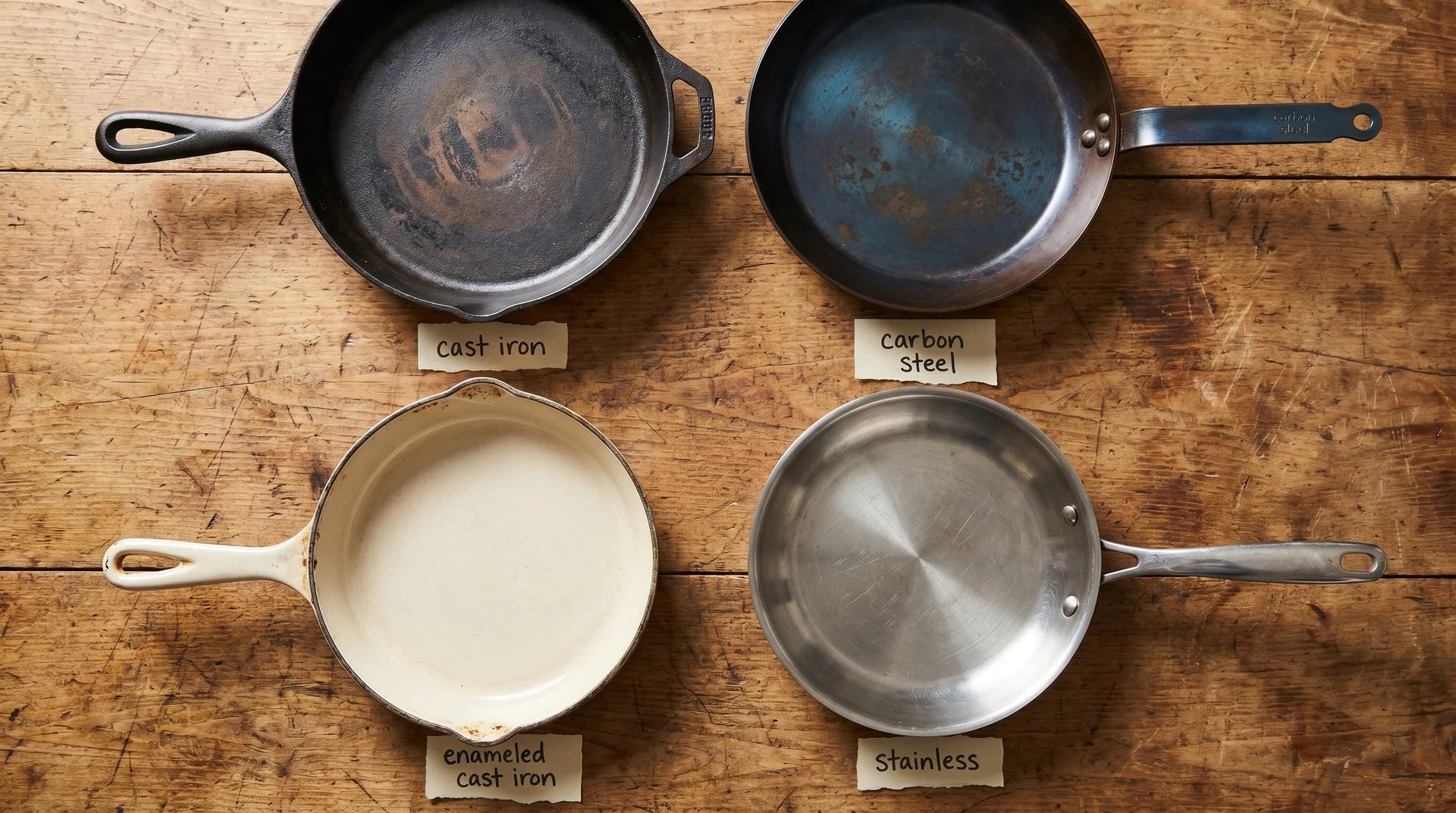
Some cookware contains no synthetic coating and never has.
The Alternatives That Genuinely Contain No PFAS
Cast iron, carbon steel, enameled cast iron, and uncoated stainless steel all cook without any synthetic nonstick layer. No sol-gel coating to test, no proprietary formulation to question, no degradation timeline to monitor. The PFAS concern doesn’t apply.
The performance tradeoffs are real, though.
- Carbon steel and cast iron require seasoning and some learning on temperature management.
- Uncoated stainless steel sticks badly if you don’t know how to use it.
- Enameled cast iron is heavy.
These are reasons to learn the material correctly, not reasons to avoid it.
Comparing those four options in any depth is a different article, and it needs different criteria than a PFAS safety question.
What matters here is that these are the only categories where the coating chemistry question genuinely doesn’t exist.
What to Look for If You’re Staying With a Ceramic?
If you’re staying with ceramic-coated cookware, the label hierarchy from earlier in this piece is your practical starting point.
- Look for “fluorine-free” over “PFAS-free.”
- Look for third-party testing disclosure, not just brand-issued claims. State compliance with the Minnesota, Colorado, or Maine PFAS bans is a useful baseline signal because those laws require that intentionally added PFAS be absent.
Treat state compliance as a floor. It’s more meaningful than a self-certified label with nothing behind it, but it isn’t a full formulation guarantee.
Replace the pan at the first consistent signs of degradation, regardless of price. A degraded coating changes the safety case that brought you to ceramic in the first place.
The Regulatory Picture Right Now
The US has no federal PFAS standard for cookware yet.
The state-level picture has moved quickly.
- Minnesota enacted the first cookware PFAS ban in January 2025.
- Colorado and Maine followed in January 2026.
- Connecticut and Illinois have bans taking effect later in 2026.
- Vermont delayed its cookware ban to 2028 after industry pushback.
- California Governor Newsom vetoed a broader cookware PFAS bill in October 2025, citing cost and product availability concerns.
All current state bans apply to intentionally added PFAS, and none require manufacturers to test and disclose across the full range of known PFAS compounds.
For a pan you’re buying now, state compliance is the most reliable available baseline.
A brand that’s compliant with the Minnesota ban and cites it in its labeling is giving you more than a brand that says “PFAS-free” with nothing behind it.
Compliant with a state ban and fully independently verified are still two different things, and the gap between them is where the label hierarchy in this piece actually does its work.