
The freezer question feels like a quick calculation. It isn’t… not if you want to get it right.
I’ve met people who spent weeks finalizing their cut sheet, then showed up to collect their beef with a freezer two sizes too small. The math seemed obvious at first, but the part that caught them off guard was that the answer isn’t the same for every animal.
There are two things you need to know before you buy a freezer for a half cow: what the animal is going to yield and how your cuts are being wrapped. Both are knowable before delivery. Let me show you how to get there.
How Much Freezer Space Does a Half Cow Need?
A half cow needs 7 to 10 cubic feet of dedicated freezer space. That range covers a packaged yield of 150 to 220 pounds; what a half beef typically produces after processing.
The math: if your beef arrives vacuum-sealed and flat-packed, you can fit roughly 35 pounds per cubic foot. At that rate, a 200-pound yield technically needs under 6 cubic feet.
Most half-cow orders come wrapped in butcher paper. That changes the number. Irregular shapes, air gaps, and thicker wrapping drop the effective rate to around 25 pounds per cubic foot and at that rate, a 200-pound yield needs 8 cubic feet before any buffer.
Baskets and dividers cut into that space too. I’ll say it plainly: plan for 10 cubic feet, not 7.
I’ve seen it go wrong on delivery day when cuts don’t pack the way anyone planned. That extra room is what saves you.
You won’t know your exact yield until the animal is hung and weighed. When delivery arrives, everything goes in at once. There’s no second chance to reorganize.
The price gap between a 7- and a 10-cubic-foot model is typically $50 to $100. That’s nothing compared to what you’re already spending on the beef.
If you’re still deciding between share sizes: a quarter cow fits in 4–5 cubic feet, and a whole cow typically needs 16–20.
What Determines Where You Fall in That Range?
The 7-to-10 range isn’t vague, it reflects two specific variables. Both are knowable before you buy a freezer.
The first is hanging weight, which is the carcass weight before butchering. For a half beef, that typically runs 300 to 425 pounds depending on breed, sex, and feed finish.
Packaged yield is roughly 55 to 65 percent of hanging weight. A 300-pound half produces about 165 to 195 pounds of take-home beef.
A 425-pound half produces 230 to 275 pounds. At that upper end, the standard range doesn’t cover you.
Here’s the thing most first-time buyers miss: you can ask for this number before you buy the freezer. Any farm or processor will give you a yield estimate before butchering.
That one number turns a vague range into a real calculation. Call and ask, it takes two minutes.
The second variable is packing method; specifically, your cut mix. This catches people off guard more than anything else on this topic.
A share heavy on 1-pound ground beef tubes packs close to maximum density; tubes stack flat and fill gaps.
A share heavy on bone-in chuck roasts, short ribs, and brisket flat is a different story. Irregular shapes leave air pockets throughout the chest, well below the 25-lbs-per-cubic-foot rule.
I’ve seen buyers with nearly identical yield weights need very different freezer sizes based on cut mix alone. More ground beef means less space needed; more bone-in roasts means more.
Chest or Upright: Which Freezer Type Works Better for a Half Cow?
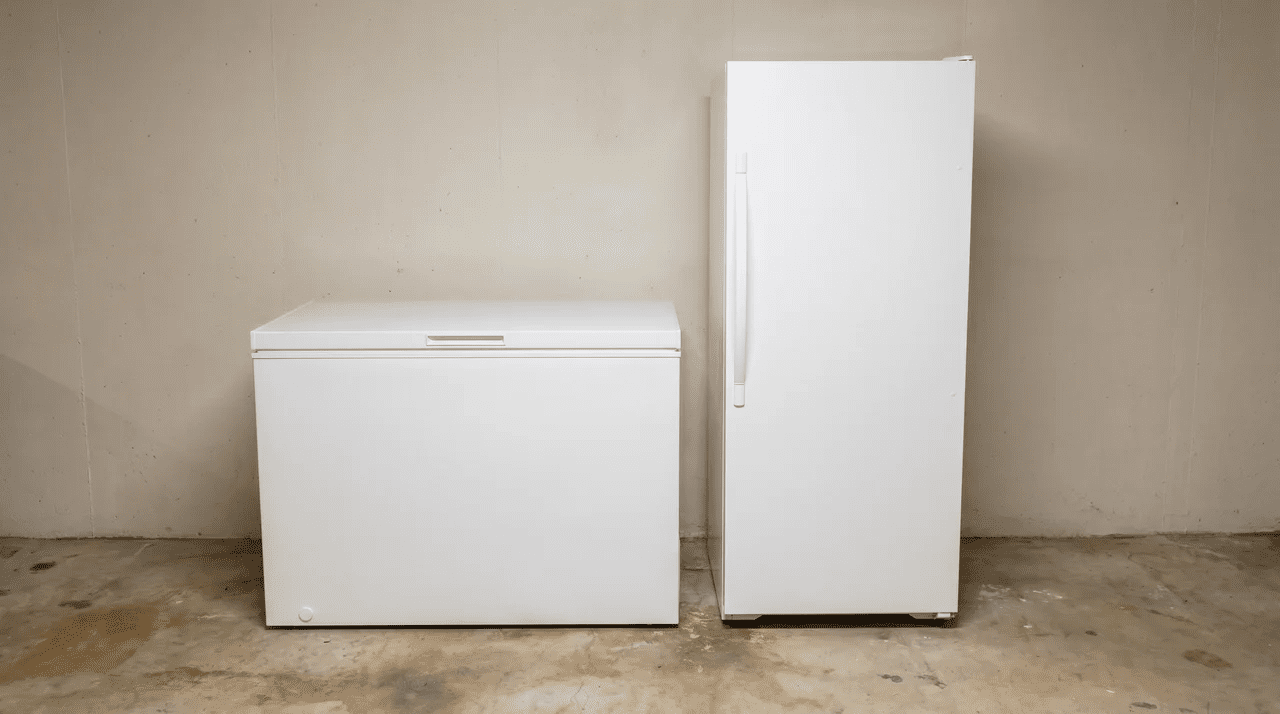
For a dedicated half-cow freezer, a chest is the better choice in most situations. If you need daily access or want to share the space with everyday groceries, the trade-off shifts.
The difference comes down to cold air behavior. When a chest freezer lid opens, cold air stays put. It’s dense and it sinks.
When an upright door opens, cold air spills from every shelf at once. This matters most at delivery, when 200 pounds of meat go in at the same time.
A chest freezer recovers temperature faster after a large load than an upright of the same rated capacity. That’s not a minor difference. It matters for both food safety and energy use.
The chest’s real downside is access, cuts at the bottom get buried fast as the freezer fills.
An upright with labeled shelves is much easier to use day to day.
Here’s how I’d call it.
Dedicated garage or basement unit, used a few times a week? A chest freezer, 7 to 9 cubic feet.
If the freezer is accessed daily or shared with everyday groceries, go with an upright. Budget 10 to 14 cubic feet.
Go bigger on the upright because cold air loss through the door lowers effective capacity over time.
How Do You Prepare Your Freezer Before the Meat Arrives?
Two things go wrong most often on beef delivery day. The freezer isn’t cold enough, and there’s no system for loading it.
In my experience, both come down to the same mistake: waiting until delivery morning. They each take less than 10 minutes if you do them the day before.
How Cold Should Your Freezer Be Before the Meat Arrives?
Your freezer needs to hit 0°F before the meat arrives. That takes at least 24 hours of continuous run time.
Plug it in the day before pickup. Not the morning of. This is the step I see skipped most often, and it’s the one that actually matters for food safety.
Don’t trust the dial. Verify with a standalone freezer thermometer placed on the floor of the chest.
The display is just a target setting, not a confirmed reading. A brand-new unit’s floor temperature can run 5 to 10 degrees warmer than the display during the first cooling cycle.
That’s not a defect. It’s just how new units behave, measure before you assume.
How Do You Organize a Chest Freezer Full of Beef?
Organization has to happen before loading, not after. You cannot reorganize a packed, frozen chest.
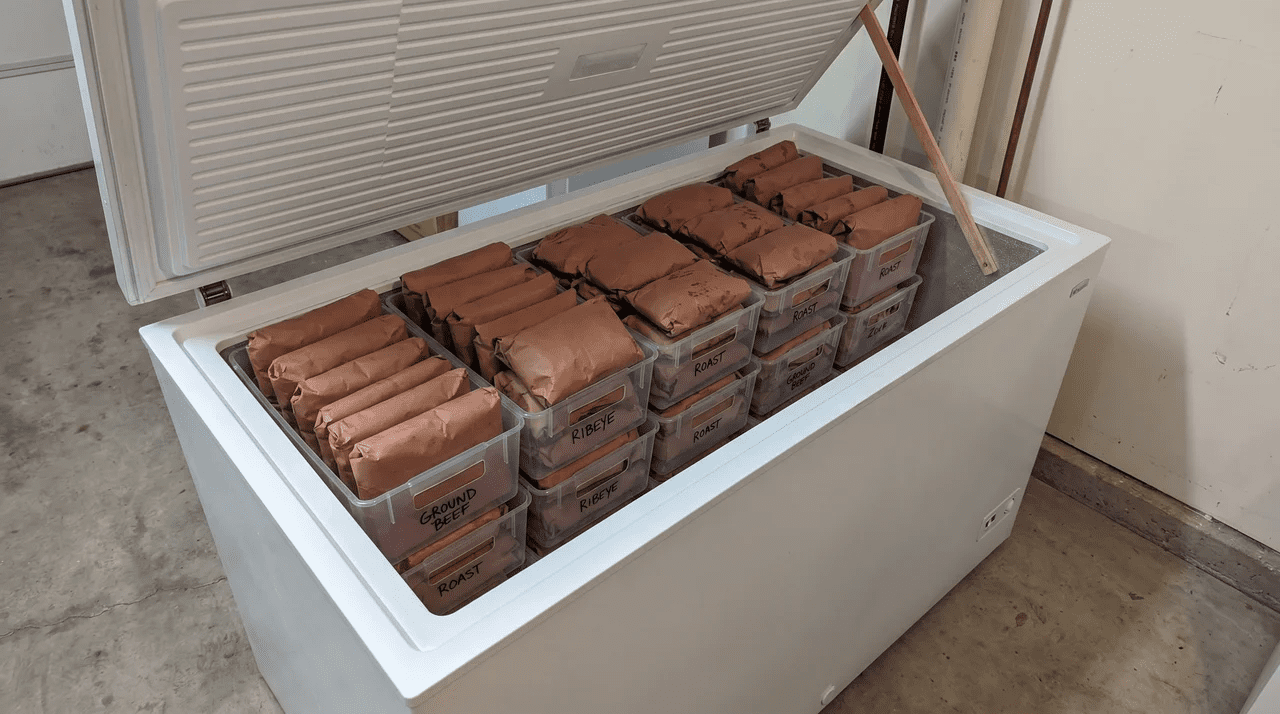
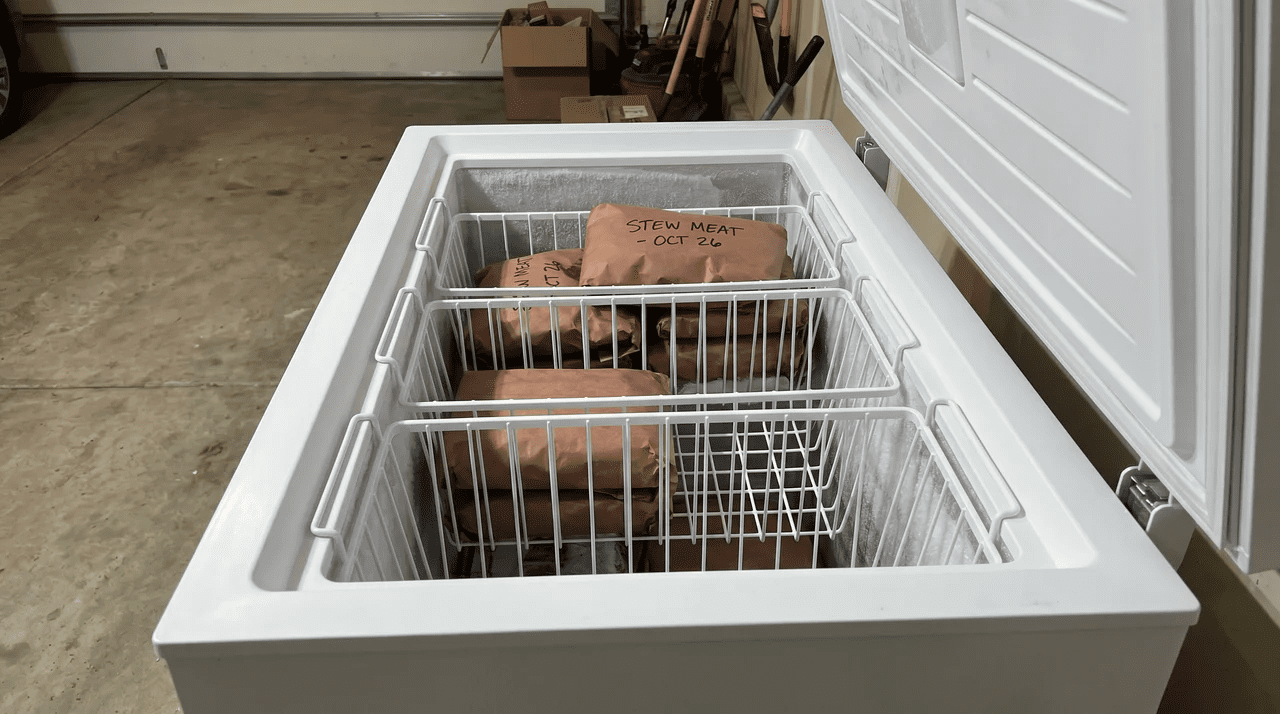
If you’re getting a chest freezer, here’s the system I use. Three to four stackable plastic freezer baskets, each assigned to one cut category.
One basket for ground beef, one for steaks, one for roasts. If your share includes soup bones or offal, those get their own basket.
Roasts and bone-in cuts go at the bottom. They’re the least-accessed cuts. Steaks and ground beef stay up top, where you can reach them easily.
The step most people leave out: labeling every package the moment it goes in. Chuck roast and arm roast look identical through butcher paper once they’re frozen.
A marker takes 10 seconds per package. Not labeling costs you 10 minutes of confused digging, every single time.
Wrapping Up
The number that matters most isn’t 7-to-10. It’s the yield estimate your farm gives you before butchering.
Get that figure. If your half cow arrives vacuum-sealed, divide by 35 for a bare minimum. If it’s butcher paper, divide by 25. Either way, plan for 8 to 10 cubic feet once you factor in the real-world load.
The rest is straightforward: plug the freezer in the day before delivery. Set up your baskets first, and label every package as it goes in.
Do those three things. Delivery day is easy when you’re not improvising.
Frequently Asked Questions
How big of a freezer do I need for a half cow?
Plan for 7 to 10 cubic feet of dedicated freezer space. A half cow typically yields 150 to 220 pounds of packaged beef. The rule is 25 pounds per cubic foot when cuts are packed efficiently. Aim for the higher end if you want room to organize or plan to store other items alongside the beef.
How long will a half cow last in the freezer?
Properly wrapped beef stored at 0°F will hold full quality for up to 12 months. Ground beef is best used within 4 to 6 months. Vacuum-sealed cuts can maintain quality for 12 to 18 months. Labeling every package with the cut type and date at loading makes rotation much easier throughout the year.
How much meat will a 10 cubic foot freezer hold?
A 10 cubic foot freezer holds roughly 250 pounds of meat when packed efficiently. That’s enough for a full half cow with a little extra room. It handles the upper end of the half cow yield range without needing perfect square stacking throughout.
What is the rule of thumb for freezer space and beef?
If your cuts arrive vacuum-sealed and flat-packed, plan for roughly 35 pounds per cubic foot. If they come in butcher paper which is more common, use 25 pounds per cubic foot as your planning figure. Add 1 to 2 cubic feet of buffer for bone-in roasts and any organizational bins. That buffer keeps the freezer navigable over time.