
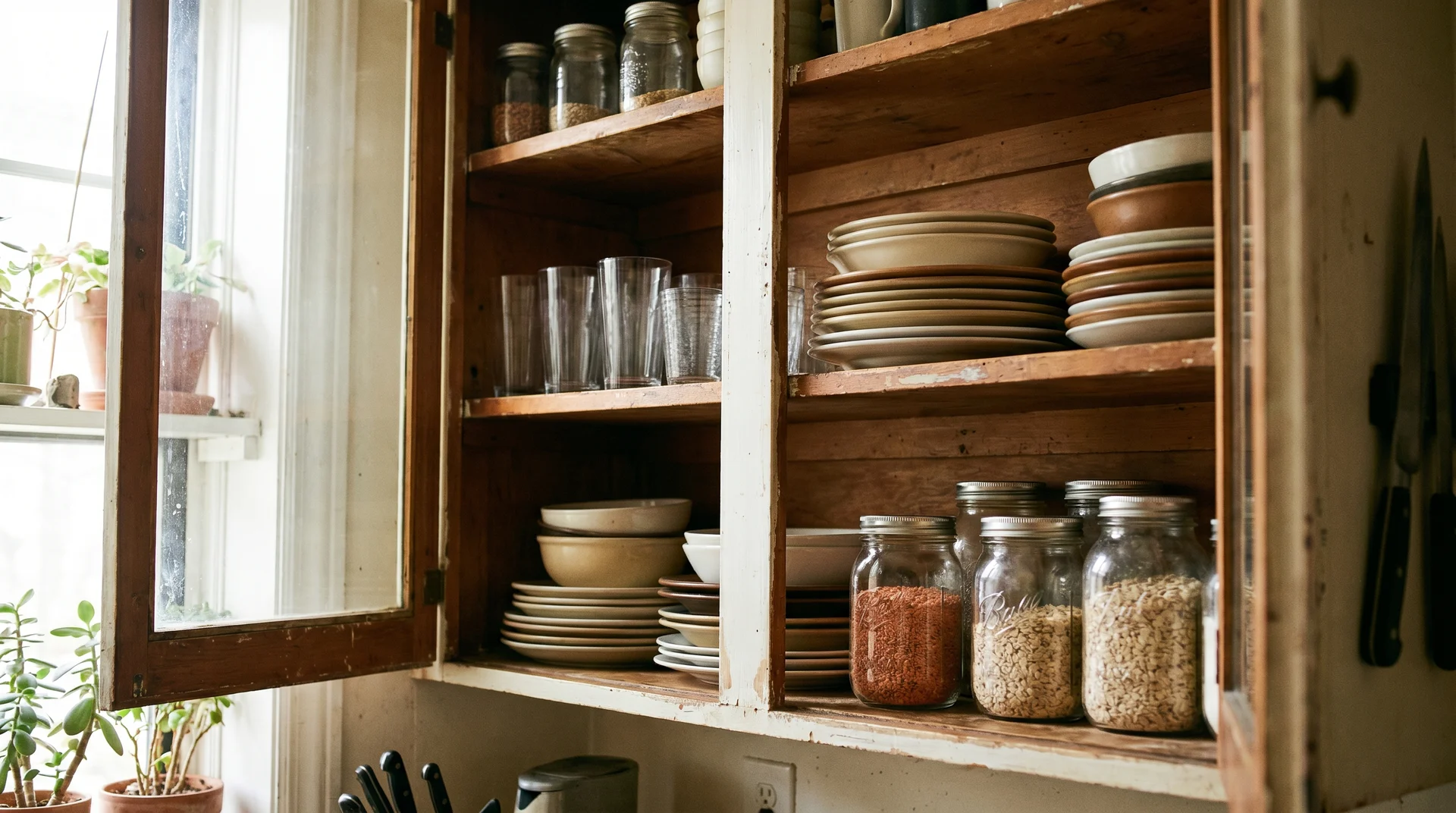
If you’ve reorganized the same cabinets twice in a year and watched the system slide back both times, the problem isn’t discipline.
The cabinets were organized by what looked chaotic, not by how you move through a kitchen. This guide works through that differently.
Organize Your Cabinets by How You Cook
“Group like items together” is the reason your system keeps failing.
It’s the most repeated piece of kitchen organization advice, and it produces systems that look good on Saturday and are already unraveling by Tuesday.
Grouping by category treats your kitchen like a filing cabinet. It ignores the one thing that determines whether an organizational system actually holds: how often you touch something, and how close it lives to where you use it.
The National Kitchen and Bath Association builds kitchen design around work zones, not storage categories. Your kitchen has a cooking zone near the stove, a prep zone at your primary work counter, and a cleaning zone at the sink.
What you store should live in the zone where you use it. That’s the organizing framework. Everything else is tidying.
Identify Your Hot Zones First
The three cabinets you open most often in a cooking session are the ones you organize first, not the ones that look most chaotic.
Think through a real dinner prep in your kitchen, not an aspirational one. Where do your hands go in the first five minutes?
For most cooks, the answer is the cabinet next to the stove, the cabinet above or below the primary prep counter, and one more that varies by layout. Those are your hot zones.
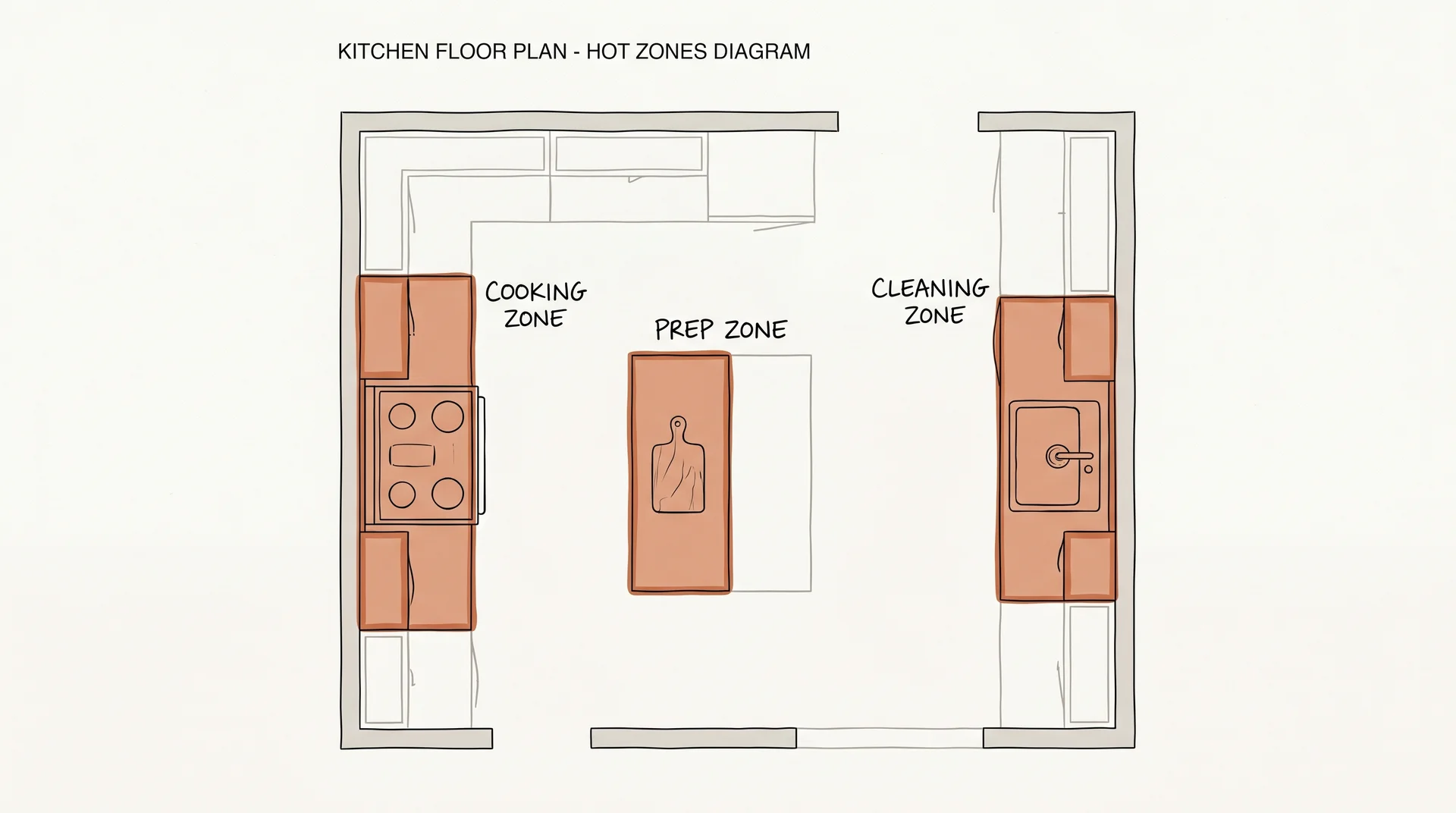
They get fully organized before you touch anything else.
I’ve watched clients spend forty minutes color-coding a pantry cabinet while the pot drawer next to the cooktop remained a tangle of lids, mismatched handles, and a strainer that had no business being there. The pantry looked better.
Nothing about the cooking changed. Kitchen organization that starts from visual disorder rather than operational friction is a reorganization of symptoms.
Once you’ve named your hot zones, the priority order becomes clear:
- Hot zone cabinets hold only what you use in that zone, daily or near-daily
- Medium-frequency items belong in the next closest cabinet
- Low-frequency items go in the hardest-to-reach spots: corner cabinets, the shelf above the refrigerator, anything requiring a step stool
The Work Triangle Still Tells You Where Things Belong
Your stove, sink, and refrigerator form the triangle that tells you which cabinets matter most in your kitchen.
The NKBA’s zone-based kitchen planning puts storage decisions inside that triangle.
- Cooking utensils and pots belong near the stove.
- Prep tools, cutting boards, mixing bowls, and food storage containers belong near where you cut and assemble.
- Dish storage belongs near the sink and dishwasher.
When something is stored outside its zone, you pay for that decision in small frictions every single time you reach for it. Small frictions multiply. They’re why kitchen organization built with good intentions stops working.
What Goes in Each Type of Kitchen Cabinet
All cabinets are not equal. A lower cabinet next to the stove is the most valuable real estate in the kitchen.
The cabinet above the refrigerator is close to the least. Organizing them with the same logic produces a kitchen where the wrong things are in the right-looking places.
Each type of cabinet works differently, and the organization has to reflect that.
Upper Cabinets
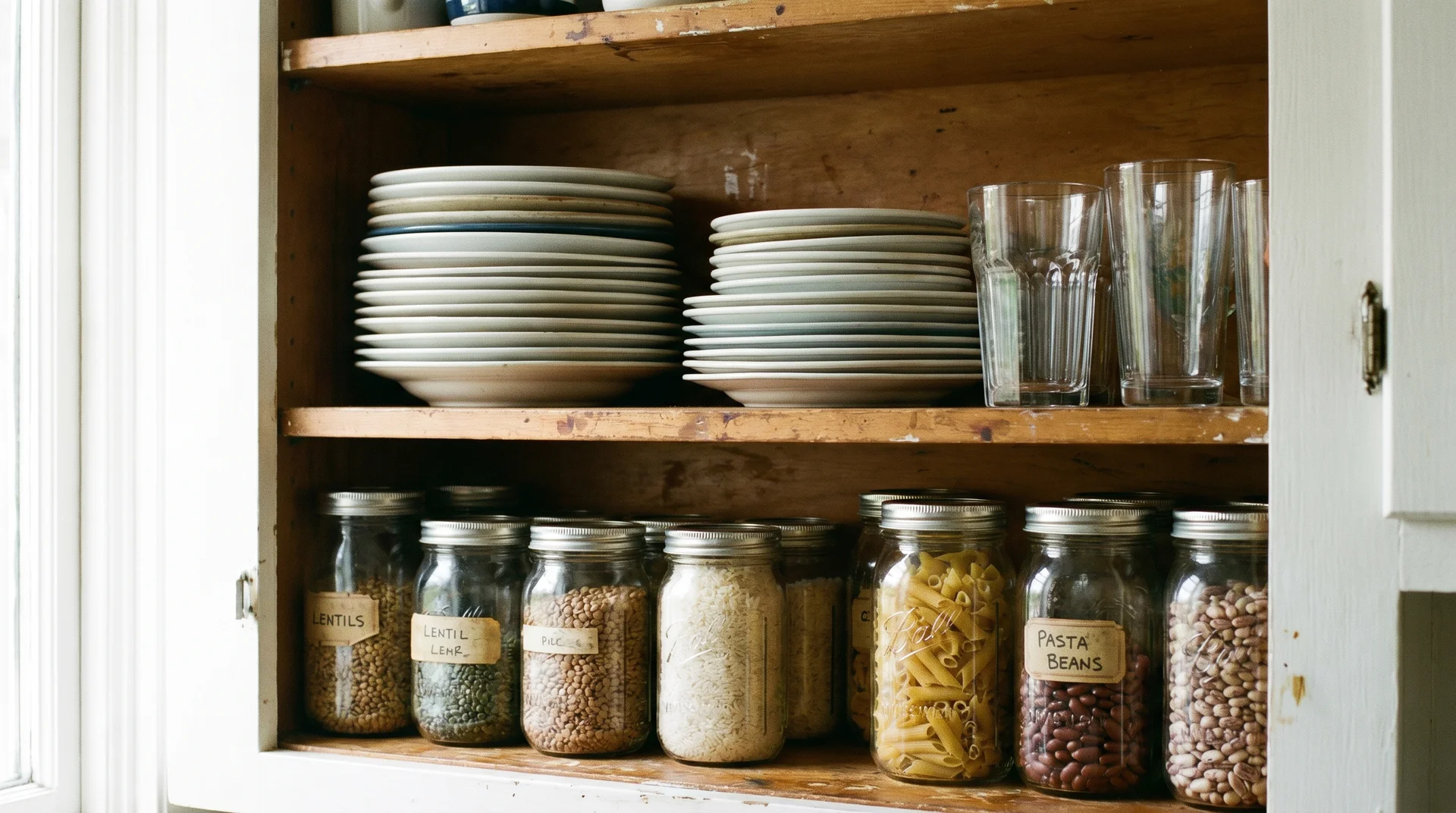
Upper cabinets hold lightweight, frequently used items at a height you can reach without effort.
Stand at your kitchen counter and look left, or right, at whichever upper cabinet is nearest. That cabinet is your most useful upper storage. What’s in it?
If the answer is things you reach for daily, it’s working.
Glasses, everyday plates, mugs, and frequently used dry goods belong here. I have never walked into a kitchen where the cabinet above the refrigerator was genuinely useful to the person cooking in it daily. It’s cold, it’s awkward, and it’s rarely at a usable height for daily access.
Seasonal pieces, anything you’d store in a closet if you had one, things you use fewer than once a month, the cabinet above the refrigerator is where those belong.
Heavy items at eye level are a design mistake I’ve documented across years of real kitchen photographs. Weight belongs lower. Light items go high. It’s not a preference; it’s a function of how you reach and how you carry.
For food storage in upper cabinets, organize dry goods by how often you reach for them, not by type. The pasta you use twice a week belongs at the front. The lentils bought in January belong behind it.
Airtight containers in consistent sizes make this significantly easier to maintain. Mixed sizes mean stacking that turns into searching, which turns into the cabinet being half-ignored within two weeks.
Stack plates by type within the same size. Dinner plates beneath salad plates beneath side plates means dismantling the whole column when someone wants the salad plate. Separate them. It takes up no additional storage space and removes a small daily irritation that compounds faster than you’d expect.
Lower Cabinets
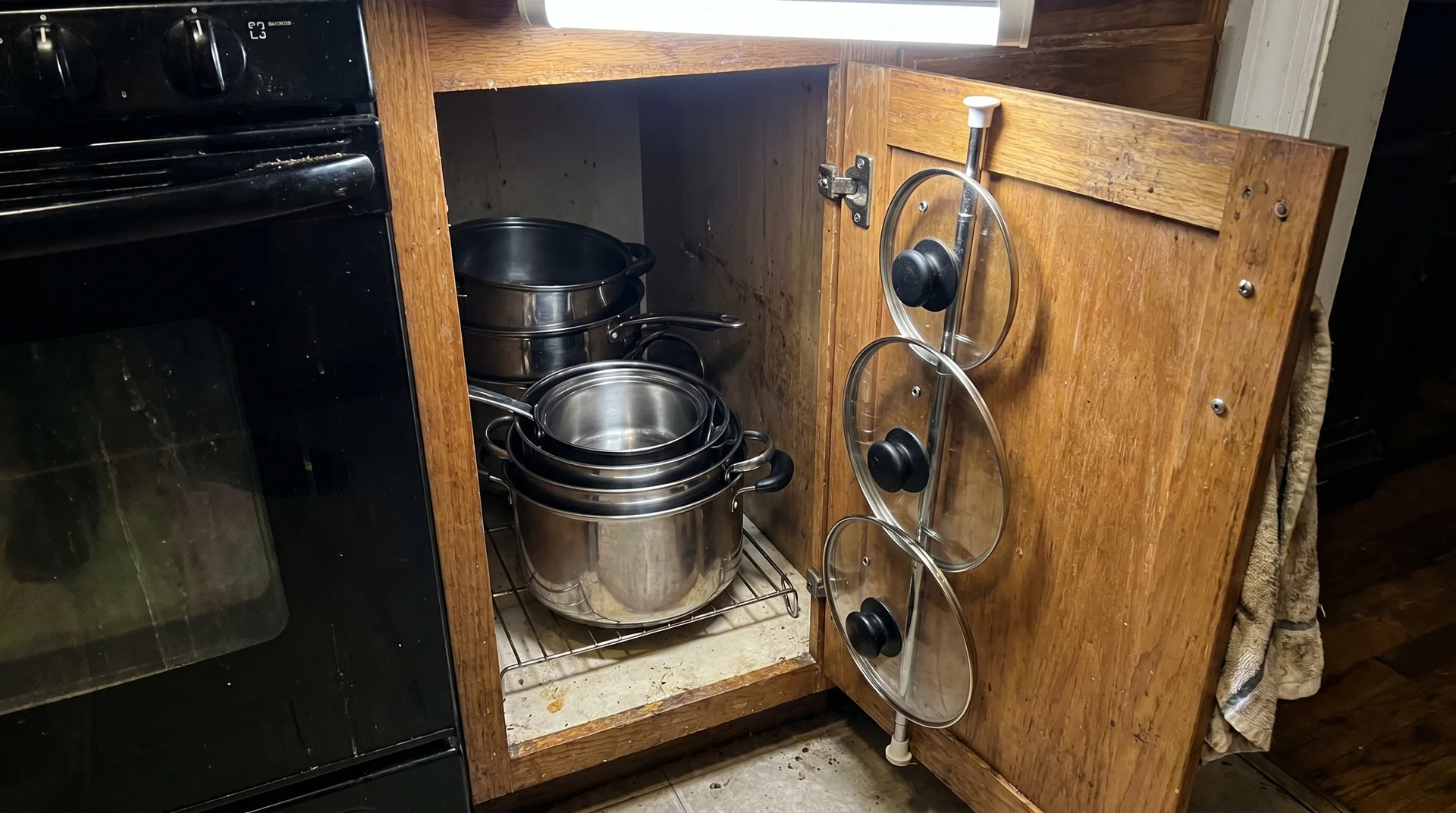
The lower cabinet next to your stove is the most valuable storage in the kitchen. Treat it accordingly.
You’re standing at the stove, something is on the heat, and you need the lid for the pan already cooking. Where is it? If the answer involves walking anywhere or opening a cabinet on the opposite wall, the system has a problem. Pots, pans, and their lids belong within arm’s reach of the range. That means the cabinet directly adjacent to the cooktop, or the drawer beneath it if your kitchen has one.
Lids stored flat inside the pot they belong to sound logical. They stack into chaos within a week. Lids belong vertically.
A tension rod mounted inside the cabinet door creates a lid rack for around two dollars. A small standing file organizer inside the cabinet works the same way.
Both outperform any purpose-made lid organizer I’ve seen installed in a real kitchen. That’s one of the genuinely good organization ideas. Most aren’t.
For the pots themselves:
- Nest by size, largest at the back or bottom, smallest at the front
- Store cast iron separately from non-stick because the weight and surface contact damage both occur over time
- Daily pans at the front; the roasting pan used four times a year goes at the back
One real constraint worth naming: most lower cabinets adjacent to a cooktop are shallower than they appear.
A full stockpot often doesn’t fit upright. If that’s your kitchen, the stockpot goes on its side in your deepest lower cabinet, or it earns a hook on an underused wall.
That’s not an organizational failure. That’s the cabinet telling you what it can physically hold, and the right response is to work with it.
Corner Cabinets

There are three common configurations of corner kitchen cabinets, and they don’t have the same answer:
| Cabinet Type | What It Is | Best Approach |
|---|---|---|
| Blind corner | One door; storage extends behind the adjacent cabinet | Blind corner optimizer or pull-out unit; a lazy susan won’t fit this configuration |
| Pie-cut (diagonal) | Two doors meeting at 45 degrees; deep triangular interior | The lazy susan works here; the kidney-shaped shelves provide more usable depth than round ones |
| Accessible corner | Two full doors open to a square interior | Pull-out drawers or simple shelving; the easiest corner configuration to organize |
The back of a corner cabinet stays dark.
That’s not a problem to solve with a light strip. It’s information about what belongs there. Low-frequency items go in corners, not things you reach for daily.
The corner cabinet is one place in your kitchen where the design problem really is about access, and the access problem doesn’t get solved by adding more to it.
Lazy Susans are a genuine improvement over an unorganized pie-cut cabinet. They’re also not the solution most people expect them to be.
A full rotation pushes things toward the back, and anything taller than eight inches tends to tip on a standard turntable. A lazy susan makes a corner usable. It doesn’t make it convenient.
The distinction matters when you’re deciding whether a simple turntable will serve you or whether a more involved pull-out system is worth the installation.
Deep Cabinets
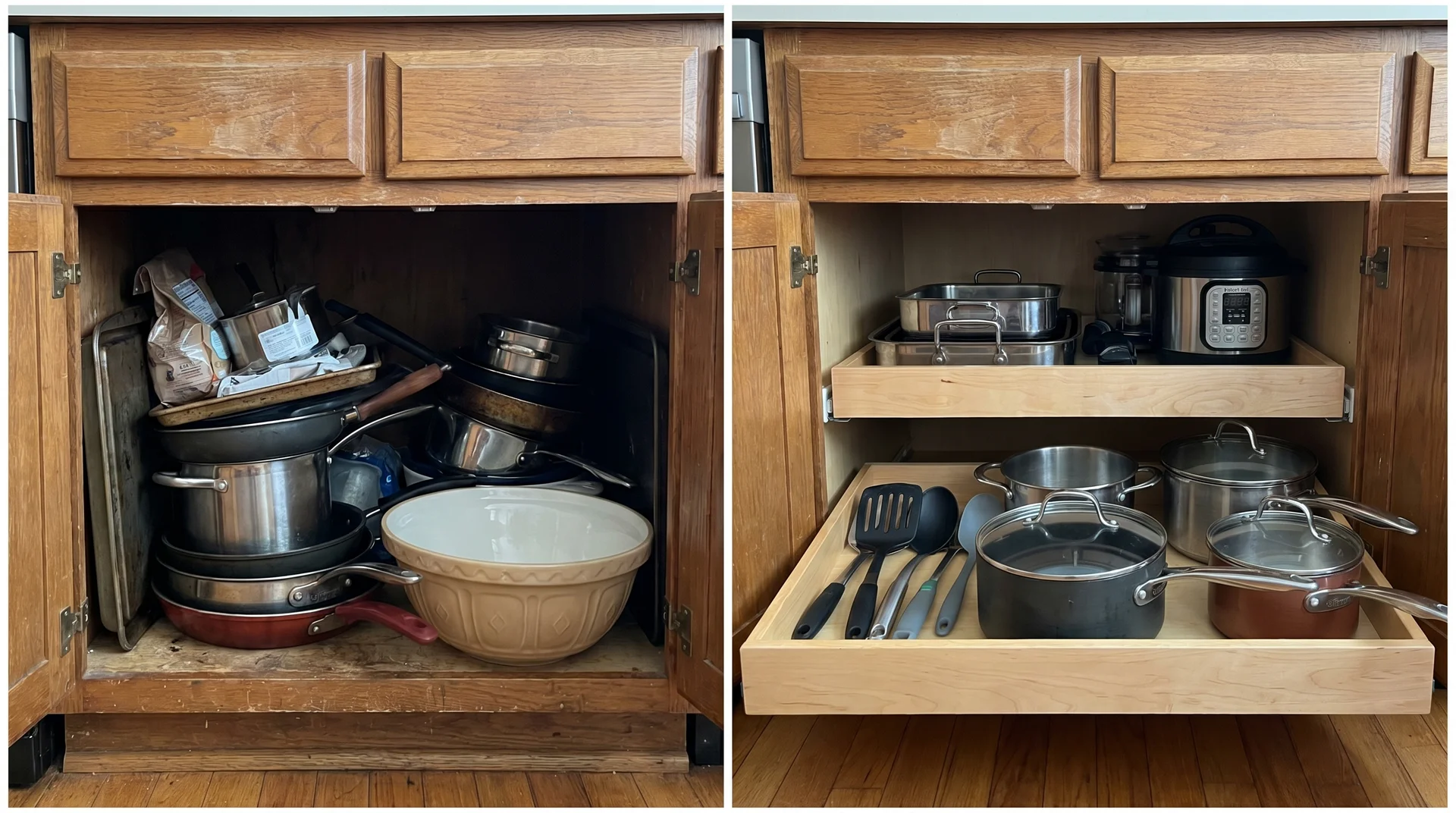
Organizing a deep cabinet by category buries things. Organizing by frequency of use, front to back, solves it.
Whatever you use daily belongs at the front.
Weekly items sit behind that. Monthly items go at the back, and if something lives at the back of a deep cabinet, the honest question is whether it belongs in the cabinet at all. This front-to-back frequency rule applies regardless of what the cabinet holds. It’s the only organization logic that works reliably for deep storage.
The one organizer genuinely worth buying for a deep cabinet is a pull-out shelf or rollout drawer insert. It brings the back of the cabinet forward.
Installation requires attaching a track to the cabinet floor, which means drilling into the base. It’s a twenty-minute job with a drill and a level.
Most product listings mention the insert and skip the installation step entirely. The installation is not difficult. It does have to happen.
Shelf risers double your vertical storage space inside a deep cabinet.
Measure the interior cabinet height before buying. Builder-grade and older kitchens vary from standard dimensions more often than manufacturer sizing charts assume.
A riser two inches too tall is a return trip to the store.
The Declutter Step That Has to Happen First
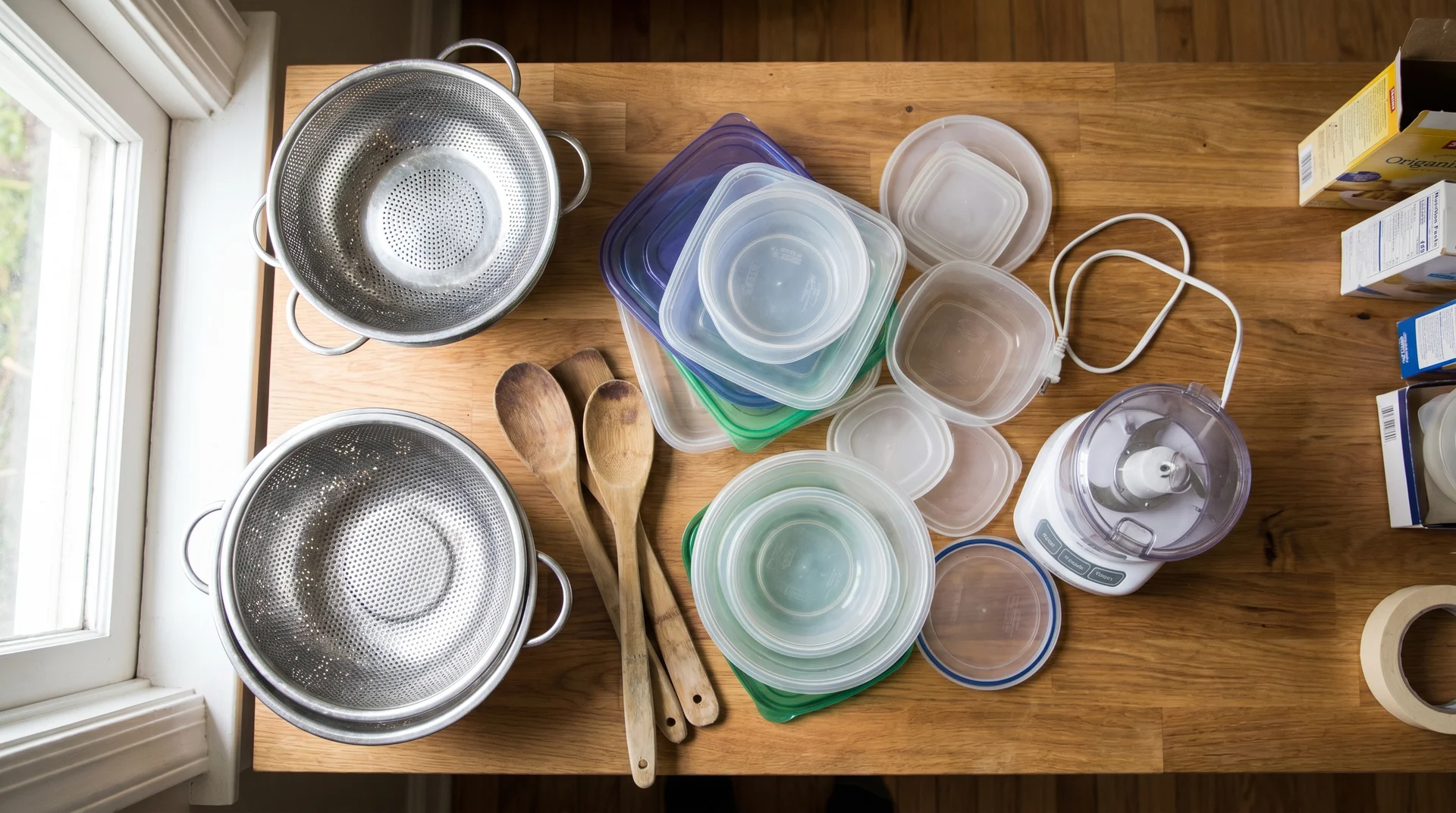
You cannot organize into less space than you actually have.
The instinct is to skip straight to buying organizers. It’s faster and more satisfying than deciding what to remove.
The reference folder of kitchen photographs I’ve kept across twelve years tells me the same story every time: beautiful organizers installed in over-full cabinets produce beautiful chaos. The bins look right. The cabinet still doesn’t work.
The honest threshold for kitchen items is six months. Not a year, not two.
If you haven’t reached for something in six months, you’re organizing around it rather than with it.
The exceptions are genuinely seasonal: the turkey baster, the cookie cutters, the springform pan. Those belong on a separate accounting because their infrequency is intentional. For everything else, six months is the line.
Things most commonly overlooked when decluttering kitchen cabinets:
- Duplicate tools doing the same job: three wooden spoons of identical size, four spatulas, two colanders
- Food storage containers without matching lids, and lids without matching containers
- Small appliances used fewer than three times in the past year, kept for occasions that haven’t materialized
- Items stored in the kitchen with no connection to cooking or food
Every kitchen has one cabinet that becomes a holding zone: the place things go when there’s no clear decision yet about where they belong. Identify that cabinet before you organize anything else.
Emptying it and consciously reassigning each item typically frees more useful storage than any organizer product you could add to the remaining cabinets.
Organizing Kitchen Cabinets in a Small Kitchen
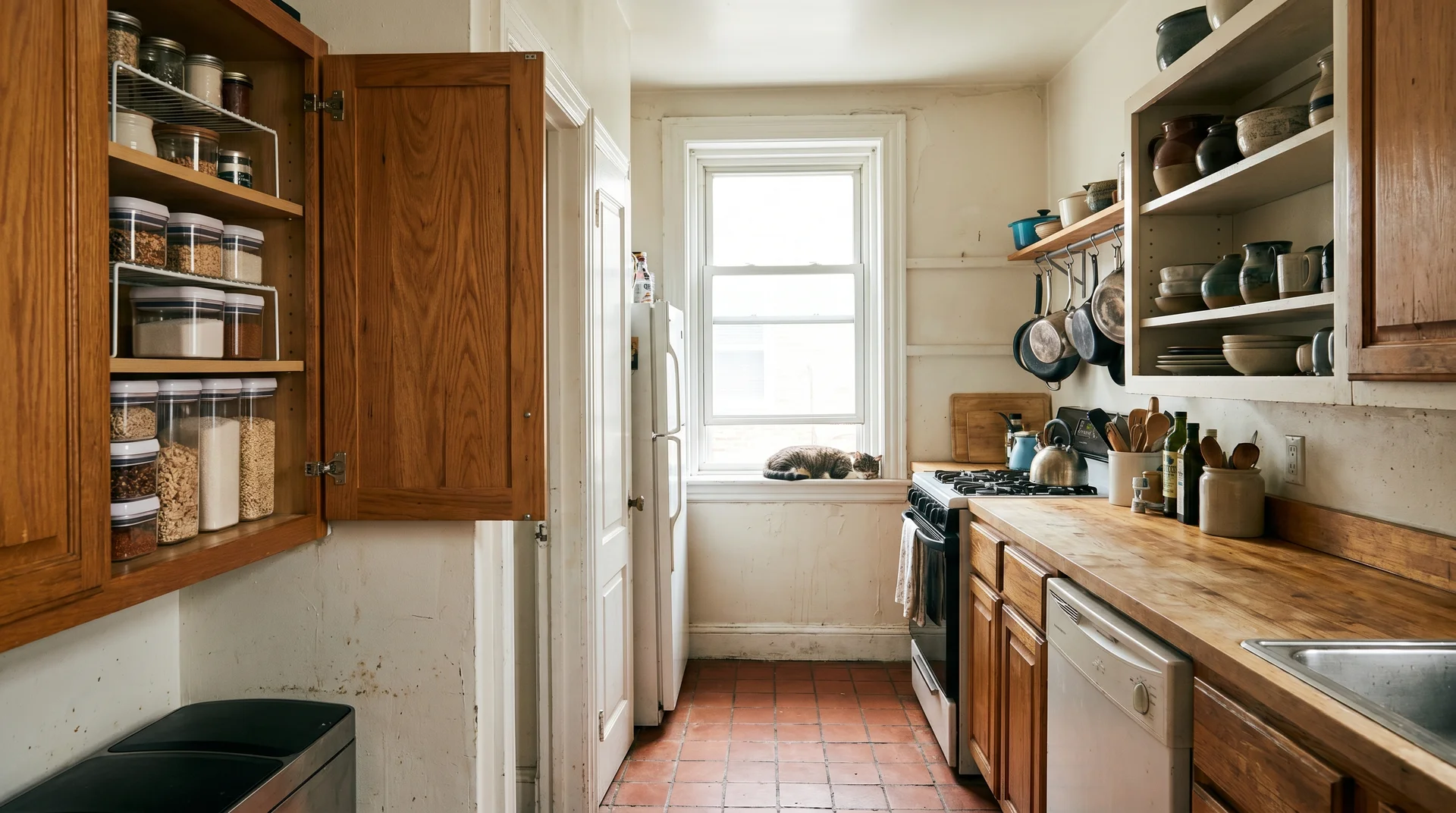
A small kitchen’s organizational problem is not a storage problem.
The instinct is to solve limited cabinet space by adding products: a turntable here, a shelf riser there, an over-door rack on every door that will take one. The result is usually more storage space that’s harder to navigate.
The constraint is where the real decision lives, and in a small kitchen, that decision is which things have genuinely earned cabinet space and which ones haven’t.
The one-hero rule, which I developed from a $6,000 project mistake early in my design practice, applies here more than anywhere.
Every kitchen needs one dominant organizational decision made well and executed completely before anything else is touched.
In a small kitchen, that decision is almost always about the primary cooking zone: the cabinet or cabinets nearest where you cook. Get those right first, fully.
A small kitchen with a well-organized cooking zone and a messy upper cabinet is more functional than one where every cabinet has been partially improved.
Three approaches that extend storage within existing space rather than requiring more of it:
- Shelf risers: Measure interior clearance above the riser level before buying. Builder-grade kitchens vary from standard dimensions more than the packaging assumes.
- Stackable food storage containers: Only stack usefully when they’re the same brand and the same shape. Mixing brands produces a leaning problem that defeats the purpose.
- Pull-down cabinet organizers: Require specific interior cabinet height and door clearance. Measure both before purchasing. The installation guides usually omit this step.
Over-door cabinet storage works in a small kitchen when the items are lightweight: foil and wrap rolls, spice packets, and small cleaning supplies.
Canned goods are not candidates. An over-door rack loaded with cans stresses the hinges and the door frame gradually and quietly. The weight limit is lower than it looks.
How to Make the Kitchen Cabinet Organization Hold?
The system fails the moment it stops matching how you cook.
Hot zones are the three cabinets you open most often in a cooking session.
A system that serves those three cabinets well will outlast any system that makes every cabinet look perfect but requires daily deliberate maintenance.
The goal isn’t a kitchen that photographs well. It’s a kitchen where you can cook Tuesday’s dinner at Tuesday’s pace without friction.
Two rules that hold across every kitchen I’ve worked in:
- The 10-second rule: if putting something away correctly takes more than ten seconds, it won’t happen consistently. Adjust the system, not your expectations.
- The search trigger: when you’ve searched for the same item twice in a week, the placement is wrong. Move the item before you resolve to remember where it is.
Labeling shelves and containers earns its place in one specific situation: when more than one person uses the kitchen, and they weren’t part of the original organization decision.
A label reduces the number of times someone puts the right thing in the wrong place because they weren’t sure where the right place was. Without shared context, the system only holds for the person who built it.
Kitchen cabinet organization isn’t a project you complete. It’s a system you adjust when something stops working. The adjustment is a single placement change, not a full reset.
That distinction is what separates a kitchen that stays functional for six months from one that needs rebuilding every two.
Organizing Kitchen Cabinets & Drawers
The general split works in most kitchens:
- Drawers hold tools and cooking utensils (spatulas, whisks, tongs, measuring spoons)
- Cabinets hold vessels, appliances, and pantry items.
That split breaks down when your only drawers are across the room from the stove, or when the kitchen has two drawers total. In those situations, drawer content and cabinet content need to be decided together, with proximity to the point of use driving both.
Drawer dividers are worth using in any drawer holding more than three types of items. Without them, drawers become the flat version of the deep cabinet problem: things slide, stack, and bury each other.
Measure the interior depth of the drawer before buying dividers, not just the width. Drawer depth is often shallower than it looks from above, and standard divider sets are sized for dimensions that don’t match every kitchen.