

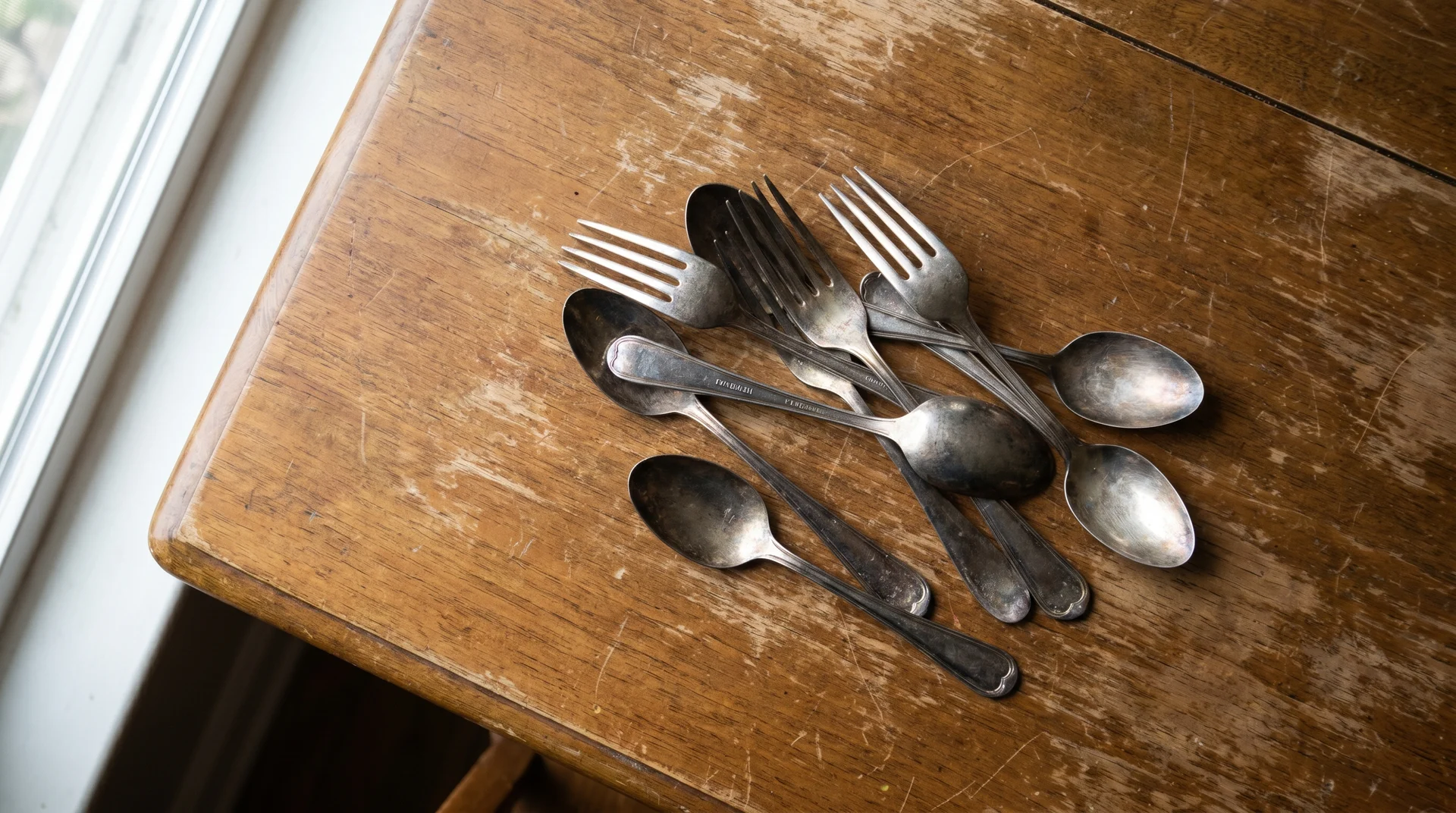
Silver-plated flatware is worth something. It is almost never worth what the person holding it hopes. The real value, where it exists, comes from collector demand for specific patterns. That market is really narrow.
Sterling silver has its own melt calculation. That’s a different article, and it needs different criteria.
Silver Plate and Sterling Silver Are Not the Same Thing
Most people searching for this question don’t yet know what they have. Getting the identification right first changes every decision that follows.
What Silver Plate Actually Is
A silver plate is a base metal object with a thin silver coating applied through a process called electroplating.
The base metal is typically copper, brass, or a nickel-zinc alloy. In pieces stamped EPNS, the base contains no silver at all. EPNS stands for electroplated nickel silver. The word “silver” in that name describes the color of the alloy, not its content.
Manufacturers apply the silver coating in layers measured in microns. A micron is one-thousandth of a millimeter. That is thinner than a human hair.
Melt value is the market price of the silver a buyer can extract from a piece. On silver plate, extracting that silver costs more than the silver is worth. Precious metal dealers decline it because the economics don’t close.
I ran the Rogers Brothers plate through restaurant service for close to eight years. When pieces wore out, we called the supplier. Nobody thought to contact a precious metals dealer.
That wasn’t an oversight. The material was doing exactly what it was designed to do.
How to Read the Marks on Your Silver Flatware
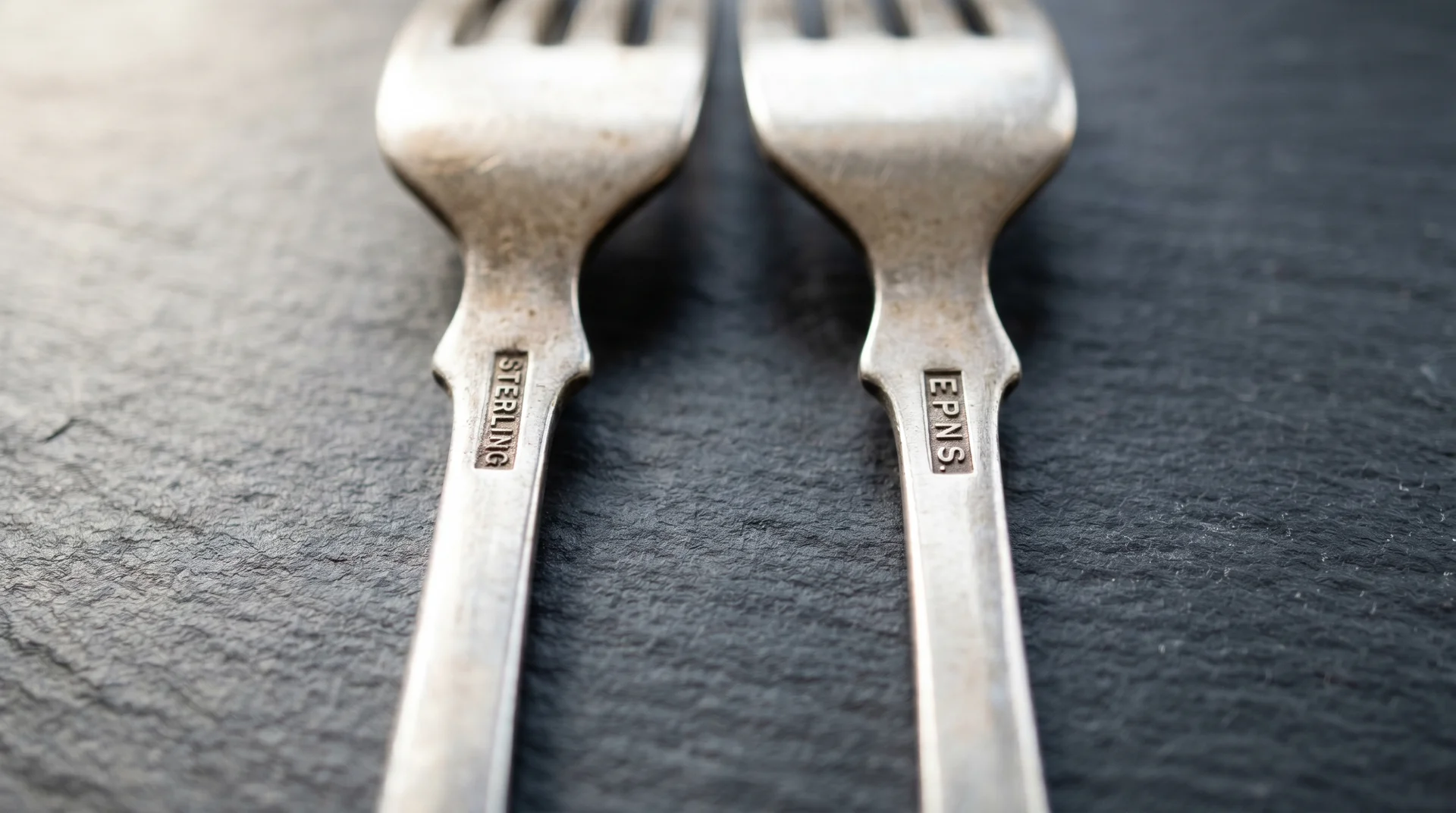
The marks on the back of the handle tell you exactly what the piece is made of.
Check where the handle meets the bowl or the tines. The marks are small. Almost every piece made after 1900 carries them.
The table below maps the most common marks and what each one means. Read this before running any other test.
| Mark on the piece | What it means |
|---|---|
| Sterling / Ster | Solid sterling silver, 92.5% silver throughout |
| 925 / .925 | Sterling silver, expressed as a number |
| Lion passant (small lion, one paw raised) | British sterling silver standard |
| EPNS | Electroplated nickel silver: the base has no silver; only the surface does |
| EP | Electroplated: silver plate, base metal unspecified |
| A1 | Lightest standard plate deposit grade |
| Triple Plate / Quadruple Plate | Heavier deposit grades, still silver plate |
| Silver Plate / Silver Plated | Silver plate, stated plainly |
| IS | International Silver Company maker’s mark, not a purity mark |
| 1847 Rogers Bros. | Brand name, not a manufacturing date |
If your piece shows “Sterling” or “925,” you have sterling silver. This piece is not the right resource for that.
If you see any of the plate marks, keep reading.
One practical note on knives: most flatware sets pair silver-plated handles with stainless steel blades. The blade has no silver content regardless of what the handle is. Check the handle stamp, not the blade.
Two physical tests can add confirmation, though neither replaces the marks. The magnet test is first: genuine silver is not magnetic. A strong magnet that sticks firmly means there is no silver in the piece at all.
If the magnet doesn’t stick, you still need the marks. Both sterling and silver plates are non-magnetic, so the test can’t tell them apart.
Sterling tarnishes in black and brown tones. Silver plate often develops multicolored tarnish, including purple and green, as the base metal comes through the surface over time.
I use the magnet test as a first pass, not a final answer. The marks are the final answer. Once you have them read, the value question has a more honest answer, too.
The Brand Names That Will Confuse You
Two stamps appear on nearly every inherited set, and both get misread.
The 1847 date and the plating grade marks are the two that generate the most confusion. Getting them right ends a significant amount of research in the wrong direction.
The 1847 Rogers Bros. Problem
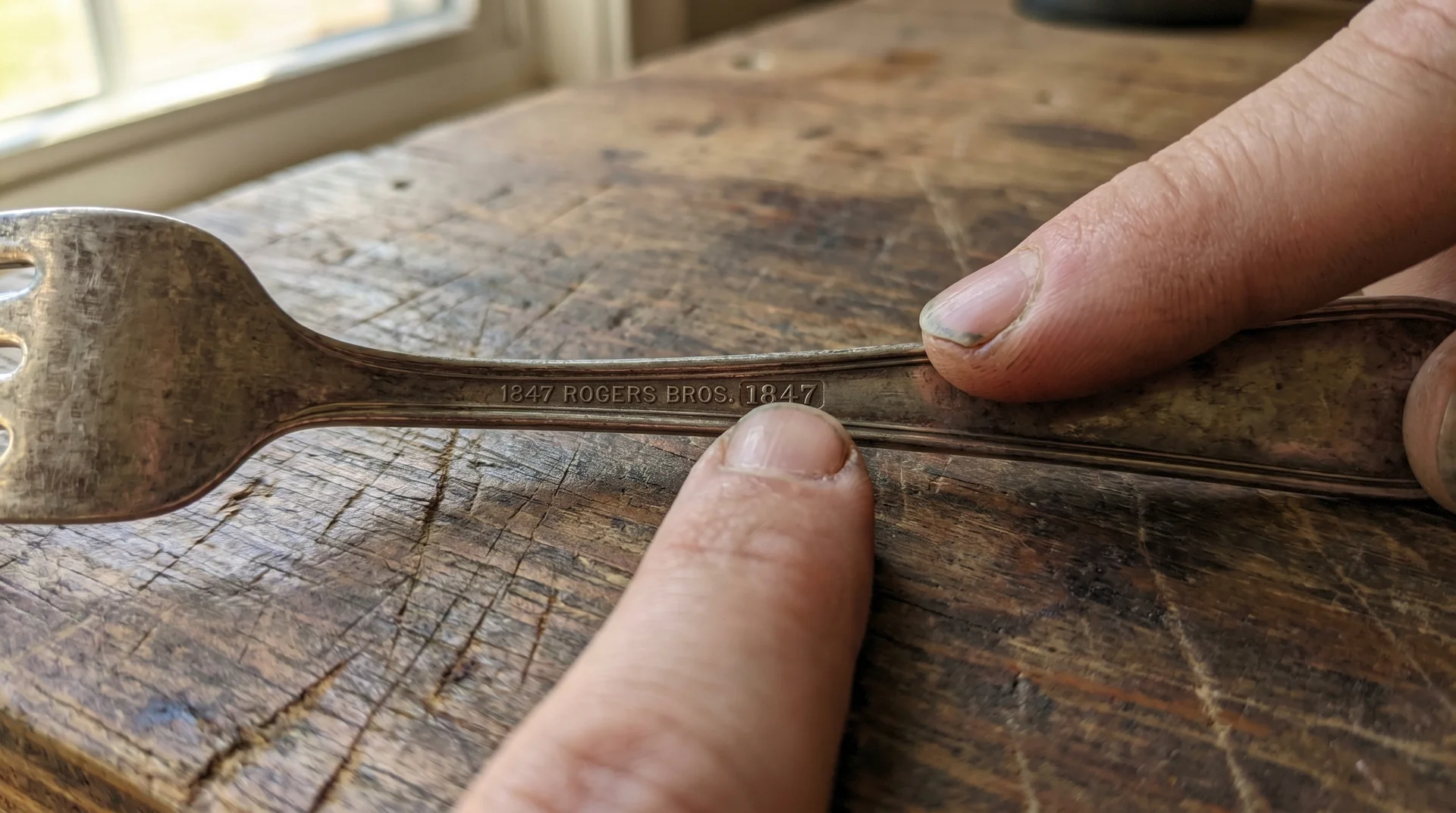
1847 Rogers Bros. is a brand name. It is not a manufacturing date.
The Rogers Brothers began their silver plating operations in Hartford, Connecticut, in 1847. That was the actual year they started electroplating. The date became part of the brand identity because it was genuinely their founding year in the silver trade.
The confusion is that people see “1847” stamped on a specific piece and assume the piece was made that year. It wasn’t. The brand name was carried through every ownership change that followed.
Meriden Britannia Company acquired Rogers Brothers in 1862. Meriden then merged with several other manufacturers to form the International Silver Company in 1898. The 1847 Rogers Bros. trademark continued through all of it.
Here is what the stamp tells you, and what it doesn’t.
- It tells you the brand: Rogers Brothers, founded in 1847
- It tells you the type: silver plate
- It does not tell you when that specific piece was made
- It does not indicate silver content beyond “plated.”
A piece stamped “1847 Rogers Bros.” and made in 1940 is not a 90-year-old antique. The date is part of the brand identity, not the manufacturing record of that specific piece.
Brand heritage means nothing for melt value. Common supply means nothing for collector demand.
What “Quadruple Plate,” “Triple Plate,” and “A1” Actually Mean
These are plating weight grades. They are not silver content grades.
Quadruple plate means a heavier weight of silver deposited per piece, typically four times the lightest standard grade. The piece is more durable than A1. It is not more silver-rich in any meaningful scrap sense.
A1 is the lightest standard deposit. The triple plate sits between A1 and the quadruple. These grades mattered for commercial durability. They have no bearing on scrap value or collector value.
The layer in any of these grades is still measured in microns. It is still not economically recoverable. The grades are worth understanding, only so they stop creating false expectations.
What Silver Plated Flatware Is Actually Worth
Silver-plated flatware has no melt value and a thin collector market.
Most complete sets sell for $20 to $200. Pattern and condition do significant work at the top of that range.
The Realistic Numbers
As a precious metal, silver-plated flatware has no recoverable scrap value.
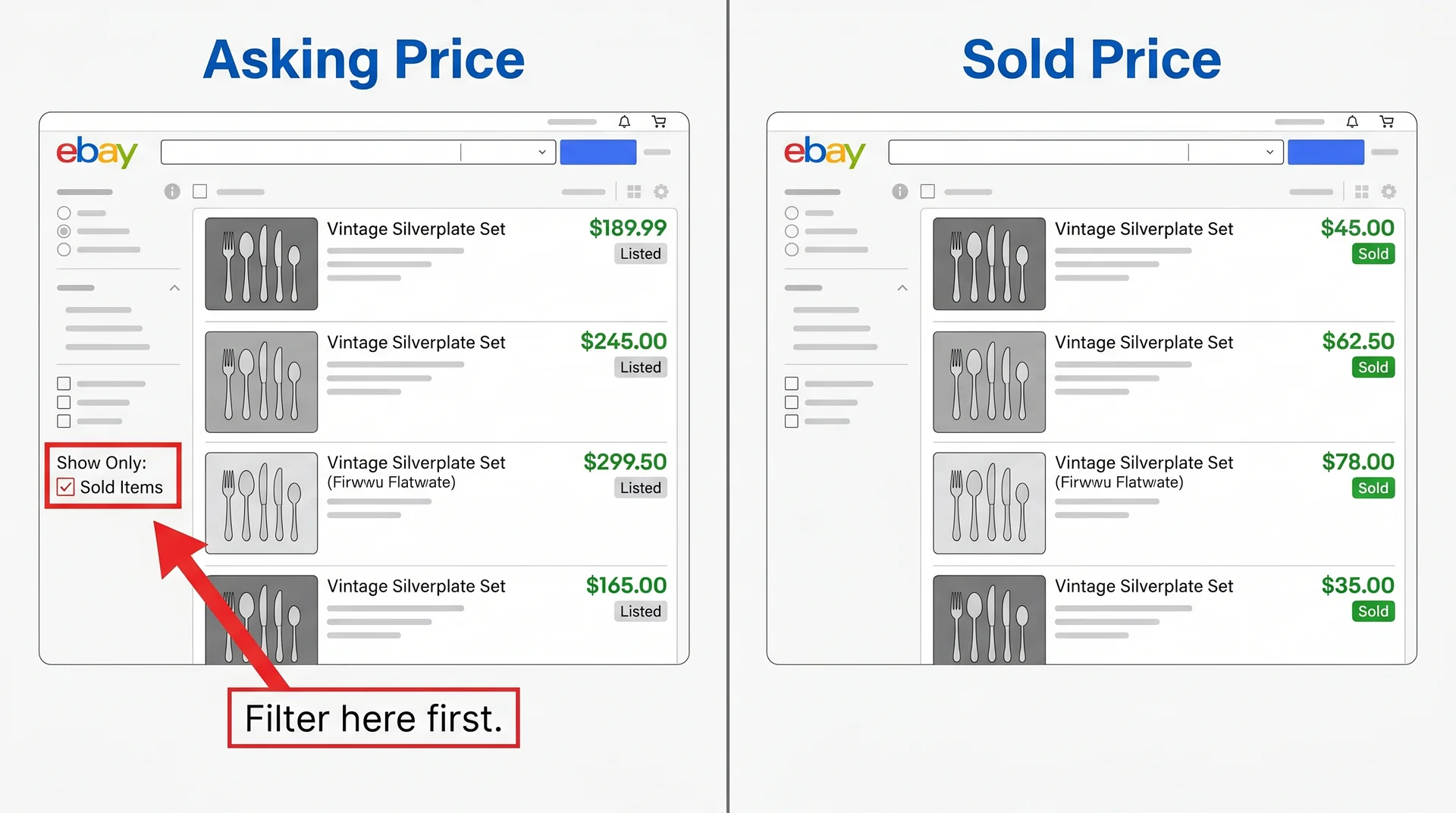
I pulled sold listings from eBay rather than asking prices. I’ve tracked enough of them to know that what sellers list and what buyers actually pay are rarely the same number.
Most common Rogers Brothers and Community Plate sets in good condition moved for $20 to $80.
Complete sets in excellent condition, with serving pieces and original storage, reached $100 to $200. Single pieces from in-demand patterns fetched $5 to $30 from buyers replacing a specific lost piece.
Before listing anywhere, search your pattern name on Replacements.com. If they stock it with buyers actively looking, demand exists. If they don’t carry it, the collector market for your pattern is likely very thin.
The table below maps each channel and what to realistically expect from each.
| Selling channel | Realistic range | Notes |
|---|---|---|
| eBay (sold listings only) | $20–$200 for complete sets | Always check sold prices, not asking prices |
| Replacements.com | $5–$30 per piece | Best for buyers replacing a single lost piece |
| Estate sale or garage sale | $10–$50 for a complete set | Local buyers avoid the shipping problem with heavy flatware |
| Pawn shop | Typically declined | No melt value to recover; no viable margin |
| Silver or precious metals dealer | Typically declined | Same structural reason as pawn shops |
| Antique dealer | Rarely accepted; very low offers | Wrong channel for standard production silver plate |
Condition matters more for a silver plate than for a sterling. Worn plating that exposes the base metal reduces value significantly on a piece that doesn’t have much to start with.
When Collector Value Does Sometimes Apply
A small number of specific patterns carry real collector demand. Most do not.
Three things determine whether any collector market exists for your set:
- Pattern: Within the Oneida Community Plate, patterns including Morning Star, Lasting Rose, and White Orchid have documented followings on Replacements.com and eBay. A single fork from one of these can bring $15 to $30 from the right buyer.
- Condition: Complete sets in excellent condition command more than partial sets. Condition matters more here than it does for sterling, because the available value is already thin.
- Age: A piece from 1890 has modest antique interest. It is not the equivalent of sterling from the same period. Age alone doesn’t add value.
Monograms reduce the market further. A family initial limits buyers to people who happen to want that specific letter. A monogram on a silver plate nearly eliminates resale.
I genuinely don’t know how collector demand for silver plate patterns will move over the next decade. The market has been contracting as the generation that grew up with these sets gets older.
If your pattern has active demand on Replacements.com right now, selling sooner is more sensible than waiting.
Where to Actually Sell Silver Plated Flatware
Two channels do most of the work.
Pawn shops and silver dealers won’t buy a silver plate. They have no way to recover value from it. That’s a structural fact about the material, not a judgment about the flatware.
The Channels That Actually Work
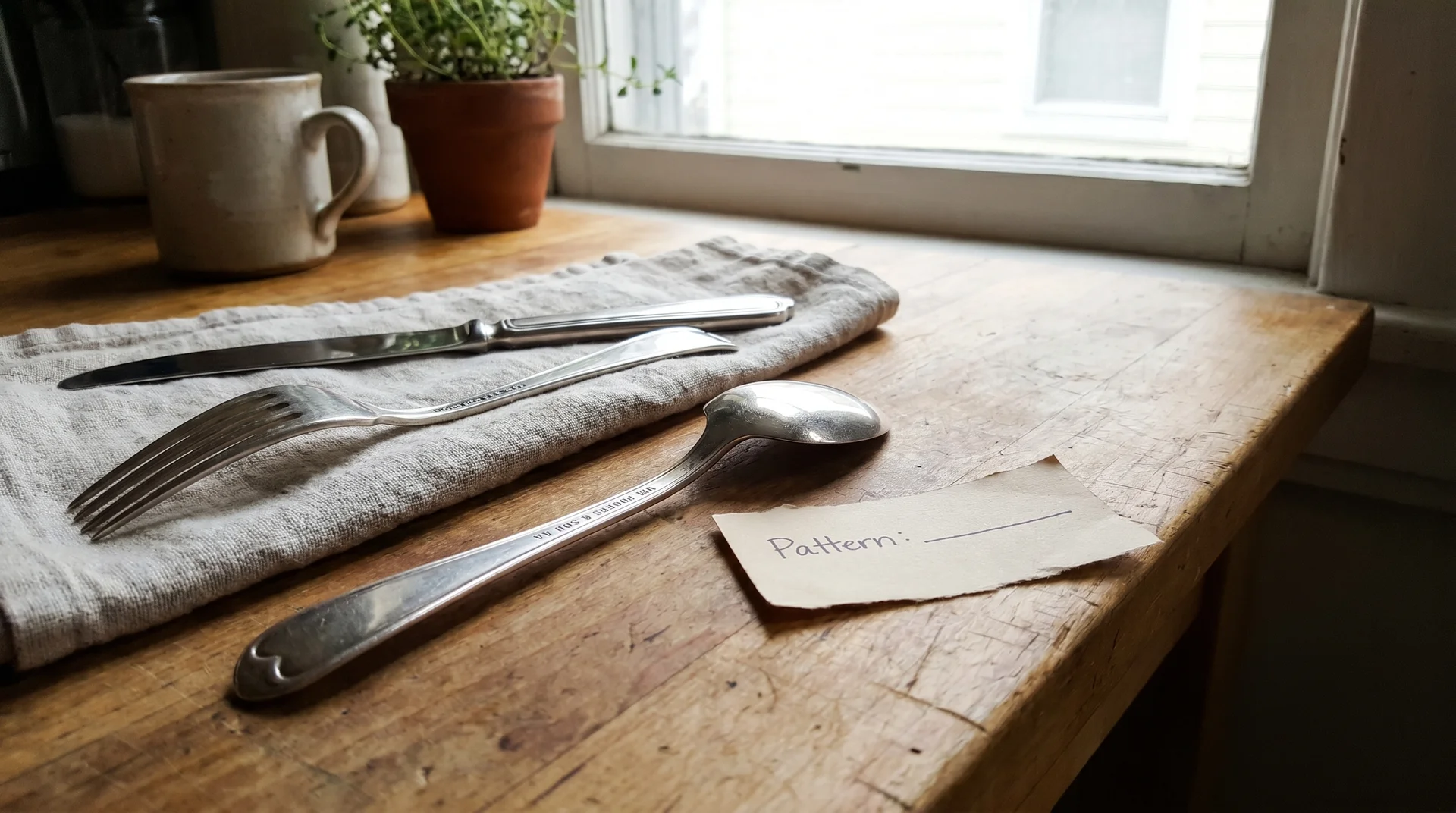
eBay is the best channel for most silver plate sets. Replacements.com is the best channel for individual pieces from popular patterns.
Identifying your pattern name comes first. The pattern name is usually stamped on the back of the handle alongside the brand name. That pattern name determines which channel is worth the effort.
- eBay: Best for complete sets with all original pieces. Photograph the back of the handle clearly so buyers can read the marks. On eBay, select “Sold Items” under “Show Only” in the left sidebar to see actual clearing prices before you set yours. Most common patterns in good condition are clear for $20 to $80.
- Replacements.com: Most useful for individual pieces from in-demand patterns. Their buy prices are low, but the platform connects you with buyers actively searching for your specific pattern. Search your pattern name on their site first to confirm demand exists before sending anything in.
- Facebook Marketplace and Craigslist: Good for fast local sales. Flatware is heavy and expensive to ship. A local buyer eliminates that problem. Price below eBay to move it quickly.
- Estate sale companies: Appropriate when liquidating a full estate. They will move it, but the silver plate won’t drive the value of the sale.
- Antique dealers: Usually pass on standard production silver plate. Worth a call to confirm before making the trip.
One mistake shows up constantly: sellers price from eBay asking prices rather than sold prices. Asking prices reflect optimism. Sold prices reflect reality. Always filter for sold listings first.
When Selling Doesn’t Work Out
If the set doesn’t sell, using it or donating it are both better outcomes than storing it indefinitely.
Silver-plated flatware was engineered for daily use. That’s the literal purpose it was built for. Using it isn’t settling for the wrong outcome.
Donating to Goodwill or a similar organization works well and has a practical advantage. Ask for a written receipt. The IRS allows you to claim the fair market value on a receipt from a qualifying charitable organization as a deduction on your return.
Letting go of the inherited silver plate is not a betrayal of the person who owned it.
People feel responsible for parting with something a parent or grandparent called their good silver. That feeling is understandable.
It was good silver. It served its purpose well and for a long time. What it’s worth now and what it was worth in a kitchen are different questions.
You’re allowed to answer them differently.
Is Silver-Plated Flatware Worth Using?
Yes, and it’s the answer most people aren’t expecting when they search this.
The commercial kitchens I worked in ran on silver-plated flatware because it was built to hold up. Pieces designed for hotel dining rooms went through industrial dishwashers six nights a week for years.
Hand washing extends the plating life considerably. I’ve run older pieces through a modern dishwasher and watched the plating go dull within a few cycles. Don’t put pre-1950 pieces with visible wear in a modern dishwasher.
Hand washing is the safer choice for any piece you plan to keep.
The set looks good on a table and holds up to daily use. If you already own it, it costs nothing. Earlier, I said the material was doing exactly what it was designed to do.
That applies here too. The disappointment isn’t a failure of the material. Once that mismatch closes between what you expected and what the piece was actually built for, the decision gets considerably easier.