

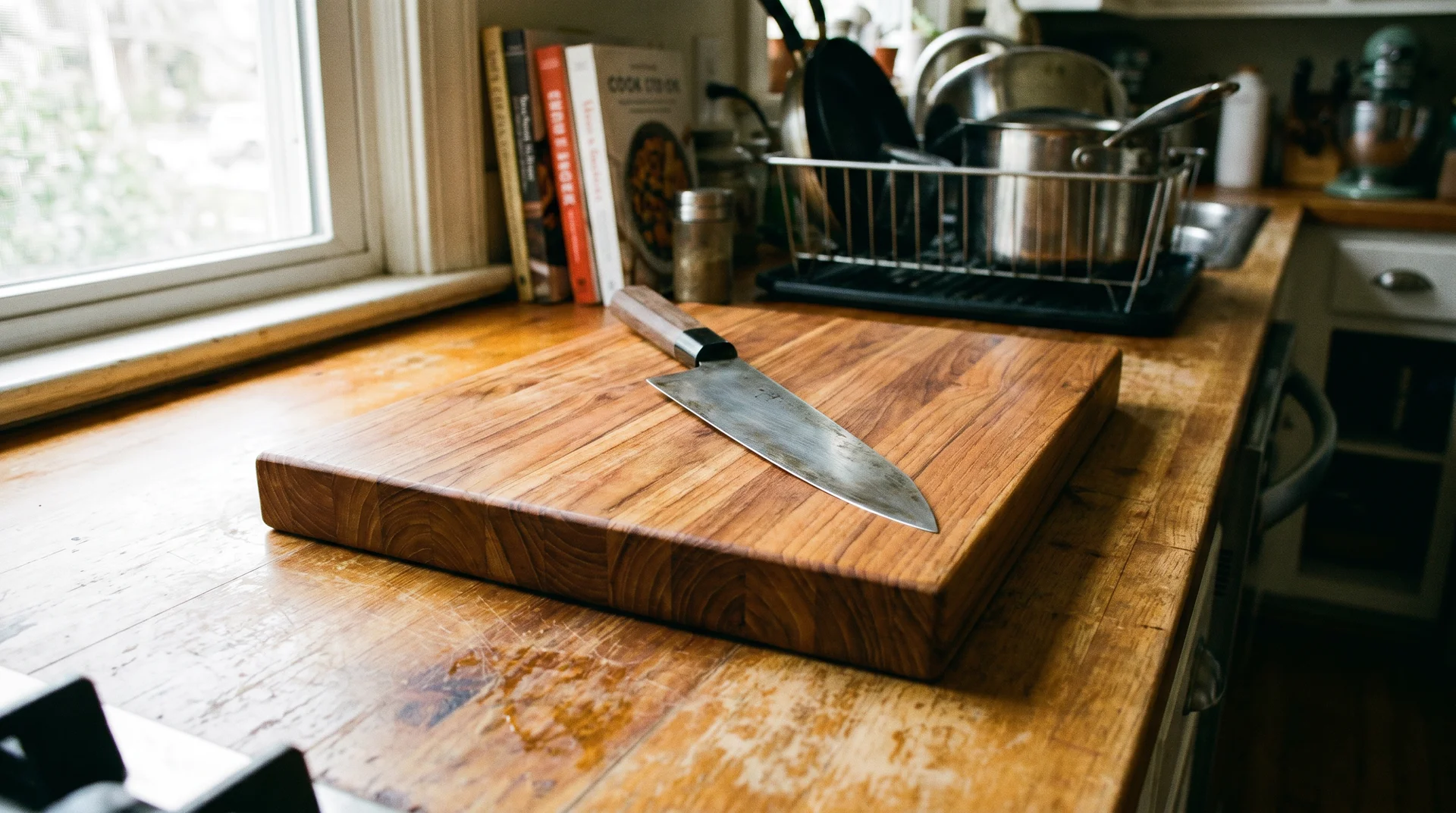
Teak makes a good cutting board for most home cooks. The part most articles skip is the part that actually determines whether it belongs in your kitchen: what kind of knife you own.
I tested both board constructions, edge grain and end grain, in my own kitchen rather than in controlled conditions. Here is what that testing actually showed.
| Disclosure: No affiliate commissions on anything mentioned here. There are no brand relationships to disclose for this piece. |
What Teak Is and Why It Ended Up in Your Kitchen
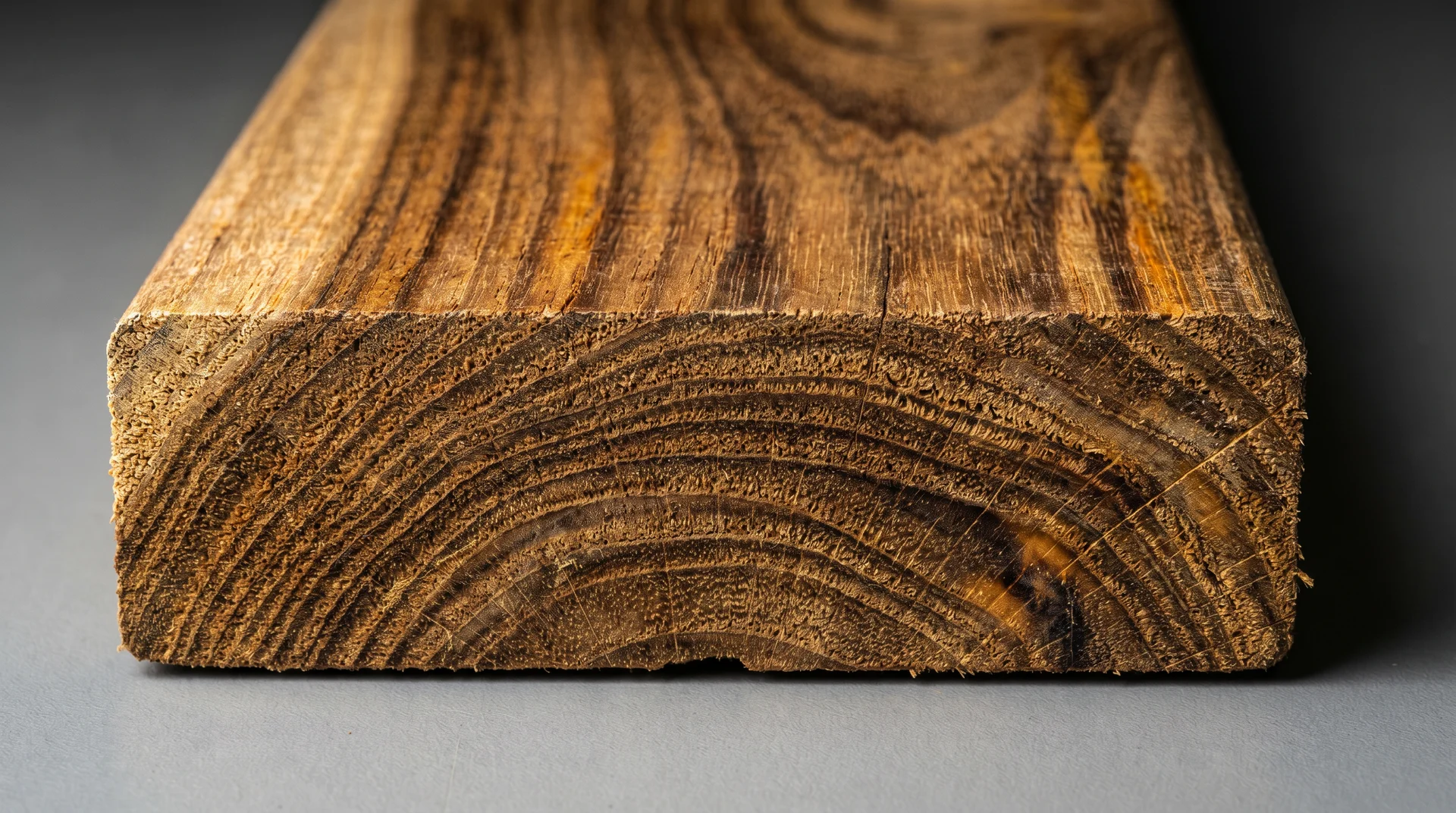
Teak is a tropical hardwood from Southeast Asia, prized above most others for one property. It is moisture-resistant.
Shipbuilders used teak for decking because it handles sustained wet conditions without rotting, warping, or splitting. That durability earned teak its reputation long before anyone put it in a kitchen.
The wood’s natural oil content protects it from within in a way that surface treatments cannot replicate.
Teak’s Natural Oils
Teak produces its own protective compounds, called tectoquinones, embedded directly in the wood fiber, not applied as a surface treatment.
Those oils are part of the structure itself. That is what makes teak genuinely water-resistant rather than just water-treated. Other hardwoods like maple need regular conditioning to maintain moisture resistance. Teak starts with an internal buffer that those woods don’t have.
The oils also create a surface that is less hospitable to bacterial growth than more porous woods.
I want to be careful about how far that claim goes, because the antimicrobial marketing around teak tends to run well ahead of what the evidence actually supports. I’ll come back to that specifically in the food safety section.
Teak’s Reputation for Cutting Boards
Cooks Illustrated tested several cutting board materials and recommended teak for durability and moisture performance, giving the category a credibility it still coasts on today.
That recommendation is real and came from credible testing. It was also based primarily on durability and moisture resistance, not on a sustained evaluation of what teak does to knife edges over months of daily use.
How Teak Performs as a Cutting Board?
Teak performs well on the measures that matter most to a home cook.
- It resists warping better than maple or walnut when exposed to moisture.
- It requires conditioning less often.
- It handles regular kitchen use without cracking when maintained reasonably well.
These are genuine performance advantages, not specification language repurposed as a sales pitch.
The Janka Hardness Scale
Wood hardness is measured on the Janka hardness scale, and teak comes in at roughly 1,070 lbf, placing it between walnut and hard maple.
- Hard maple sits at approximately 1,450 lbf.
- Walnut comes in around 1,010 lbf.
The Janka number measures how much force it takes to embed a steel ball halfway into the wood. Higher numbers mean a surface that resists scratching better, and a surface that puts more stress on knife edges.
On hardness alone, teak is not the worst choice for knives. Most professional kitchens use maple, which is harder. The knife question with teak comes from somewhere else in the wood’s chemistry, which the next section covers.
Edge Grain vs End Grain
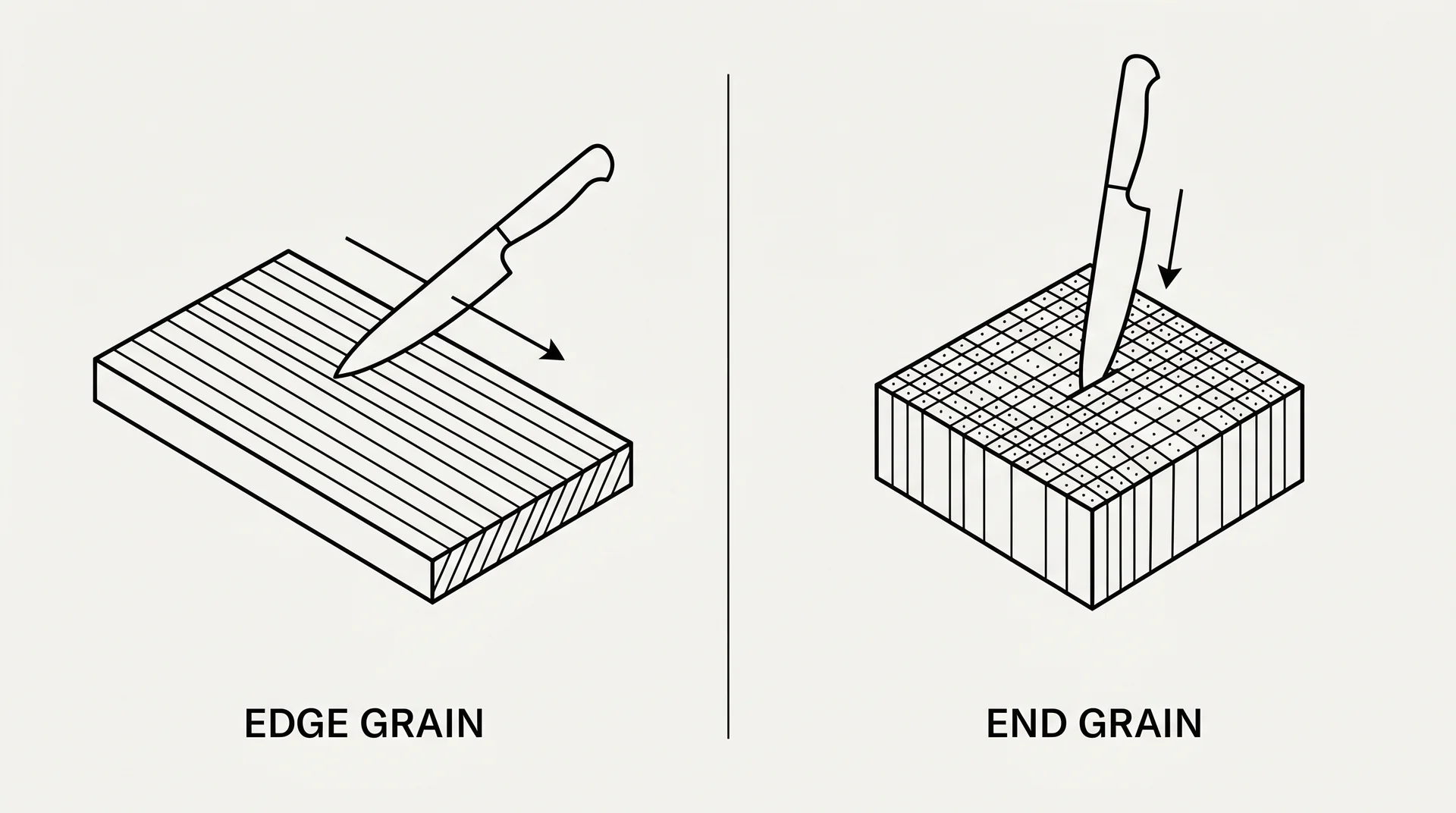
Whether your board is edge grain or end grain changes how teak behaves under a knife, and most articles evaluating teak do not say which construction they are actually testing.
- Edge-grain boards are built with the long face of the wood facing up. The grain runs parallel to the cutting surface.
- End-grain boards are built with the cut ends of the wood facing up, so the grain runs perpendicular to the board, producing the familiar checkerboard pattern you see on butcher block counters.
When you cut on an end-grain board, your knife blade enters the wood fiber rather than riding across it. That is gentler on the edge.
On an edge-grain board, the blade rides across the surface, meaning sustained lateral contact with whatever is in that surface.
This distinction matters specifically for teak’s silica content, which the next section explains in full.
Water Resistance in Practice
Teak’s moisture resistance is genuine, and it is the main reason I feel comfortable recommending it for home cooks who aren’t meticulous about drying boards immediately.
Maple has real advantages as a cutting surface. It will also punish you for neglecting it.
Leave a maple board wet on one side, and it will cup relatively quickly. I’ve used a teak edge-grain board for just under two years in my own kitchen, not in controlled conditions, and it has not warped despite a household that doesn’t always dry dishes immediately.
That tolerance for imperfect care is Teak’s most practical selling point for a real home kitchen.
Does Teak Dull Knives?
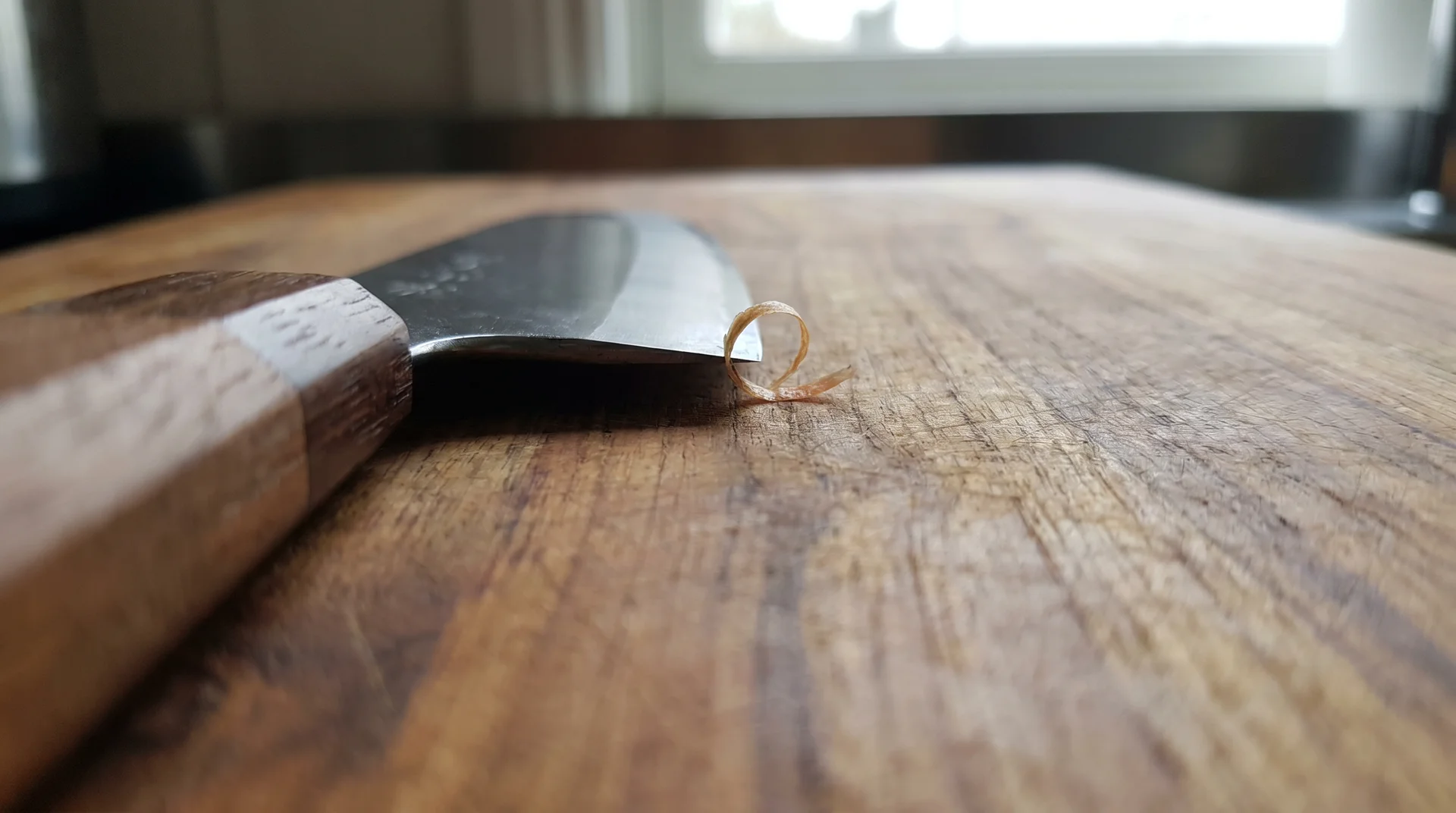
Teak contains silica, and silica dulls knife edges.
For most home cooks using standard Western-style knives, the effect is minor in practice. For cooks using thin Japanese knives at a daily volume on edge-grain boards, it is real and worth taking seriously.
What Silica Is and How It Affects an Edge
Silica is a naturally occurring mineral compound, the same material glass is made from, and teak contains meaningful amounts of it distributed through the wood fiber.
Silica is abrasive. When a blade contacts it under lateral pressure, it acts like fine-grit sandpaper on edge geometry. That is why experienced woodworkers are so emphatic about teak damaging their tools.
When a woodworker mills or planes teak, the blade contacts silica along its full length under significant sustained force. The resulting edge degradation is measurable and real.
The situation on a cutting board is not the same thing.
The Woodworker vs Home Cook Contradiction
The woodworkers are not wrong about teak and tool edges. They are just not describing the same motion you make when you slice an onion.
The difference is in contact mechanics. When a woodworker planes teak, the blade contacts silica laterally and continuously under load.
When you chop on a teak board, your blade makes brief perpendicular contact with the surface. The silica is present in both situations. The mechanical stress on the edge is not comparable between the two.
On an end-grain teak board, the blade enters the wood fiber rather than riding across it. That reduces lateral silica contact further still.
Edge-grain teak is where the knife-dulling concern is most legitimate, specifically for thin, acutely beveled knives used at daily volume. That is a real condition, not a universal problem.
When Teak Becomes a Genuine Knife Problem
The people most likely to experience real edge degradation on a teak board are specific.
If you use a thin Japanese knife, something with a 10-to-15-degree bevel angle, at a daily cooking volume, with a heavy rocking technique, on an edge-grain board, you are putting your edge in sustained lateral contact with a silica-containing surface. Over weeks and months, you will sharpen more often than you otherwise would.
If you use German-style knives with a 20-degree-plus bevel, cut with a push-cut or press technique, or work on an end-grain board, the silica issue becomes largely theoretical for practical home use. Most home cooks fall into that second category.
I want to be straightforward. How much the knife-dulling effect varies between individual teak boards depends on the sourcing region and actual silica concentration in a given specimen.
Teak Cutting Board and Food Safety
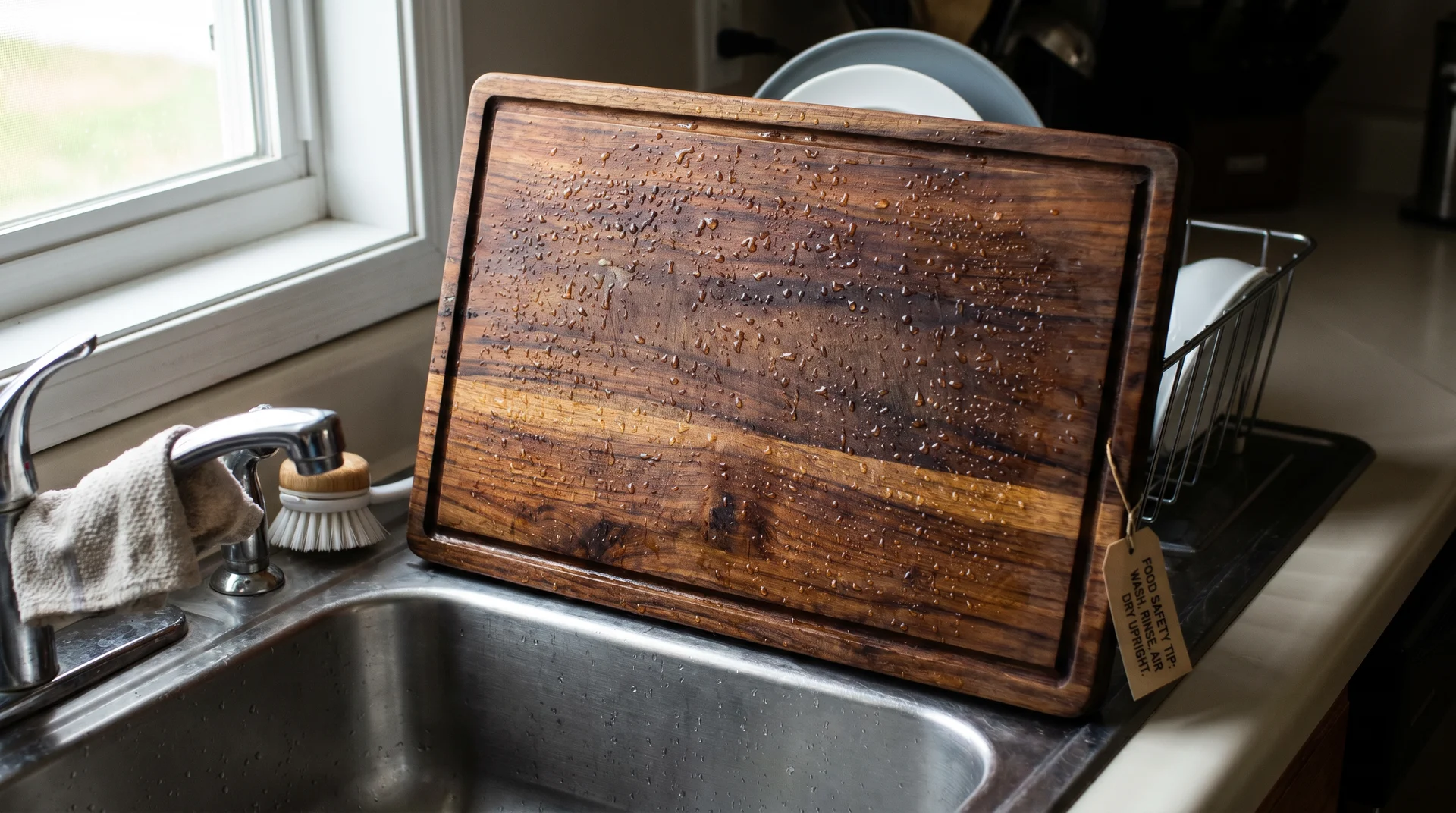
Teak is safe for food contact when properly maintained.
Teak’s natural oils are routinely marketed as making the wood inherently antimicrobial. That framing is where the marketing runs ahead of the evidence, and it is worth understanding exactly where the line sits.
The Antimicrobial Claim
Teak’s natural oils create a surface less hospitable to bacterial growth than open-grained or porous woods, but the “antimicrobial” label common in teak product marketing goes too far.
The oils reduce moisture absorption in the wood, which reduces the conditions bacteria need to survive at the surface. That is a real mechanism and a real benefit. It is not the same as saying teak actively eliminates bacteria or that proper cleaning becomes optional. It does not become optional.
Bob Vila’s material analysis, drawing on industry grain and hardness data, correctly notes that teak has larger pores than hard maple.
Maple is genuinely tighter at the cellular level. For most home cooking, a properly cleaned and maintained teak board is safe.
For raw meat prep specifically, your cleaning process matters more than the wood species.
What Large Pores Mean in Practice
Teak’s larger pore structure makes it slightly more vulnerable to bacteria, staining, and moisture absorption over time than hard maple.
This does not make teak unsafe for a home kitchen. It means the food safety gap between teak and maple is real.
End-grain teak reduces some of this disadvantage, since the wood fiber closes more tightly around knife cuts. If food safety is your primary concern, maple is the better choice.
For standard home cooking, properly maintained teak is safe to use.
Teak vs Maple: What the Comparison Comes Down To
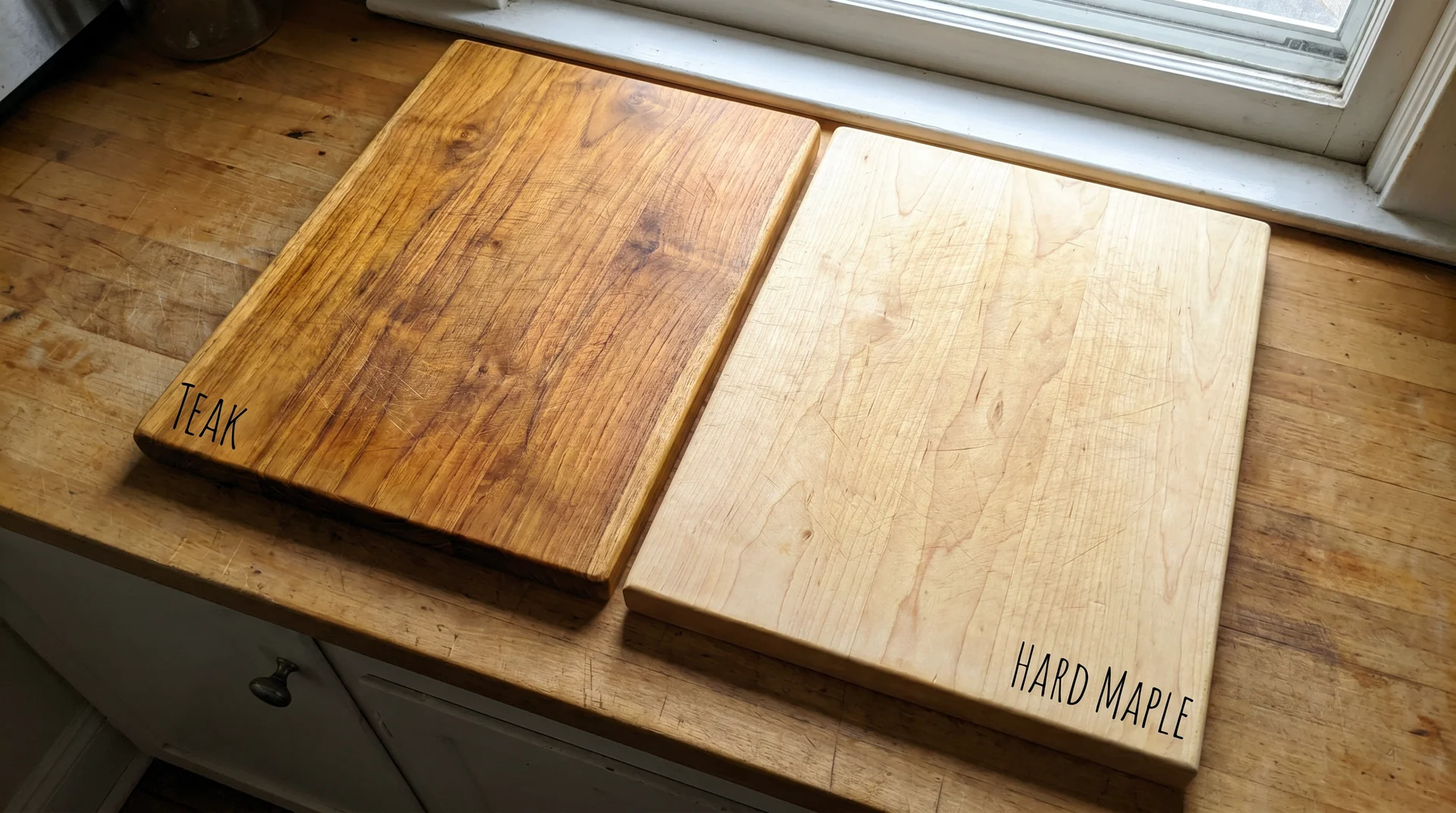
Maple and teak are the two most compared cutting board woods.
| Factor | Teak | Hard Maple |
|---|---|---|
| Janka hardness | ~1,070 lbf | ~1,450 lbf |
| Silica content | Present, relevant for thin knives on edge grain | Not present |
| Natural water resistance | High, built into the wood fiber | Low, requires regular conditioning |
| Pore size | Larger | Tighter, better at blocking bacteria and staining |
| Conditioning frequency | Quarterly to biannually | Monthly to bimonthly |
| Best for | Lower-maintenance home cooks | High-volume cooks who sharpen on a schedule |
Maple is the standard in professional kitchens because it is a better surface for sustained high-volume prep.
It is harder, tighter, and better for edge retention across thousands of cuts a week. It also requires consistent conditioning, handles moisture less gracefully, and shows every stain on its light surface.
Teak asks less of you. That is its honest selling point.
Walnut deserves a brief mention here. It sits at around 1,010 lbf on the Janka scale, softer than teak, and contains no silica. It is the most forgiving option for knife edges of the three.
It requires more conditioning than teak and marks more visibly than either. If edge protection is your highest priority and you are willing to maintain the board carefully, walnut is worth considering alongside these two.
If You Already Own a Teak Board
Sharpen your knife properly, then track how many weeks pass before you feel the edge degrading in normal daily use.
- If you are cooking regularly with a German-style knife and getting four to six weeks from a sharpening, your board is probably not your problem.
- If you are cooking daily with a thin Japanese knife and getting two to three weeks between sharpenings, the board may be contributing, though your technique and sharpening method are factors too.
That test, not the wood category or the brand claim, is the actual answer for your kitchen.
When Teak Makes Sense and When It Doesn’t

The right cutting board wood depends on your knives and your habits.
Who Should Choose Teak
Teak is the stronger choice for home cooks who want a durable, low-maintenance board and don’t own high-end Japanese knives.
Consider teak if:
- You use German-style or general home cook knives with a 20-degree-plus bevel
- You sharpen your knives occasionally rather than on a set schedule
- You don’t always dry your board immediately after washing
- You want a board that doubles as a serving piece
- You cook outdoors or in a kitchen with significant humidity variation
- Sustainability matters to you: FSC-certified teak is widely available and worth specifying
For this profile, teak’s moisture resistance and forgiving conditioning schedule are genuinely useful. The silica concern is real. For this kind of cook, it is unlikely to show up as a practical problem.
Who Should Look at Maple Instead
Maple is the stronger choice if you care about edge retention and cook at high volume.
Consider maple if:
- You own Japanese knives with thin, acute bevel angles
- You cook daily and use a rocking cutting technique
- You sharpen on a schedule and track your edge retention carefully
- You are willing to condition your board monthly or more often
Maple’s lack of silica makes it a safer surface for thin, acute edges. If your knife investment reflects that, your board should too.
How to Care for a Teak Cutting Board
The claim that teak “barely needs oiling” because of its natural oils is the most repeated piece of advice in this category, and it is the reason most damaged teak boards got that way. The oils are real, but they are not permanent.
They deplete with washing and use, and a dried-out teak board cracks exactly like any other wood.
Cleaning
Hand-wash your teak board with warm water and mild dish soap after every use, the same day rather than the next morning.
Use a soft sponge or cloth. Avoid abrasive pads. Wash both sides even if you only used one, because uneven water absorption between faces is what causes warping over time.
Soaps with high alcohol content strip natural oils faster than standard mild soap. Mild soap and warm water are the standard because it cleans effectively without accelerating oil depletion.
Drying
Stand your board upright on its edge to dry after every wash, never flat on a wet countertop.
Flat drying traps moisture under the board. One side dries faster than the other. The resulting moisture differential is what causes cupping and warping.
This applies to every wood cutting board, but teak’s durability gives some owners the impression they can skip the step. You cannot.
Oiling
Use food-grade mineral oil, and let the board’s surface tell you when it needs conditioning rather than following a fixed calendar.
The practical signal is simple. Water should bead on a well-conditioned teak surface. When water starts soaking in rather than beading, oil the board.
For most cooks using teak regularly, that interval lands between once a month and once every six to eight weeks. Manufacturers recommend every two to three weeks. Some sources say quarterly. Both figures can be accurate depending on how often you cook and how heavily you wash.
Apply food-grade mineral oil generously to all surfaces. Let it soak in for at least 15 minutes before wiping off the excess.
End-grain boards absorb more oil than edge-grain boards and need conditioning more often. The exposed fiber at the cut-end surface is more porous than the long-face grain. End grain carries a higher maintenance cost than edge grain in that one respect.
Do not use olive oil, coconut oil, or any cooking oil on your board. Those fats oxidize inside the wood and turn rancid. A beeswax-based board cream works well as a follow-up conditioner once the mineral oil has soaked in fully.
Restoring a Dry or Scuffed Board
A lightly scarred or dried-out teak board can usually be brought back with careful sanding followed immediately by mineral oil conditioning.
Sand with 220-grit or finer, working with the grain, until the surface is smooth. Remove all dust before conditioning: any dust left in the grain will absorb into the wood with the oil. Then condition immediately. The sanding opens fresh wood fiber, and it needs sealing right away.
Deeper work, including flattening a warped board, repairing cracked sections, or recovering a board damaged by repeated dishwasher use, goes beyond what this piece covers. That kind of restoration involves enough variables that it warrants its own guide.