

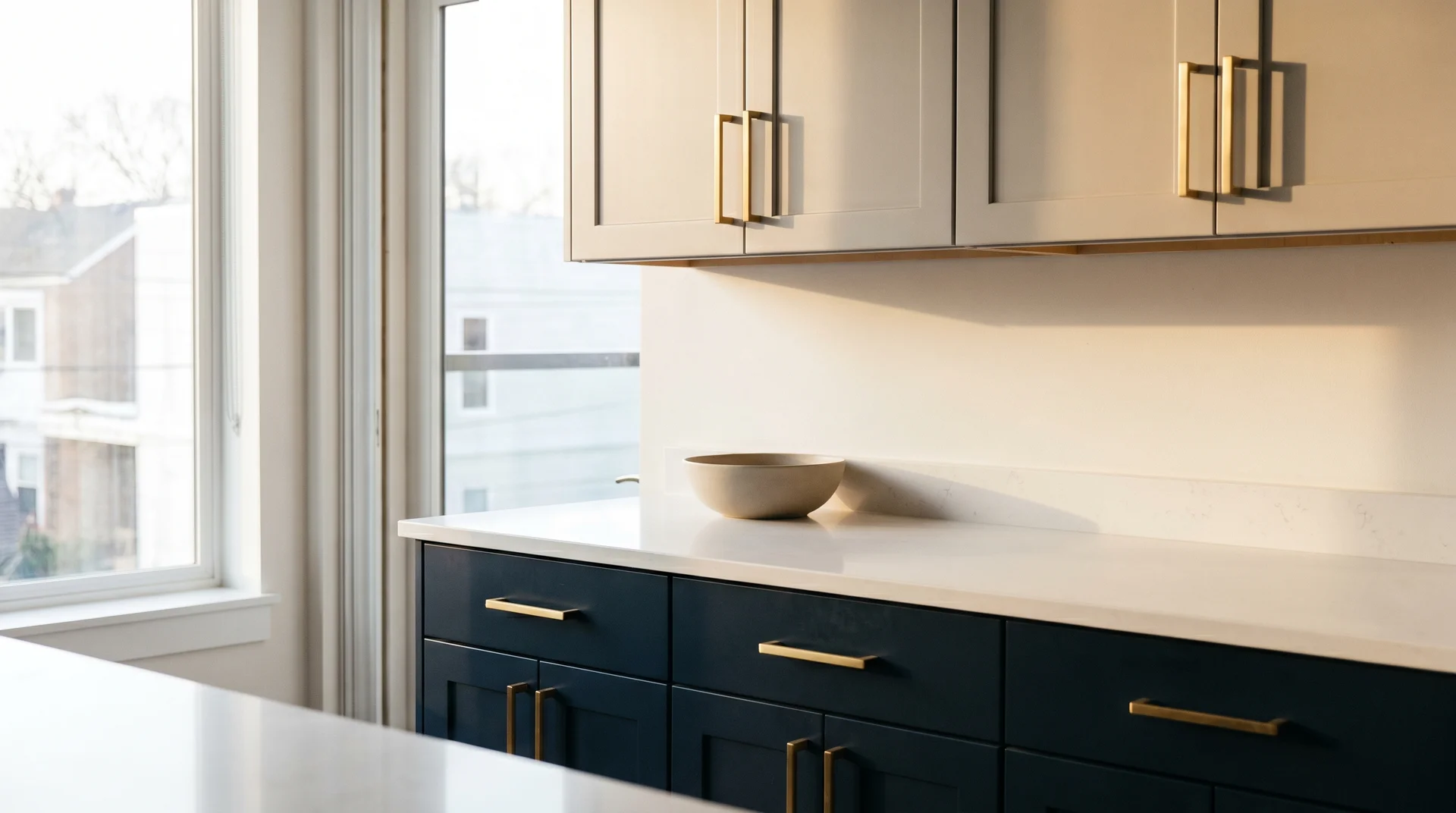
Blue and gray share a cool, calm tonal base that most kitchens can carry.
They sit close enough on the spectrum that the transition between them reads as deliberate rather than accidental.
That internal logic is the same reason navy and white work, with more complexity and less contrast. The problem appears when a room’s specific conditions don’t support the palette.
The Specific Condition That Makes This Combination Fail
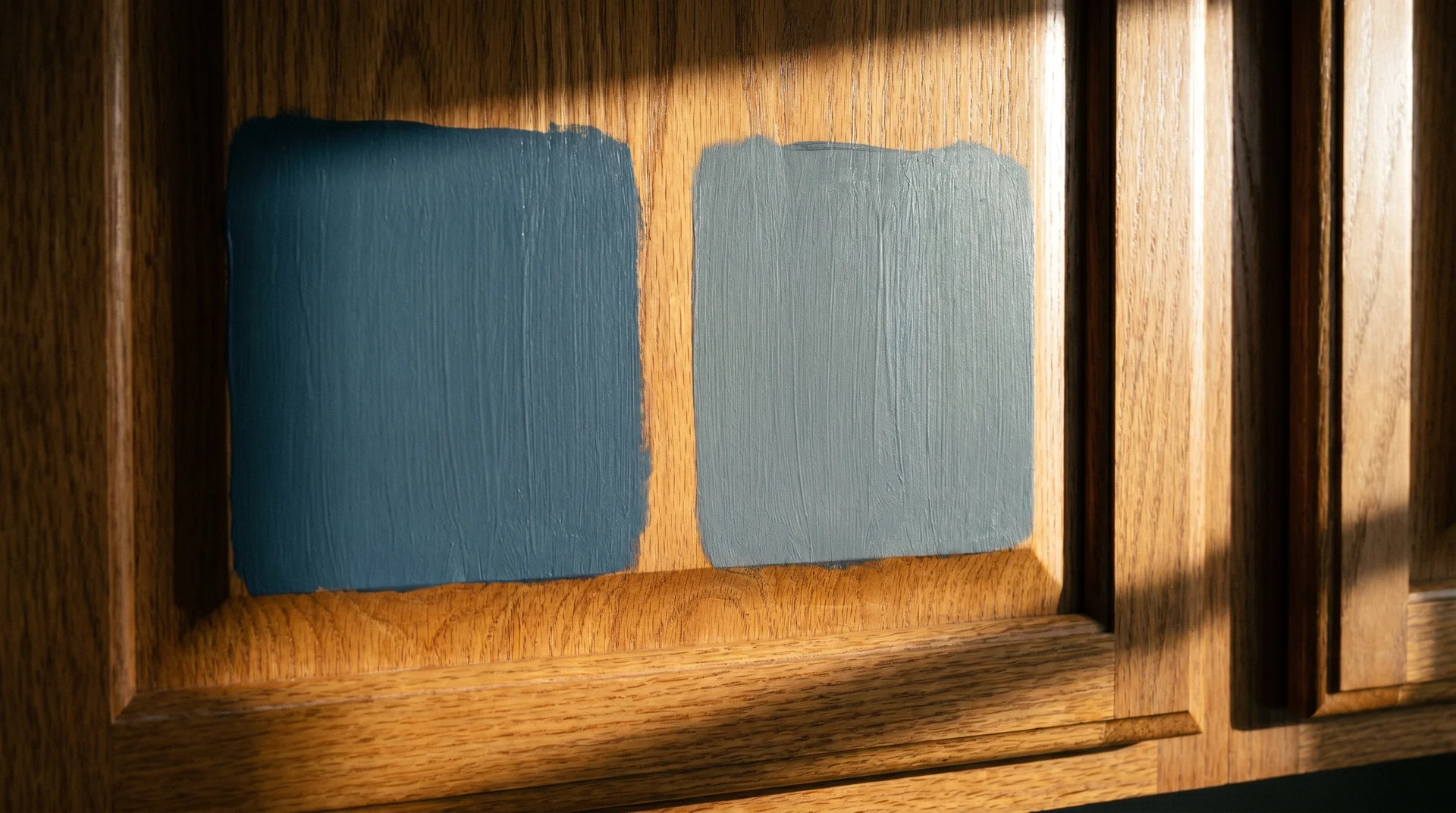
The combination fails when both colors carry a cool undertone, and the kitchen has no warm light source to offset them.
Walk into that kitchen and the first thing your eye registers, before you’ve looked at a single cabinet door, is temperature. Cool surfaces read as cold before they read as designed.
I keep a reference file of kitchen failures, twelve years of photographed real rooms. One pattern appears more often than any other: a blue-gray palette chosen from a well-lit photo and installed in a north-facing kitchen with a single overhead fixture. That room feels wrong before you can explain why.
The actual fix is choosing the right value of each color for your specific room’s light, before committing to any paint.
Which Color Goes Where?
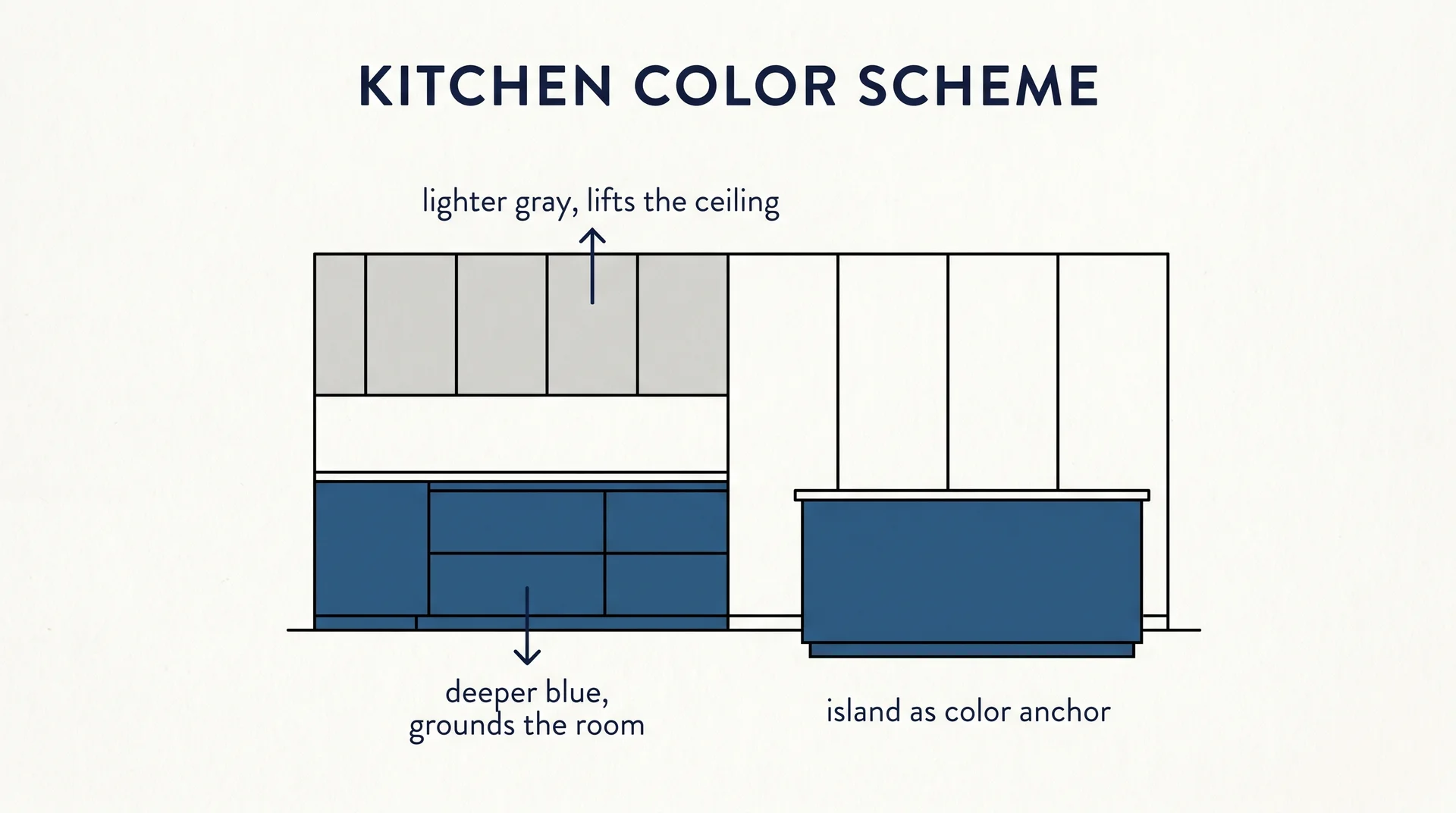
Most people choose shades first and figure out placement afterward. That’s the wrong order. Which surface each color occupies changes which value works and how the room reads from the doorway.
Should upper or lower cabinets be darker in a two-tone kitchen? Darker on the lowers, lighter on the uppers.
- Dark shades lower the ground of the room and draw the eye toward the countertops and hardware.
- Light shades uplift the ceiling and keep the top half from feeling heavy.
For most blue-and-gray schemes, blue goes on the lowers and gray on the uppers. Blue is almost always the deeper, more saturated tone.
That holds as long as your blue is genuinely darker than your gray. If you’ve picked a pale dusty blue and a deep charcoal, the logic reverses accordingly.
Do You Have a Tall Ceiling Room?
Darker lowers and lighter uppers are right for most kitchens, but tall-ceilinged rooms can handle more visual weight up high.
If your ceiling clears nine feet and the kitchen runs long, a deeper blue on the uppers with soft gray below can feel cozy rather than overwhelming.
It wraps the room rather than just grounding it. I’d only make that call after seeing the room in person; for standard eight-foot ceilings, stay with the conventional placement.
Island as the Third Zone
An island changes the logic for the perimeter cabinets because it becomes the natural color anchor for the whole room.
A saturated navy island with soft gray perimeter cabinets is a cleaner version of this palette than trying to split blue and gray across the full perimeter run.
How to Match Blue and Gray Without an Undertone Clash
The undertone clash is the most common reason this combination fails in real kitchens.
Reading Undertones Before You Buy Paint
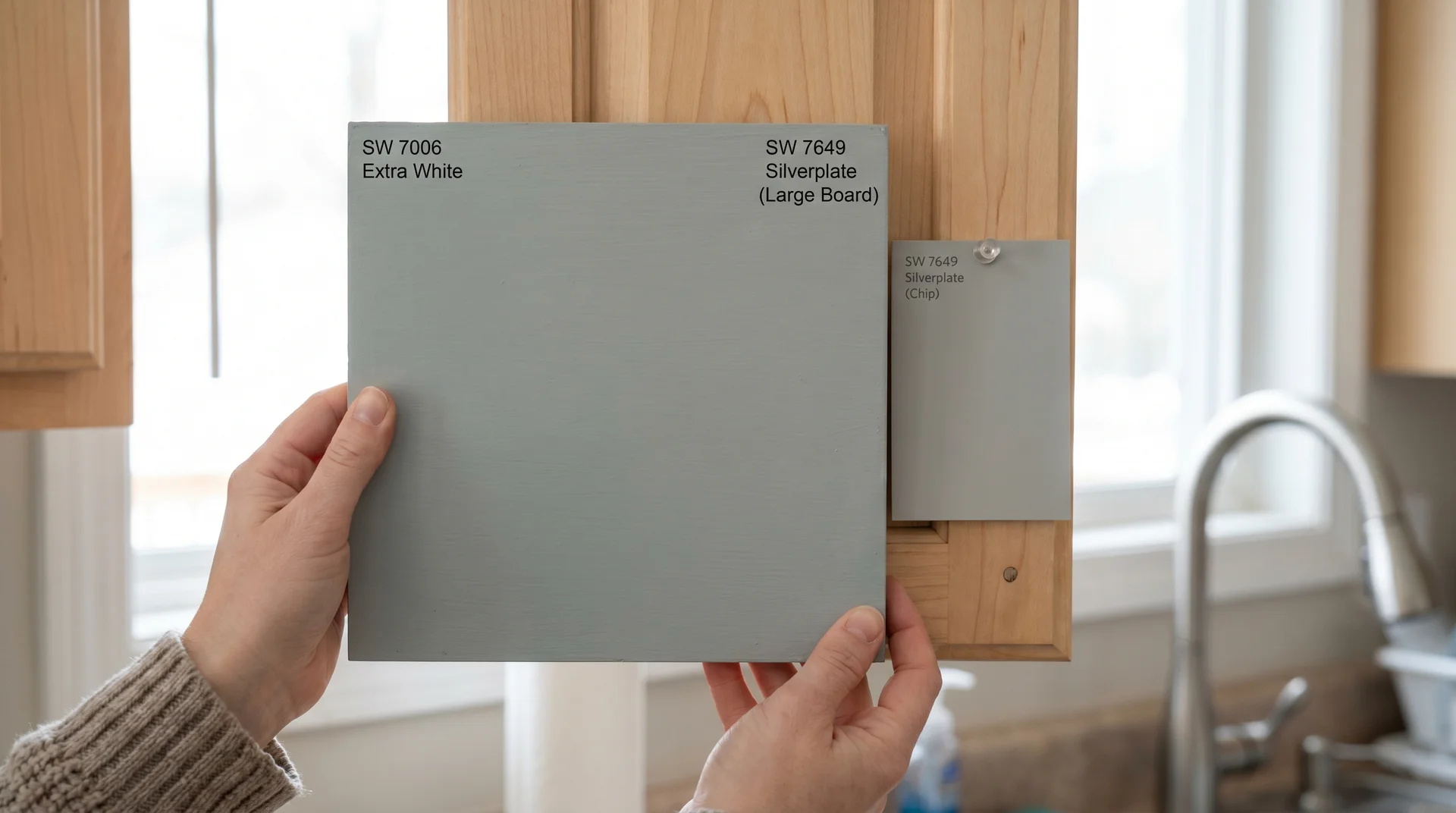
A small paint chip is not a reliable test for undertone, not in a kitchen environment, and not with these two colors.
The chip shows you the color under store lighting against a white card. Your kitchen has different lighting, different surrounding surfaces, and a different ceiling, all of which shift how a shade reads once it covers a large cabinet surface.
Use a 12-by-12-inch sample board painted in the actual color and view it in your kitchen at three different times of day: early morning, midday, and late afternoon.
- Gray has undertones that pull green, purple, or blue, depending on its base pigments.
- Cool gray with a blue base will start to read almost teal under late-afternoon kitchen light.
If your blue cabinet tone is a clean, saturated navy and your gray is secretly pulling blue too, the two tones merge instead of contrasting. That shift is your kitchen lighting doing its job.
Benjamin Moore and Sherwin-Williams both publish undertone breakdowns for their gray color families. They’re more reliable than reading a chip in a fluorescent store light.
The sample result in your own kitchen light is the only data that matters.
The North-Facing Kitchen Problem
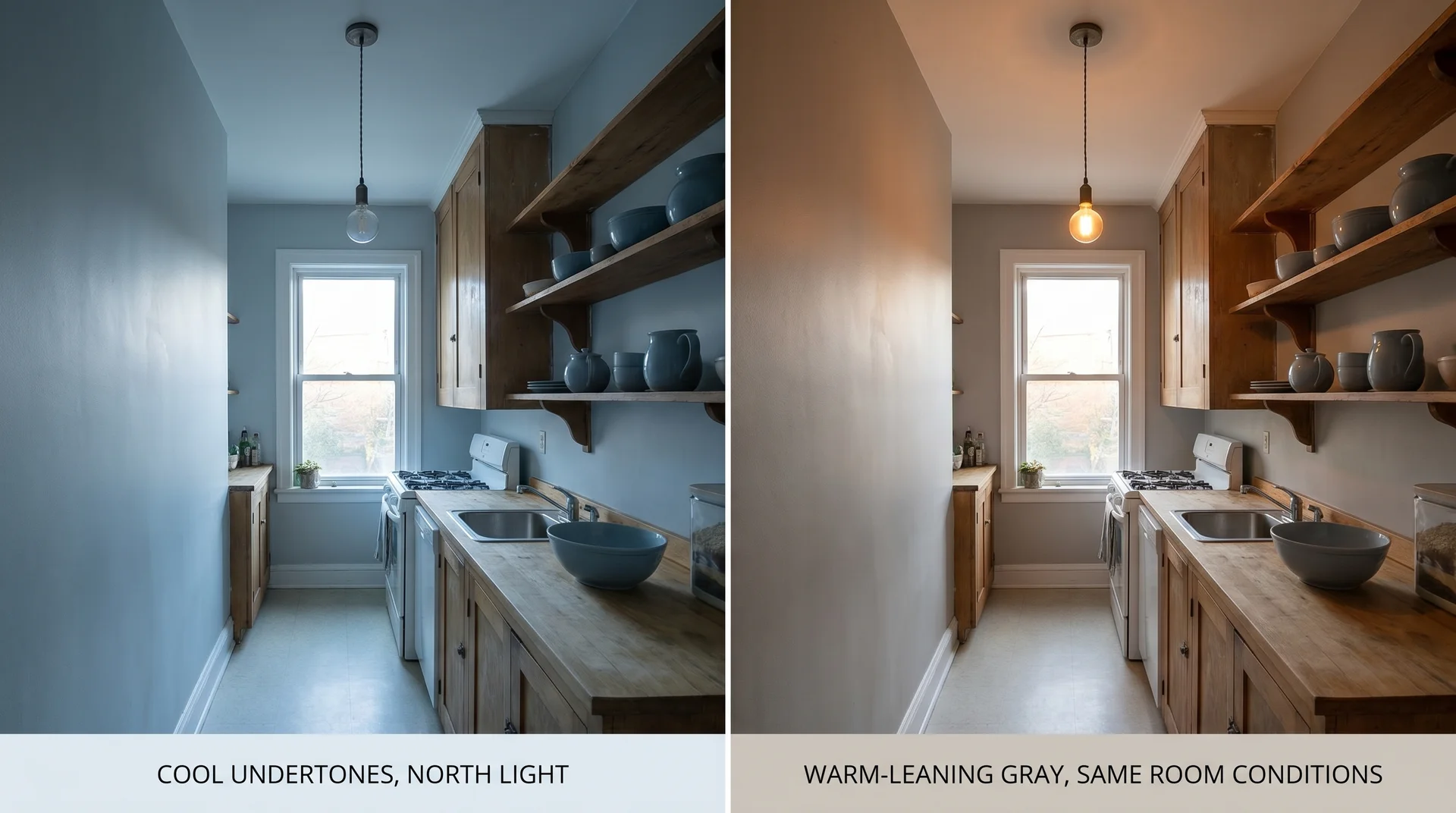
A north-facing kitchen needs warmer shades on both sides of this palette, without exception.
North-facing rooms receive cool, indirect light all day. Cool paint colors in cool light compound the temperature problem rather than resolve it.
I’ve walked into north-facing kitchens painted in designer-approved blue-gray palettes and felt the room fell flat and cold even when the installation is complete.
Ideally,
- Your gray should carry a warm base, leaning toward greige, gray with a warm beige base, rather than toward blue or purple
- Your blue should be muted and dusty rather than saturated.
I genuinely don’t know where the exact line falls for every room, because ceiling height, window size, and overhead fixtures all play into it. But the direction is always the same: warmer on both sides.
Paint Colors That Actually Work: Specific Pairings by Room Condition
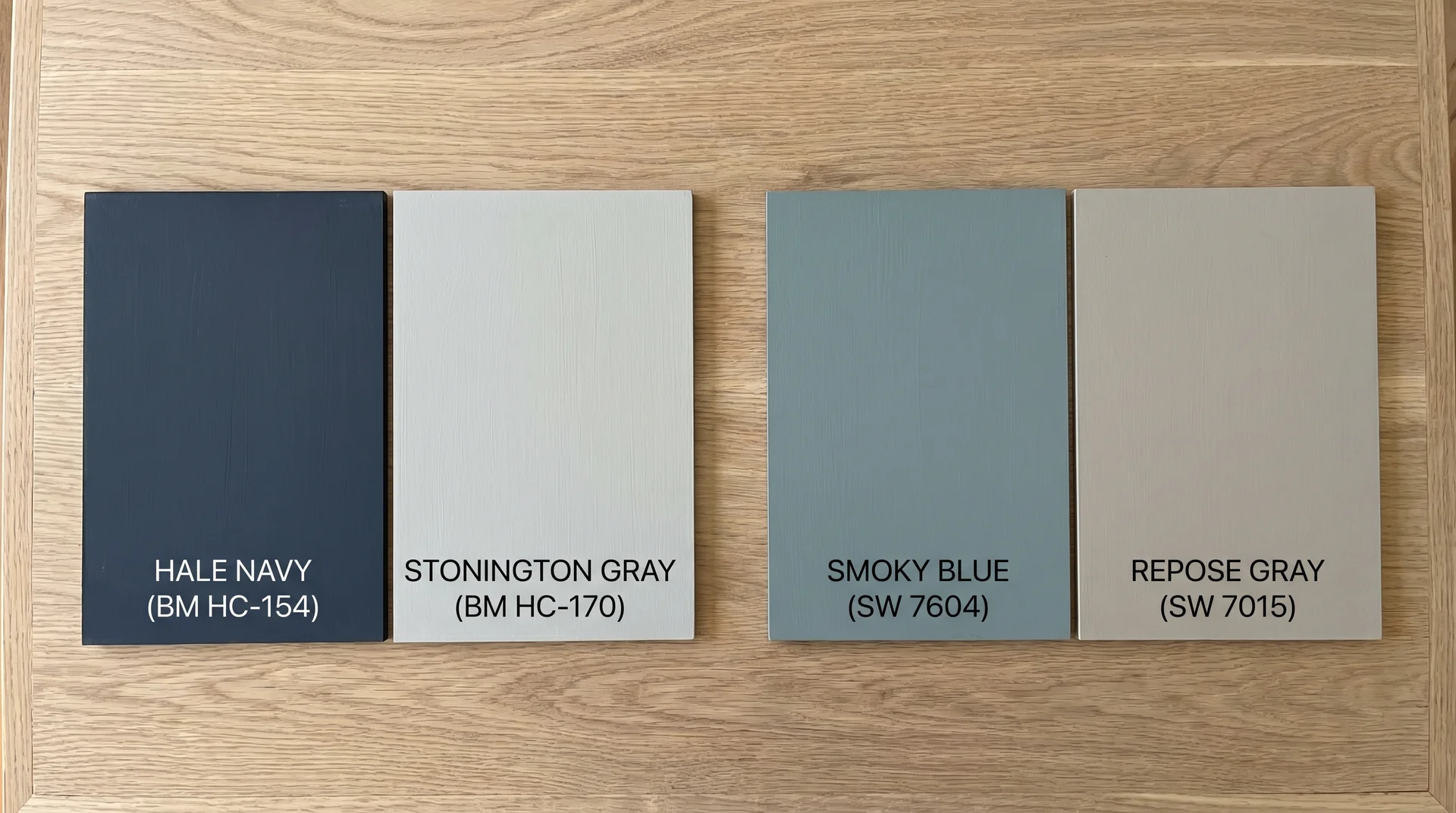
These combinations come from real project results, not showroom palettes. They’re organized by light condition, which is the variable that matters most.
For Kitchens with Strong Natural Light
In a well-lit kitchen, you have room to go deeper with both tones without losing the space.
Two pairings that hold up consistently. First,
- Hale Navy (Benjamin Moore HC-154) on lowers with
- Stonington Gray (Benjamin Moore HC-170) on uppers.
The combination has real depth without tipping into heaviness, because the gray uppers lift it.
Second,
- Smoky Blue (Sherwin-Williams SW 7604) on lowers with
- Repose Gray (SW 7015) on uppers, for a softer, more Scandinavian result.
Repose Gray is overused in renovation projects right now, but it earns attention. It holds warmth better than most mid-tone grays.
For Kitchens with Limited or North-Facing Light
In a low-light kitchen, shift toward warmer values on both sides of the palette.
Avoid any gray with a visible blue or purple base. It reads gray at the paint store and lands closer to slate once it’s on the cabinets. For the gray,
- Revere Pewter (Benjamin Moore HC-172) is overused in general renovations, but earns its place here because it carries green-brown warmth that resists going cold.
- Edgecomb Gray (Benjamin Moore HC-173) is a less common alternative with similar warmth.
For the blue in low-light conditions, muted and dusty is the right direction.
- Smoky Blue (Sherwin-Williams SW 7604) is the most reliable mid-tone, reading clearly as blue without reading sharp.
- Rain (Benjamin Moore 2135-40) reads similarly with a bit more depth. Stay away from cobalt or bright sky blue in a north-facing kitchen. The saturation amplifies the coldness rather than offsetting it.
The One-Hero Rule Applied to Blue and Gray
One of these two colors leads the room. Decide which one before you choose any specific shade.
I developed the one-hero rule after a project I got badly wrong. Every element competed: patterned backsplash, dark cabinets, open shelving, brass hardware. My client cried at the reveal, and I redesigned the room at my own cost.
That redesign cost $6,000. The rule I produced: every kitchen needs one dominant visual statement, and everything else submits to it.
Applied to a blue-and-gray scheme: blue is almost always the hero. It carries the room’s personality. Gray is the support structure that lets the blue read clearly.
This means choosing your blue first, committing to it, and then choosing a gray that serves it. A gray you’d select for a gray-only kitchen often has its own presence and won’t behave as a supporting tone.
Choosing gray for a gray-only kitchen is a different project, and it needs different criteria.
Choosing the Right Finish for Each Tone
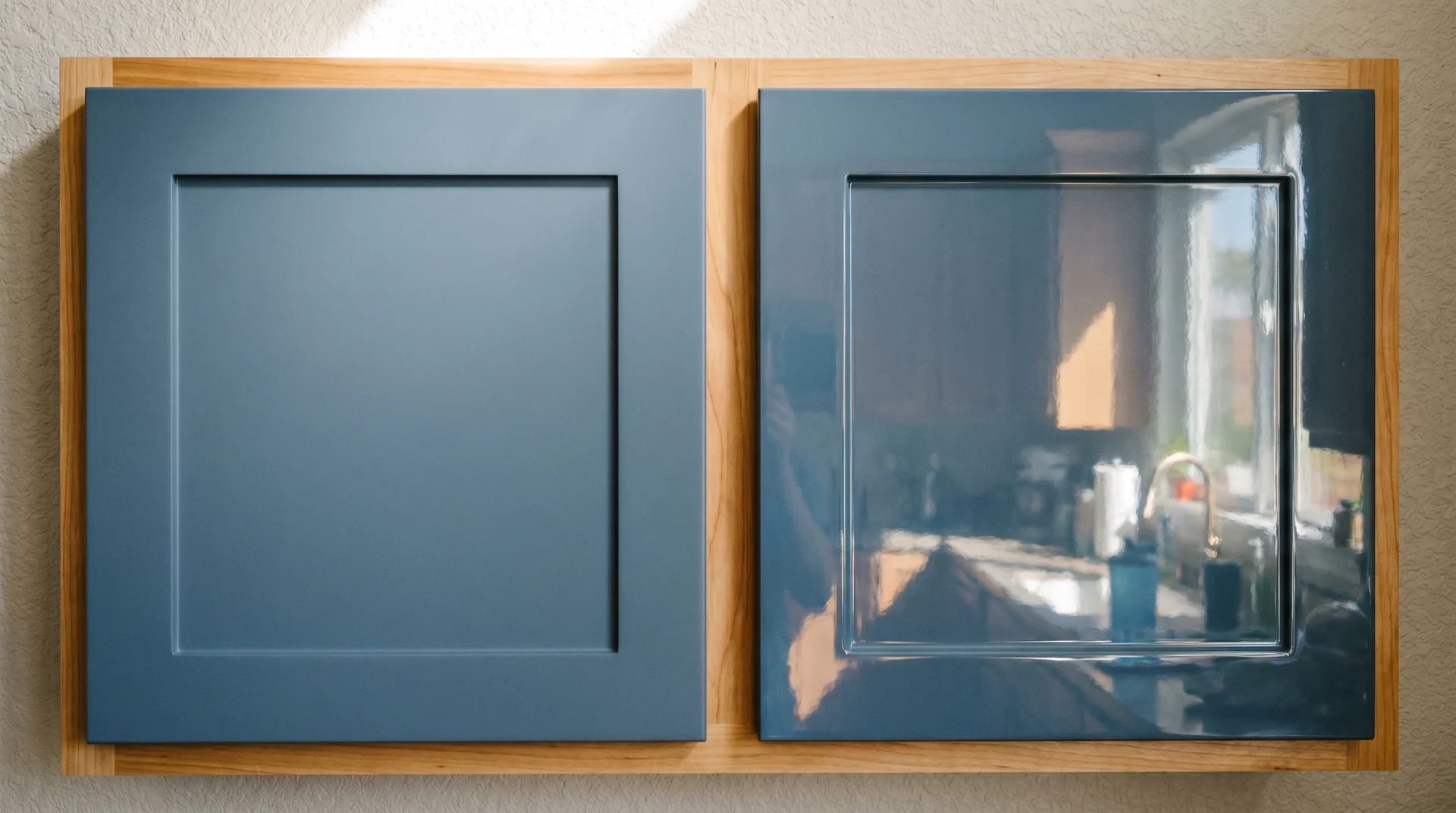
Finish level changes how each tone reads under real kitchen light.
A mismatched sheen, satin on one tone and semi-gloss on the other, reads as incomplete rather than intentional. Natural light hitting both cabinet zones at once makes it obvious.
Whether to Match or Differentiate Finish Levels
For a blue-gray palette, matching the finish level across both tones reads as intentional. Differentiating them adds noise where this palette doesn’t need it.
- With a white-and-dark two-tone palette, a finish contrast can add visual punch.
- With blue and gray, two tones that already carry a certain visual quietness, a sheen difference competes with the subtlety you’re working toward.
Satin on both tones is my recommendation. It’s forgiving in application, hides minor surface variations better than semi-gloss, and holds the cool palette without amplifying it.
If the lower cabinets take heavy daily use near the sink or stove, semi-gloss is defensible for durability. Match the uppers to the same sheen if you go that route.
One note on finish standardization: satin and semi-gloss are not standardized terms across paint manufacturers, as per Block Renovation’s finish guidance documents. One brand’s satin can carry a noticeably different sheen than another’s. Request physical samples from the specific paint line being used and view them in your actual kitchen light before confirming.
What the finish does to your kitchen cabinets and how the hardware reads is the next decision.
Hardware That Holds the Palette Together
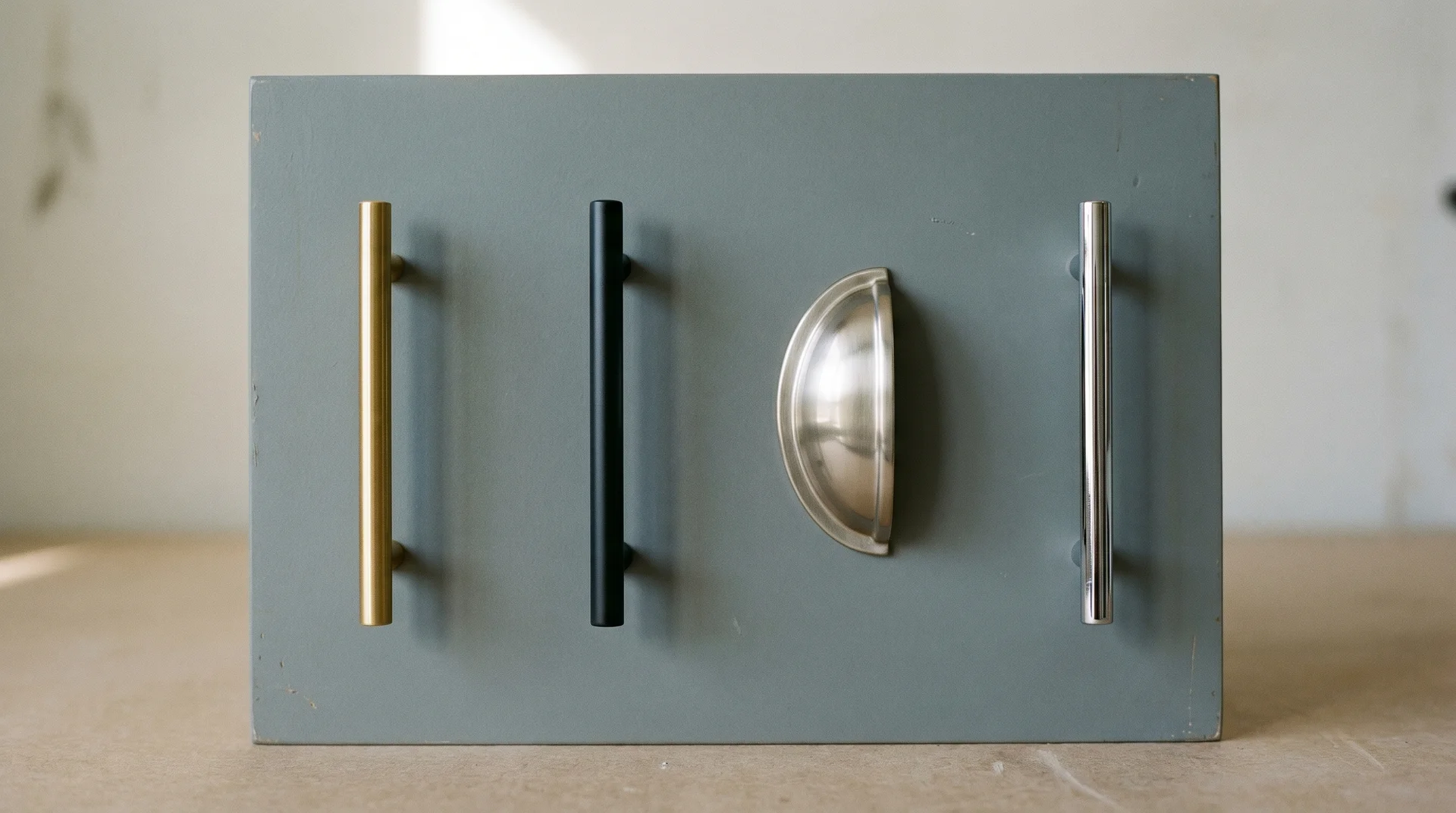
Hardware is the fastest way to fix a cold, blue-gray palette.
The right finish at eye level, on pulls and bar handles, introduces warmth or contrast that paint alone cannot deliver. The wrong finish deepens the same cold-palette problem that undertone mismatches create.
There’s no way to paint over it once the hardware is installed. So be mindful.
| Hardware Finish | Effect on This Palette | Best Room Condition | When to Avoid |
|---|---|---|---|
| Brushed Brass | Introduces warmth; softens a cool-dominant palette | North-facing, low-light, or rooms where the palette has gone cold | An industrial or very modern aesthetic where warmth conflicts with the design direction |
| Matte Black | Adds contrast; keeps palette cool and contemporary | Well-lit kitchens with strong natural light | North-facing or low-light rooms deepen the cold rather than cutting it |
| Brushed Nickel | Neutral; neither warms nor cools the palette further | Transitional kitchens where the palette is already balanced | When the room needs warmth, nickel won’t provide it |
| Chrome | Keeps the palette crisp and cool | Very modern, high-light kitchens | Any low-light or north-facing room reinforces cold |
The Hardware Finish That Fixes a Cold Palette
Brushed brass is my recommendation for most blue-gray two-tone kitchens, and for any room where the palette has gone flat or cold.
The warm gold undertone in brushed brass sits at eye level every time someone opens a cabinet. I’ve installed it in rooms that felt cold and institutional, rooms where undertone mismatches had pushed the palette too far toward cold.
Those rooms became places people actually wanted to spend time.
The execution requirement: brushed brass needs a hardware style that fits the scale of the door. A long bar pull, 128mm or longer, reads well on wide base cabinet doors. A smaller cup pull or a rounded knob is right for a narrow shaker upper. Don’t get the scale wrong, or the hardware reads like an afterthought even when the finish is correct.
Order physical samples and hold them against the actual cabinet doors in your actual kitchen light before purchasing in full.
Once the hardware finish is set, the countertop and backsplash decision becomes considerably clearer.
Countertops, Backsplash, and the Third Element
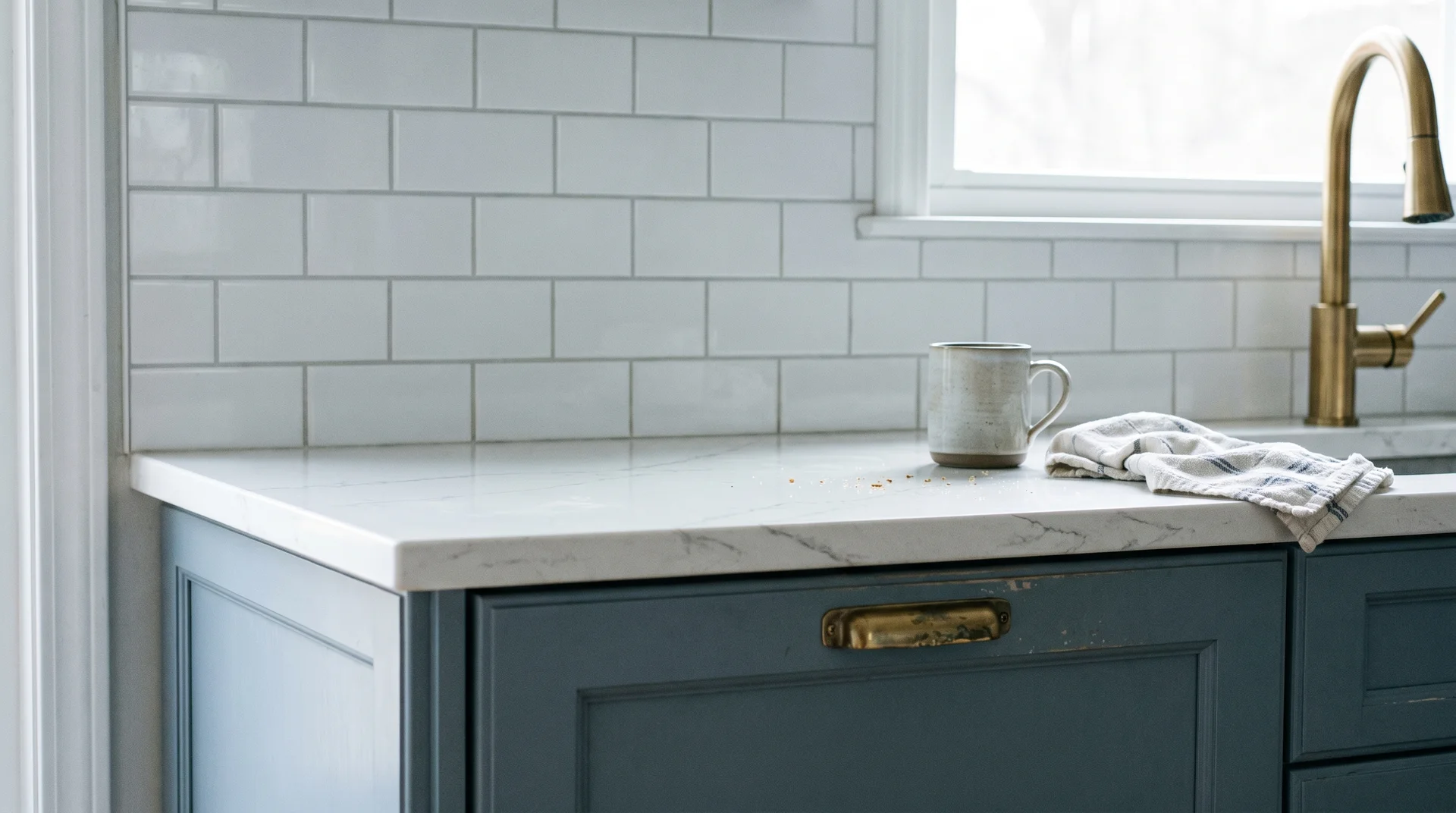
Countertops and backsplash either anchor the blue-gray palette or pull against it.
What countertops work with blue and gray cabinets? White quartz with subtle veining is the lowest-risk choice and the default recommendation. Three options, organized by room condition:
- White quartz with subtle veining is the default. Reflects light, carries no competing undertone, and works across the full range of blue and gray shades.
- Marble-look quartz is the same temperature logic as white quartz, with more visual movement. Works in any light condition.
- Light cream quartz is the right choice when warm elements in the flooring or window trim need a bridge between warm and cool. Avoids the starkness of pure white in mixed-temperature rooms.
What Not to Put Adjacent to This Palette
Warm beige tile backsplash breaks the temperature logic of a blue-gray kitchen immediately and visibly.
The contrast between warm beige tile and cool blue-gray cabinets reads as two separate decisions that never spoke to each other.
I’ve documented this failure more than any other backsplash error in my reference archive, usually in renovations where the tile was chosen because it “goes with everything.” It doesn’t go with a cool-dominant palette.
Stay on the same temperature side as the cabinets: cool white subway, light gray stone tile, or white tile with gray veining all hold the palette. Warm terracotta, cream-yellow, or beige-brown tile all fight it.
Natural wood is a different case. Open wood shelving, a butcher block island surface, or warm wood flooring all coexist with this palette because wood reads as texture before it reads as temperature.
That makes it a safer warm addition than a warm-colored tile, which reads as a color decision first.
Will This Still Look Right in Ten Years
Is blue and gray a timeless kitchen color combination? Yes, at the right values.
Saturated cobalt or bright sky blue will date because that level of saturation follows fashion cycles. A muted, dusty blue paired with a warm-leaning gray reads as considered rather than trendy, and this palette has appeared in kitchen design for decades in different forms.
The 2026 design direction is moving toward warmer neutrals in kitchen cabinets generally. That actually strengthens the case for the muted, warm-leaning version of this palette. The fully cool-dominant version, cold gray with saturated navy, is what faces pressure.
Design for how you want to live in the room for the next ten years.
The palette is not the risk. The finish preparation and the hardware selection are where your attention belongs.