

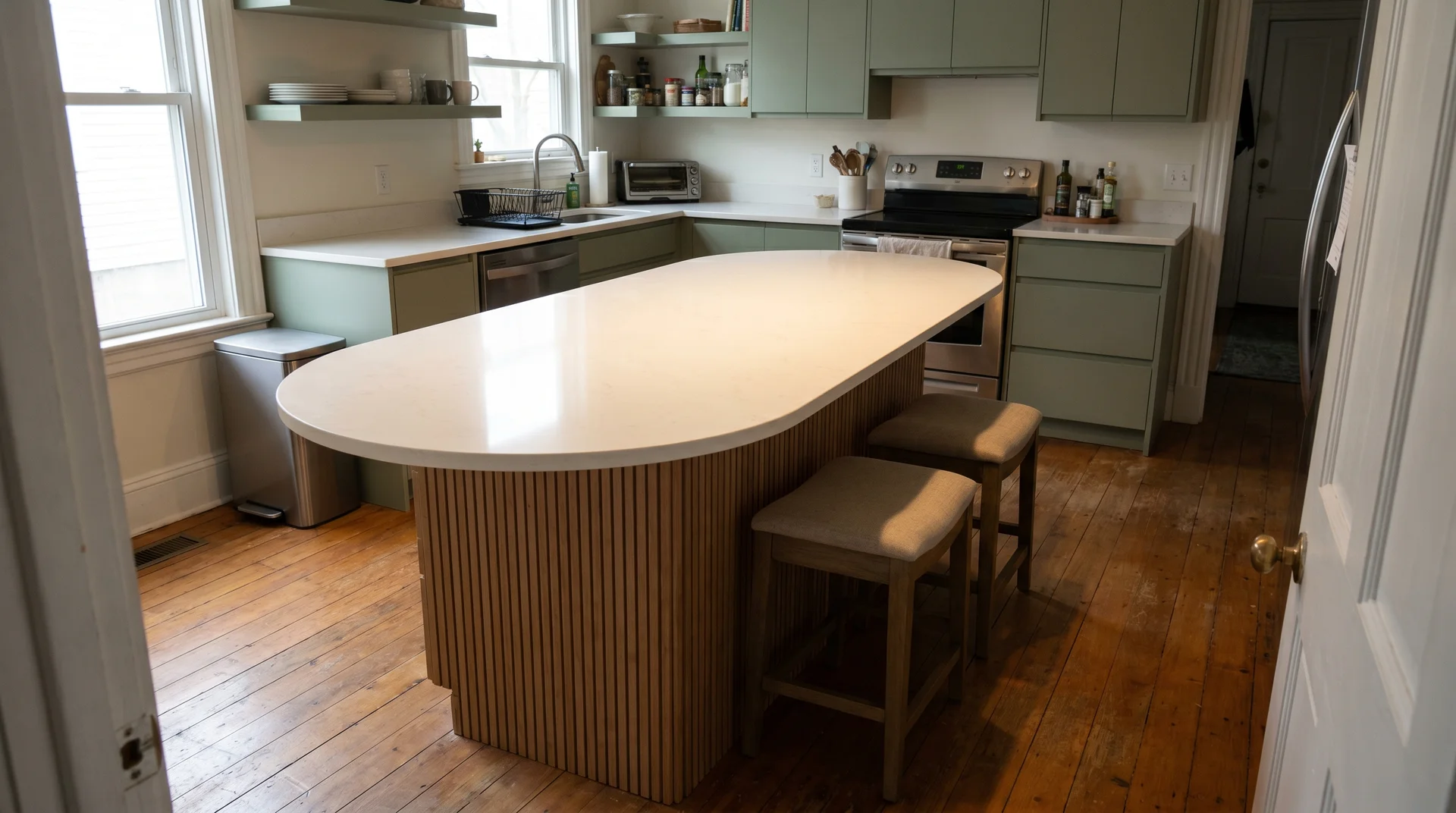
Stand in any kitchen showroom, and every island looks like a rectangle.
The rectangle is the default because it’s the easiest shape to build. Standard cabinet boxes fit it, and most contractors can price it without a custom drawing.
Seven non-rectangular shapes are worth knowing. Each one does something a rectangle cannot.
Each shape also creates new demands in cost, clearance, and storage. Both sides of that trade-off deserve a direct answer before you decide.
This piece covers permanently built-in islands only. Rolling carts and freestanding units are a different conversation with different criteria entirely.
What “Unique” Actually Means for a Kitchen Island Shape
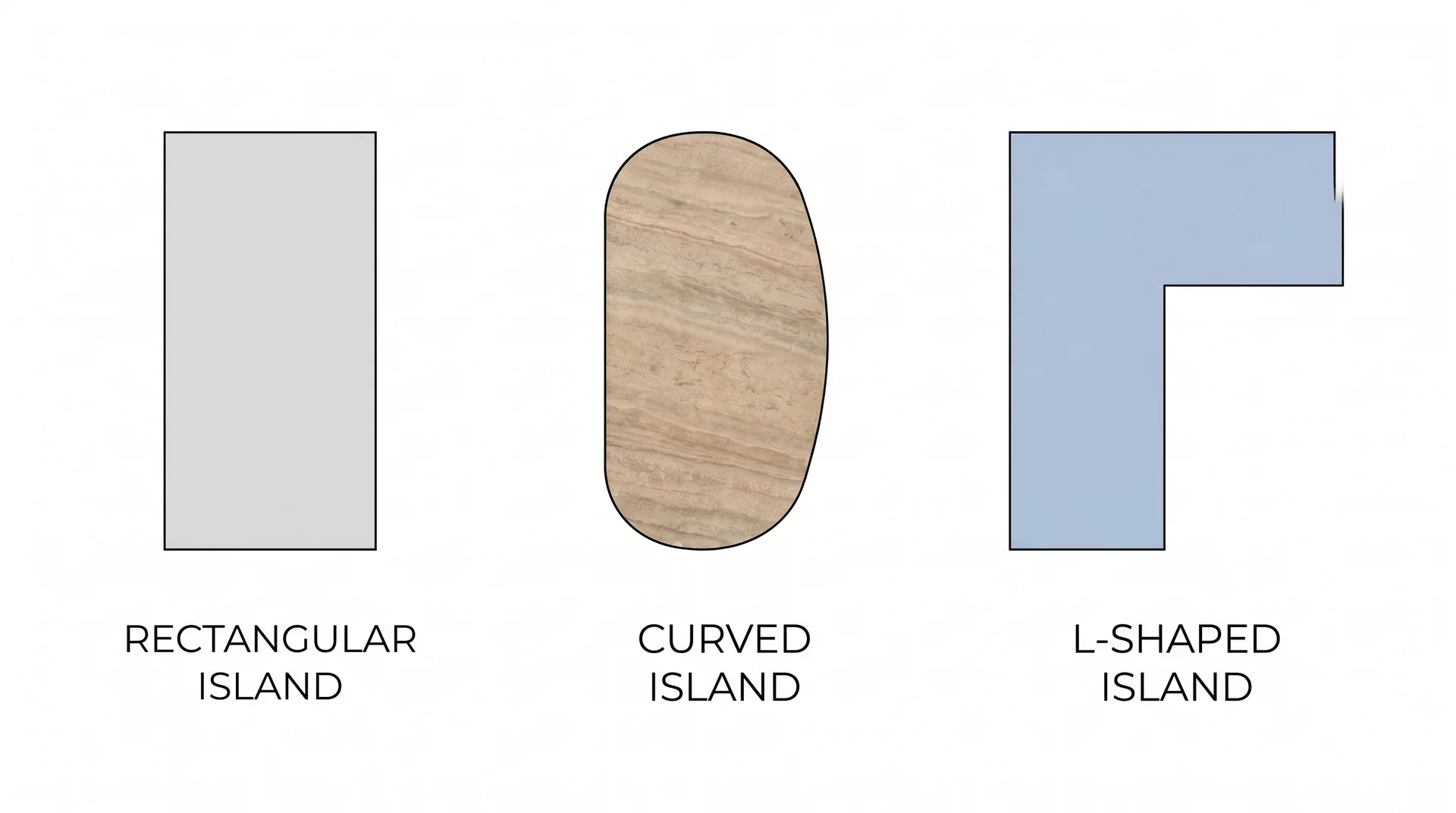
A unique island shape is any shape that breaks from the rectangular default.
The word doesn’t mean unusual for style’s sake. A shape qualifies when it solves a real layout problem. It can also qualify by making a visual statement that a rectangle simply cannot make.
Non-rectangular shapes in current kitchen design fall into two groups. Knowing which group your preferred shape belongs to changes the planning conversation.
- Curved and organic: rounded islands, oval and pill-shaped islands, piano-shaped islands. These soften the visual weight of a kitchen and make it feel more social to gather around.
- Angular and structural: L-shaped, T-shaped, wedge or trapezoid, hexagonal. These define and zone space rather than soften it.
The curved group is leading the 2026 design conversation.
Rounded and pill-shaped islands with waterfall edge countertops, where the stone surface continues straight down the side of the island to the floor, are appearing in mid-budget renovations now.
That trend matters because curved shapes cost more to fabricate. They also store less per linear foot than a rectangle of the same exterior footprint.
Each shape below handles that trade-off differently. Understanding yours before you decide is the whole point of this piece.
The Unique Kitchen Island Shapes Worth Knowing About
Each of these shapes does something a rectangle cannot.
Before you choose one, you need to know what it takes to build it in a real kitchen. That means understanding the cost, the storage capacity, and what it demands from your floor plan.
The Curved or Rounded Island
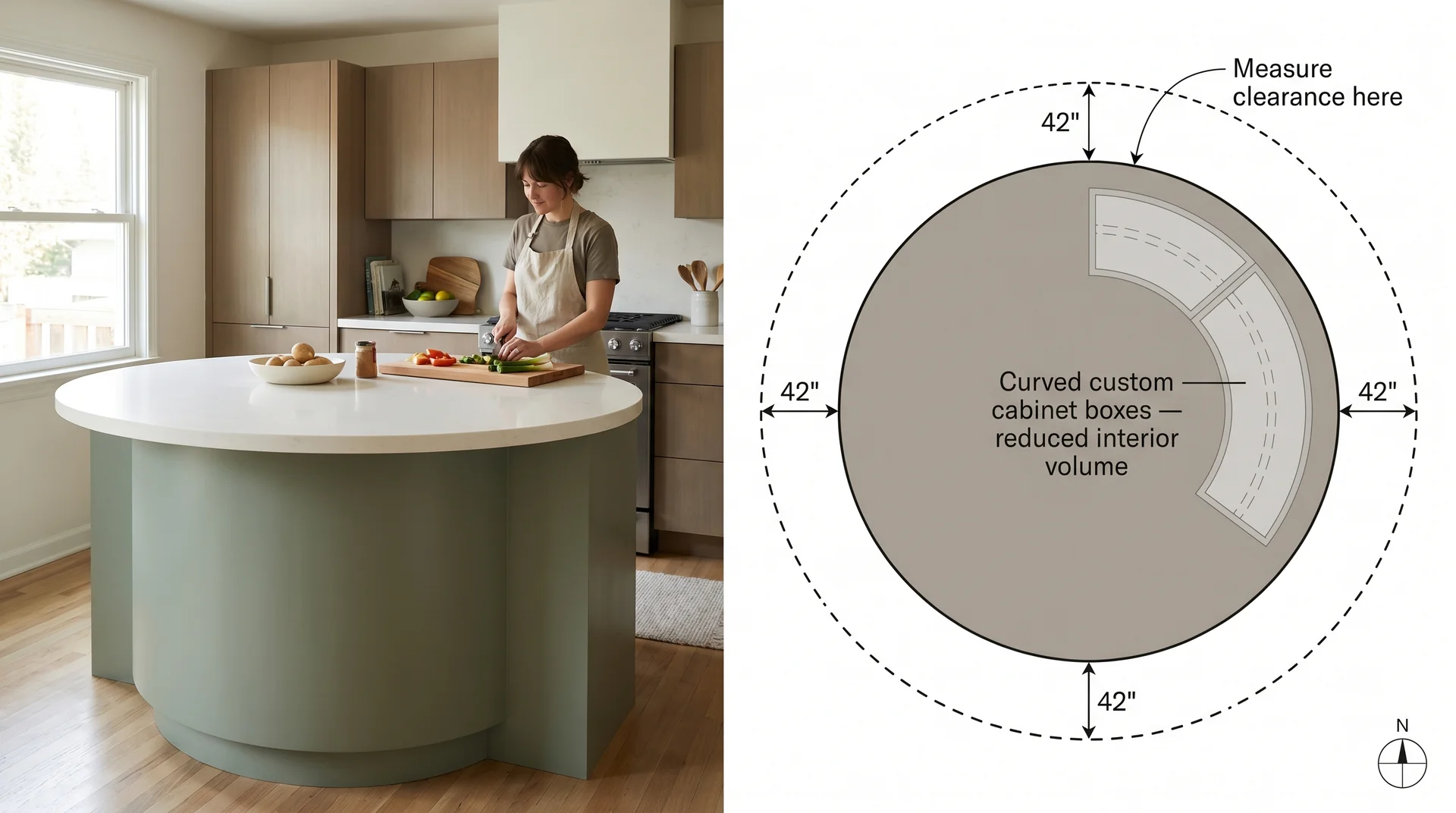
A curved island is the most social shape in this list and the most expensive to fabricate correctly.
The curve changes how people interact at the counter. You can make eye contact with someone on the other side. Traffic moves around the island naturally rather than catching on a corner.
Execution requires custom cabinetry from the start. Cabinet boxes must follow the arc. No stock supplier makes them in curved geometry, which means every cabinet in the run is a custom order.
The countertop needs a custom template as well. That adds both cost and lead time to the project.
The storage trade-off is the part that rarely comes up at the planning stage.
The curved interior of those custom cabinet boxes holds less usable volume than a rectangular cabinet of the same exterior footprint. Most people discover this after the contract is signed.
You gain the form. You trade some of the volume. I’d tell every client considering a curved island: run the storage numbers before you fall in love with the render.
The L-Shaped Island
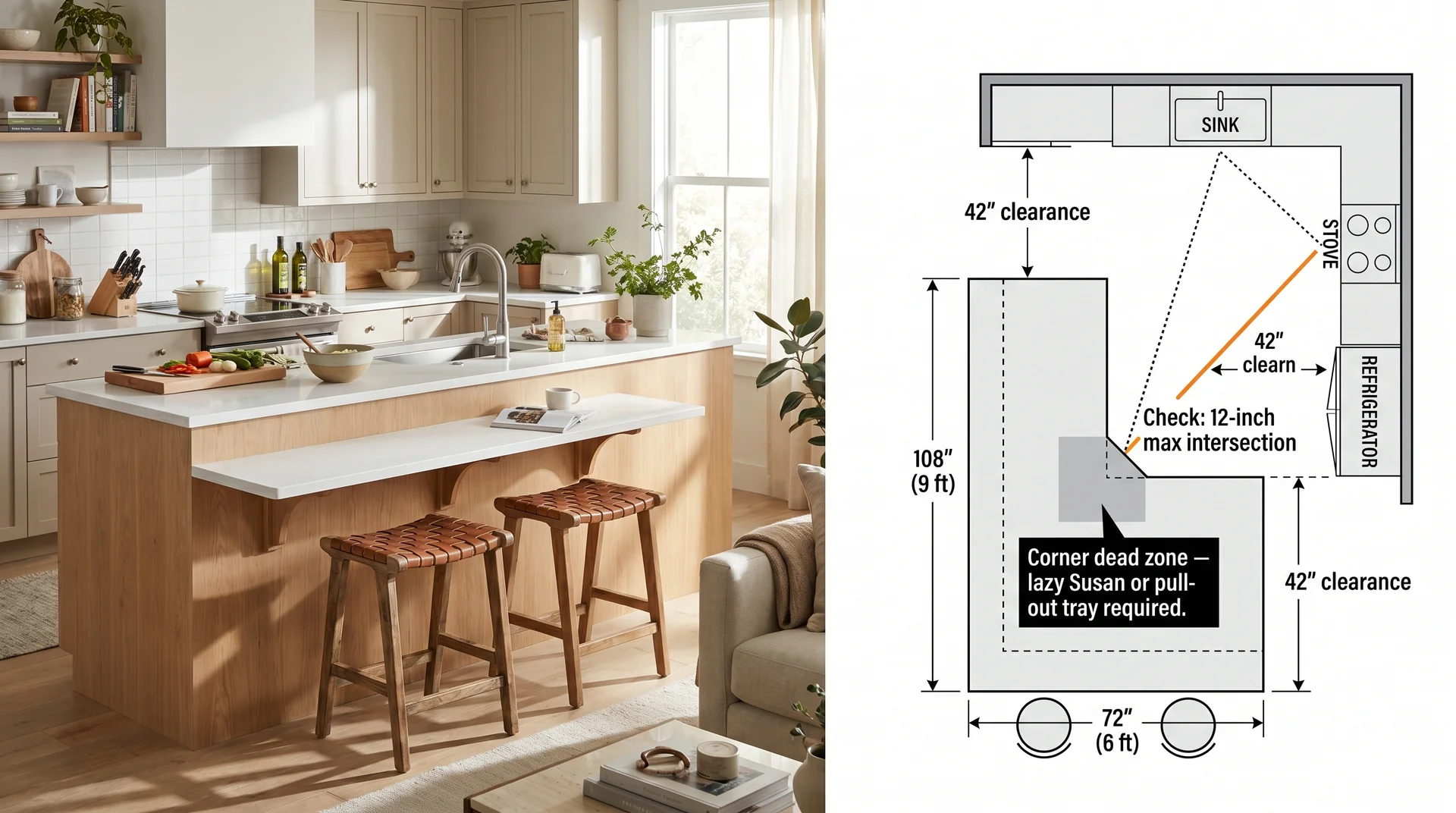
An L-shaped island divides an open-plan kitchen without putting up a wall to do it.
One leg is the prep zone. The other leg is the seating or serving side. The shape creates a clear boundary between the cooking and living spaces without closing the room off.
The corner is the problem area in any L-shaped build. Corner cabinet interiors are hard to reach and easy to underuse. A lazy Susan or pull-out corner tray addresses it, but both add cost and complexity to an already non-standard build.
The kitchen work triangle, the path between your sink, stove, and refrigerator, is the other issue to map early. The NKBA guideline states that no island should interrupt a work triangle leg by more than 12 inches. An L-shaped island planned without this measurement in mind forces a longer walk between the three zones.
L-shaped islands work best in L-shaped kitchens. When the room’s geometry is already irregular, this shape fits naturally. In a square or rectangular kitchen, it often fights the layout rather than completing it.
The Oval or Pill-Shaped Island
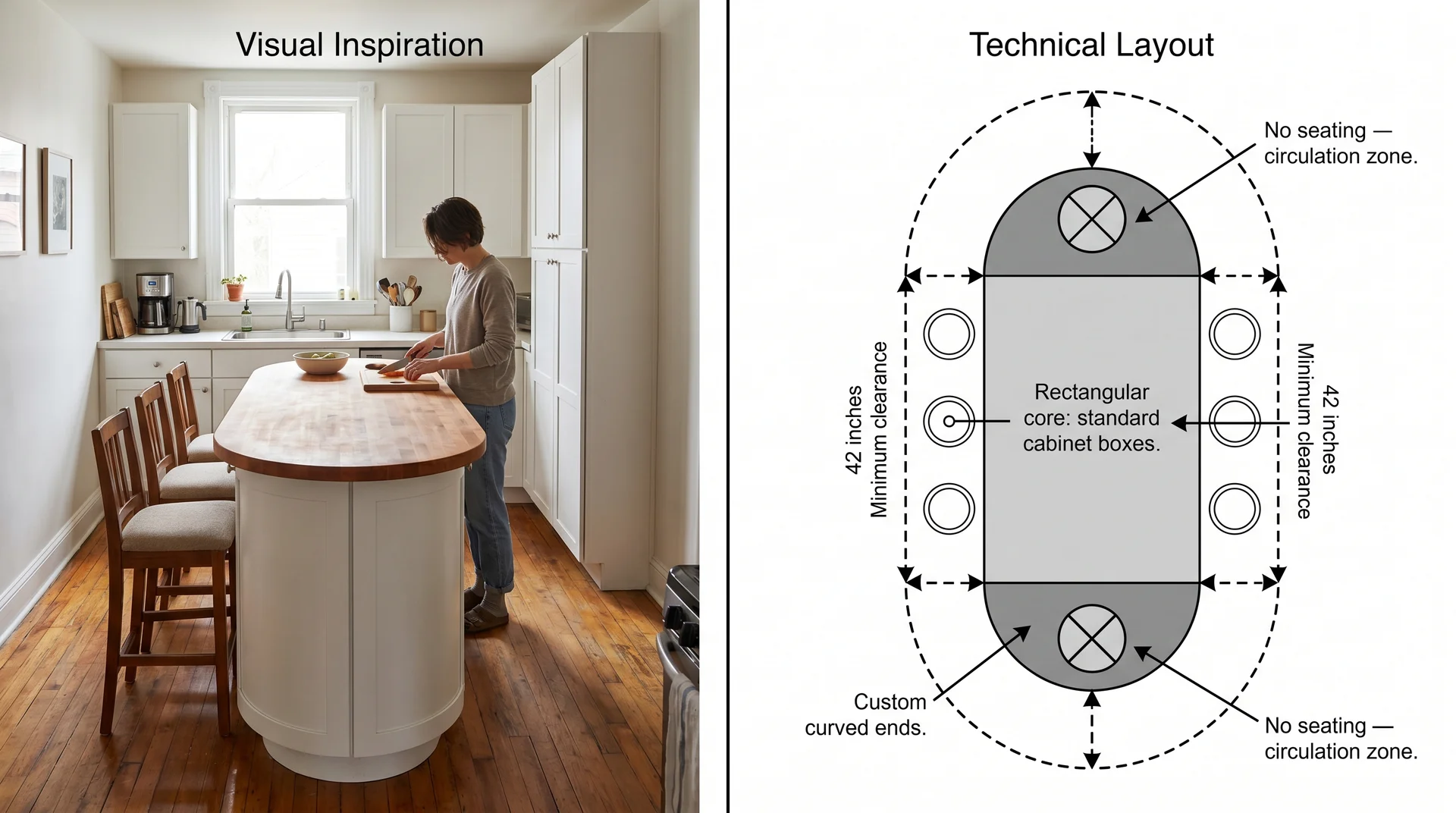
An oval island is the curved island’s more practical version: rounded ends, rectangular core, and lower fabrication cost.
The rounded ends improve traffic flow in tight passage areas. The rectangular middle section holds more usable storage than a fully curved build of the same length.
Of all the non-rectangular options, I tend to reach for this one first when a client wants something different and isn’t ready to go fully custom. It carries the most accessible trade-off in this list.
Custom cabinetry is still required for the curved ends. The rectangular middle section takes standard cabinet boxes, though. That makes an oval island meaningfully cheaper to build than a fully curved one.
Seating works along the longer, straighter side. The rounded ends are for circulation. Don’t plan extra stools around the curves.
The T-Shaped Island
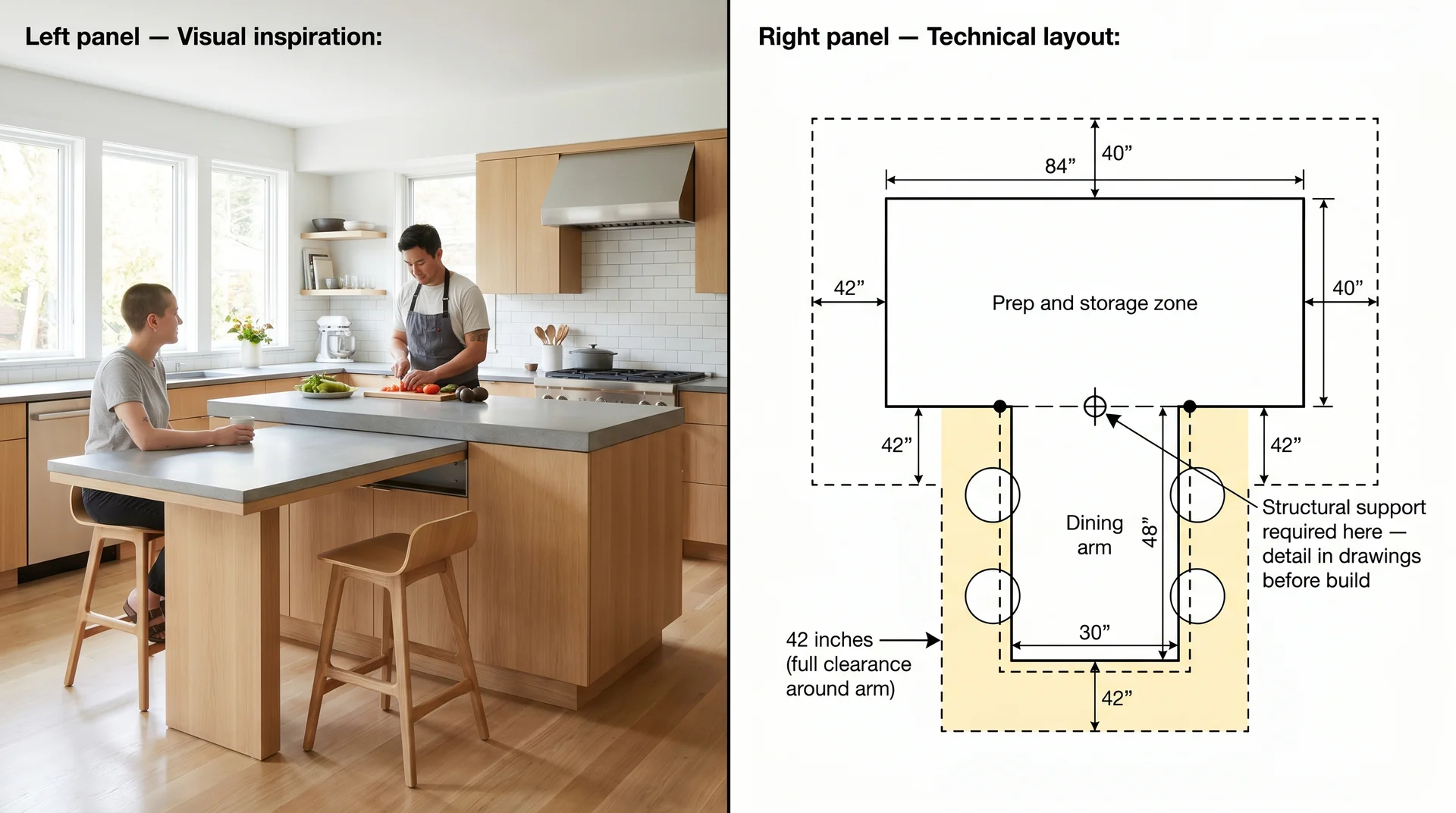
A T-shaped island adds a built-in dining extension to a standard rectangular island without requiring a separate piece of furniture.
The arm extends from one end of the island at a right angle. It creates a dedicated spot for casual meals or for someone to sit near the cook without standing in the work zone.
The arm needs structural support. It must cantilever or be braced from below without blocking the passage beneath it. Those structural details go into the drawings well before anything gets built.
Footprint is the controlling factor. The T shape needs enough kitchen width so the arm leaves at least 42 inches of clear passage space on all sides.
The Hexagonal or Geometric Island
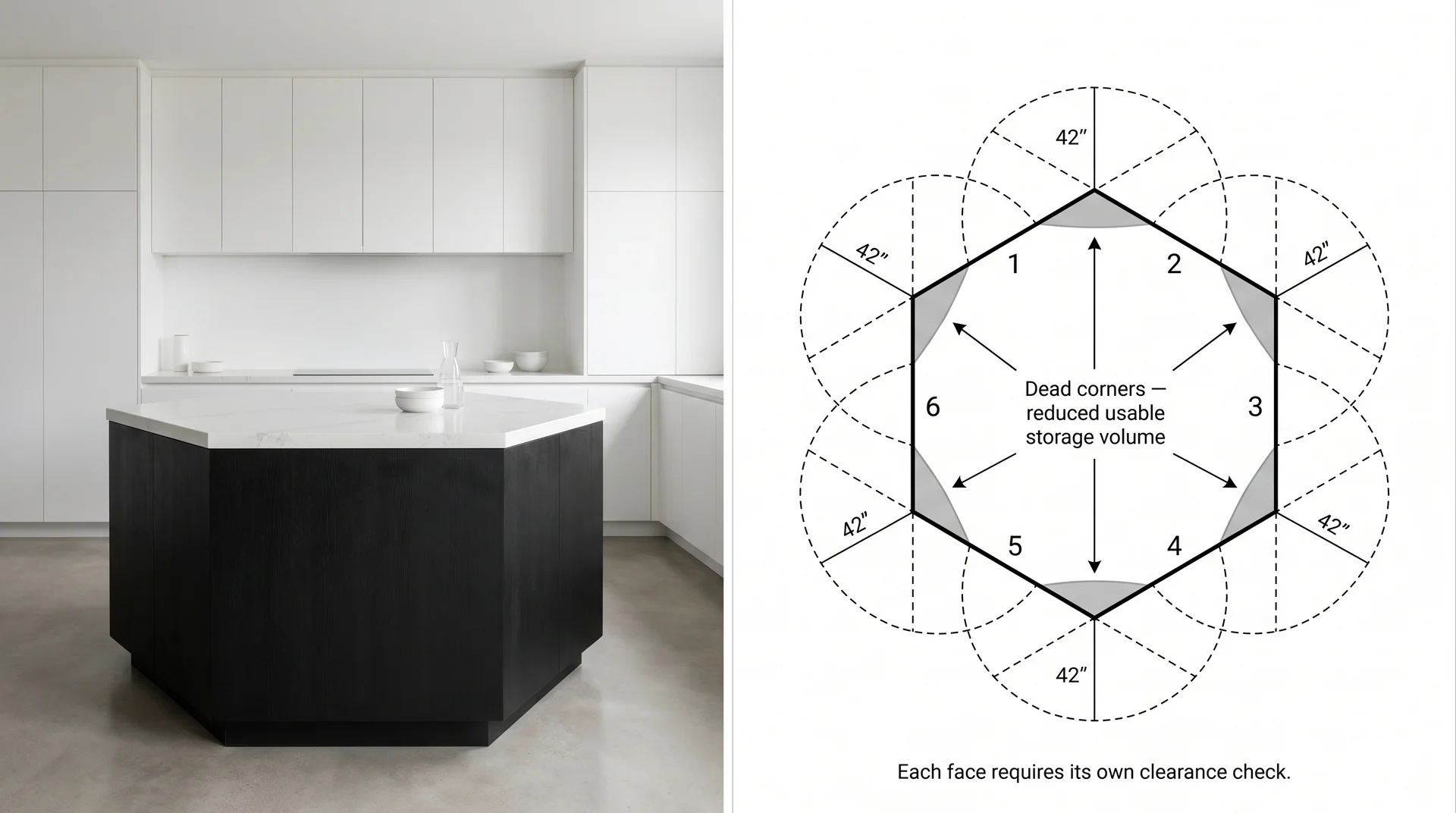
A hexagonal island only works when it’s the single dominant visual element in the room.
Six flat faces create multiple seating angles. From a fabrication standpoint, flat panels are easier to build than curves, but the angles still require custom work. No stock cabinet fits a hexagonal footprint.
Storage inside a hexagonal island is lower per linear foot than in a rectangular island of similar visual size. The angled corners cut into usable interior volume.
My honest read: this is the shape most likely to feel dated in five years. It holds up only when everything else in the room stays very quiet around it. When it competes with patterned tile or colored cabinetry, it becomes cluttered with a countertop.
The Wedge or Trapezoid Island
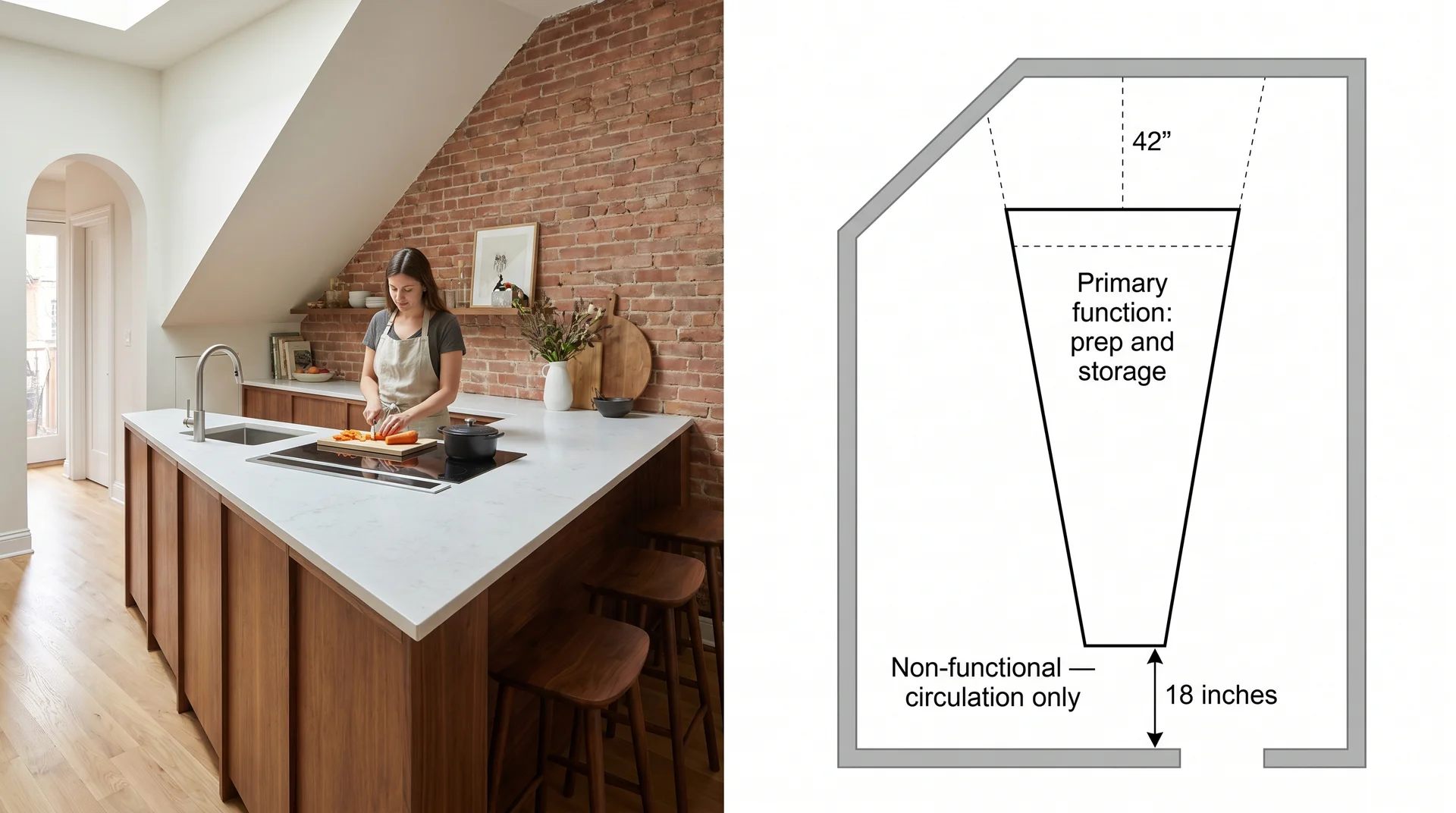
A wedge-shaped island is a problem-solving shape built for rooms where a rectangle doesn’t fit cleanly.
A wedge narrows at one end and widens at the other. It can follow an awkward room’s footprint without leaving dead space on either side of the island.
The narrow end of a wedge isn’t useful for prep work or seating. The wider end carries most of the function. Plan storage and work surfaces accordingly before the fabricator starts.
I’ve priced wedge builds for clients who loved the look in a rectangular room. The decision always came down to storage loss and added fabrication cost. The shape tends to win the render. It tends to lose the practical conversation.
The Piano-Shaped Island
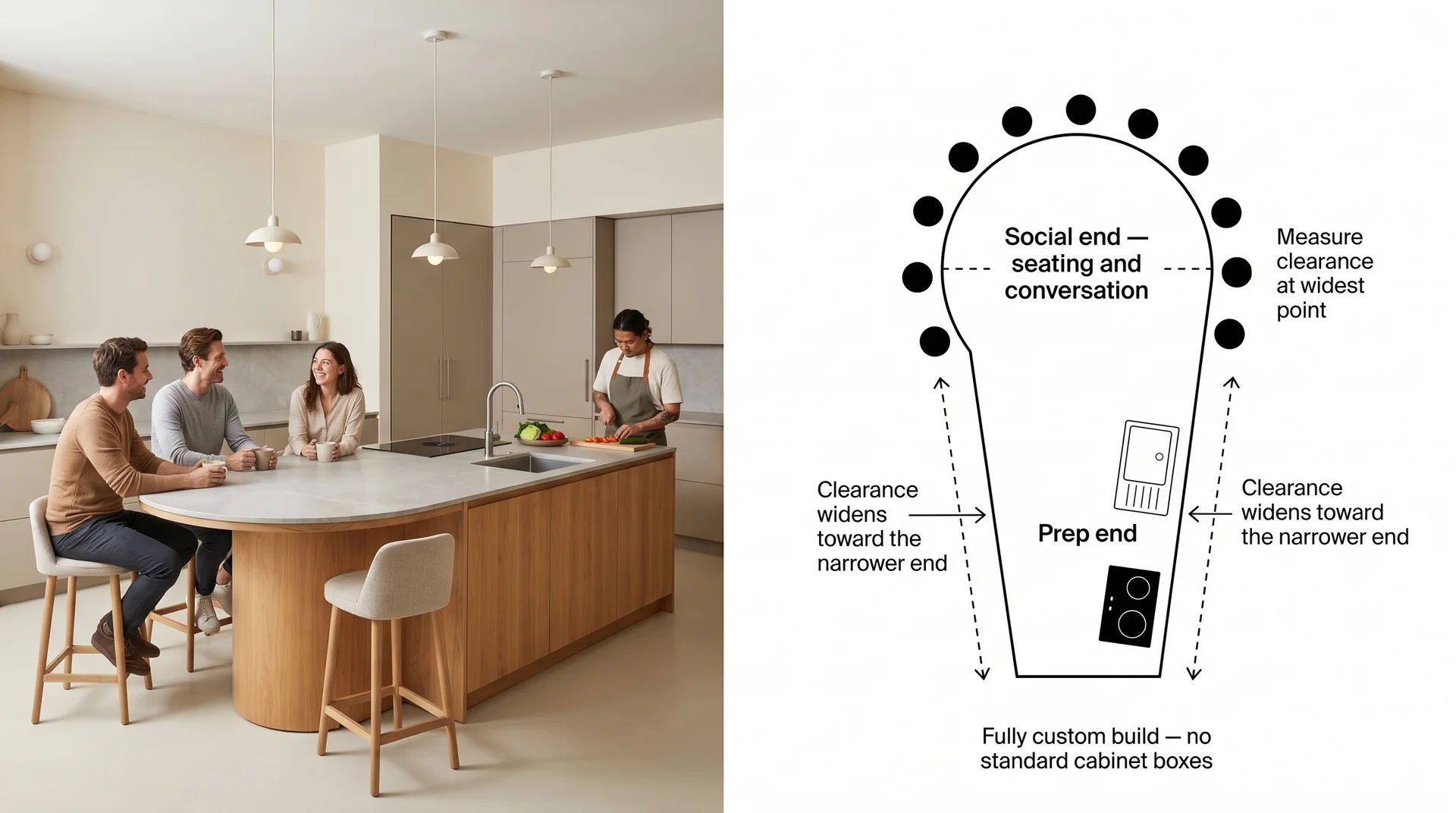
A piano-shaped island is rounded at one end and tapered toward the other, following the outline of a grand piano.
The shape is built for conversation. Seated guests curve around the rounded end and face each other rather than sitting in a straight row facing the same direction.
The rounded end is the social end of the island. That is the reason this shape exists.
Piano-shaped islands are fully custom-built. You need custom cabinetry, a custom countertop template, and extended lead time. Budget for all three before the project starts.
This is the newest form in the non-rectangular island conversation. It works best when the island sits at the center of the room, and everything else around it stays deliberately quiet.
How Shape Determines How Your Kitchen Actually Works
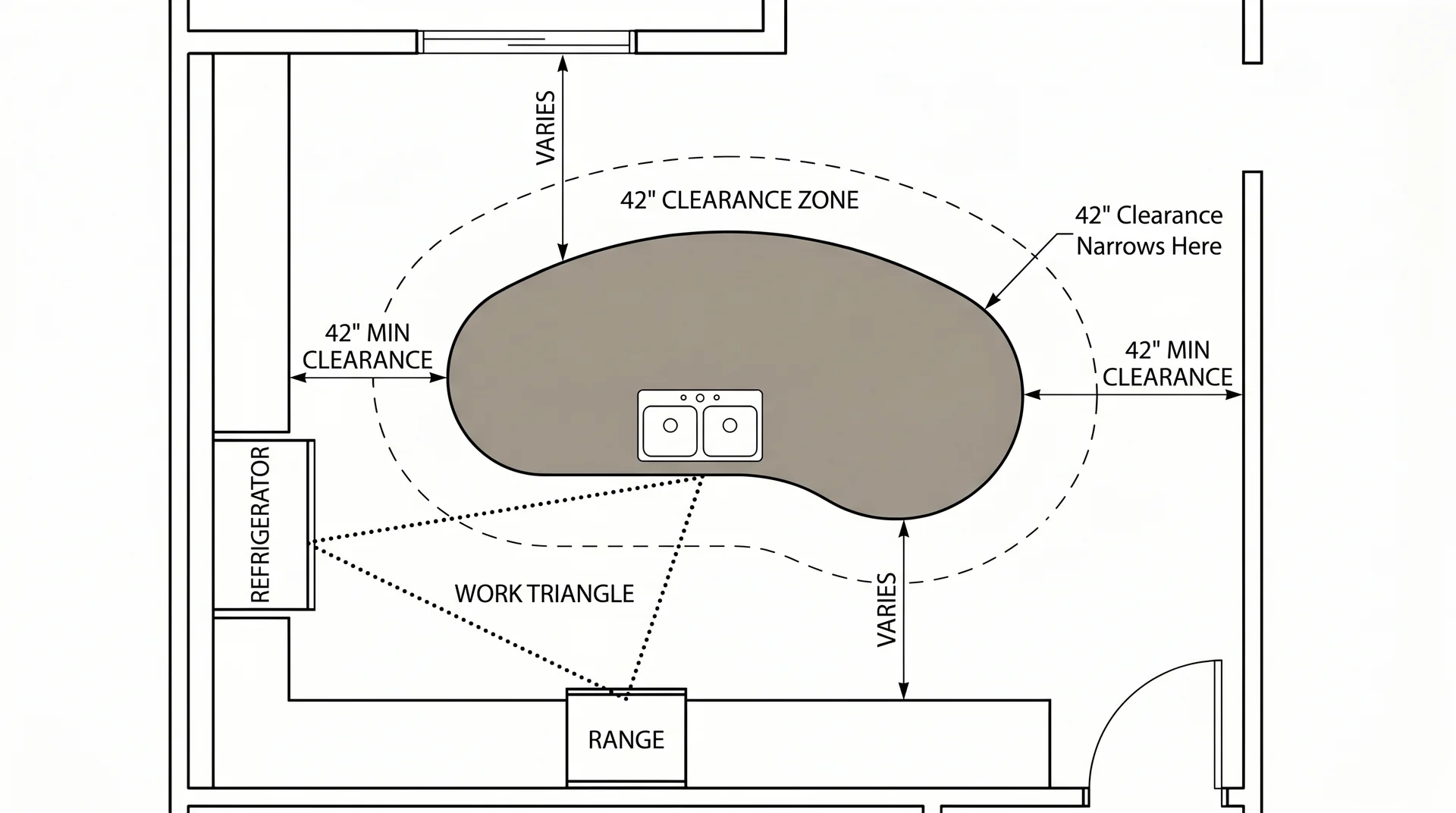
Your island’s shape changes the geometry of your whole kitchen.
A rectangle is predictable: consistent clearance on all sides, stable traffic flow, straightforward appliance access. Every other shape introduces spatial variables you won’t encounter with a standard build.
The NKBA, the National Kitchen and Bath Association, publishes planning guidelines that most designers use as a starting point. Two numbers matter most when you’re choosing a non-standard island shape.
- Clearance minimums: 42 inches for a one-cook kitchen; 48 inches when multiple people cook at the same time. This is measured from countertop edge to countertop edge, not from the cabinet face.
- Work triangle intersection: No island should interrupt the path between your sink, stove, and refrigerator by more than 12 inches. The NKBA sets this as a planning guideline. Violating it consistently makes kitchens harder to use.
Both numbers become more demanding with non-rectangular shapes.
A curved island has variable clearance depending on where you measure. The widest point of the curve projects further into the aisle than the ends do. One measurement taken at the ends will underreport how tight the space actually is.
An L-shaped island extends in two directions. Each leg needs to clear 42 inches separately. The corner where both legs meet compresses traffic flow on both sides of the junction.
I can tell you what the guidelines say. I can’t tell you whether your specific kitchen passes them without knowing where your appliances are, how your refrigerator door swings, and which direction the oven opens.
| Shape | Minimum Clearance | Special Condition | Work Triangle Risk |
|---|---|---|---|
| Rectangular | 42 in. (one cook) | Standard – no variation | Low |
| Curved / Rounded | 42–48 in. | Clearance varies at the curve peak; measure at the widest projection | Moderate |
| L-Shaped | 42–48 in. per leg | Corner dead zone; each leg tested separately | High |
| Oval / Pill | 42–48 in. | Curved ends vary; the rectangular middle is consistent | Moderate |
| T-Shaped | 42 in. main body; arm clearance tested separately | Arm extension must be clear on all sides | Moderate |
| Hexagonal | 42–48 in. per face | Multiple active faces; each face tested separately | High |
| Wedge / Trapezoid | 42 in. at the widest point | The narrow end is typically non-functional | Low to moderate |
| Piano-Shaped | 42–48 in. | Tapered end varies; plan clearance at the widest point | Moderate |
Use this table as the starting point for the conversation with your designer or contractor. Every number needs to come from your actual kitchen, not from a planning document.
The Real Cost of Going Non-Rectangular for Your Kitchen Island
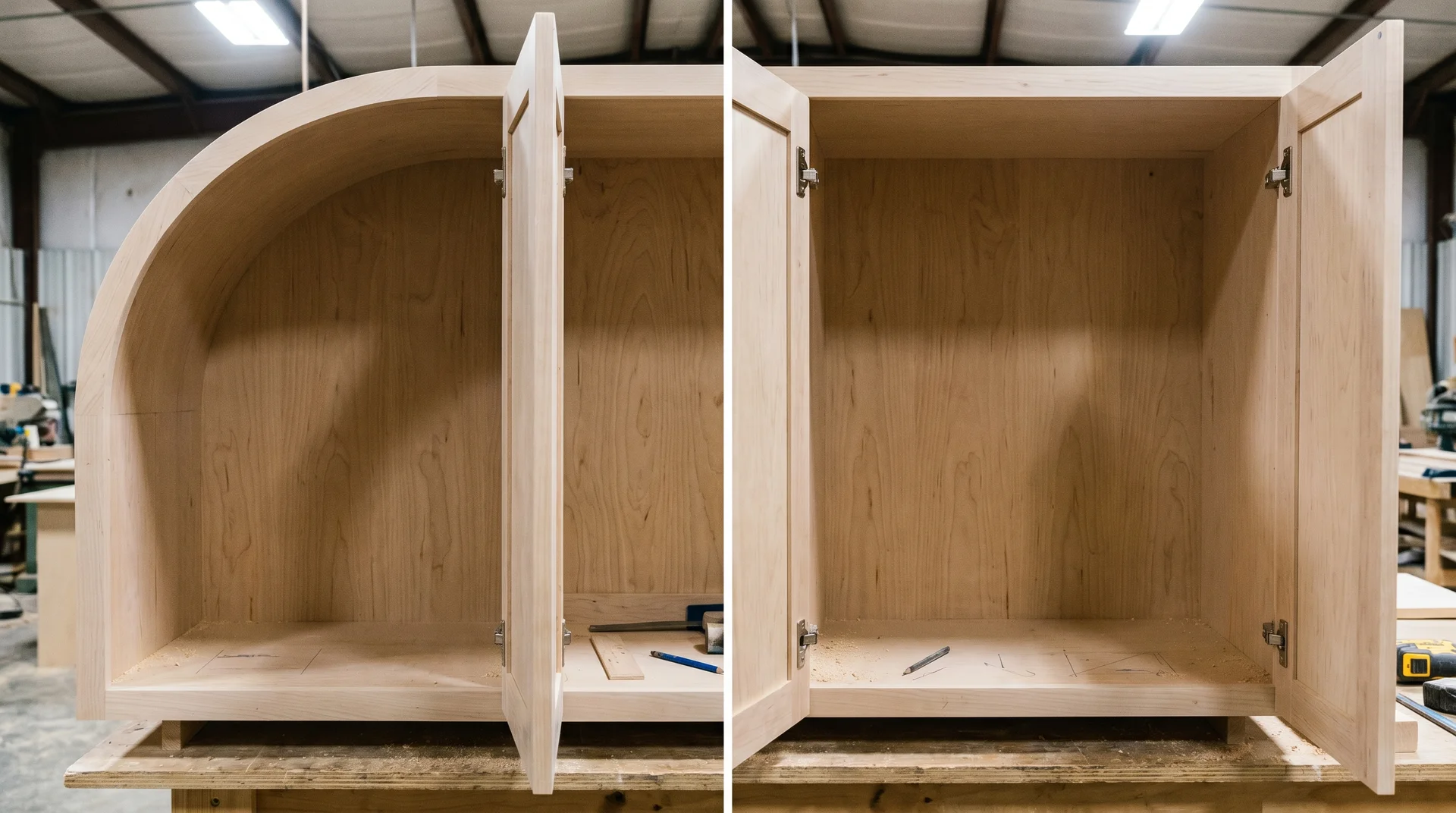
If you’ve decided a non-rectangular shape is right for your kitchen, the next thing you need is an honest cost picture.
Going non-rectangular adds cost in three specific places, and the gap from a standard rectangular build is not small.
The first is cabinetry. Curved and angled island configurations require custom cabinet boxes. Stock cabinets don’t exist in these geometries. Custom cabinetry carries a higher cost per linear foot than a standard rectangular build. The exact premium varies by fabricator and region. [VERIFY]
The second is countertop fabrication. Curved and irregular island edges require a custom template and custom cuts. Non-rectangular configurations produce material waste that a rectangular slab doesn’t generate. That waste is priced into the job.
The third is replacement and repair over time. Custom curved cabinet doors are not interchangeable with stock doors. If a door warps or cracks in five years, you’re ordering a custom replacement at a custom price. The commitment here isn’t just what the island costs today.
The constraint is where the real decision lives. Once you understand the full cost picture, the one-hero rule section below will make more sense.
The One-Hero Rule and Why It Should Drive Your Shape Decision
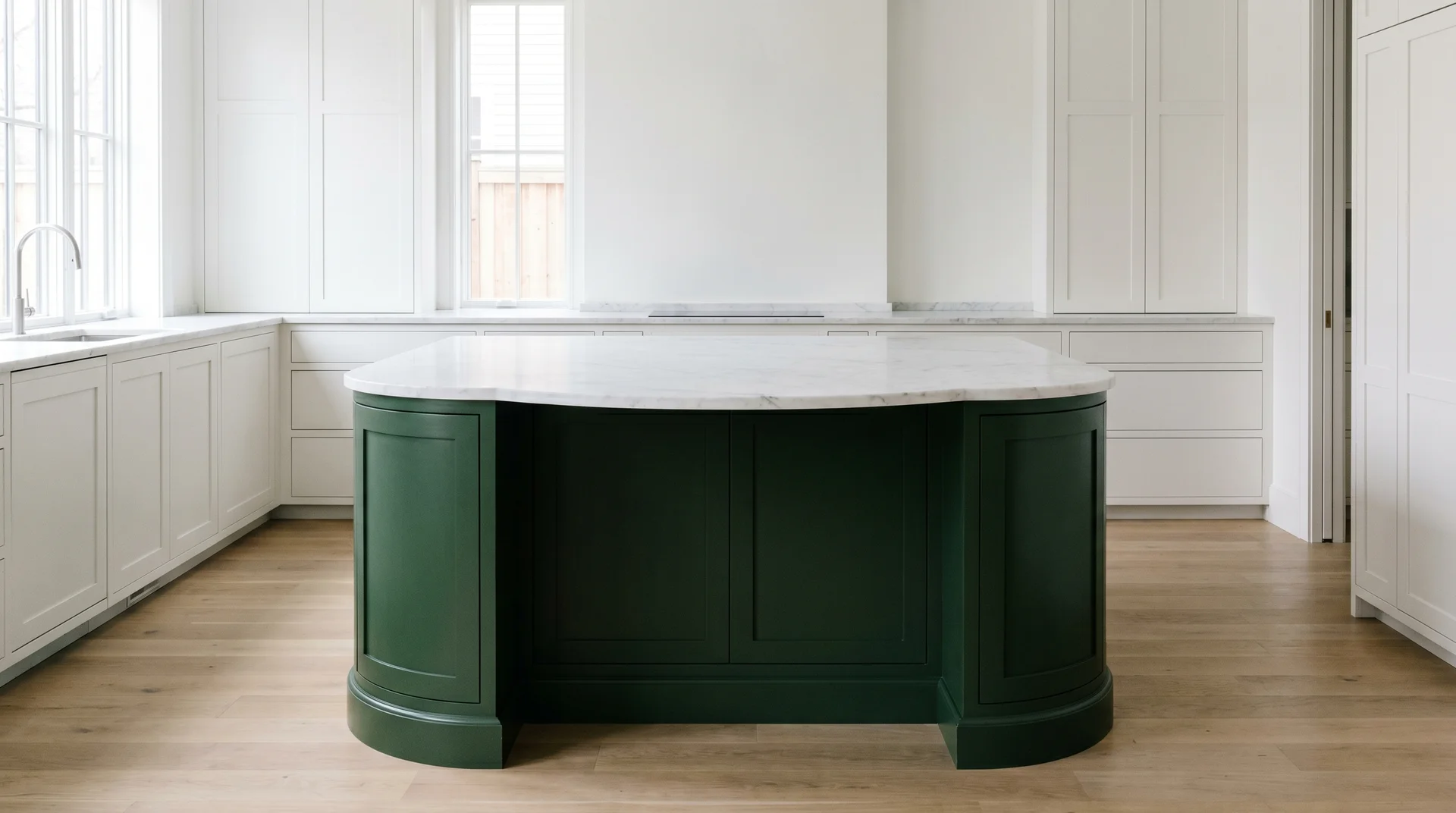
The island shape is the kitchen’s most powerful single design decision.
I came to this conclusion the hard way.
In 2014, I put too many competing elements into a client’s kitchen at once. Patterned backsplash, brass hardware, marble counter, dark cabinets, and open shelving loaded with mismatched objects. Every element was fighting for attention.
My client cried at the reveal. I redesigned that kitchen at my own cost because it was wrong, not to earn credit for fixing it. I never told her what I spent.
That project gave me the rule I apply to every kitchen I work on: every space can hold one dominant visual statement. One. Everything else submits to it. I call it the one-hero rule.
It applies directly to the shape conversation.
Walk into a kitchen with a curved or piano-shaped island. Your eye goes straight to it. That shape is the hero. Now add a bold countertop, colored cabinets, and a decorative range hood. The island becomes one voice in a room where everyone is talking at once.
Surface treatments layer onto this decision, too. A two-tone finish or fluted paneling on the island base can reinforce the hero effect. They can also become a second hero if the rest of the room isn’t controlled around them.
Choose the shape you want. Then ask whether everything else in the kitchen is willing to get out of its way. If the answer is yes, the shape works. If the answer is “but I also want,” start over.
Unique Kitchen Island Shapes for Small Kitchens
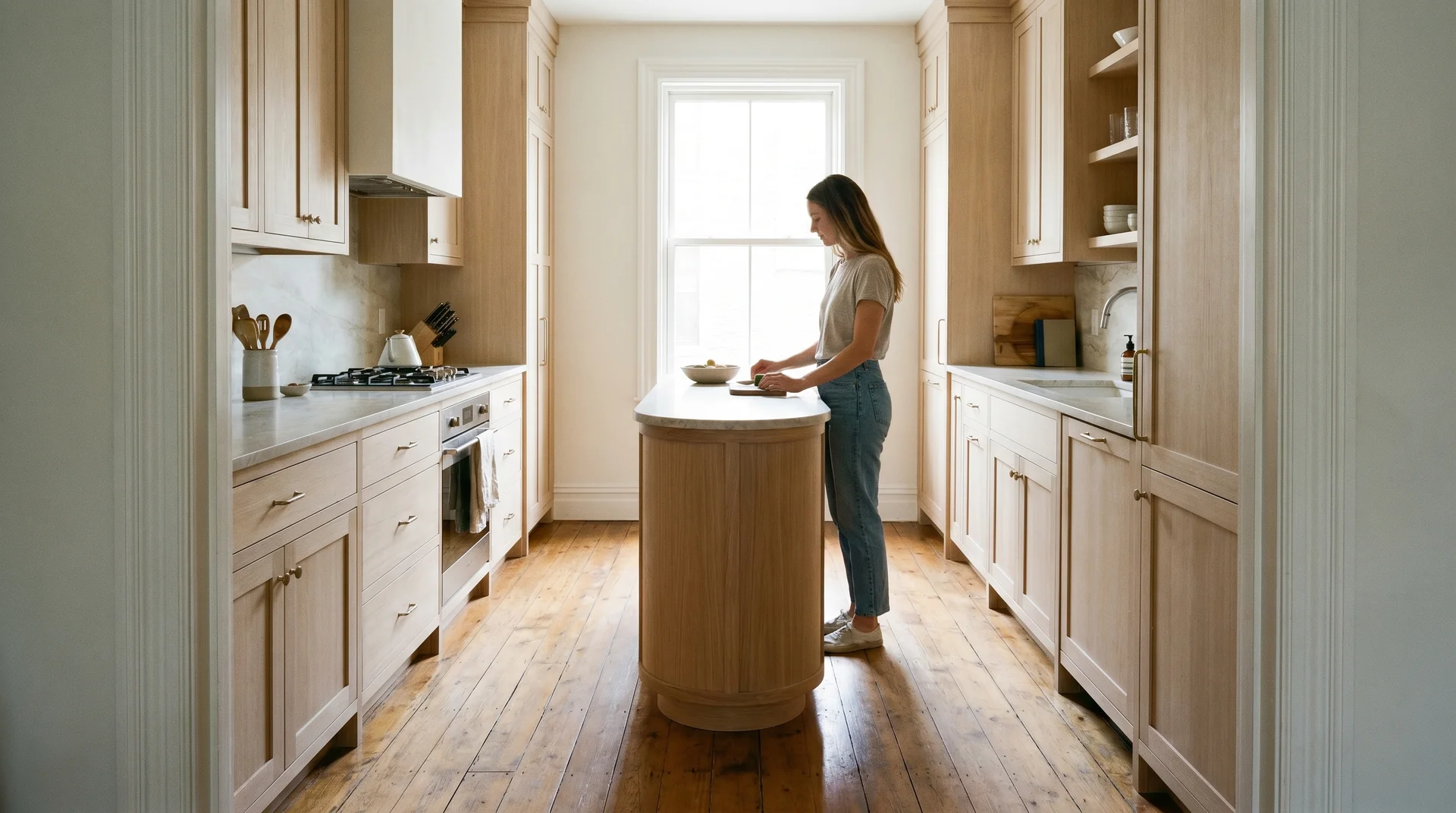
Not every kitchen has room for an unusual-shaped island.
Stand in a kitchen under 12 feet wide. The clearance math becomes the whole conversation. Most kitchens at this width can’t comfortably fit even a standard rectangular island with proper clearance on both sides. A non-rectangular island makes that problem harder to solve, not easier.
The best shape for a small kitchen island is oval or pill-shaped. The rounded ends reduce the effective footprint in tight passage areas. The rectangular core keeps the storage practical.
If the space is genuinely tight, the honest answer may be no island at all.
If you’re committed to the farmhouse aesthetic, though, there are configurations designed specifically for tighter kitchens, including freestanding table islands and repurposed sideboards that clear the aisle requirements a fixed build can’t.
Read: Farmhouse Kitchen Island Ideas
A rolling cart or peninsula configuration solves the prep space problem without the clearance cost. A kitchen that works every day is worth more than a shape that looks right in a planning document.
One small-kitchen shape I’d push back on strongly: the hexagonal island. Every one of its six faces creates a separate clearance demand. It tends to look striking in a render. In a compact kitchen, that math simply doesn’t work.
Unique Kitchen Island Shapes for Open-Plan Kitchens
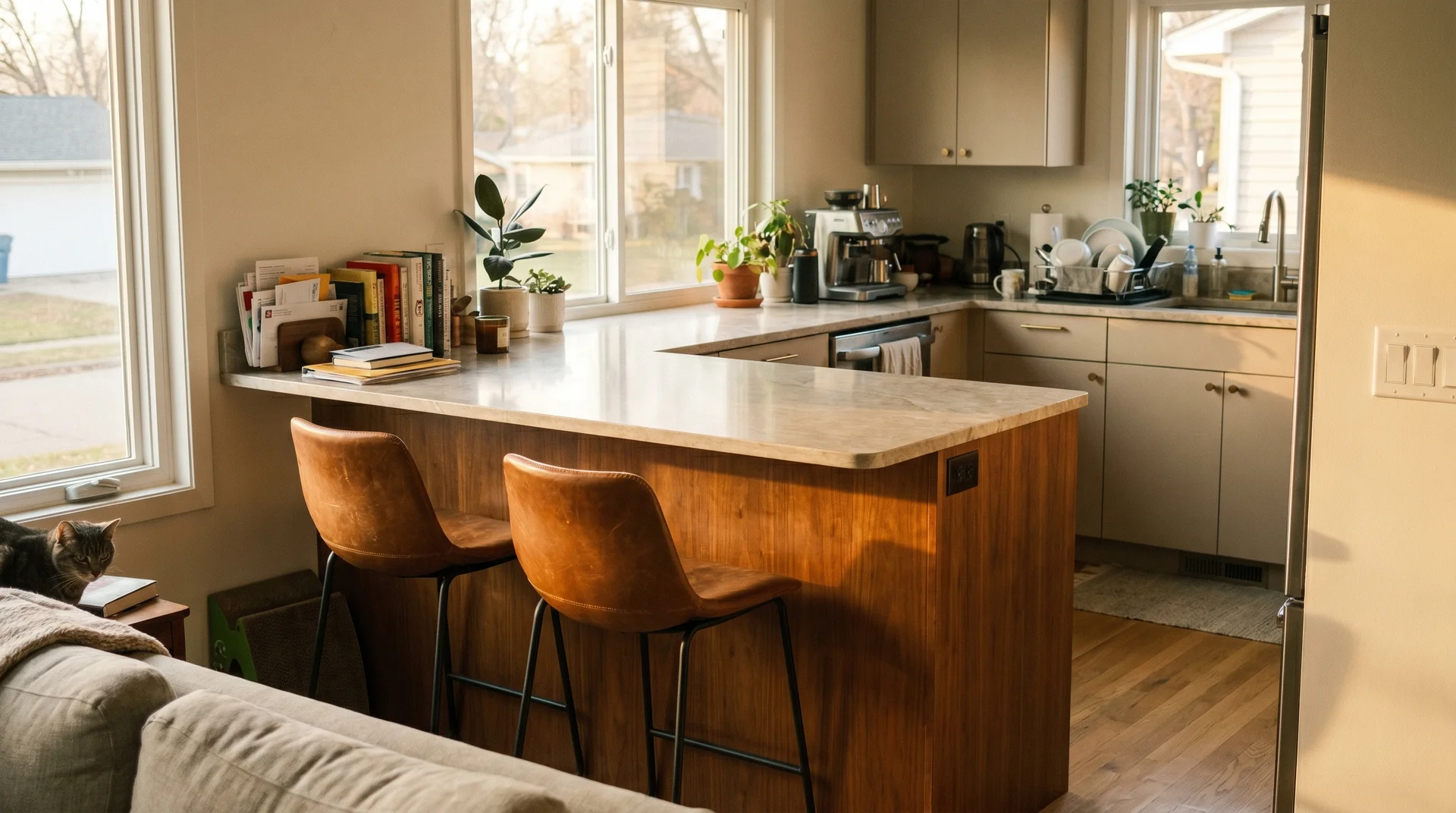
Open-plan kitchens ask more of an island than closed kitchens do.
Stand at the threshold between your kitchen and your living room. That’s where your island’s shape is doing its real work. It isn’t just a prep surface anymore. It’s also a zone marker and the visual anchor between two spaces that share one room.
The L-shaped island is the strongest choice for defining those zones. One leg stays in the cooking zone. The other leg faces the living space and serves as the social side. The shape creates a clear boundary without building a wall.
Curved and rounded islands are the strongest choice when conversation and flow matter more than strict zone separation. The curved edge guides traffic around the island naturally.
Seating around a curved end creates a different dynamic than a straight row, where guests face each other rather than facing the same wall.
Waterfall edge countertops pair naturally with both curved and L-shaped islands in open-plan spaces. As noted above, a waterfall edge is where the stone continues down the side of the island to the floor. The side facing the living room is what guests see from the sofa. A waterfall edge makes that view intentional.
The execution requirement for a waterfall edge is a mitered corner joint, where two pieces of stone are cut at matching angles and fitted precisely where the top surface meets the descending side. That joint adds to both fabrication cost and installation time.
Double islands work in large open-plan kitchens. Two parallel islands create a wide working zone between them. The outer sides become the social zones.
This only works when the space between the two islands meets the NKBA 48-inch clearance for multi-cook kitchens. Two islands in the wrong space become one obstacle.
Frequently Asked Questions
These are the questions that come up most often when the shape conversation starts.
What Is the Best Shape for a Small Kitchen Island?
An oval or pill-shaped island handles tight spaces better than any other non-rectangular option.
The rounded ends reduce the effective footprint in tight passage areas. If your kitchen is under 12 feet wide, measure clearance on all sides before committing to any shape. Check the widest projection of the island, not just the ends.
What Are the Most Unique Kitchen Island Designs Right Now?
In 2026, the most distinctive designs are curved and pill-shaped islands with waterfall edge countertops, piano-shaped islands in centrally placed open kitchens, and L-shaped islands used for deliberate zone separation.
Hexagonal and wedge shapes exist but are more situational. They work for specific room geometries, not for visual effect alone.
How Much Space Do You Need Around a Kitchen Island?
The NKBA recommends 42 inches of clearance for a one-cook kitchen and 48 inches when multiple people cook at the same time.
Measure from countertop edge to countertop edge, not from the cabinet face. Non-rectangular islands have variable clearance depending on where you measure. Always check at the widest projection of the shape.
What Kitchen Island Shape Works Best for Seating?
For social seating where guests face each other, curved and piano-shaped islands are the strongest options.
For practical linear seating, an oval or pill shape gives the most comfortable arrangement along the straight side. L-shaped islands create a dedicated seating leg on the non-cooking side, which keeps guests clear of the work zone.
Can You Have a Non-Rectangular Island on a Mid-Range Budget?
Yes, but the shape needs to match the budget constraint from the start.
An oval or pill-shaped island is the most accessible non-rectangular option. The rectangular middle section takes standard cabinet boxes. A fully curved, L-shaped, or piano-shaped island requires more custom cabinetry work, which raises the cost meaningfully.
The Final Shape Decision
Choose the shape that solves a real problem in your specific kitchen.
The curved island works when social connection is the priority, and the budget supports custom cabinetry. The L-shaped island works for zone separation in an open-plan layout.
The oval works when you want the curved look with a more accessible fabrication cost. Every other shape on this list has one specific condition where it earns its place. That condition is the question to ask before you commit.