


A chef’s kitchen is a home kitchen built around efficient, high-volume cooking. It prioritizes prep surface, appliance output, and a layout that minimizes unnecessary movement.
The term also appears in real estate listings, where it means something else. There, it signals premium upgrades without confirming whether those upgrades support cooking well.
What “Chef’s Kitchen” Means in a Real Estate Listing
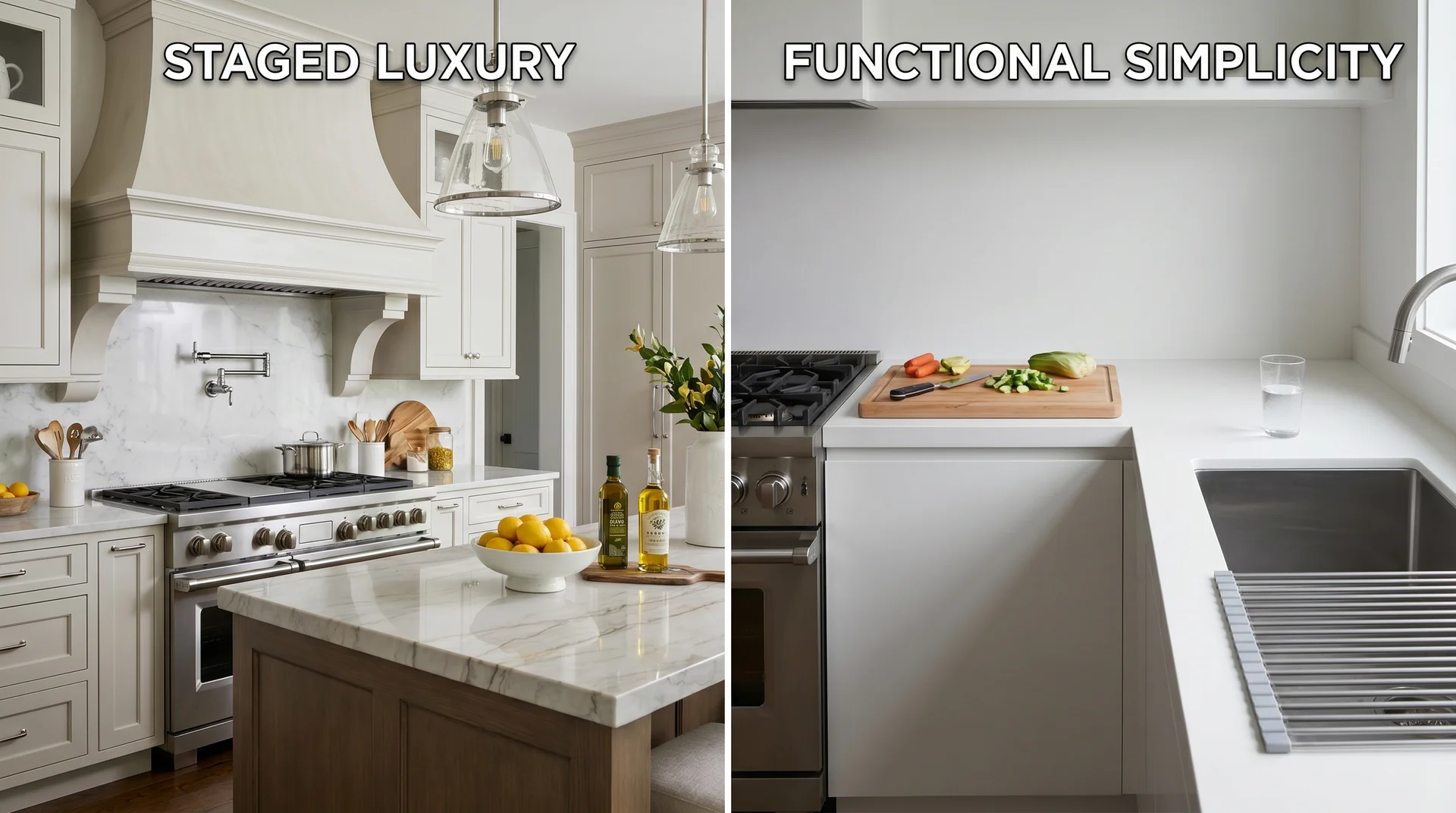
In a listing, “chef’s kitchen” is a marketing term with no regulated definition.
Any seller or builder can apply it to any kitchen. What the label actually implies varies widely from one listing to the next.
Is “Chef’s Kitchen” a Regulated Term?
Any builder, agent, or homeowner can apply the label to any kitchen without restriction. I’ve seen it attached to a 30-inch electric range with no prep surface next to it.
This matters if you’re paying more based on the term. The features you actually want are separate from the label. Look for those features specifically.
What Agents Mean When They Use It
When a listing says “chef’s kitchen,” it usually points to a recognizable cluster of premium features.
Most of those features are real upgrades. What they don’t guarantee is a kitchen that performs well for cooking.
The term typically implies:
- A professional-style range, often 36 to 48 inches wide, with multiple burners
- A ventilation hood, sometimes functional and sometimes decorative only
- Upgraded counter material, such as stone, quartz, or solid surface
- A double-basin or apron-front sink
- Expanded storage, often a pantry or enlarged cabinetry
These are legitimate upgrades. Whether they produce a kitchen that performs depends entirely on how they’re arranged in relation to each other.
The label tells you what someone wanted the kitchen to be. The counter space next to the range tells you what it actually is.
The Features That Actually Define a Chef’s Kitchen
The features that actually define a chef’s kitchen are fewer than most listings suggest.
Counter Space and Work Surface

Unbroken counter space beside the range is the single most important feature in a functional kitchen.
The NKBA recommends at least 36 inches of clear prep surface next to the primary cooking zone. That’s where your cutting board lives during an active cook. Your prepped ingredients stay there too, within arm’s reach of the heat.
I’ve cooked on professional lines where that minimum wasn’t met. You feel the consequence inside the first fifteen minutes of a serious meal.
Surface continuity next to your heat source matters more than total counter footage.
A kitchen can have 12 feet of total counter space and still frustrate a cook. When appliances eat the space next to the range, there’s nowhere left to work. That’s the variable that matters.
Professional-Grade Appliances
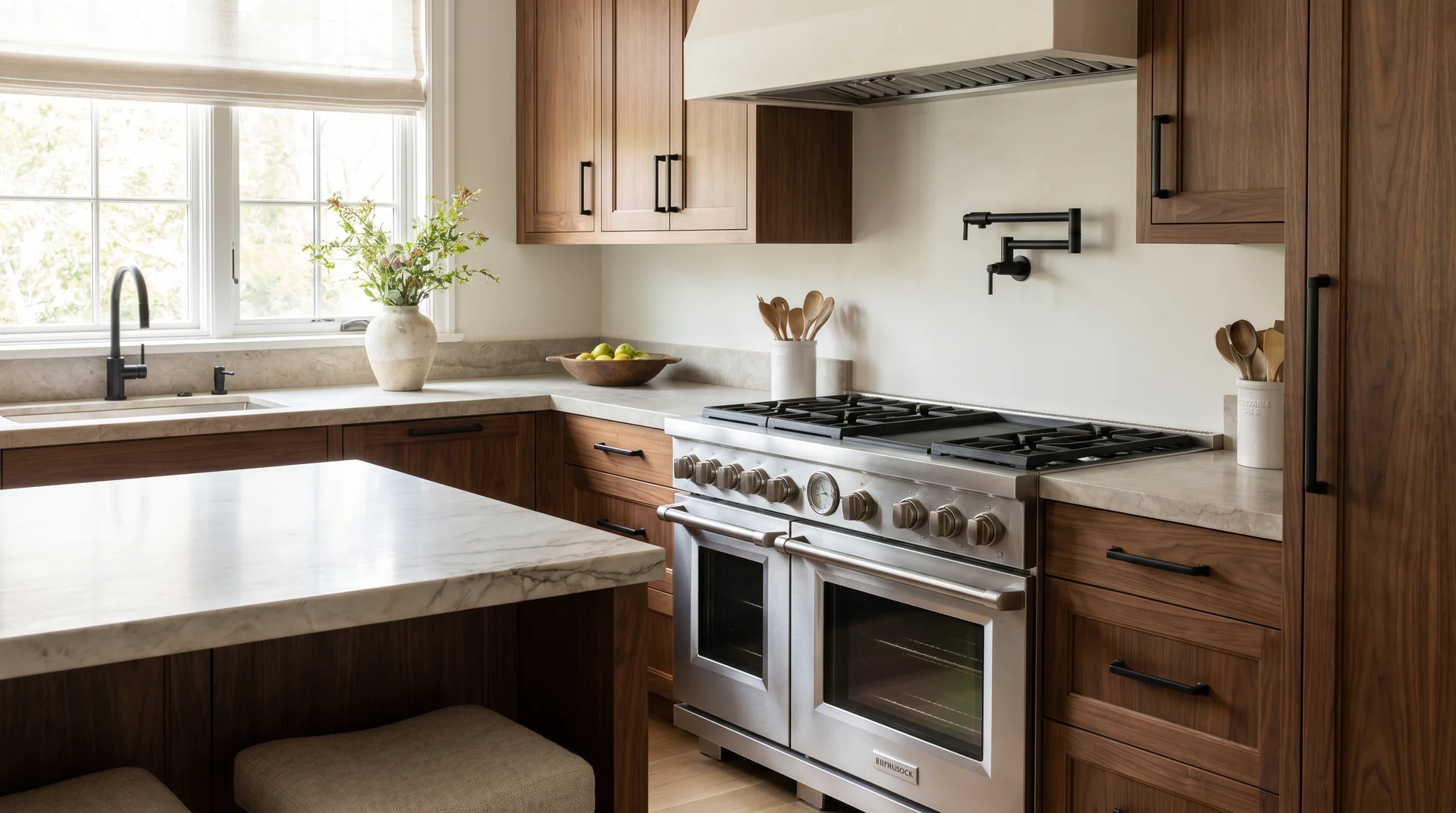
“Professional-grade” on a home appliance label refers to design direction, not commercial production output.
Restaurant equipment runs at commercial gas pressures. Home appliances marketed as professional-style are built to residential standards. The label is as much about aesthetics as performance.
Two specs actually separate a useful range from a poor one:
- BTU output: how much heat each burner produces. Standard home burners run around 10,000 BTUs. High-performance burners reach 18,000 or more.
- Oven temperature consistency: how reliably the oven holds its set temperature throughout a cook.
America’s Test Kitchen evaluates home ranges in real kitchen conditions, not on specification sheets alone. They consistently find that these two specs are what separate useful ranges from poor ones.
Most home cooks don’t need a 48-inch, six-burner range. In my experience testing ranges in real residential kitchens, the 30- to 36-inch dual-fuel format is the better call for most households. Spend the cost difference on counter infrastructure.
Ventilation That Actually Works
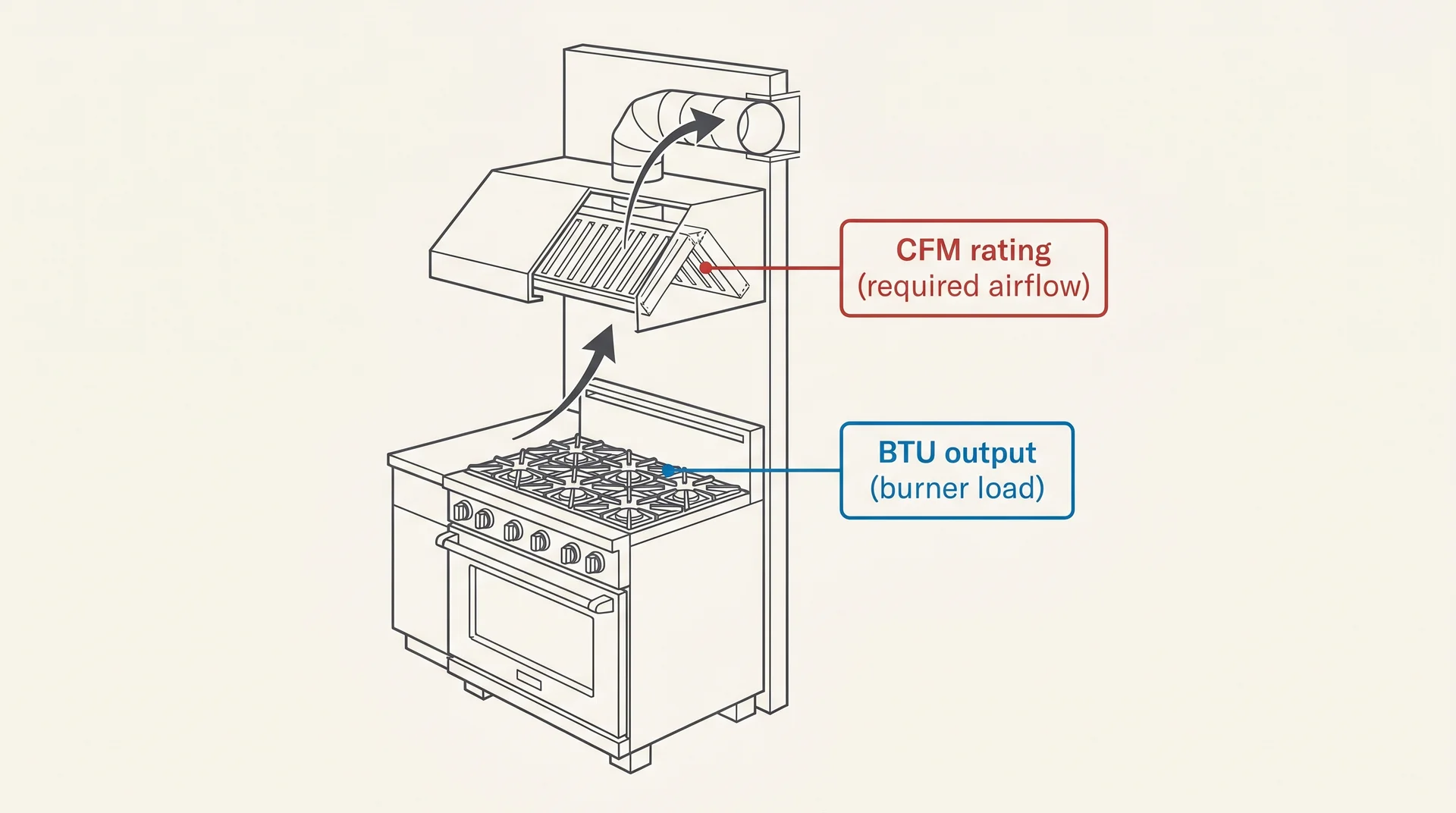
Ventilation is the most overlooked functional feature in kitchens marketed as chef’s kitchens.
A range hood’s job is to clear combustion byproducts, cooking steam, and airborne grease from above your range. The measurement that matters is CFM, which stands for cubic feet per minute. NKBA guidelines recommend roughly 100 CFM for every 10,000 BTUs of range output.
A decorative hood rated at 300 CFM installed over a range producing 60,000 total BTUs is not adequate ventilation. It looks like ventilation. Those are different things.
Matching CFM output to the range’s BTU load is what separates functional ventilation from an expensive fixture above your stove.
Duct routing, makeup air requirements, and hood sizing for a specific layout are contractor questions. That’s a different article, and it needs different criteria.
Storage Designed for Cooking Workflow

Useful kitchen storage is organized by closeness to where things are used, not by category.
The NKBA identifies distinct functional zones in a kitchen based on what happens in each one. Tools and ingredients should live at the zone where they’re needed, not wherever there happens to be space.
A few placements that change how a kitchen works in practice:
- Spices and oils are stored next to the range, not in a pantry across the kitchen
- Pots and pans in a drawer or cabinet immediately beside the stove
- Knives within reach of the cutting board at the prep station
Total cabinet volume is secondary. A smaller kitchen with storage in the right places will outperform a larger one organized by instinct.
The Sink

Sink placement matters more than sink style in a functional kitchen.
An apron-front or double-basin sink is common in chef’s kitchen listings. Both are solid choices. Neither matters as much as where the sink sits relative to your prep surface and range.
The NKBA uses the work triangle as a measure of kitchen efficiency. The work triangle describes the path between the refrigerator, the sink, and the range. When the sink sits far from the prep zone, every cooking task adds extra steps. Position trumps finish.
How a Chef’s Kitchen Differs from a Standard Kitchen
The real difference between a chef’s kitchen and a standard kitchen is workflow.
Appliance brands and finish materials are secondary. How efficiently the kitchen moves you from prep to plate is what changes how cooking feels.
The Workflow Difference
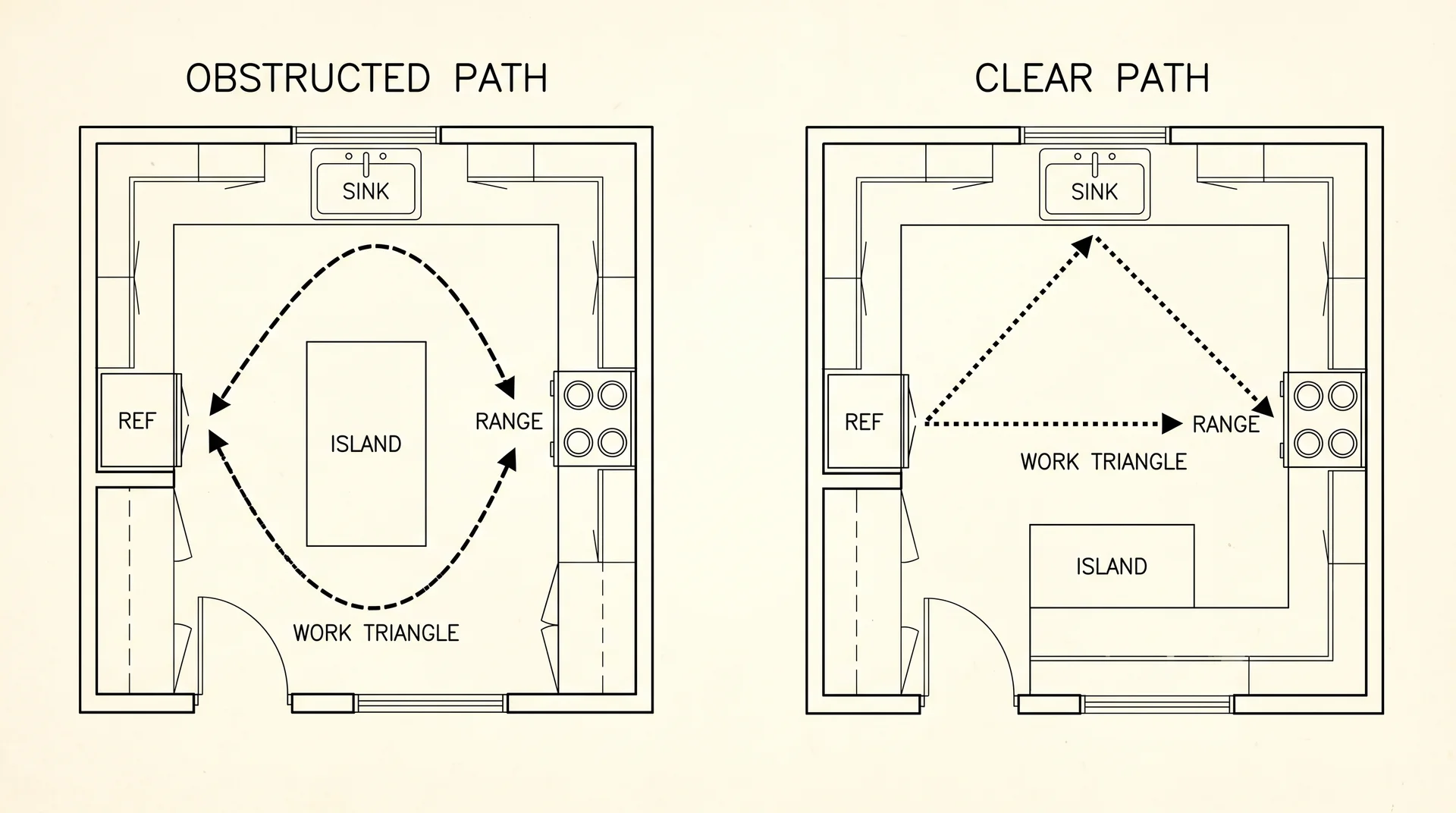
A chef’s kitchen minimizes the steps between the refrigerator, the prep surface, and the heat source.
The NKBA work triangle measures the total distance a cook travels between the refrigerator, the sink, and the range during meal preparation. A well-designed kitchen keeps that path short and clear of obstructions.
Standard kitchens often interrupt that path with a center island, which adds seating and extra counter space. Both are useful things. They can also add unnecessary steps per meal that you stop noticing, but never stop taking.
An island placed correctly adds counter space without cutting across the work path.
A chef’s kitchen can have an island. The island just can’t sit inside the work path.
The Features That Look Professional But Don’t Change How You Cook

Several features common in chef’s kitchen listings add visual appeal without meaningfully improving cooking performance.
The pot filler is the clearest example. I’ve had clients committed to one before we discussed anything else. Not one of them has told me afterward that it changed how they cooked.
The issue is directional. A pot filler fills the pot at the stove, saving the trip from the sink with cold water. The return trip, with a full pot of boiling water, is still yours to make.
Brand name is not the same thing as cooking performance.
Sub-Zero refrigeration is a quality product with real advantages in temperature stability and long-term durability. It’s not the only refrigerator that will support serious home cooking. Comparable performance exists at lower price points.
Decorative hoods with low CFM ratings, premium backsplash tile, and designer hardware all signal “chef’s kitchen” in a listing. None of them changes how a kitchen performs.
A kitchen with adequate ventilation and plain finishes will outperform a beautiful one that can’t clear smoke.
What a Chef’s Kitchen Is Not
A chef’s kitchen is not a restaurant kitchen scaled down for home use.
Restaurant kitchens run on commercial gas lines, with non-porous surfaces throughout and drainage systems sized for production volume. No home kitchen operates under those conditions.
The functional priorities that transfer are workflow, surface area, and ventilation, matched to the cooking load.
The brand in the range is the last thing I look at when I’m assessing a kitchen. I’ve walked into beautifully equipped kitchens with no room for a cutting board beside the stove. Layout first, appliances second.
What You Actually Need to Build One
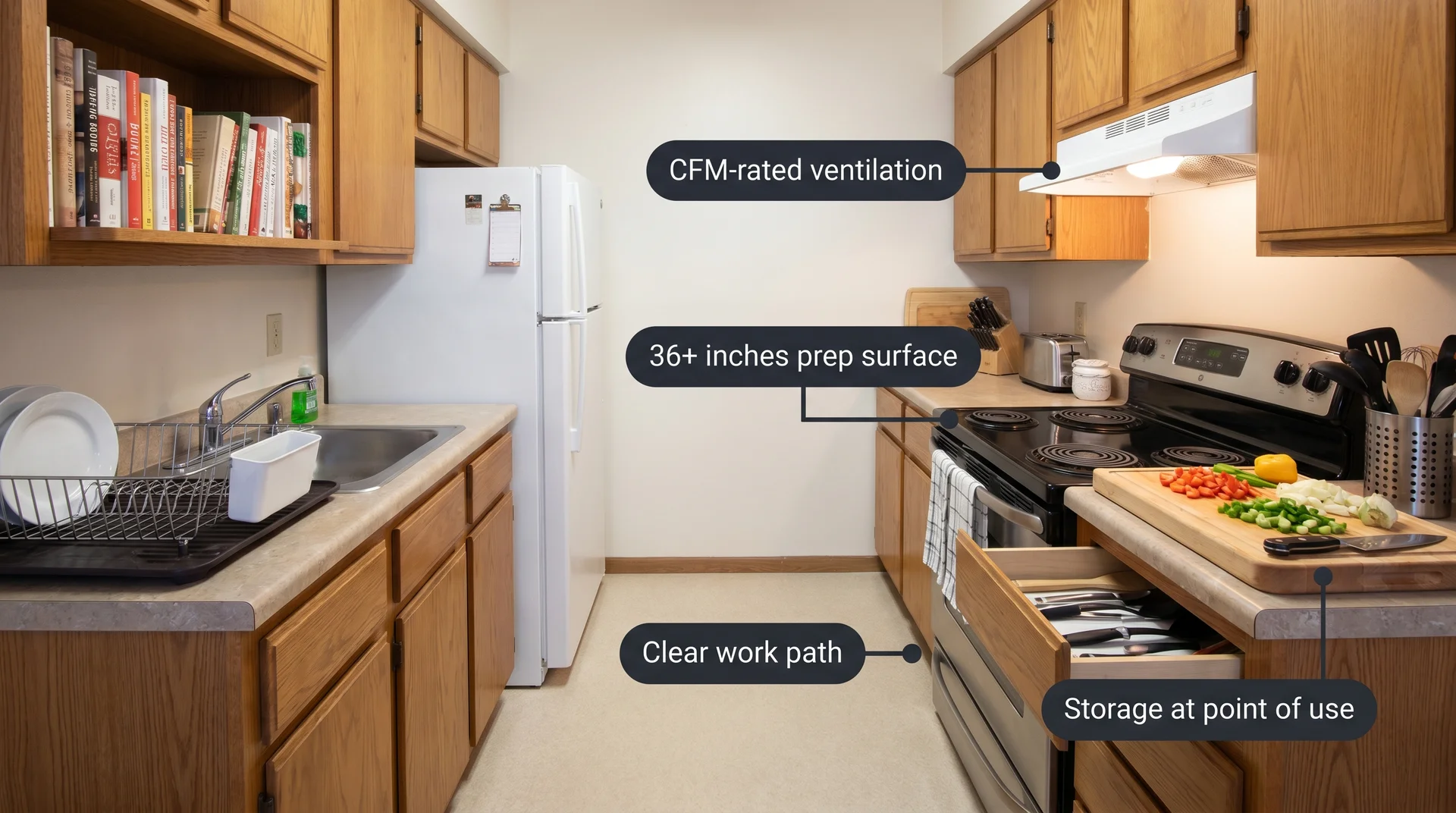
Building a kitchen that performs well requires getting four things right.
Most features associated with the label are worth having. A smaller set of them is non-negotiable if performance is the actual goal.
The Non-Negotiables
These are the features that materially change how a kitchen performs.
When I assess a kitchen, I look for these before anything else. Their absence makes high-performance cooking harder than it needs to be, regardless of what else the kitchen has.
- At least 36 inches of unbroken counter surface next to the primary cooking zone
- Ventilation rated in CFM to match the BTU load of the range below it
- A layout that keeps the path between the refrigerator, sink, and range short and clear
- Place storage based on where things are actually used, not by category or aesthetic logic
Get these four right, and most other decisions become adjustable.
What’s Optional (and Worth Understanding Why)
Most features marketed as defining a chef’s kitchen are genuine upgrades, not requirements.
The pot filler, as covered earlier, solves one direction of one problem. It’s worth having for cooks who regularly boil large quantities of water. For most kitchens, it’s a convenience.
Here’s how three commonly marketed chef’s kitchens hold up when you look at what they actually deliver:
| Feature | What It Adds | What to Know |
|---|---|---|
| Pot filler | Fills pots at the stove without carrying water from the sink | One-directional. You still carry the full pot back to drain it. |
| Sub-Zero refrigeration | Superior temperature stability and long-term durability | Strong product. Comparable performance available at lower price points. |
| Marble countertops | Heat tolerance and visual warmth | Porous surface. Food safety guidance recommends easy-to-sanitize surfaces in active raw protein prep areas. |
Marble requires regular sealing to maintain its surface integrity. Stone and quartz alternatives offer comparable heat tolerance with less ongoing maintenance.
Counter material is also genuinely variable. I won’t flatten that into a single recommendation because the honest answer depends on how you cook and how much upkeep you’ll realistically do.
Task lighting, which means under-cabinet fixtures positioned to illuminate your prep surface directly, is worth planning before cabinets are finalized. It won’t change how a kitchen performs. It will change how comfortable it is to use across longer cooking sessions.
These upgrades belong after the non-negotiables are in place. They are not substitutes for them.
Planning and budgeting a kitchen renovation to reach this point is a different article. It needs different criteria.
A “chef’s kitchen” in a listing tells you someone cared about the aesthetic of a high-performance kitchen. Whether the kitchen actually performs is a different question entirely.
Ask how much unbroken counter space sits next to the range. Then ask what CFM the ventilation carries. Those two answers will tell you more than the label ever will.