
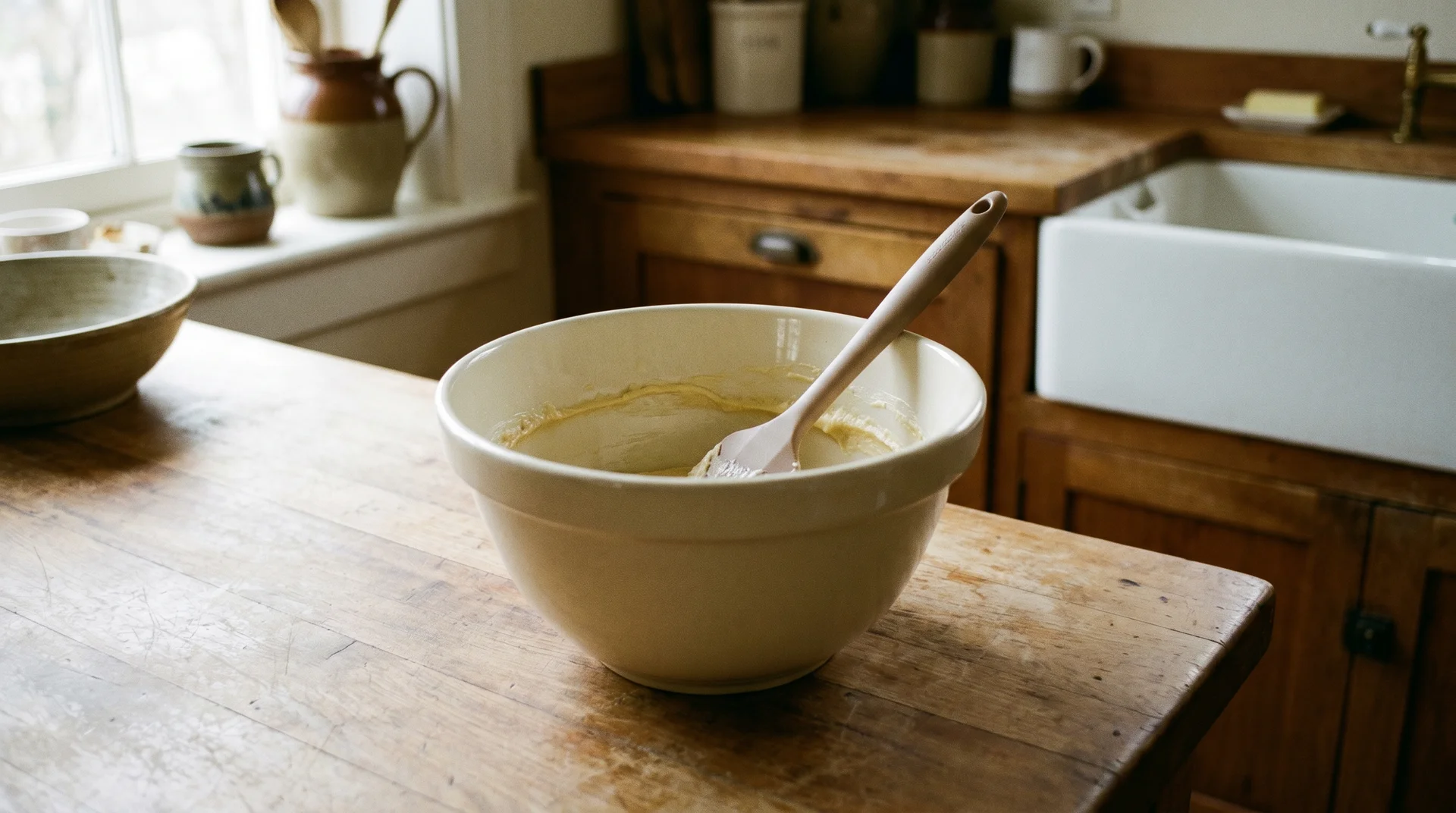
A rubber scraper is a flexible kitchen tool used for scraping, folding, mixing, and clearing ingredients from bowls and jars. If a recipe calls for one and you’re holding a silicone spatula, you probably already have what you need.
Whether it does the specific job correctly depends on its size and how you use it.
What a Rubber Scraper Actually Is
A rubber scraper is a flexible-bladed utensil designed to conform to the curved surfaces of bowls and jars. Modern versions are made from food-grade silicone, which gradually replaced natural rubber in kitchen scrapers through the 1990s.
A rubber scraper and a silicone spatula are the same tool for most purposes.
If a recipe calls for a rubber scraper and you own a silicone spatula with a flexible head and a handle, that qualifies. What matters more than the name is whether the blade flexes and what you need it to do.
Why the Name “Rubber Scraper” Stuck
Recipe writers kept the term because their readers already knew it.
Cookbooks published before 2000 used “rubber scraper” consistently. Writers who learned from those books carried the term into newer publications.
You’ll find “rubber scraper” in a 1978 edition of Joy of Cooking. You’ll also find it on the packaging of a current silicone spatula from any kitchen store: same category, different material, same name.
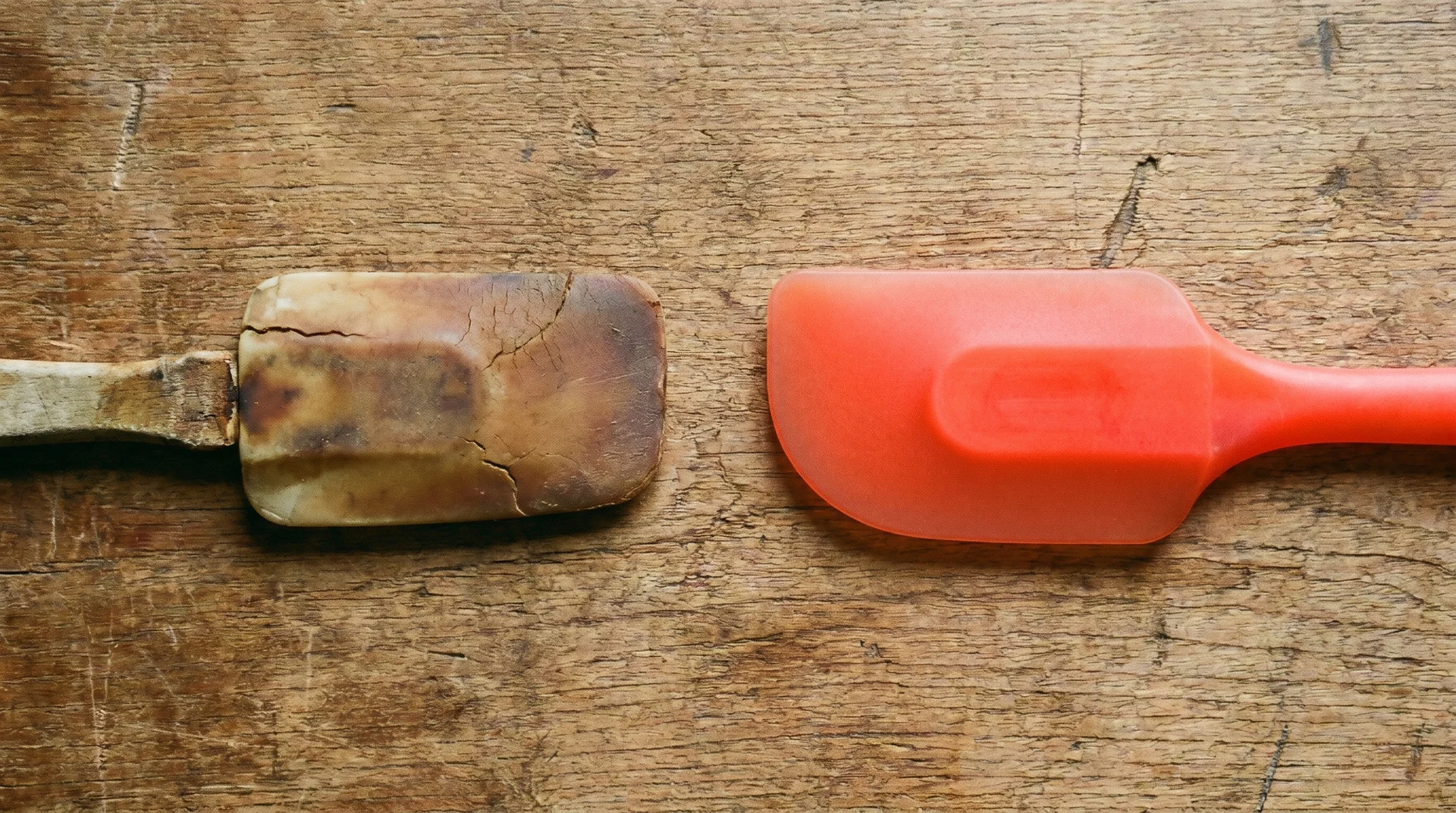
Old natural-rubber scrapers still exist. If you find one at the back of a drawer, it likely predates the silicone transition. It will feel stiffer and slightly tackier compared to silicone. That difference matters near heat, which the heat section below addresses directly.
The Two Forms: Bowl Scrapers and Spatula Scrapers
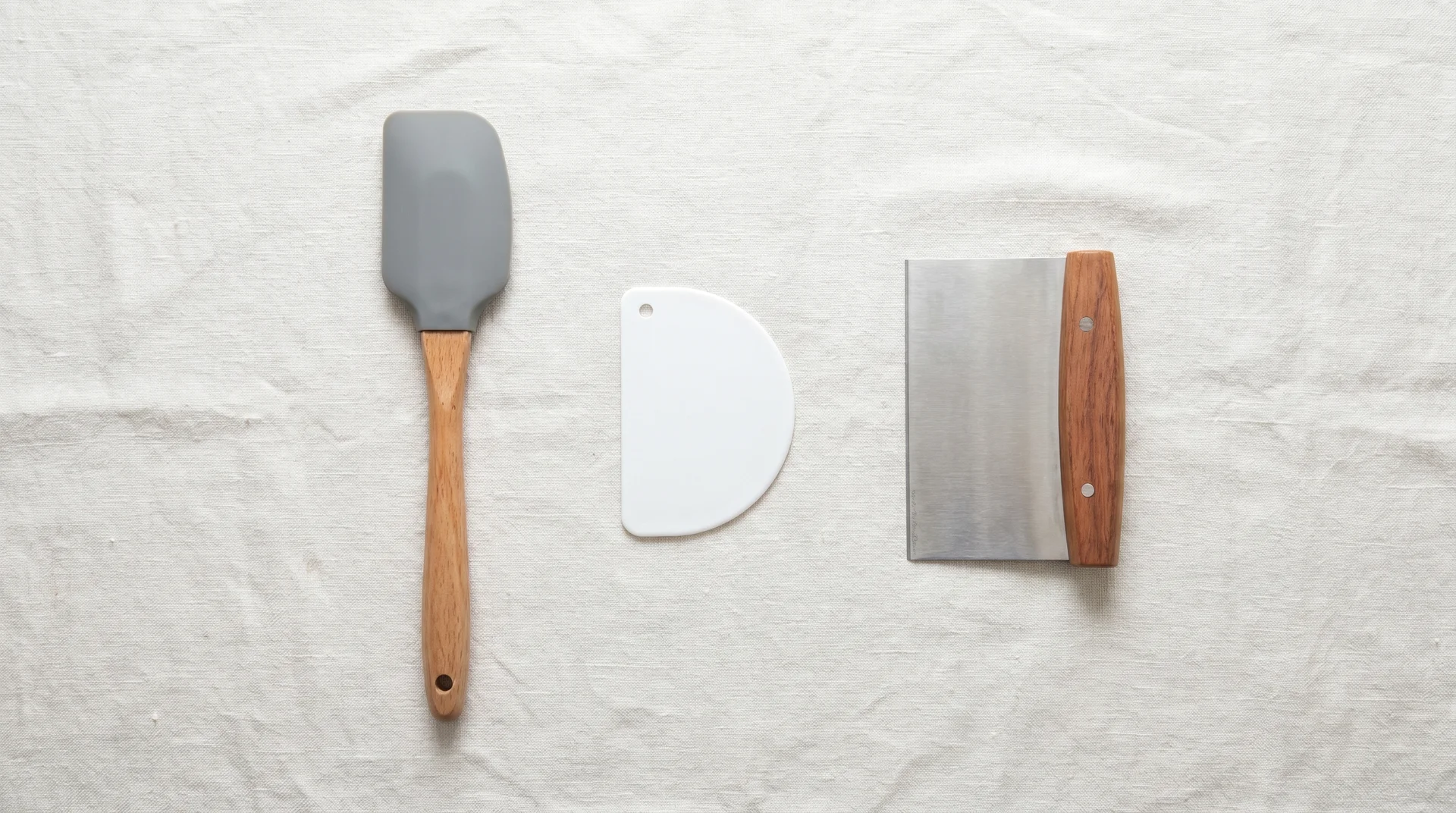
Two distinct physical tools share the rubber scraper name.
Most recipes call for one form. Most kitchens own it. A third category, the rigid bench or dough scraper made from metal or hard plastic, is a separate tool altogether and belongs in a different conversation.
That distinction becomes clear once you look at where the rubber scraper and the flip spatula actually part ways.
The Handled Spatula Scraper
The handled scraper is what most recipes mean when they say “rubber scraper.”
It has a long handle attached to a flexible head. You work it against bowl and jar surfaces to clear the contents. This form is sometimes called a spatula scraper or plate scraper.
If you own a silicone spatula with a handle, this is the tool. The blade needs to flex. A stiff blade defeats the purpose.
The Handleless Bowl Scraper
The bowl scraper has no handle and fits in the palm of your hand.
It’s a palm-sized piece of flexible silicone or firm plastic with one curved edge shaped to match the inside of a mixing bowl. Professional bakers use it to move dough from a work surface or transfer full batches from bowl to pan in one controlled motion.
Most home bakers own the handled version and rarely use the handleless one. Both are rubber scrapers. They’re built for different tasks and aren’t interchangeable for all of them.
What the Flexibility Actually Does
A flexible blade conforms to curved surfaces the way a rigid blade cannot.
The inside of a mixing bowl curves. A rubber scraper’s blade bends to match that curve. It gives you full contact between blade and bowl in a single pass.
A stiff blade skips the curve and leaves residue at the sides and bottom. The flexibility is not a design preference. It’s the functional reason the tool was built this way.
This matters most during folding, where the blade needs to maintain bowl contact through each pass. A blade that can’t conform means more passes. More passes mean more air lost.
Rubber Scraper vs. Spatula: What’s Actually Different
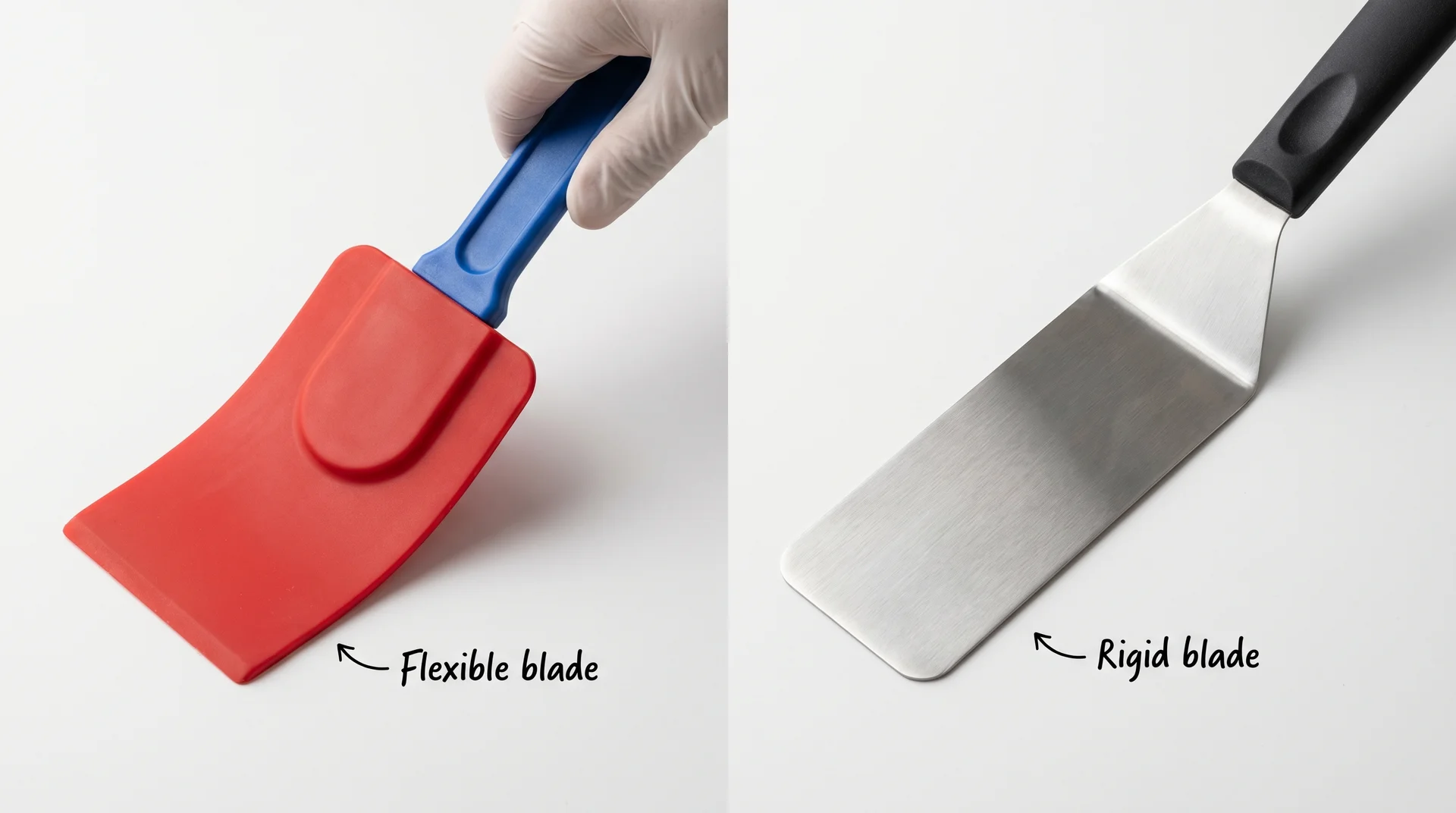
These are two tools with two different jobs.
Most home cooks use “spatula” to mean whatever flexible utensil is nearby. The word covers several distinct tool types, including the rubber scraper and the flipper spatula. They’re built very differently from each other.
A flipper spatula has a rigid or semi-rigid blade designed to slide under food and turn it. A rubber scraper has a flexible, often curved blade designed to conform to surfaces and move semi-liquid ingredients.
| Rubber Scraper | Flipper Spatula | |
|---|---|---|
| Blade flexibility | High: bends to match curved surfaces | Low to medium: holds its shape under food |
| Primary use | Scraping, folding, mixing | Flipping, turning, lifting |
| Safe for non-stick cookware | Yes, silicone versions | Silicone, yes; metal, no |
| High-heat cooking | Food-grade silicone only | Most versions |
| Best for baking | Yes | No |
Using a flipper spatula to fold egg whites into a batter will deflate it. The stiff blade breaks air bubbles instead of carrying them through the mixture. The difference shows up in what comes out of the oven.
What a Rubber Scraper Is Used For
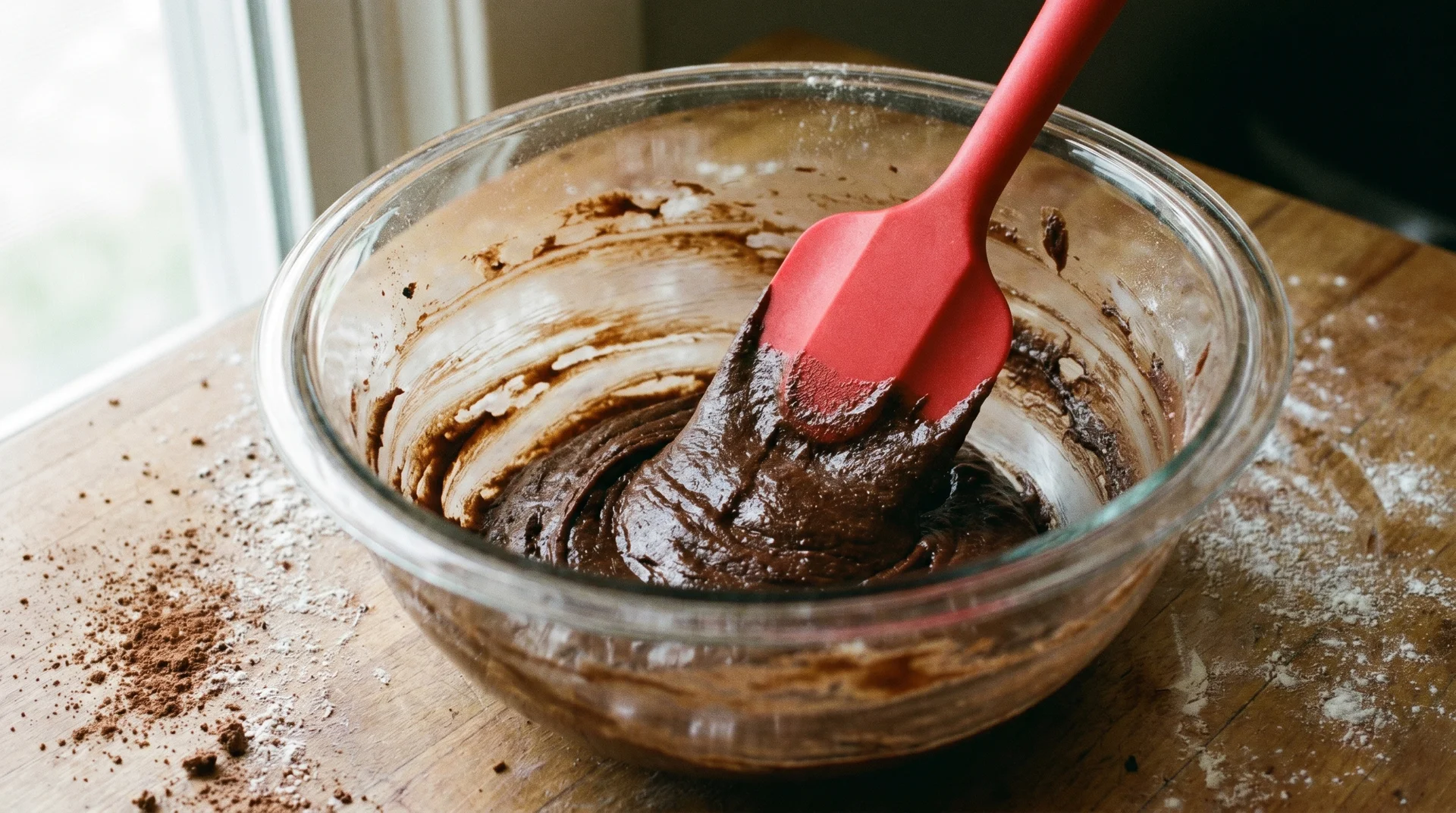
A rubber scraper has six core uses in the kitchen.
Scraping is the obvious one, and it earns the name. A flexible blade gets every last bit of batter from a mixing bowl. It clears jar bottoms. It moves batter to a pan without losing half of it on the sides.
The folding use is less obvious and more consequential for baking results than any other use on this list.
- Scraping mixing bowls, jars, and containers: the namesake function; a flexible blade clears every bit of batter, sauce, or paste in a single pass without leaving residue
- Folding delicate mixtures: egg whites, whipped cream, meringue; technique-dependent, and where the tool’s real baking value is shown
- Mixing and incorporating: combining wet and dry ingredients, or stirring custards and sauces that need continuous gentle movement without a whisk’s agitation
- Spreading batter, fillings, and frosting: distributing cake batter evenly before baking, spreading frosting onto layers, or pushing a filling to the edges of a tart shell
- Clearing jars and deep containers: nut butter, tomato paste, tahini; a narrow jar-spatula blade reaches the bottom of deep containers where a standard blade can’t
- Transferring chopped ingredients: moving vegetables from the cutting board to the pan without leaving a third of them behind on the board
- Cleaning whisk wires: a pointed-tip scraper blade clears batter from between tines in one pass; a spoon or cloth doesn’t
The folding use is what sets this tool apart from everything else in a kitchen drawer. It’s technique-dependent, and the technique is worth learning.
The Fold: How to Use a Rubber Scraper Correctly?
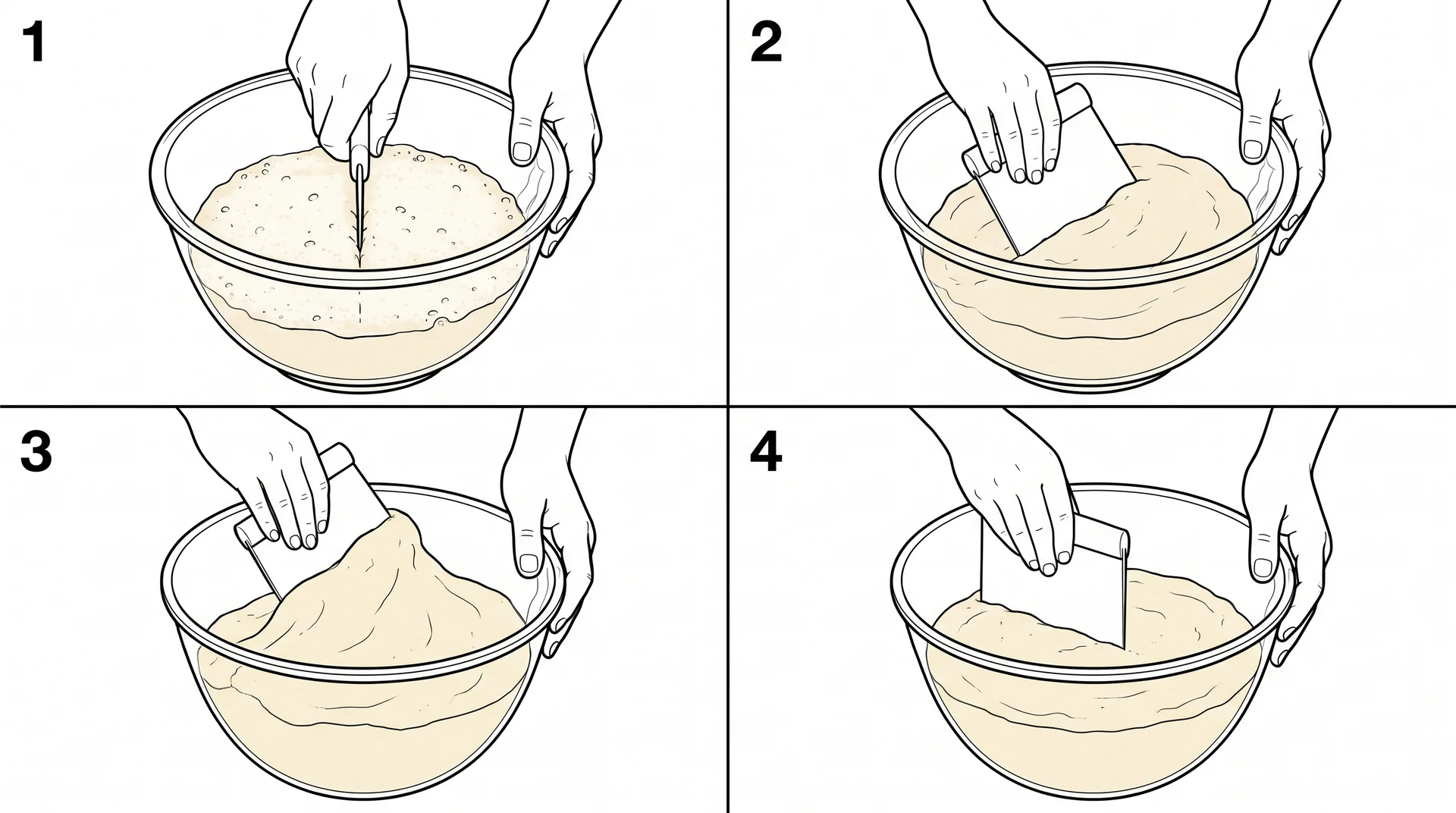
Folding is the rubber scraper’s most important function in baking.
Folding is not gentle mixing. It’s a specific motion that incorporates ingredients while preserving the air whipped into one of them. When a recipe says to fold egg whites into a batter, those whites carry the air the cake needs to rise. Stirring destroys that air. Folding carries it through.
America’s Test Kitchen documents the correct technique for this. The motion is vertical and sweeping throughout, never circular.
- Add about a quarter of the lighter mixture (whipped whites or cream) to the heavier batter first. This loosens the batter without losing much air.
- Hold the scraper vertically. Cut straight down through the center of the bowl to the bottom.
- Draw the blade across the bottom and sweep it up the far side of the bowl in one continuous motion.
- Fold the mixture from the far side back over the center.
- Rotate the bowl a quarter turn and repeat.
- Stop when the mixture is almost fully combined. A few faint streaks are fine. They blend during baking, and the air you’d lose chasing them doesn’t come back.
I tested this across a dozen batters in my own kitchen, not in controlled conditions. Here’s what I found: stopping with a faint streak produces better rise and texture than folding to full uniformity.
The last few passes are where most air loss happens. The temptation is to fold until everything looks perfect. Resist it.
In February 2023, King Arthur Baking made a case that a whisk is the better folding tool for certain high-egg-white applications, specifically Japanese-style soufflé cheesecake. Their argument is solid for that recipe type.
I haven’t tested it across enough batter types to say whether it extends beyond that. For chiffon cake, mousse, and most standard home baking, the rubber scraper is still the right call.
Size Matters More Than People Think
A scraper that’s too small for the bowl cannot fold correctly.
The blade needs to cover a meaningful arc of the bowl’s curved surface in a single pass. A small scraper in a large bowl means more passes. More passes mean more contact with the batter. More contact means more air lost.
This explains more collapsed batters than any technique error does. The scraper and the bowl are a matched system. Match them.
For a standard mixing bowl used for cake or mousse batters, a blade of about 3 inches and a total tool length of around 11 inches is the practical minimum. A mini scraper is for small-batch work, jar tasks, and decorating.
When the Heat Matters: Rubber vs. Silicone at Temperature
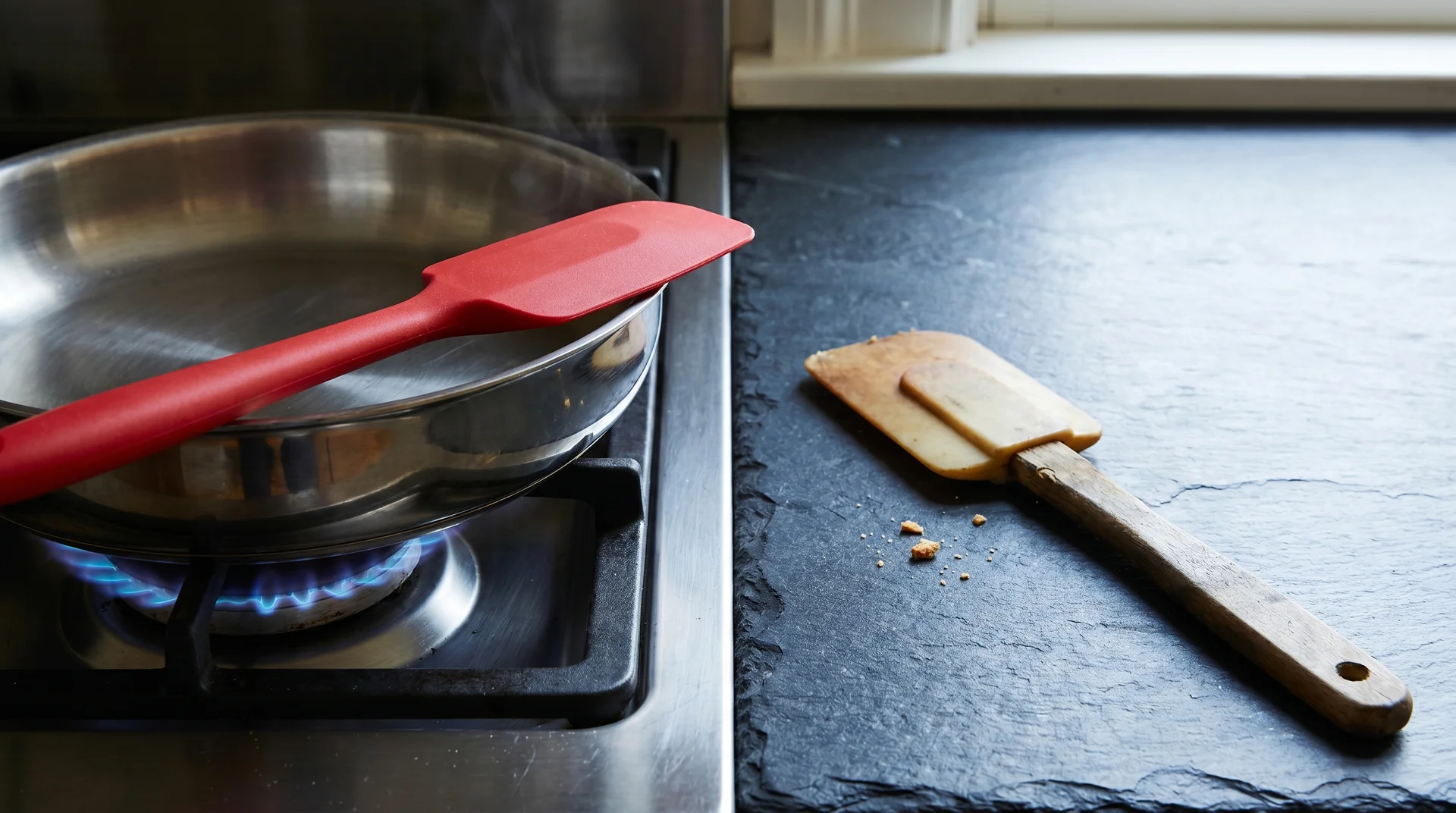
The rubber-versus-silicone distinction only becomes relevant near heat.
For room-temperature scraping, folding, and mixing, both materials perform similarly. The gap opens when heat enters. Natural rubber has a low heat threshold. Use it near a hot pan, and you risk warping the blade.
A warped natural-rubber blade also transfers a faint odor to whatever you’re stirring. I’ve seen this happen faster than most people expect.
Food-grade silicone scrapers are rated for sustained heat. Most fall between 400°F and 600°F. That covers virtually every stovetop and oven application a home cook will encounter.
- Old-style natural rubber scrapers: flexible but slightly tacky, usually opaque: use for room-temperature tasks only and keep away from any heat source
- Modern food-grade silicone scrapers: firm but pliable, often brighter or slightly translucent: check the manufacturer’s stated heat rating before the first stovetop use
The question “Can I stir my scrambled eggs with this?” has a different answer depending on which of those two tools you’re actually holding. Five seconds to check the label is worth it.
Once you know your scraper handles the task at the temperature, the other thing worth understanding before you buy is how the tool is built.
Two-Piece vs. One-Piece Construction
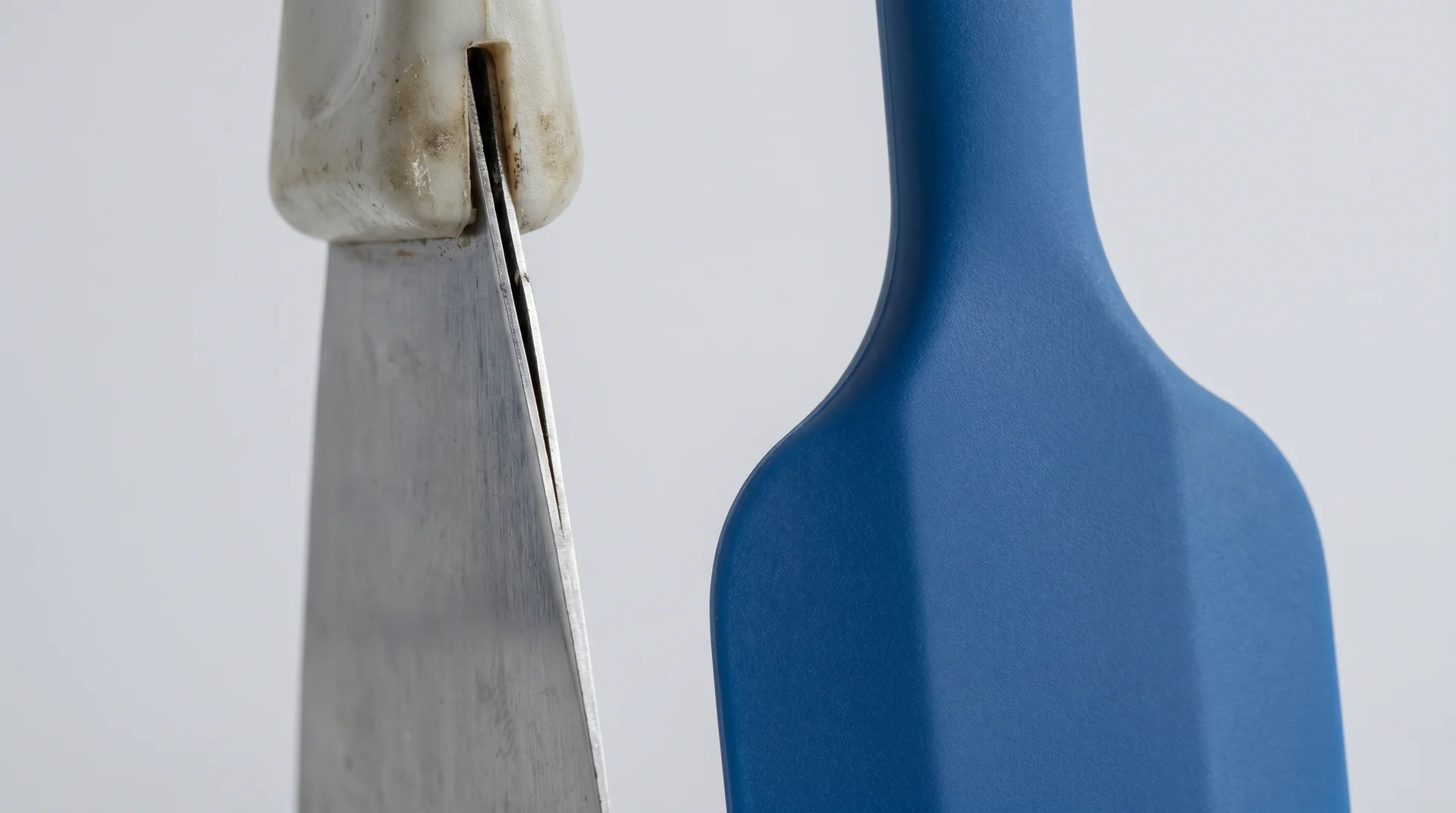
Two-piece scrapers are the most common low-cost version in kitchen stores.
A two-piece scraper has a handle that inserts into a separate rubber or silicone head. A small gap forms at that junction. Food and moisture collect there during use. CooksInfo notes that the residue at a two-piece handle-head junction is difficult to clear across multiple wash cycles.
In warm batters, the head can also separate from the handle during use. I keep a record of tools I’ve tested and set aside, and two-piece scrapers appear on it more than their market share would suggest. I’ve tested enough of them to say that with some confidence.
One-piece silicone construction removes both problems. No joint means no hygiene trap. No separate head means no failure point during use.
When you’re looking at a scraper, check whether the blade and handle are molded as a single unit. If they’re two separate pieces joined at the base, that’s the tradeoff you’re accepting.
However it’s built, a good scraper needs very little from you to last.
Caring for a Rubber Scraper

A silicone scraper in good condition lasts for years with minimal attention.
Most modern food-grade silicone scrapers are dishwasher-safe on the top rack. Hand-wash two-piece scrapers with wooden handles and any old natural-rubber scrapers. For both, dry completely before storing.
Specific signs indicate when a scraper should be replaced. Watch for any of these:
- Cracks or tears in the blade, especially at the flex points near the edges, should be replaced immediately, as cracked rubber or silicone harbors bacteria in fissures that normal cleaning can’t reach
- Persistent odor or flavor transfer that doesn’t clear after washing
- Stiffness that develops over time, reducing how well the blade conforms to bowl surfaces
- Head separation from the handle on a two-piece version
Store scrapers in a utensil crock or flat drawer where the blade isn’t compressed under heavier tools. A blade held in a bent position for months takes on that shape.
A blade that loses its flexibility loses its primary baking function with it.
Final Scrape
Most home bakers use a rubber scraper to empty a bowl. Its real value is in the fold.
Match the scraper to your bowl, use the correct sweeping motion, and stop before the mixture looks fully uniform. Every light cake, mousse, and soufflé you make after that will show the difference.
A matched system of scraper and technique is worth more than any material upgrade.