

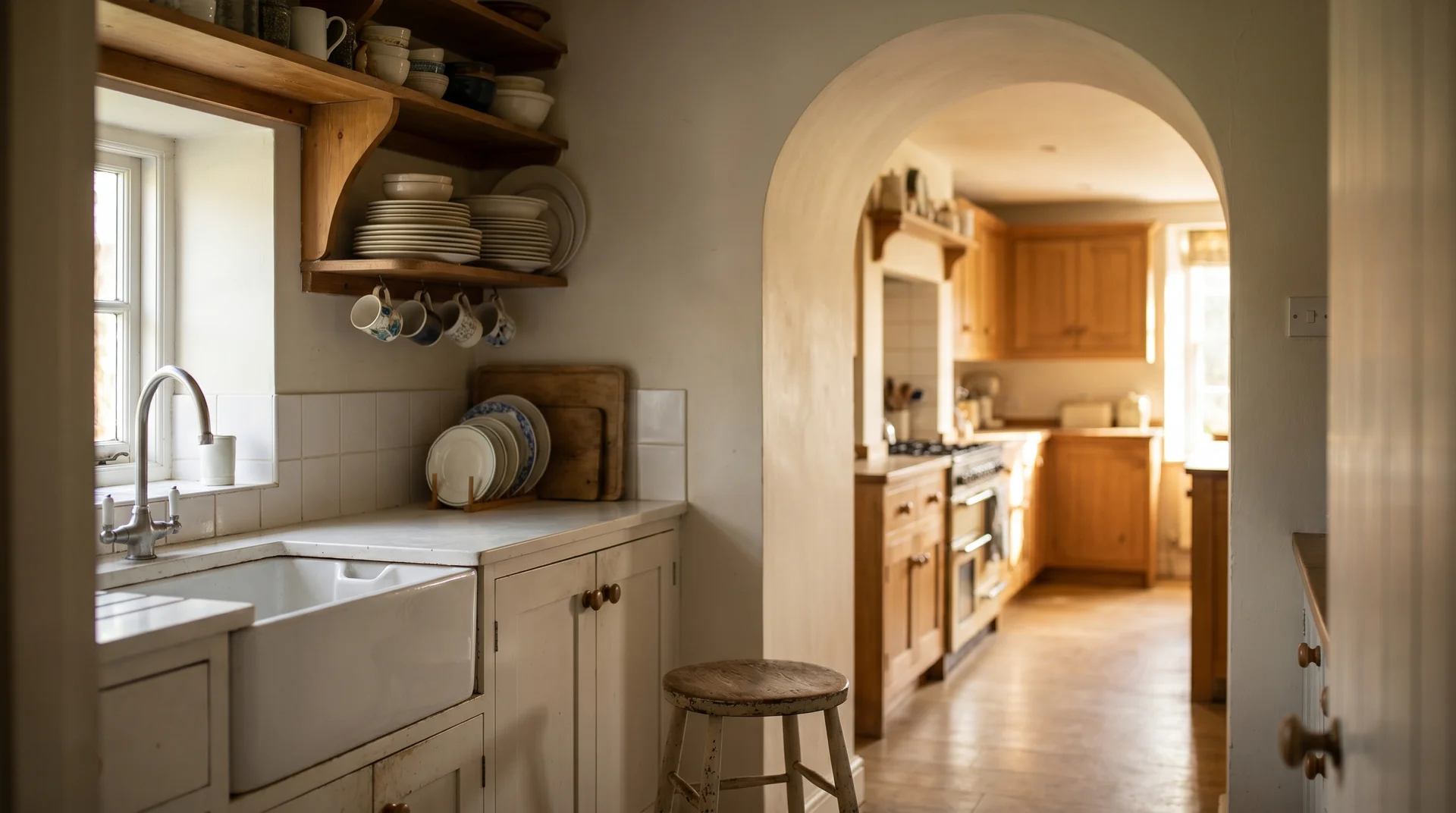
A scullery kitchen is a secondary room adjacent to your main kitchen, designed around a sink for dishwashing, overflow prep, and appliance storage.
Whether it belongs in your renovation depends on three things: how your household cooks, where the room can physically go, and what it will actually cost.
What is a Scullery Kitchen?
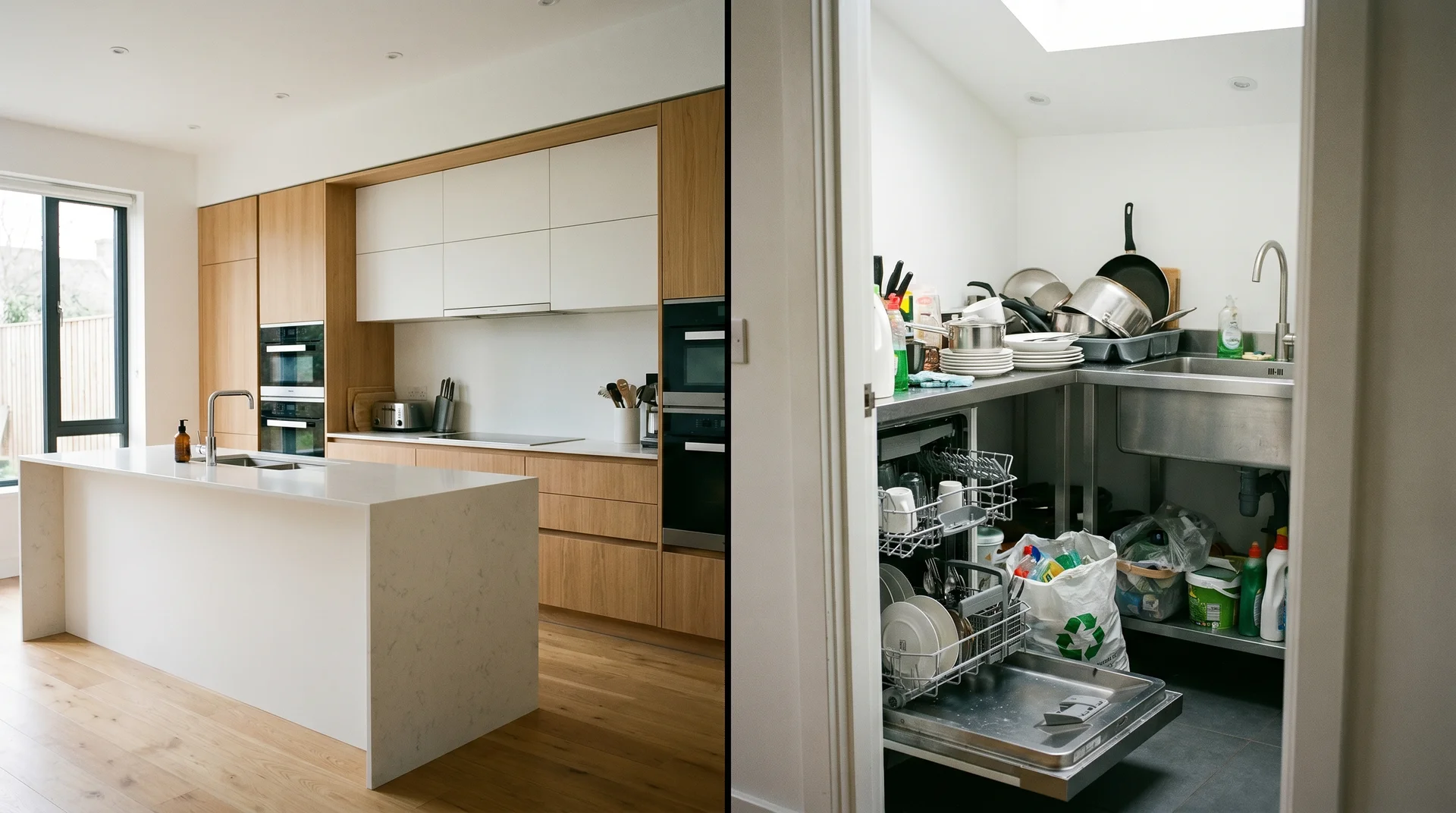
A scullery has one defining feature, and that is a sink.
It’s a secondary room, next to the main kitchen, designed for dishwashing, cleanup, and overflow food prep. The sink is what separates it from a walk-in pantry. Without plumbing, you have a storage room.
With plumbing, you have a scullery.
The concept comes from Victorian-era British estates. Household staff handled messy kitchen work in a back room. The main cooking area stayed presentable for guests.
Open-concept kitchen design brought the problem back. When the cooking area is visible from the living room, there’s nowhere to put the mess. A scullery gives it somewhere to go.
Scullery vs. Butler’s Pantry vs. Dirty Kitchen
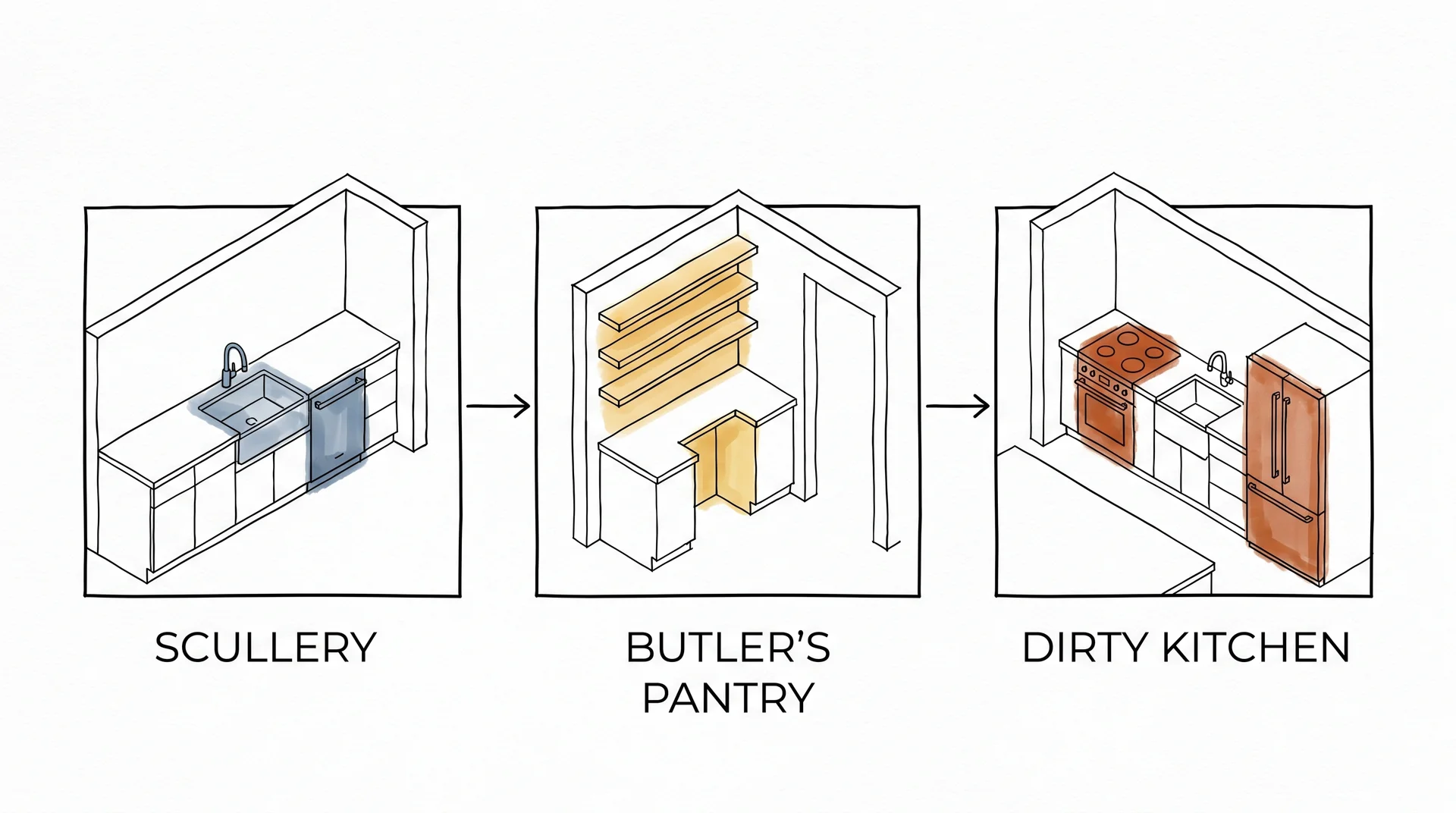
These terms get used interchangeably online, and they shouldn’t be.
The key difference is plumbing and purpose.
- A scullery has a sink and is built for cleanup and overflow prep.
- A butler’s pantry focuses on storage and serving, with a sink as an optional extra.
- A dirty kitchen is a full secondary cooking room with a cooktop, a different scope entirely.
Ask a contractor for a scullery, and they may spec a butler’s pantry instead. You’ll get a less functional space for roughly the same budget. If they read it as a dirty kitchen, the scope and cost expand well beyond what you planned.
| Space | Primary Function | Plumbing Required | Cooking Capability | Typical Size |
|---|---|---|---|---|
| Scullery | Dishwashing, cleanup, appliance overflow | Yes | Small appliances only | 50–120 sq ft |
| Butler’s Pantry | Storage, staging, light prep | Optional | No | 30–80 sq ft |
| Dirty Kitchen | Full secondary cooking and prep | Yes (full) | Yes, including cooktop | 80–200 sq ft |
| Walk-in Pantry | Food and dry goods storage | No | No | 20–60 sq ft |
A scullery sits between a butler’s pantry and a dirty kitchen. It has a sink and a functional workspace. There is no cooktop and no full cooking setup.
When Designers Use These Terms Interchangeably
The naming confusion tends to surface during the cabinetry specification phase.
By that point, room dimensions are fixed. Structural decisions have already been made. A misalignment discovered then costs more to correct than one caught upfront.
Before any contractor conversation, ask one specific question.
Does this space include a full-size sink, a dishwasher rough-in, and at least three feet of clear prep counter?
A rough-in means the plumbing connections, supply lines, and drain are built into the wall before the cabinets go in. You can add the dishwasher later. Running those lines back in after the cabinets are set costs significantly more.
- Full sink, rough-in, three feet of counter: you’re describing a scullery.
- No rough-in planned: you’re describing a butler’s pantry with plumbing.
- Cooktop included: you’re describing a dirty kitchen. Different budget, different permits.
Get that in writing before anything is ordered.
What a Modern Scullery Kitchen Actually Contains
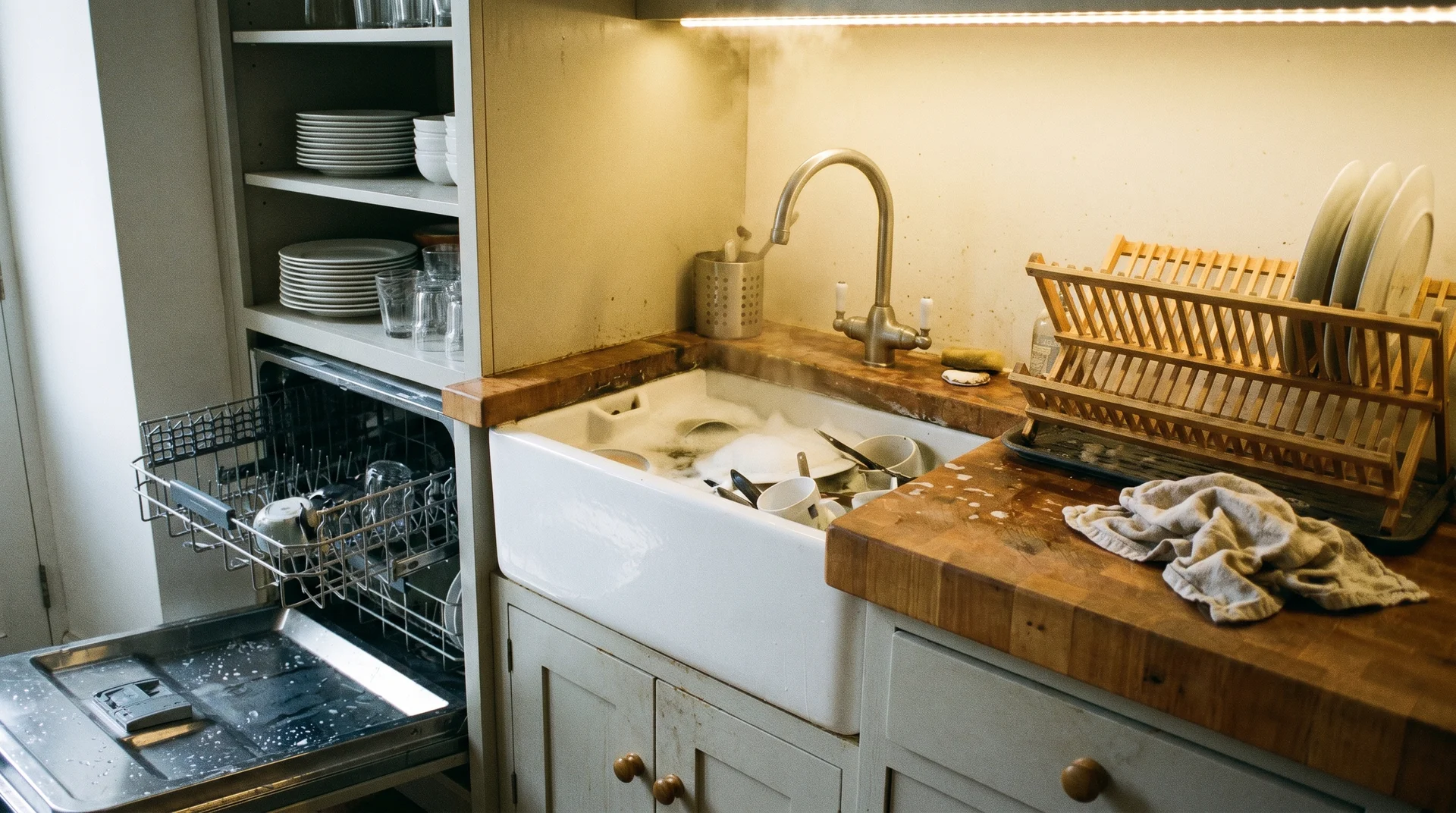
The feature list is shorter than most articles make it seem.
A scullery is a secondary kitchen room with a sink and clear workspace for dishwashing and overflow prep. It needs three things to function as one. Beyond those three, every other addition is a choice.
The Features Every Scullery Needs
Three things separate a proper scullery from a pantry that happens to have a sink.
These are the elements that define the category, not the finish.
- A full-size sink, not a prep sink. A scullery handles full cleanup, which means the basin needs to fit a sheet pan or a stockpot. Depth matters more than width.
- At least three feet of continuous counter space on one side of the sink. Less than that, and the room becomes a drop zone rather than a working surface.
- A dishwasher rough-in is planned during the build, even if the dishwasher waits. Running that plumbing back after the cabinets are set costs far more than speccing it up front.
The National Kitchen and Bath Association (NKBA) recommends 42 inches of clear floor space between facing surfaces in a single-cook workspace.
In a scullery, that means enough room to open the dishwasher door fully without blocking access to the sink.
The Features Worth Considering
These additions make a scullery more versatile.
Evaluate each one against how your household actually cooks and entertains, not how you intend to.
- A second dishwasher, most useful for households that regularly host eight or more guests at a sitting
- A refrigerator drawer or undercounter fridge, which reduces trips to the main kitchen during large-scale prep
- Appliance garage cabinetry to keep stand mixers and food processors accessible without occupying counter space
- Overhead ventilation is required if you plan to run heat-generating appliances in the space regularly, and easy to forget until the cabinetry is already in place
A wine fridge appears in nearly every scullery photo published online. It is not what makes this room functional.
How Much Space Does a Scullery Actually Need
A functional scullery starts at around 50 square feet.
That’s roughly six feet by nine feet. It’s tight, but it works if the layout is right.
Eighty to a hundred square feet is more comfortable. That clearance lets you open the dishwasher fully while someone else reaches the dish rack. In a household where two people clean up after cooking, that matters every night.
I wouldn’t specify anything under 45 square feet. Below that threshold, you have a sink in a closet. I’ve seen that version built to save budget, and it disappoints every time.
Is a Scullery Kitchen Worth Adding?
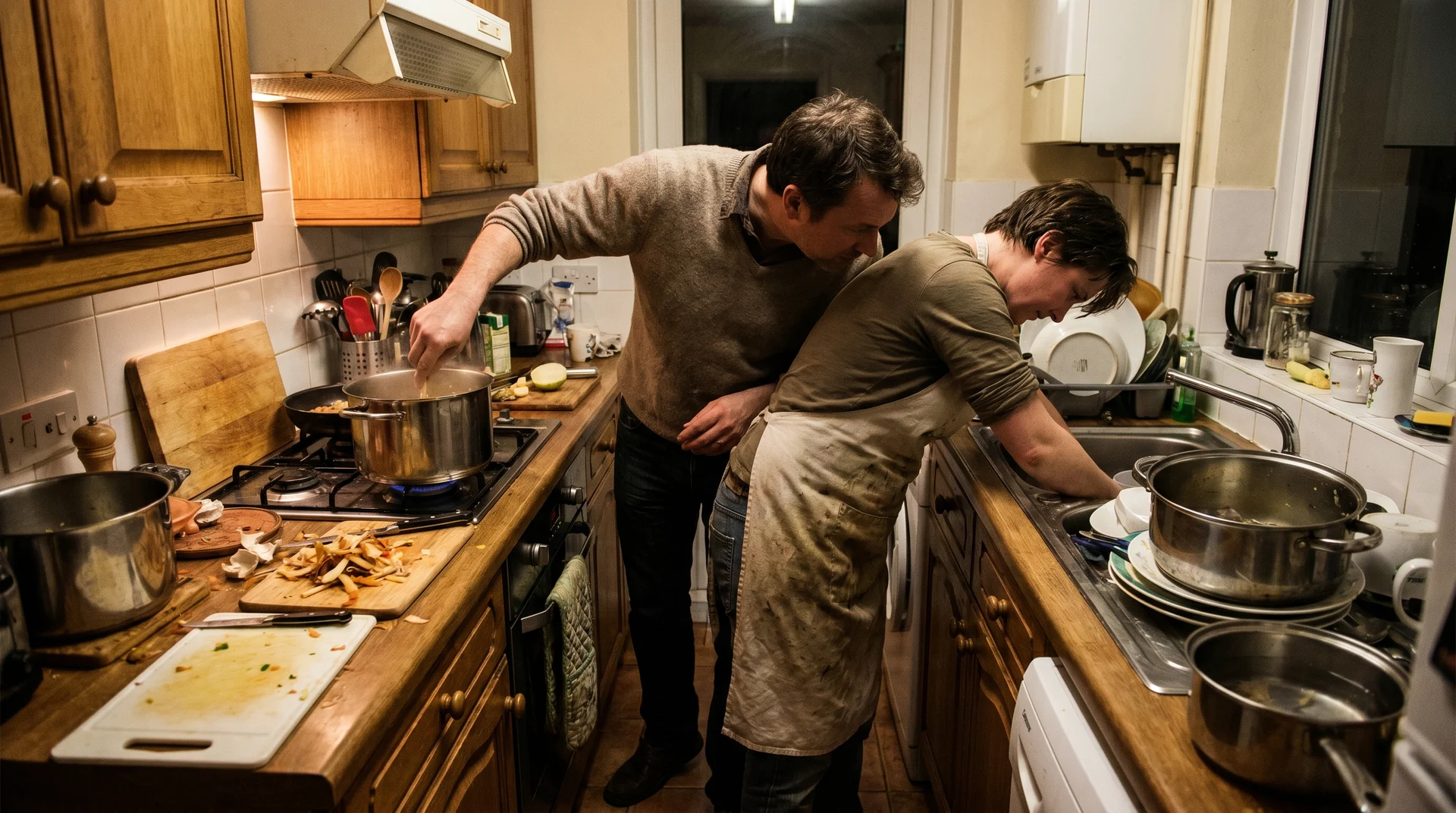
A scullery is worth adding when cooking and cleanup compete for the same sink and counter every time you make a real meal.
The Downton Abbey framing makes a scullery feel like a luxury revival for people who want to live like they have household staff.
The Victorian heritage is irrelevant to whether your family needs a second sink.
If two people regularly share one kitchen sink, or you host often enough that a full dishwasher cycle runs before the guests leave, a scullery addresses a daily problem. If you cook alone and host twice a year, it probably doesn’t.
The Households That Get Real Value from a Scullery
Three household profiles consistently get lasting, practical use from a scullery.
These are the cases where the room earns its square footage every week, not just at the holidays.
- Households that entertain regularly with eight or more guests. Cleanup and behind-the-scenes prep move to the hidden kitchen space. The main area stays presentable for the rest of the evening. This is where the overflow kitchen concept earns its keep.
- Families where two adults use the kitchen at the same time. One person cooking while the other cleans is a daily traffic problem in most open-plan kitchens. A scullery separates those two activities so both people can work.
- Home cooks with large appliance collections. If a stand mixer, food processor, blender, and coffee setup all compete for the same counter, dedicated appliance storage in a scullery solves a problem that ongoing tidying never fully resolves.
The second dishwasher is the clearest signal that a household genuinely needs a scullery. If you’re running a full cycle before dinner guests leave and dishes are still waiting, a second machine is not an indulgence.
When a Butler’s Pantry Is the Better Answer
- A butler’s pantry costs roughly $3,000.
- A scullery costs $5,000 to $15,000.
That gap is the design problem itself, not a footnote to it.
If your main goal is overflow storage and a drink station for guests before they arrive, a butler’s pantry handles that well. It doesn’t require a dishwasher rough-in or a new plumbing run. It fits in a smaller footprint.
Small homes can have sculleries. The limiting factor isn’t house size, it’s whether a properly adjacent space exists. A scullery more than ten or twelve steps from the main sink will sit unused within a few months.
The room doesn’t fail because it was poorly designed. It fails because the distance broke the habit before it had a chance to form.
Whether a scullery adds meaningful resale value depends on your market and your buyer profile. I can’t give you a reliable universal figure here. Anyone offering one is working from national averages that may not reflect your neighborhood.
The cost breakdown is the clearest place to start making that call.
How Much Does a Scullery Kitchen Cost?
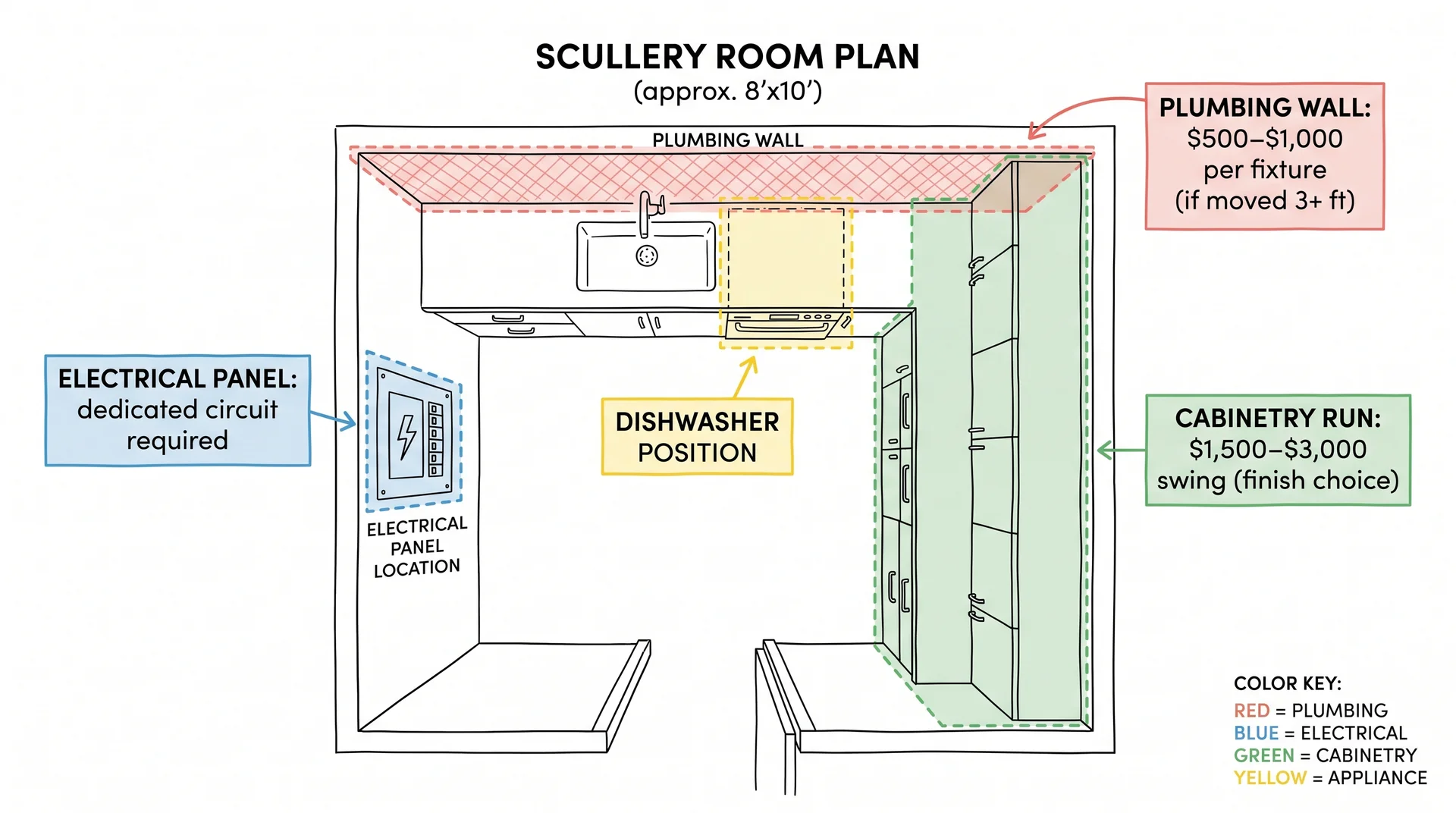
A scullery kitchen typically costs between $5,000 and $15,000 in a renovation.
A basic setup, which includes sink, cabinetry, countertop, and a dishwasher rough-in, starts around $5,000.
A fully specified version with a dishwasher installed, a secondary undercounter refrigerator, and finished cabinetry can reach $15,000 or beyond. Contractor-verified data from Angi puts the typical range at $5,000 to $15,000.
The spread is driven primarily by plumbing complexity and finish quality. Where you land in that range is the design decision.
What Drives the Cost Up
Four factors separate a $5,000 scullery from a $15,000 one.
All four come down to what your space already has and how far the build needs to go beyond it.
- Distance from existing plumbing lines. Moving a fixture more than three feet from the current water supply and drain lines adds $500 to $1,000 per appliance. A scullery that shares a wall with the main kitchen plumbing costs significantly less than one carved from a room on the opposite side of the house.
- Electrical requirements. A dishwasher needs a dedicated circuit, a separate electrical line just for that appliance. If one doesn’t already run near the scullery location, a new circuit adds to the project cost. A secondary refrigerator adds another.
- Ventilation. Heat-generating appliances need an exhaust path. The further that path sits from an exterior wall or an existing penetration point, the more the build costs.
- Cabinetry finish. Matching the main kitchen cabinetry exactly is where most of the budget flexibility lives. Paint-grade cabinetry painted rather than stained, typically less expensive in a complementary rather than matching finish, can reduce the cabinetry line by $1,500 to $3,000.
Where a Scullery Goes in a Real Home
Location is the decision that determines whether a scullery gets used.
You’re standing at your main kitchen sink after dinner, hands wet. The scullery door is four steps to your left. You’ll use that room every night.
Move that door twelve steps away and around a corner, and the habit breaks within a month.
I’ve watched that happen in rooms that were beautifully designed and poorly located.
A scullery needs a direct physical connection to the cooking zone. It has to share a wall with the kitchen or sit immediately adjacent through a door that costs almost nothing to reach.
A scullery accessed through a hallway becomes storage.
Starting from What You Already Have
Most scullery additions in mid-range renovations start with an existing adjacent space, not a new room addition.
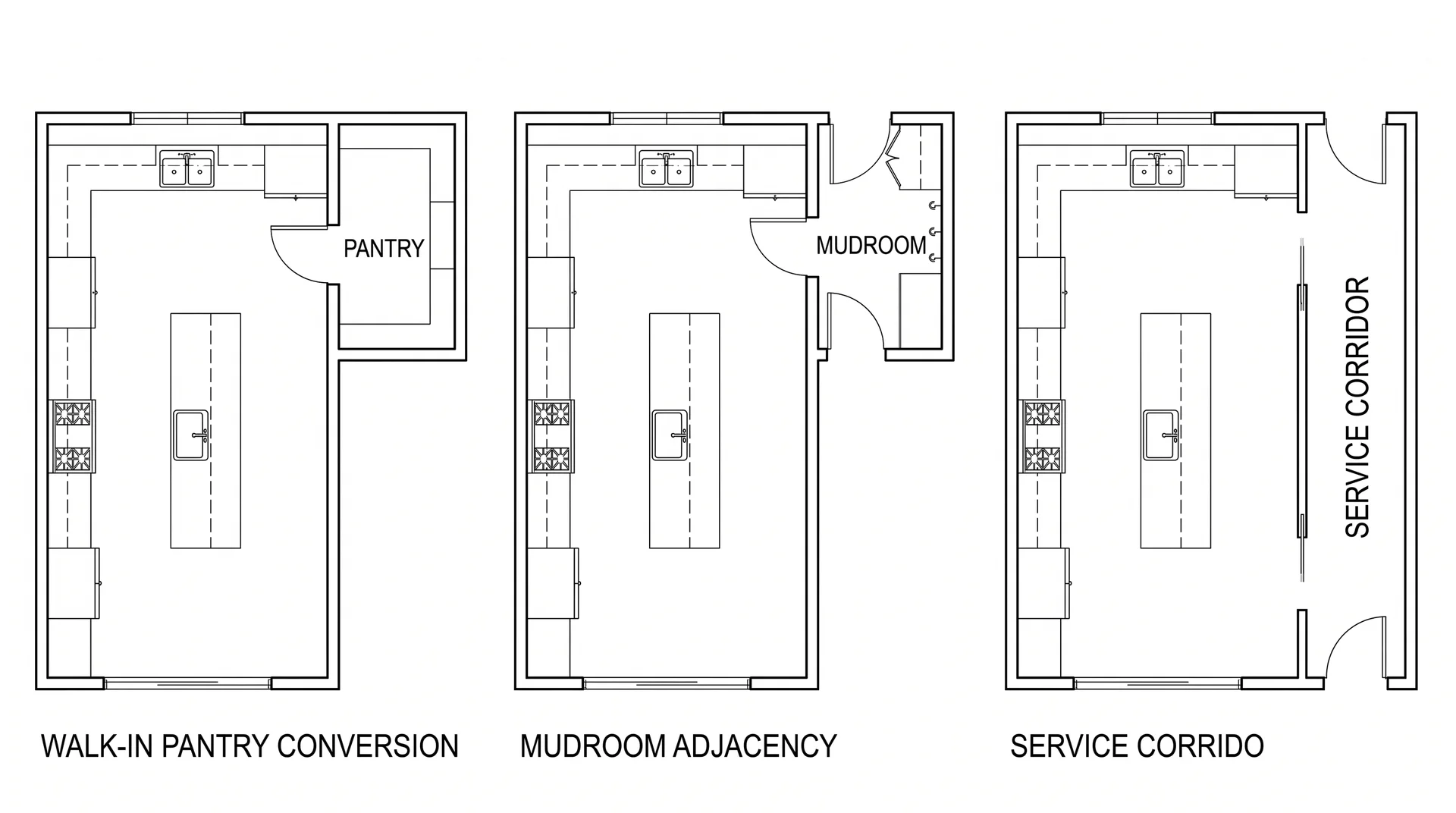
Three starting points tend to work in practice. The one thing they share is direct adjacency to the cooking zone.
- A walk-in pantry with at least 60 square feet, sharing a wall with the kitchen. The location is already correct. Infrastructure gets added. This is the most common conversion path in mid-budget renovation.
- A mudroom that opens directly into the kitchen. Common in older homes and often with utility plumbing already nearby. Both rooms are designed for the transition between mess and order, so the workflow is intuitive from day one.
- A service corridor, a narrow utility passageway between the kitchen and the garage or back entry, wide enough for a counter run on one side and 42 inches of clear floor space opposite. That clearance is the NKBA minimum for a single-cook workspace.
What doesn’t work: any path that crosses a social space. Once reaching the scullery, which means walking past guests, the household stops using it for daily tasks.
Designing a Scullery That Actually Gets Used
The useful ones look nothing like the magazine photos.
Most published scullery images are from custom homes built with the room in the original plan. The version that works in a mid-range renovation is simpler.
It needs good lighting, a deep sink, and three feet of clear counter. The door has to open without catching the cabinetry. It gets used because it’s accessible. Beauty is secondary.
The One Design Rule That Makes or Breaks It
The main kitchen is the visual hero. The scullery serves it.
That’s the principle I’ve applied across every project since 2014. I arrived at it through a kitchen renovation I got badly wrong.
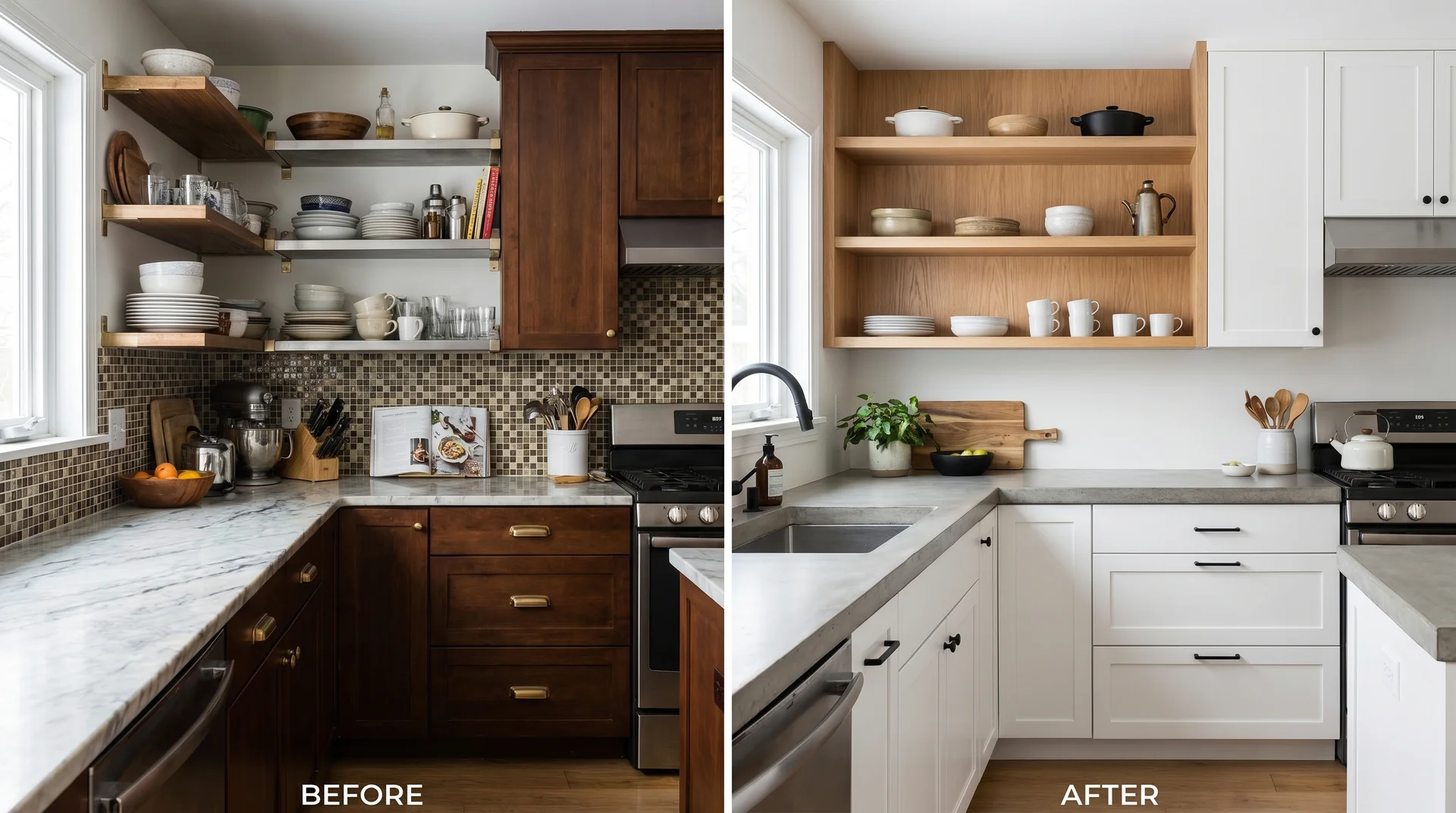
Every surface competed for attention: dark cabinets, patterned backsplash, open shelving with mismatched objects, brass hardware, and marble countertops all in one room. Nothing led.
My client cried at the reveal. I redesigned that kitchen at my own cost. I built this rule from what I’d learned.
The one-hero rule: one surface, material, or feature leads the room. Everything else, the scullery included, submits to it rather than competing with it.
In practice, this means the scullery doesn’t need to match the main kitchen. It needs to function cleanly and stay visually quiet.
If matching cabinetry matters to you, that’s a legitimate choice. Matching cabinet fronts in the scullery adds roughly $1,500 to $3,000 over paint-grade alternatives in a complementary finish.
That’s the execution requirement attached to the aesthetic decision. Know the number before you commit to the finish.
The scullery’s job is to hold the mess so the main kitchen can hold its role.
The defining feature of a scullery is the sink. The plumbing and the adjacency are the decisions that matter. The finish comes after.