
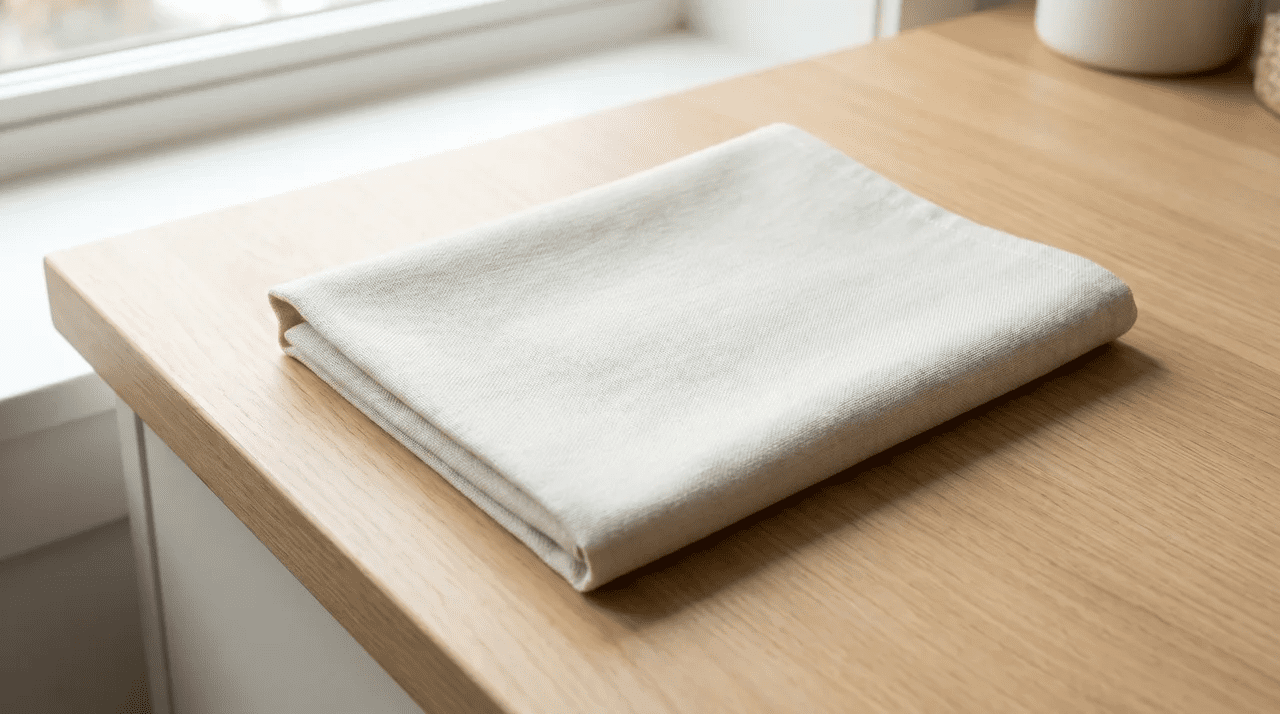
A tea towel is a flat-woven kitchen cloth made from linen, cotton, or a linen-cotton blend. That flat weave is what separates it from everything else in your kitchen.
It’s not a thinner dish towel. It’s not just a British name for the same thing. These two cloths are built differently, and that difference matters.
I’ve watched people grab the wrong one and wonder why their glasses are streaky. Once you understand what a tea towel actually is, you’ll stop making that mistake.
What Is a Tea Towel?
A tea towel is a flat-woven, lightweight kitchen cloth made from linen, cotton, or a linen-cotton blend. The weave is tight and smooth across the surface, with no raised loops anywhere.
That construction is what defines it, not its size, its pattern, or the list of uses on the tag. In my kitchen, both a tea towel and a dish towel live in the same drawer. I reach for them for completely different jobs.
A terry cloth dish towel can sit right next to a tea towel and look similar in size. But it’s a structurally different object.
Tea towels and dish towels aren’t regional names for the same cloth. They’re built differently, and once you see why, you’ll use them that way too.
If you’re choosing between linen and cotton, linen is the stronger performer. It softens with use, sheds less lint as it ages, and releases moisture cleanly without holding dampness against whatever you’re drying.
How Is a Tea Towel Different From a Dish Towel?
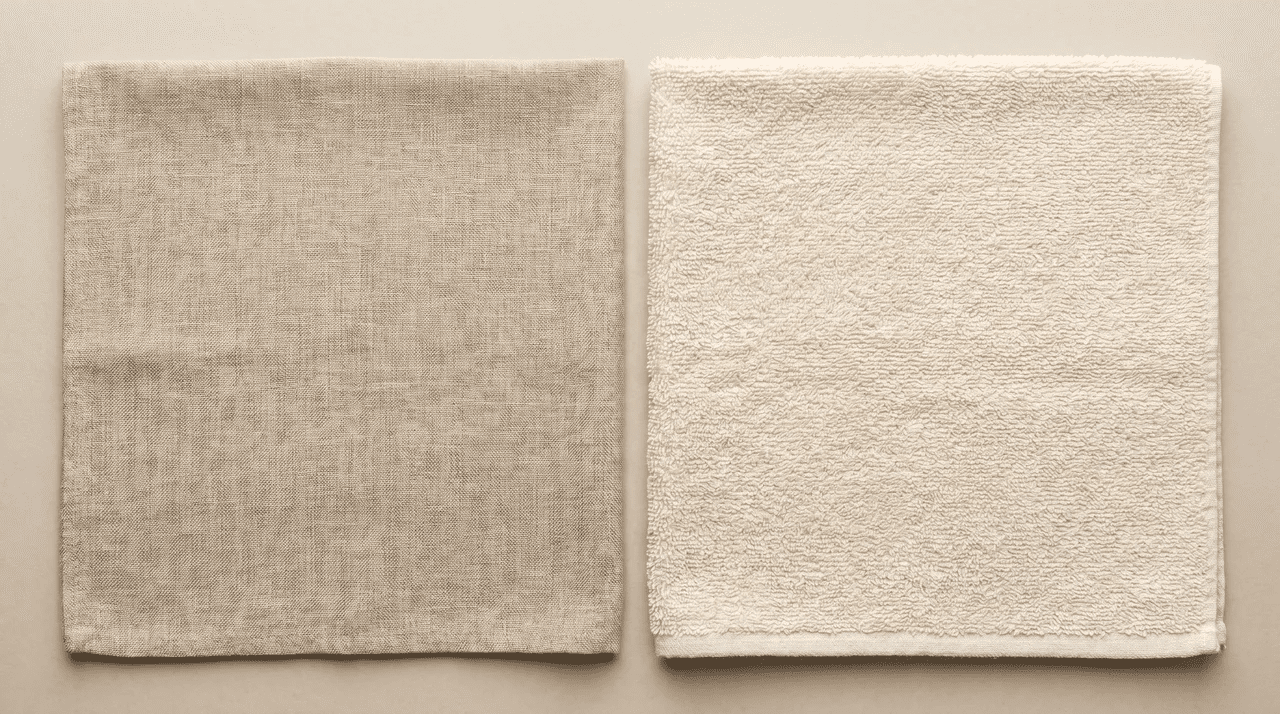
The root difference is structural: flat weave on one side, looped terry cloth pile on the other. How they handle water, what they leave on surfaces, which jobs they suit, it all comes from that one construction difference.
In a flat-woven cloth, threads run parallel and tightly interlocked. When the cloth touches something wet, moisture spreads sideways across those threads.
There are no fiber loops to trap liquid and no loose fibers to deposit on whatever you’re drying. That’s the actual reason tea towels don’t leave lint on glass.
It’s not a property of linen or cotton on their own. It’s how the weave behaves.
If you’ve been getting streaky results on your glassware, this is probably why. The cloth is shedding onto the surface.
Terry cloth works the other way. The looped pile draws in and holds a lot of water fast.
For spills, wet hands, or drying the outside of a soaked pot, that absorbency is useful. But those loops shed fibers, especially as the cloth gets older.
That’s why terry cloth is wrong for wine glasses: it doesn’t absorb too much, it leaves something behind. I’ve seen people blame hard water or the dishwasher for streaky glasses. Half the time, it’s the towel.
“Less absorbent” gets used to describe tea towels like it’s a limitation. It isn’t. It’s a design property.
Use a tea towel for glassware, stemware, crockery, and cutlery. Use a dish towel for high-volume moisture: wet hands, damp counters, soaked pots.
What Are Tea Towels Used For?
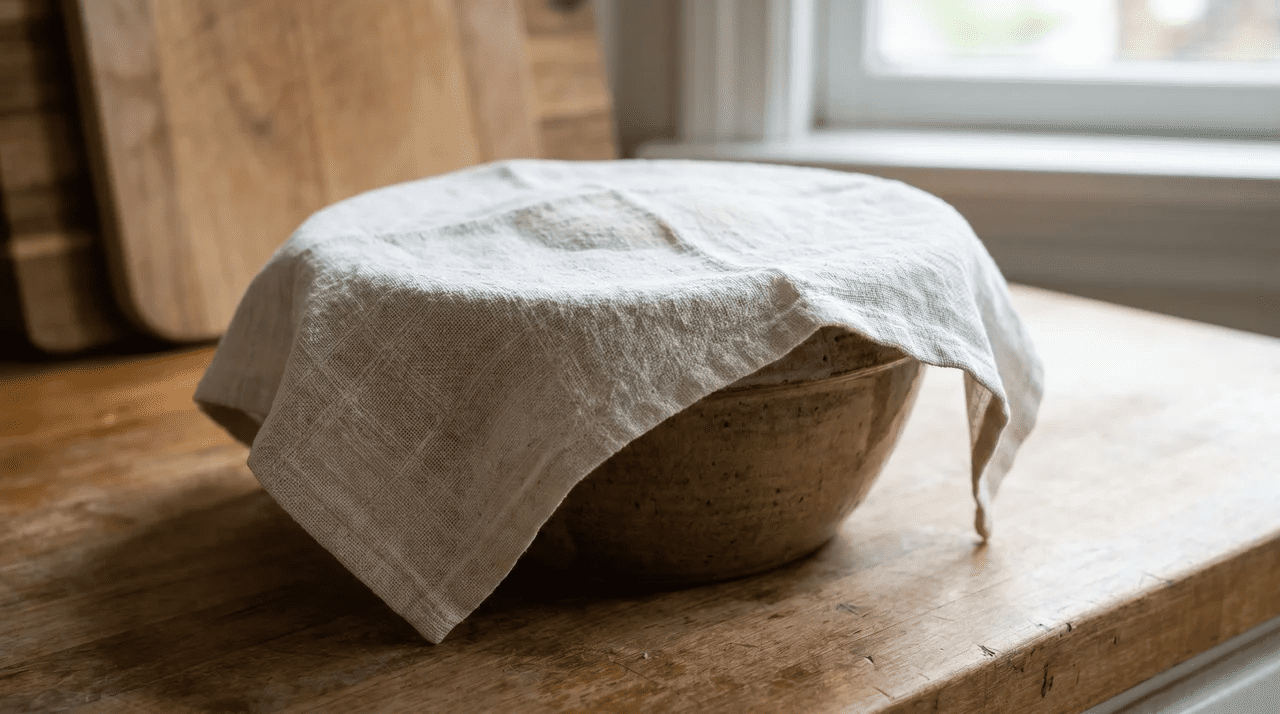
Tea towels serve four main roles: drying delicate items, covering proofing dough, lining serving pieces, and decor. The first two are where the flat weave does the actual work.
Drying and polishing glassware, stemware, crockery, and cutlery is what the cloth is built for. Moisture spreads across the flat surface instead of pooling in fiber loops.
A clean tea towel brings a wine glass to a streak-free finish without shedding a fiber. There’s a catch, though: a heavily washed tea towel won’t do this as well.
The weave loosens over time, and a loose weave sheds. I replace mine once they start leaving faint marks on glass.
Covering bread dough during proofing is the second use, and the one that needs more explanation. The flat weave lets air move across the dough surface and absorbs surface condensation without sealing it in.
If you use a plastic wrap, it traps moisture completely and can make the dough surface sweat, and a dense cloth holds too much humidity against the surface.
A tea towel sits in the middle: breathable enough for proper development, close enough to stop a skin from forming. Linen works better than cotton here; it picks up moisture faster and releases it cleanly.
If you’ve been covering dough with plastic wrap and getting a sticky crust, a linen tea towel is worth trying.
Lining baskets, hanging from a stove handle, wall display… these are real uses too, just secondary ones.
Why Is It Called a Tea Towel?
The name comes from 18th-century England, where these cloths were made specifically for afternoon tea service. They had three specific jobs.
They lined serving trays to protect the surface and stop cups from sliding. The same cloth went around teapots to hold heat longer. It also dried fine porcelain teacups that couldn’t take rougher cloth without risking the glaze.
The cloth had to be smooth, low-shedding, and lightweight to do all three. Flat-woven linen was the obvious choice.
What strikes me is how little the object changed as it moved from the tea table into the everyday kitchen. The same flat weave that protected a porcelain teacup in 1750 handles a wine glass just as well today.
The cloth stayed essentially the same, so the name stayed with it.
In the US, the term never caught on. Americans call the same flat-woven cloth a dish towel or kitchen towel.
If “tea towel” sounds British to you, that’s because it is. The term is standard in the UK, Ireland, and Australia. The object isn’t foreign; just the name is.
Wrapping Up
A tea towel is a flat-woven kitchen cloth built to move moisture sideways, not trap it. That’s what makes it right for glass and dough, and wrong for a wet counter.
Once you know that, you’ll use it differently. Reach for it when something needs to be polished clean or covered without trapping steam. The terry cloth towel handles everything else.
The right cloth for the right job. That’s all this is.
Frequently Asked Questions
What is a tea towel called in the United States?
In the US, tea towels are most often called dish towels or kitchen towels. “Tea towel” is the standard term in the UK, Ireland, and Australia. The same flat-woven cloth exists in American kitchens. It just goes by a different name. The two terms often refer to the same object, though not always.
Can I use a tea towel instead of a cloth for proofing sourdough?
Yes. A linen tea towel dusted with flour works well for lining a proofing basket. The flat weave lets the dough breathe without sticking. Avoid terry cloth, which grips the dough surface. Linen absorbs less moisture than cotton and releases the dough more cleanly when the basket is turned out.
What does “tea towel” mean as slang or an insult?
In some British and Australian speech, “tea towel” is a mild insult for someone considered ineffectual or forgettable. The usage is informal and regional, entirely separate from the kitchen cloth. It isn’t recognized outside the UK and Australia. It doesn’t appear in standard dictionaries as a defined slang term.
What is the standard size of a tea towel?
Most tea towels measure approximately 18 by 28 inches, though dimensions vary by brand and country. British tea towels tend to run slightly narrower. American dish towels are often larger. The standard size folds into quarters for polishing work or lies flat over a bowl of dough without bunching at the edges.