

Most nonstick pans don’t fail because they’re cheap. They fail because of three specific things done consistently over months.
Every care rule for nonstick pans traces back to one of these three:
- Heat above the coating’s safe threshold
- Cleaning with the wrong sequence or the wrong tools
- Cooking spray buildup that bonds to the surface over time
Understand what each one does, and the rules stop feeling arbitrary.
This article covers PTFE-coated nonstick pans specifically. Ceramic-coated pans have a different care profile, and the guidance here doesn’t transfer to them reliably.
If you’re working with a ceramic-coated pan, start with how to clean ceramic cookware instead.
Read:How to Clean Ceramic Cookware?
What Actually Damages a Nonstick Coating
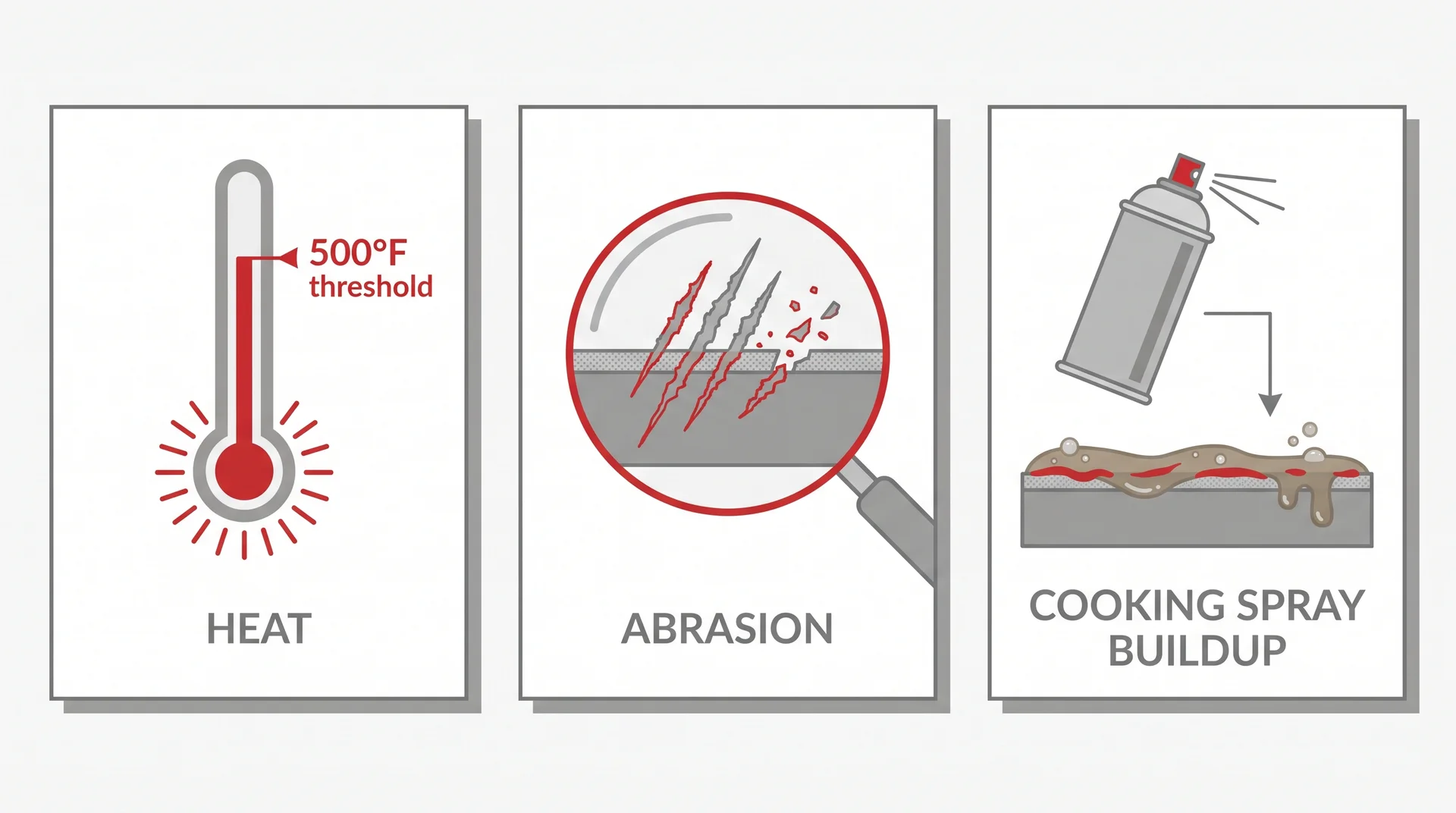
Two things degrade PTFE: heat and abrasion.
PTFE is polytetrafluoroethylene, the coating in most nonstick pans. At normal cooking temperatures, it’s stable.
Above approximately 500°F, it begins to break down chemically. FDA safety data places this threshold clearly. Most home cooking never approaches it. Two specific situations do: an empty pan left on high heat, and oven use above the manufacturer’s rated maximum.
The third factor is polymerized residue from aerosol cooking sprays. This is distinct from heat damage and abrasion.
Polymerized means the spray’s propellants have chemically bonded to the surface through heat, forming a layer that thickens with each use.
Normal dish soap and water don’t remove that layer. People often mistake it for early coating degradation. That is not the same problem, and it has a different fix.
The same abrasion principle applies to what you cook with. Wooden cooking utensils are the right choice for a nonstick surface; the reasoning is the same as with cleaning tools.
Read:Is Acacia Wood Good for Cooking Utensils?
Most nonstick pans don’t fail from a single mistake. The pattern is cumulative:
- Slightly too hot, more often than not
- Slightly too aggressive with the cleaning tool
- Cooking spray is used every session for months
The pan doesn’t signal the damage as it happens. It just stops performing.
The pans I see fail earliest have usually been doing all three things at once, not just one. The buildup and the abrasion reinforce each other.
Before the First Cook: Setting Up a New Nonstick Pan
Two steps matter before you cook in a new nonstick pan. They take five minutes. Most people skip them entirely.
The First Wash
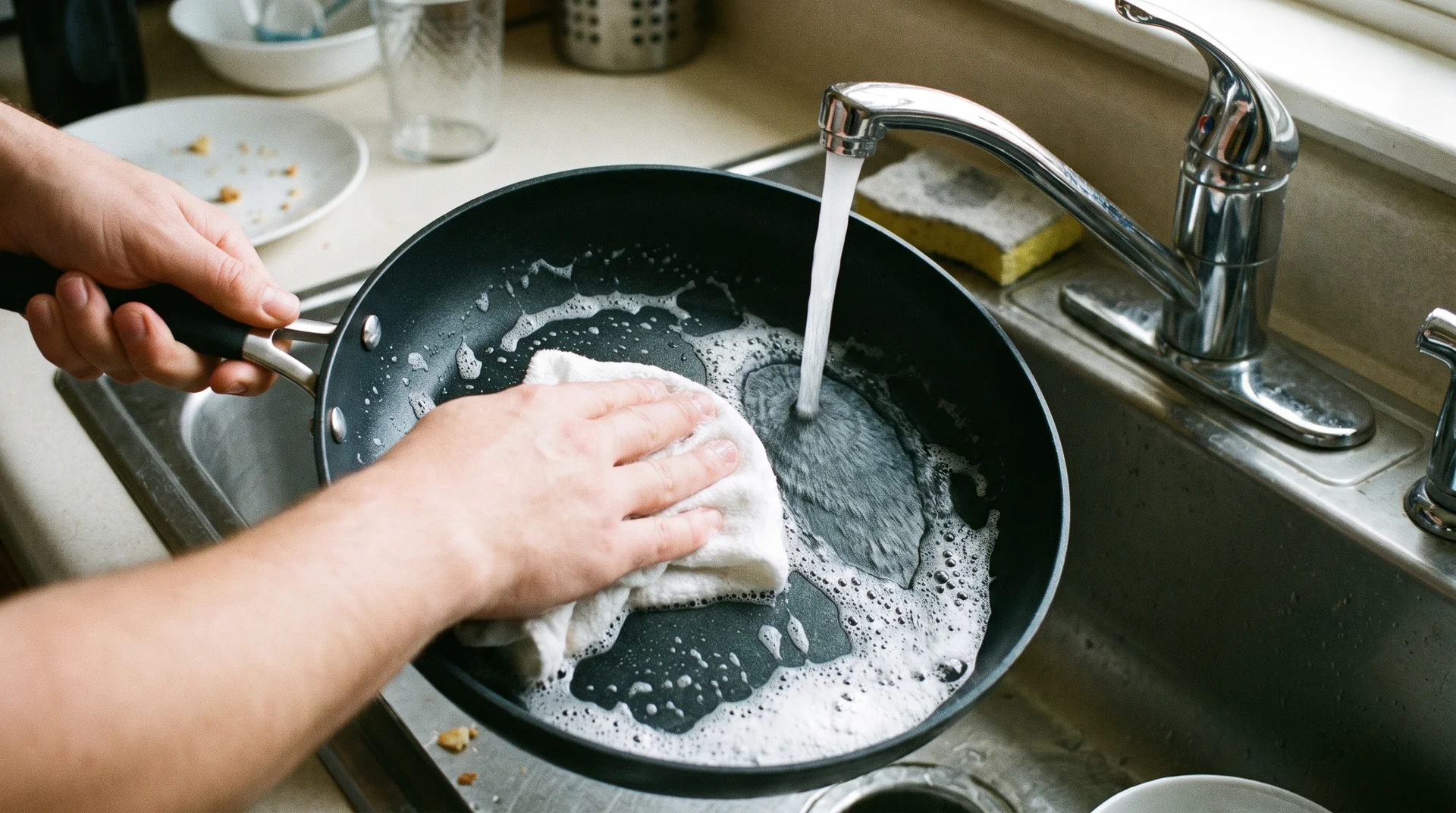
Wash the pan before you cook on it, even if it looks clean out of the box.
Manufacturing residue sits on the surface of new cookware. A single wash removes it. You need:
- Warm water
- Mild dish soap
- A soft cloth
That’s the same method as every subsequent wash. Start as you mean to continue.
The One-Time Season Step
Some manufacturers recommend a one-time seasoning step before first use. This is not the same as seasoning cast iron.
With PTFE pans, the step just conditions the surface for its first cook. Follow these steps in order:
- Wipe the interior with a small amount of neutral oil
- Heat on low for 30 seconds
- Let cool, then wipe clean with a soft cloth
That’s a one-time step, not a recurring protocol.
People who’ve used cast iron often expect a PTFE pan to build up a seasoning layer. It doesn’t work that way. If your pan isn’t releasing food well after the first few uses, insufficient seasoning is not the problem.
Heat: The Fastest Way to Shorten a Nonstick Pan’s Life
Heat management is where most nonstick pans lose years of useful life.
The rules here are specific. Vague guidance like “use low heat” skips the part that actually matters.
What Low-to-Medium Heat Actually Means
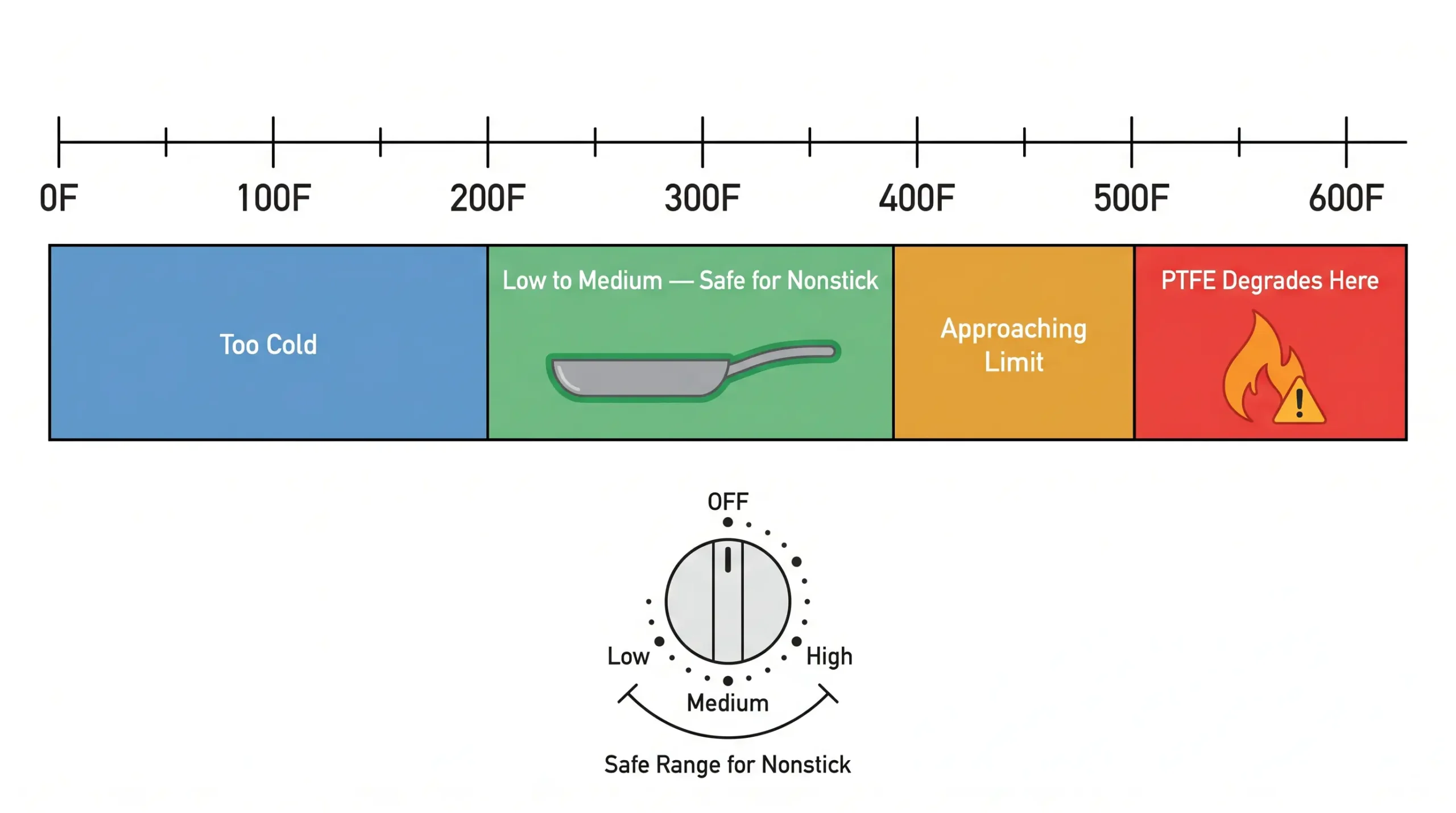
Low to medium on a home stove puts the cooking surface at roughly 250 to 375°F.
PTFE begins to degrade at approximately 500°F. That gap is wider than it sounds. Standard egg cooking and sautéing on medium heat stay well below the threshold. Most PTFE-coated pan manufacturers cap oven use at 400 to 450°F.
If you’re unsure whether your pan is oven-safe at a specific temperature, check before it goes in.
If a recipe calls for a very hot pan, a nonstick surface is the wrong tool. That’s a tool selection question with a separate answer.
Why an Empty Pan Is the Specific Risk
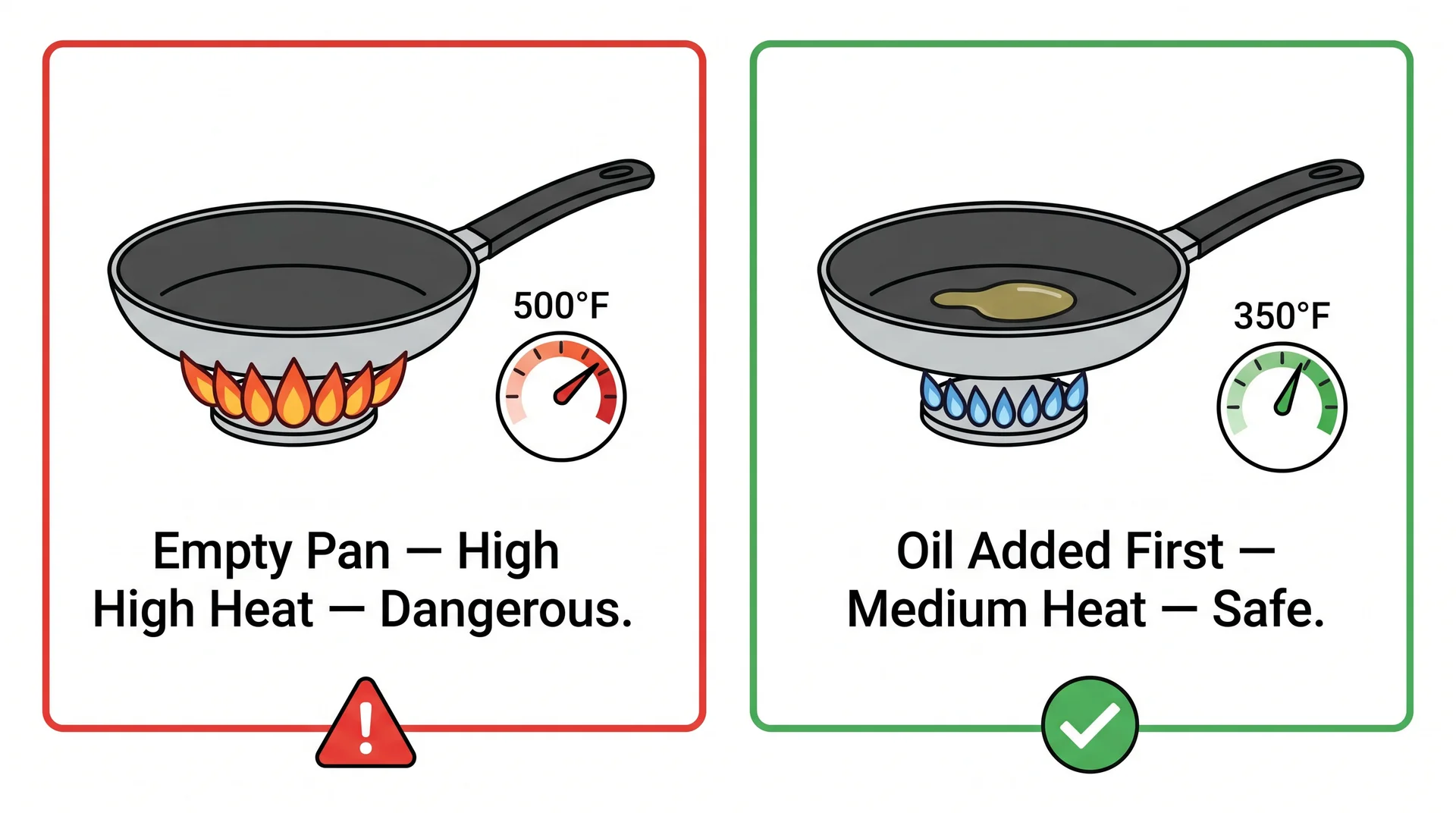
An unattended empty nonstick pan on high heat can reach 500°F within minutes on a gas burner.
This is the failure scenario. Not high-heat cooking with food in the pan. The specific situation is an empty pan, unattended, on high heat.
| Above 500°F, PTFE releases fumes harmful to birds and can irritate humans with sustained exposure. That specific scenario is what the warning addresses. Standard cooking on medium heat with food in the pan doesn’t approach it. |
The correct order isn’t interchangeable: add fat or another ingredient before applying heat, on medium or lower. Reversing those two steps is how a nonstick pan ends early.
The Cooking Spray Problem
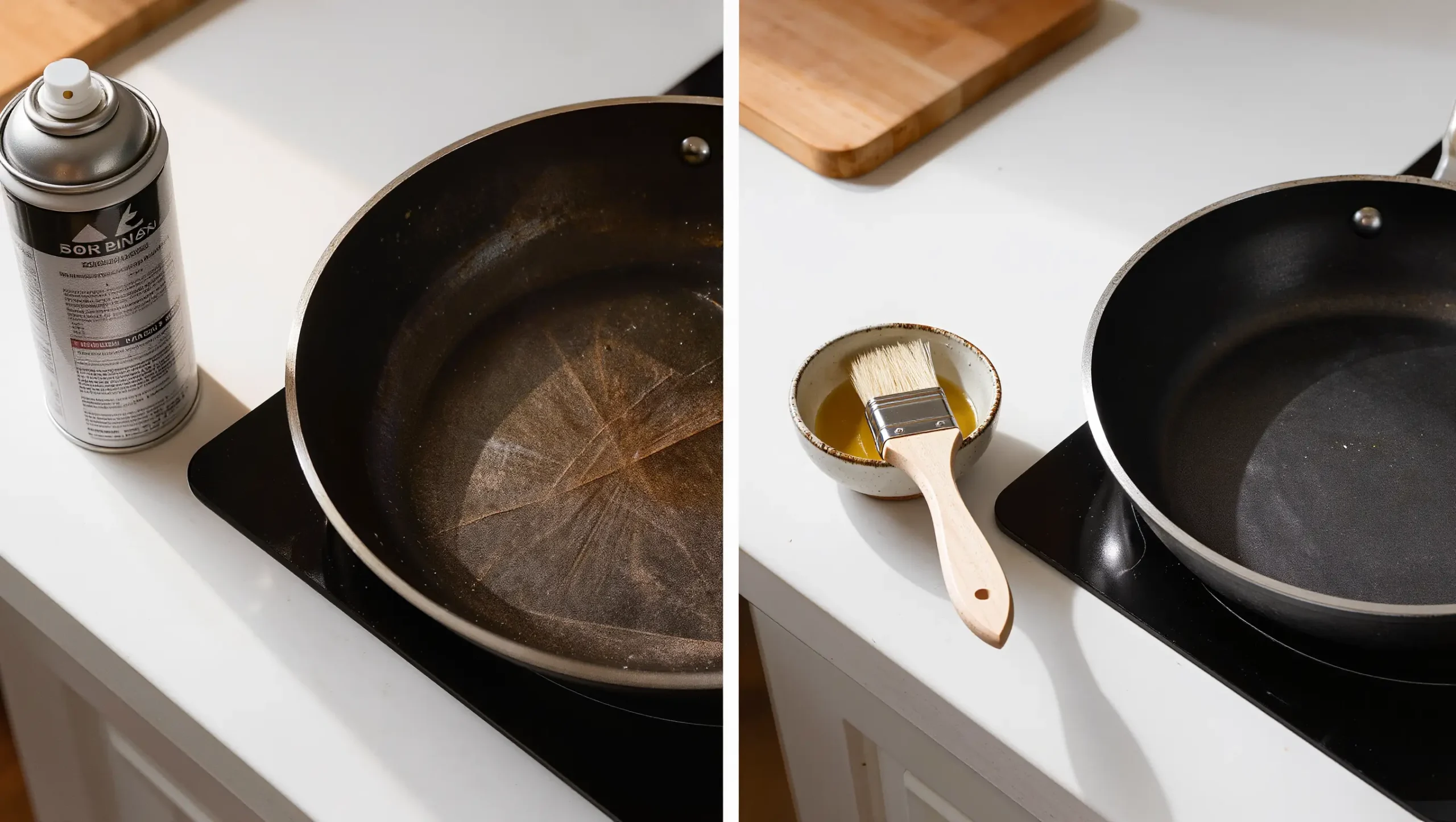
Aerosol cooking sprays leave a residue on PTFE surfaces that normal washing doesn’t remove.
The propellants in aerosol sprays bond with the PTFE surface at cooking temperatures. They form a layer that thickens with each use and gradually reduces release performance.
The label on most cooking sprays says “safe for nonstick cookware.” What independent testing shows is different. Repeated aerosol use creates surface buildup regardless of what the label claims.
Use a pastry brush or a folded paper towel with a small amount of neutral oil instead. The result is a thin, even coating that doesn’t leave residue behind.
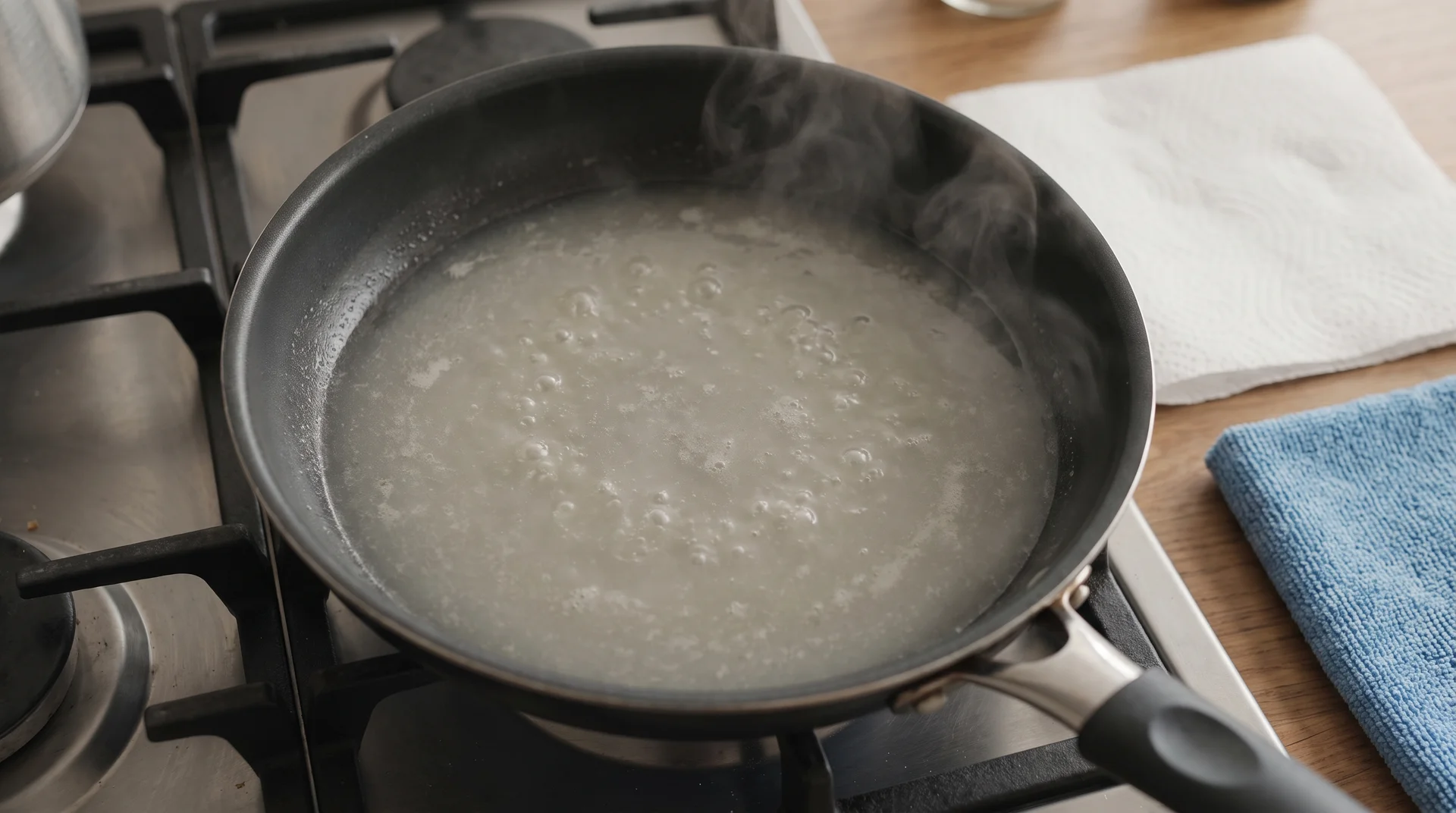
If your pan already has spray buildup, the white vinegar simmer method addresses this specific type of residue. Here’s the protocol:
- Surface type: PTFE-coated nonstick pan, cooled to room temperature
- Solution: Equal parts white vinegar and water
- Contact time: Bring to a gentle simmer, hold for five minutes
- Sequence: Cool completely, then wipe with a soft cloth
I find this is the one cleaning approach with enough chemistry behind it to actually move polymerized spray residue. It won’t restore a coating that’s physically degraded.
If your problem is buildup rather than damage, this is where to start.
How to Wash a Nonstick Pan Correctly?
Method matters more than frequency.
I spent years in an institutional kitchen training, watching exactly this play out. The thing that changed outcomes every time was the same: frequency without method is not a protocol.
The Correct Sequence
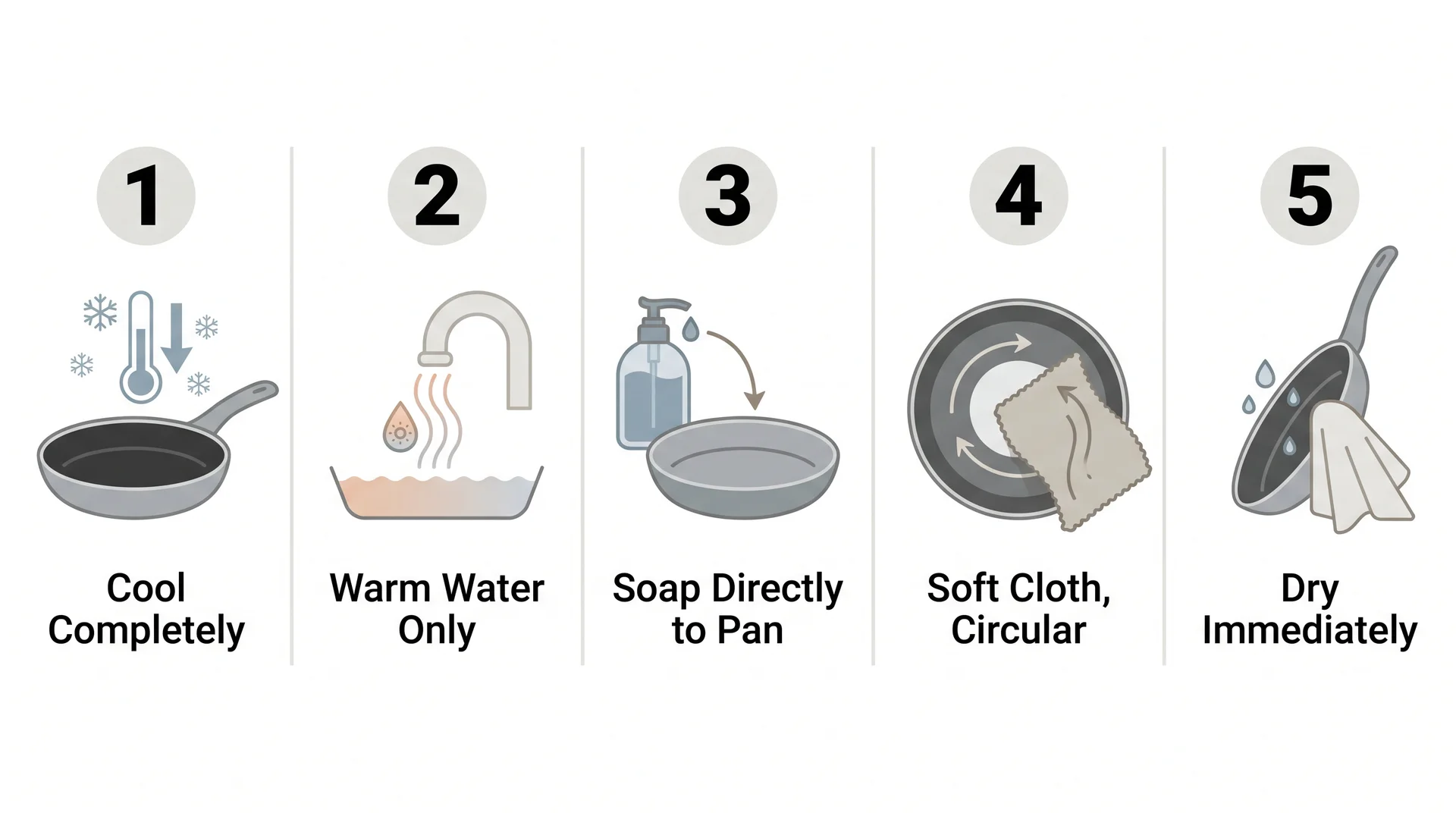
The sequence of washing a nonstick pan matters as much as the tools you use to do it.
Most care instructions say “hand washes only” and stop there. They don’t specify water temperature, the order of steps, or how to dry the pan. All of those details affect the outcome.
Follow these steps in this order:
- Let the pan cool completely before introducing water. Thermal shock, meaning sudden temperature change, warps the metal. A warped pan sits unevenly on the burner and distributes heat poorly. Don’t skip this step.
- Fill with warm water. Hot water isn’t necessary for cleaning PTFE and adds thermal stress to a pan that’s already cycled through cooking temperatures.
- Apply mild dish soap directly to the pan interior. This puts the cleaning agent in direct contact with the surface first. You get better cleaning with less scrubbing.
- Use a soft cloth or non-scratch sponge in a gentle circular motion. Light, even pressure across the full surface cleans more thoroughly than concentrated scrubbing in one spot.
- Rinse with warm water, then dry immediately with a soft cloth. Don’t let the pan air-dry. Water pooling in micro-scratches accelerates degradation at those specific sites.
That sequence is what “hand wash only” actually means in practice.
My father’s position on this is that soap strips the nonstick coating. He rinses with hot water and skips soap entirely. He is not entirely wrong. Harsh soaps used aggressively over time do affect PTFE surfaces. He is also not entirely right.
Mild dish soap, applied in the right amount and sequence, does not damage PTFE. Skipping soap leaves cooking residue on the surface. That residue hardens with the next cooking session and creates sticking that looks exactly like coating degradation. It isn’t.
I’ve spent part of this year trying to document this kind of step-level difference in a surface-specific cleaning methodology. The sequence effect shows up in pan performance over months, not in a single session. The pan doesn’t tell you it’s happening.
Removing Burnt-On Residue from a Nonstick Pan
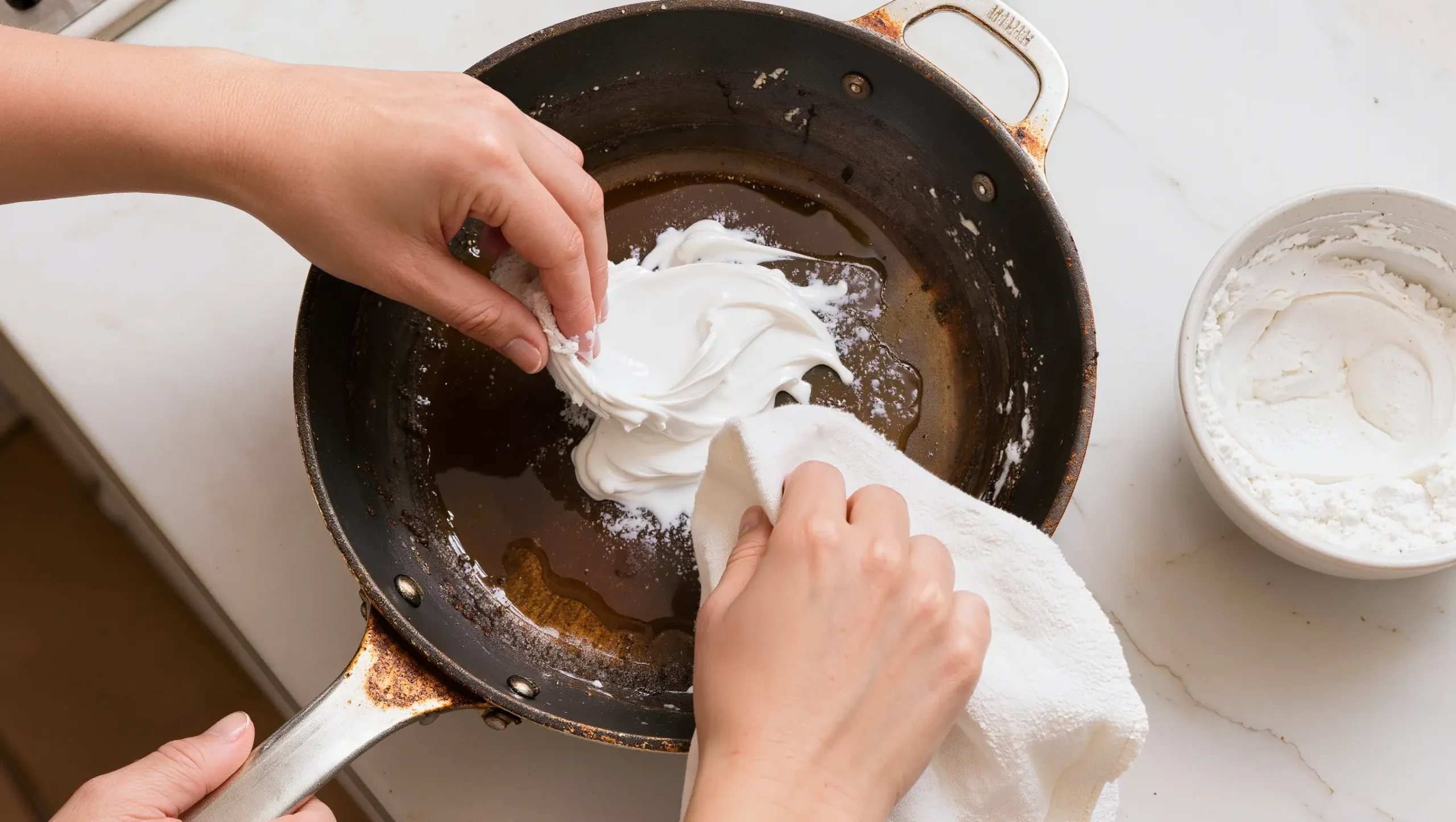
The goal with stuck food on a nonstick pan is to soften the bond, not scrub it off.
Scrubbing stuck food from a nonstick surface accelerates degradation faster than almost anything else.
Micro-scratches from scrubbing become sites where food bonds more easily on the next cook. The damage builds on itself.
In my experience, most food that looks stuck to a nonstick surface hasn’t fully bonded to the coating.
A short warm-water soak handles the majority of it. Fill the pan and leave it for five to ten minutes, then wipe with a soft cloth.
Keep the soak short; soaking a nonstick pan overnight allows water to pool in existing scratches, accelerating degradation at those sites.
For heavier residue that a soak doesn’t shift, use the baking soda paste method. It’s safe for PTFE and works without mechanical abrasion:
- Surface type: PTFE-coated nonstick pan, cooled to room temperature
- Contact time: At least 15 to 20 minutes
- Sequence: Mix two tablespoons of baking soda with enough water to form a paste. Apply with a soft cloth in a gentle circular motion. Leave for 15 to 20 minutes. Wipe with a damp cloth and rinse.
Baking soda’s mild alkaline chemistry loosens bonded food without mechanical force. Apply it before reaching for anything more aggressive.
If one application doesn’t resolve the residue, it has bonded with the coating itself. Scrubbing harder won’t change that. At that point, cleaning is the wrong tool for the problem.
What Cleaning Tools Do to the Surface Over Time
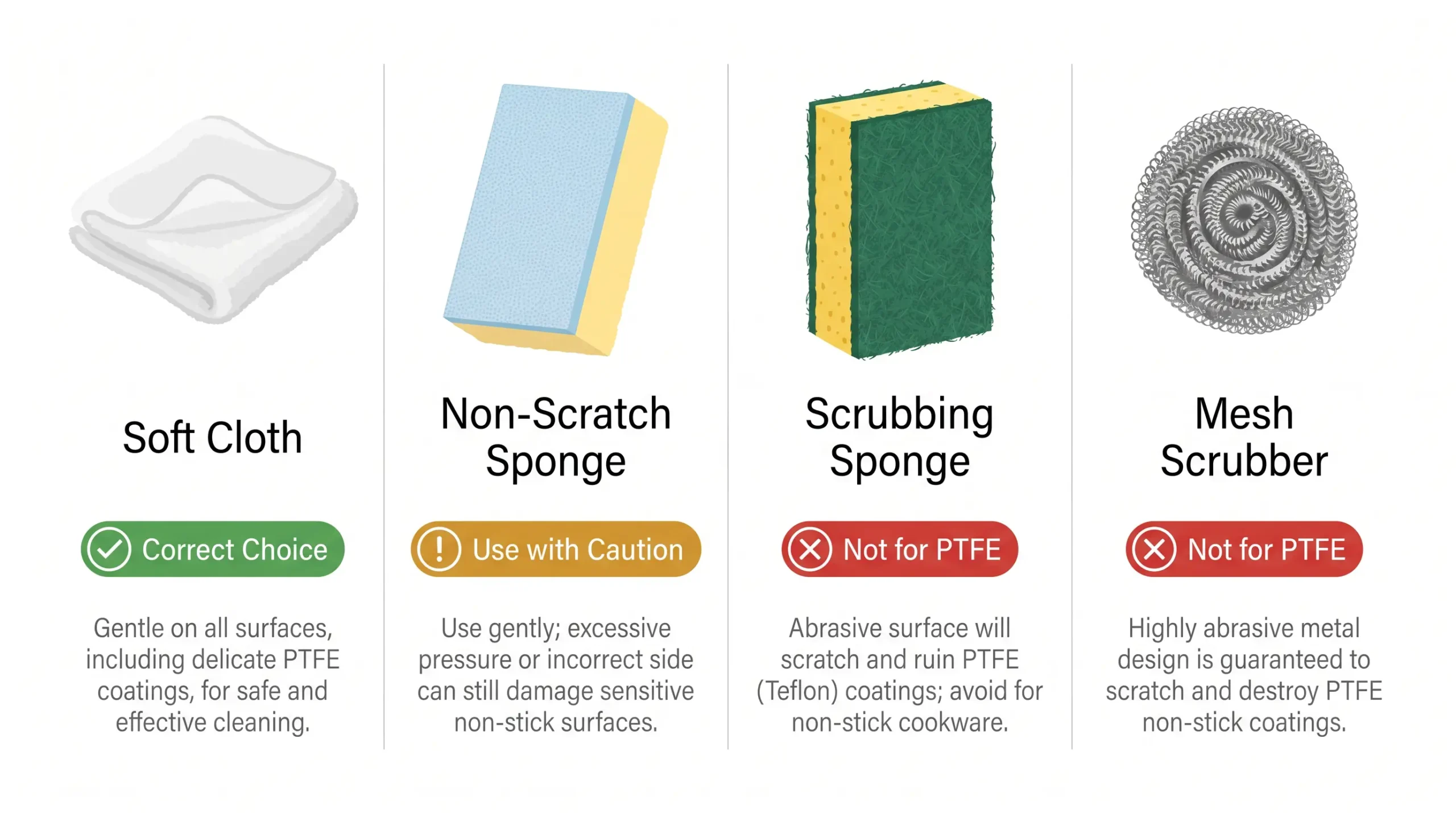
The cleaning tool matters as much as the cleaning agent on a PTFE surface.
A soft cloth is the right choice. A non-scratch sponge is acceptable, with the condition that the label claim and the actual surface behavior don’t always match.
Some products marketed as “safe for nonstick” have a micro-textured scrubbing layer that creates surface wear with repeated use. The exact threshold at which this becomes meaningful PTFE degradation isn’t settled in the research. A soft cloth removes that uncertainty entirely.
I’ve tested and set aside a category of cleaning tools I won’t use on PTFE surfaces:
- Sponges with a green or rough scrubbing back, regardless of what the label says
- Mesh scrubbers are marketed as “gentle” or “safe for nonstick”
- Firm-bristle dish brushes with stiff nylon bristles
All of them feel gentle in your hand. Against a PTFE surface across months of use, the cumulative effect is real. The soft cloth removes that variable entirely.
Storage Without Causing Scratches
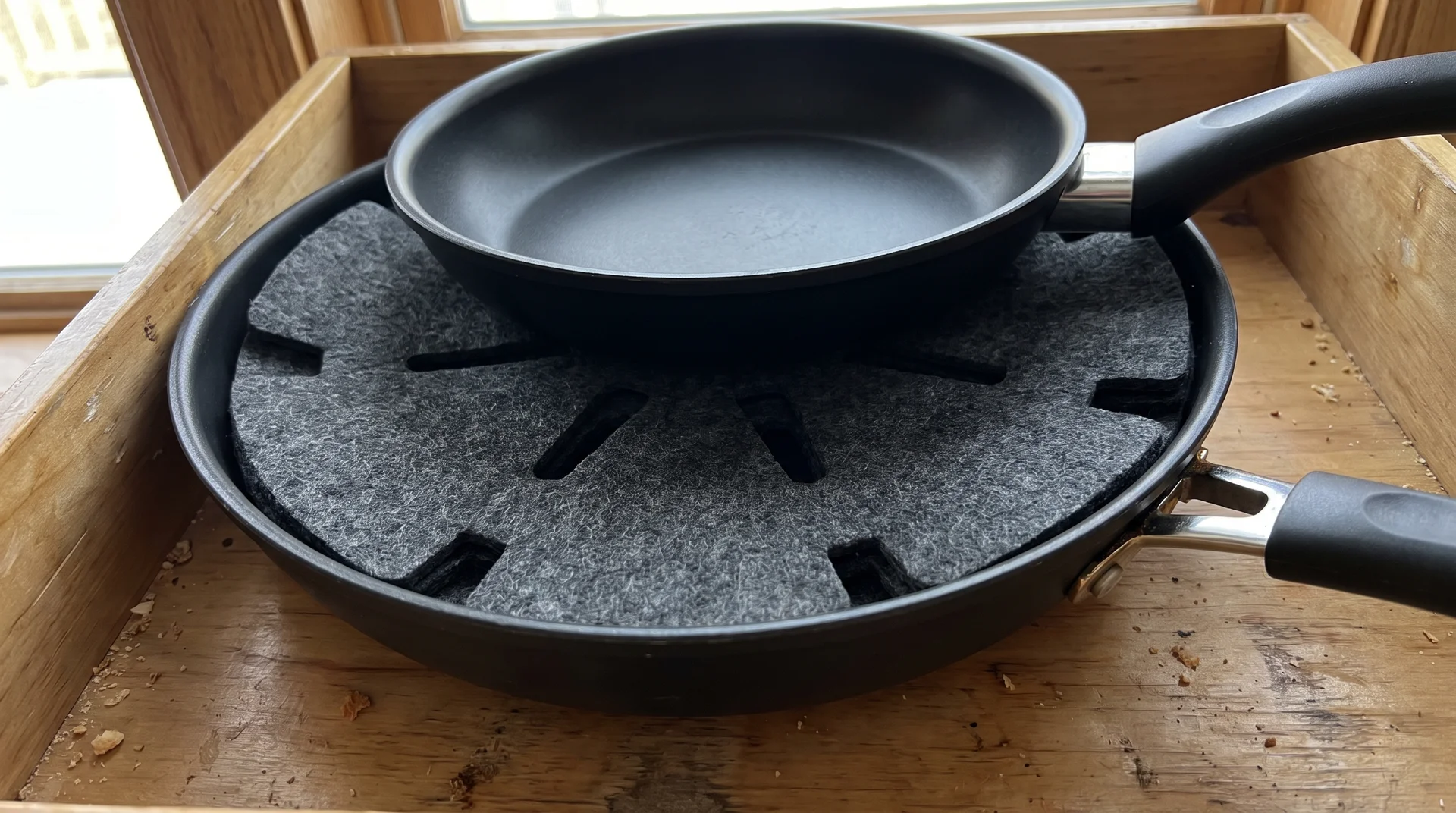
The coating is the first failure point. Storage is where the second one starts.
Stacking nonstick pans directly on top of each other causes surface abrasion. The base of the upper pan contacts the interior cooking surface below when they’re nested.
That contact scratches the PTFE each time you pull a pan from the stack. The damage is cumulative and invisible until the surface stops performing.
Three options prevent it:
- Felt pan protectors placed between stacked pans are the most reliable option, and the one I resisted buying for longer than I should have
- Folded paper towels between pans work just as well and cost nothing
- Hanging the pans, if your kitchen layout allows it, no contact with other surfaces at all
Any of those three works. The one that doesn’t is doing nothing.
Can You Make a Nonstick Pan Nonstick Again?
PTFE coating degradation is irreversible.
Once the coating breaks down, no home method restores it. Re-oiling a degraded pan temporarily reduces sticking by filling micro-scratches with fat. In my testing, that improvement lasts a few uses. Then performance returns to where it was.
Some social media advice promises restoration through simmering vinegar water or scrubbing with baking soda. Earlier in this article, I described the white vinegar simmer method, but that method works on cooking spray buildup, not on a degraded coating.
If your pan is sticky because of polymerized spray residue, the vinegar simmer can genuinely restore release performance.
Here’s how to tell which problem you have:
- Run the vinegar simmer protocol once and let the pan cool completely
- Test release: lightly oil the cooled pan, heat on low for 30 seconds, and check surface performance
- If release performance improves, the problem was the buildup
- If performance doesn’t improve, the coating is physically degraded
More cleaning attempts won’t change the outcome of step four. A coating that has broken down has broken down.
When to Replace Your Nonstick Pan
Replace your nonstick pan when specific conditions appear, not when a fixed timeline runs out.
The “two to five years” figure in most care guides is a statistical average based on typical use patterns. A pan cared for correctly can last five years or more.
One consistently overheated or washed with abrasive tools can fail in just 12 months.
The Conditions That Mean It’s Time
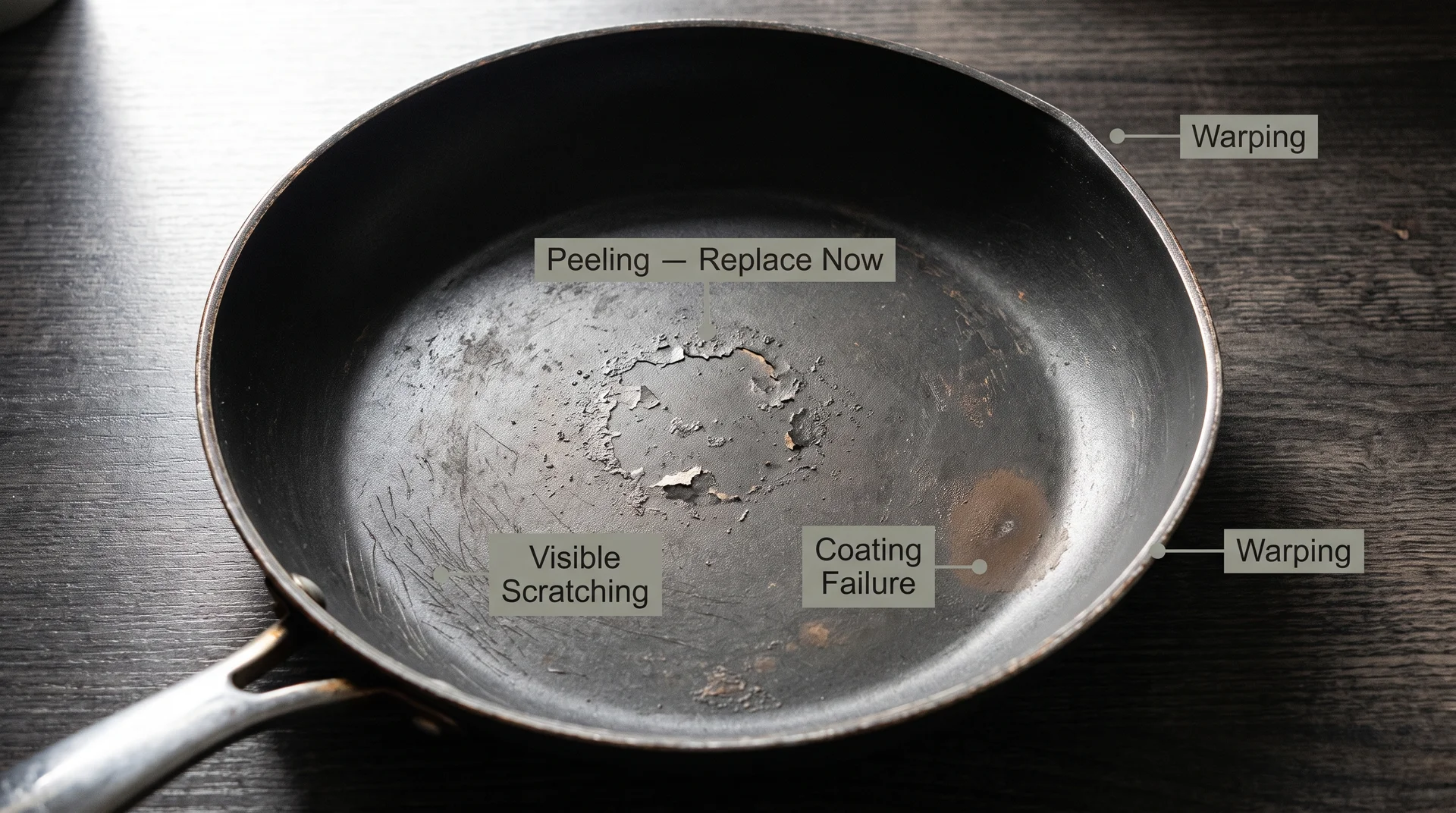
Four specific conditions tell you a nonstick pan has reached the end of its useful life.
Replace the pan when any of these are present:
- Visible peeling or flaking of the coating. Degraded coating material should not enter food. Stop using the pan immediately when this appears.
- Scratching across the cooking surface visible under normal light. Light surface marks are cosmetic early on. When scratching is visible without angling the pan toward a light source, the surface integrity has changed.
- Food sticks consistently in specific spots after correct washing and a light oil application before cooking. If the baking soda method and vinegar simmer haven’t resolved it, the coating has failed at those sites.
- Warping that prevents the pan from sitting flat on the burner. This is structural damage from thermal shock, separate from coating wear. It affects heat distribution significantly and won’t self-correct.
Of those four, the first is the one I take most seriously, and the last is the one people notice least. A pan that rocks on the burner often gets used for months before anyone thinks of it as damaged. It is.
What to Replace It With
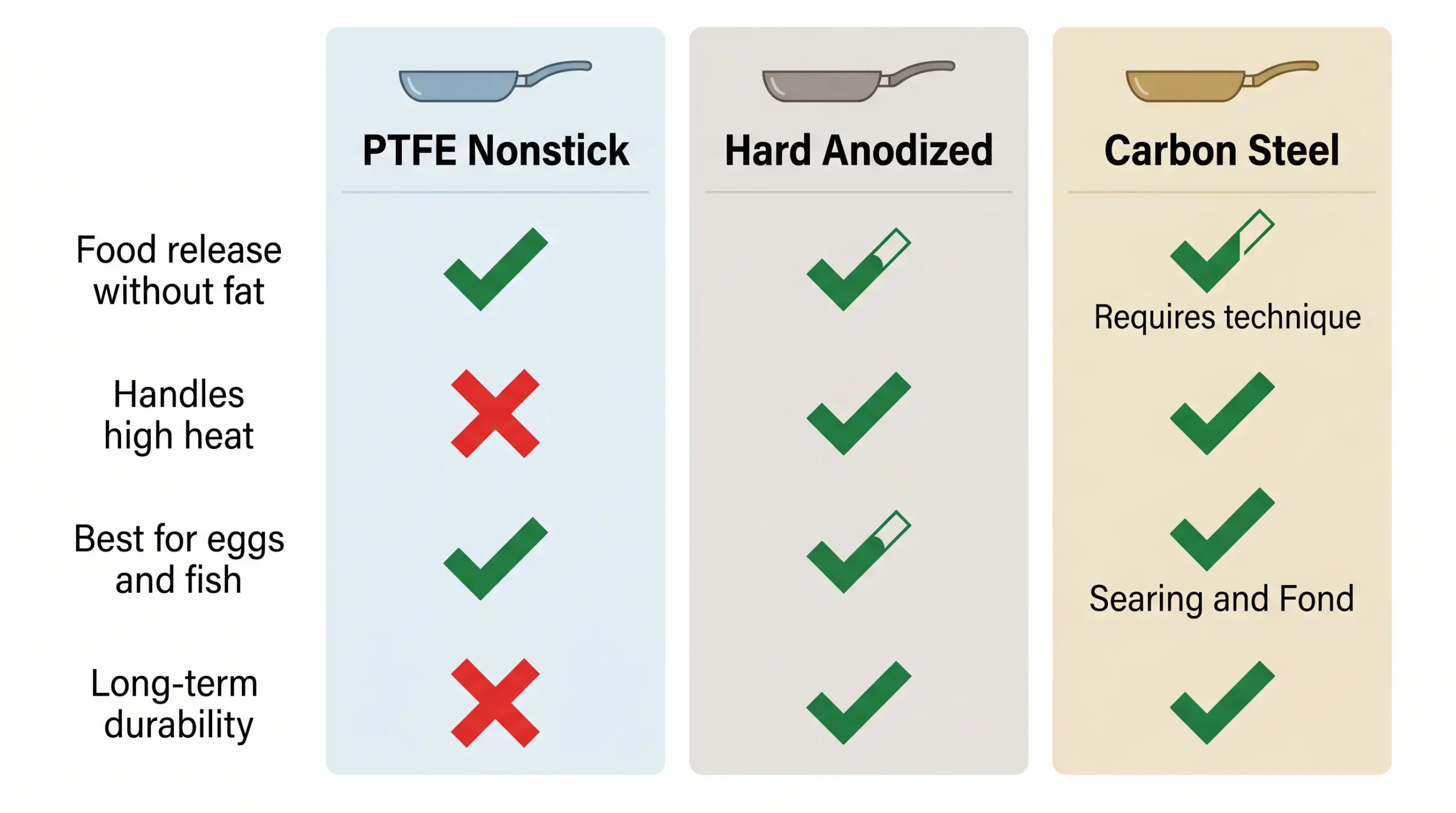
Whether to replace your pan with another nonstick depends on what you were cooking in it.
PTFE handles eggs, fish, and delicate proteins well. If those were your primary use cases, a replacement nonstick pan makes sense.
If you kept reaching for this pan to sear or build a fond, the failure is telling you something about the fit between the tool and the task.
A pan that fails at twelve months didn’t fail on its own. Knowing what caused it is the only way the next one lasts longer.