
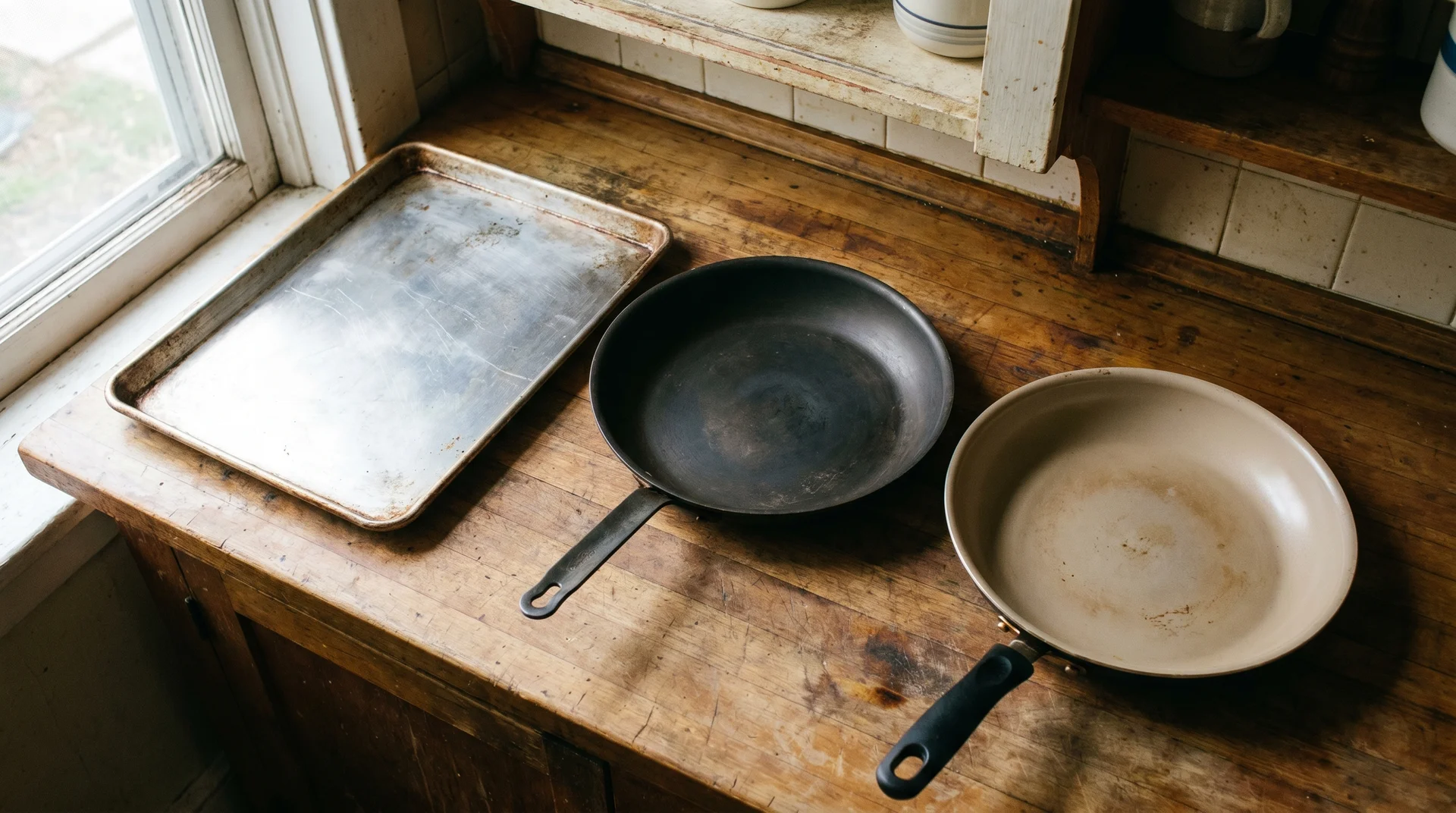
Most nonstick pans are aluminum pans. That’s the thing, the “aluminum vs nonstick” framing never tells you.
Aluminum is a base material that the pan body is made of. Nonstick is a surface coating applied on top of the body.
A single pan can be both at once, and that’s where most of the confusion about this comparison starts and stops.
What “Aluminum” and “Nonstick” Actually Mean
These two words describe different attributes of a pan, not two competing products.
Aluminum Is the Pan Body, Not the Surface
Aluminum refers to what the pan is constructed from, not what the cooking surface feels or behaves like.
It’s one of the most common base materials in cookware because it’s lightweight, inexpensive to manufacture, and conducts heat faster than stainless steel.
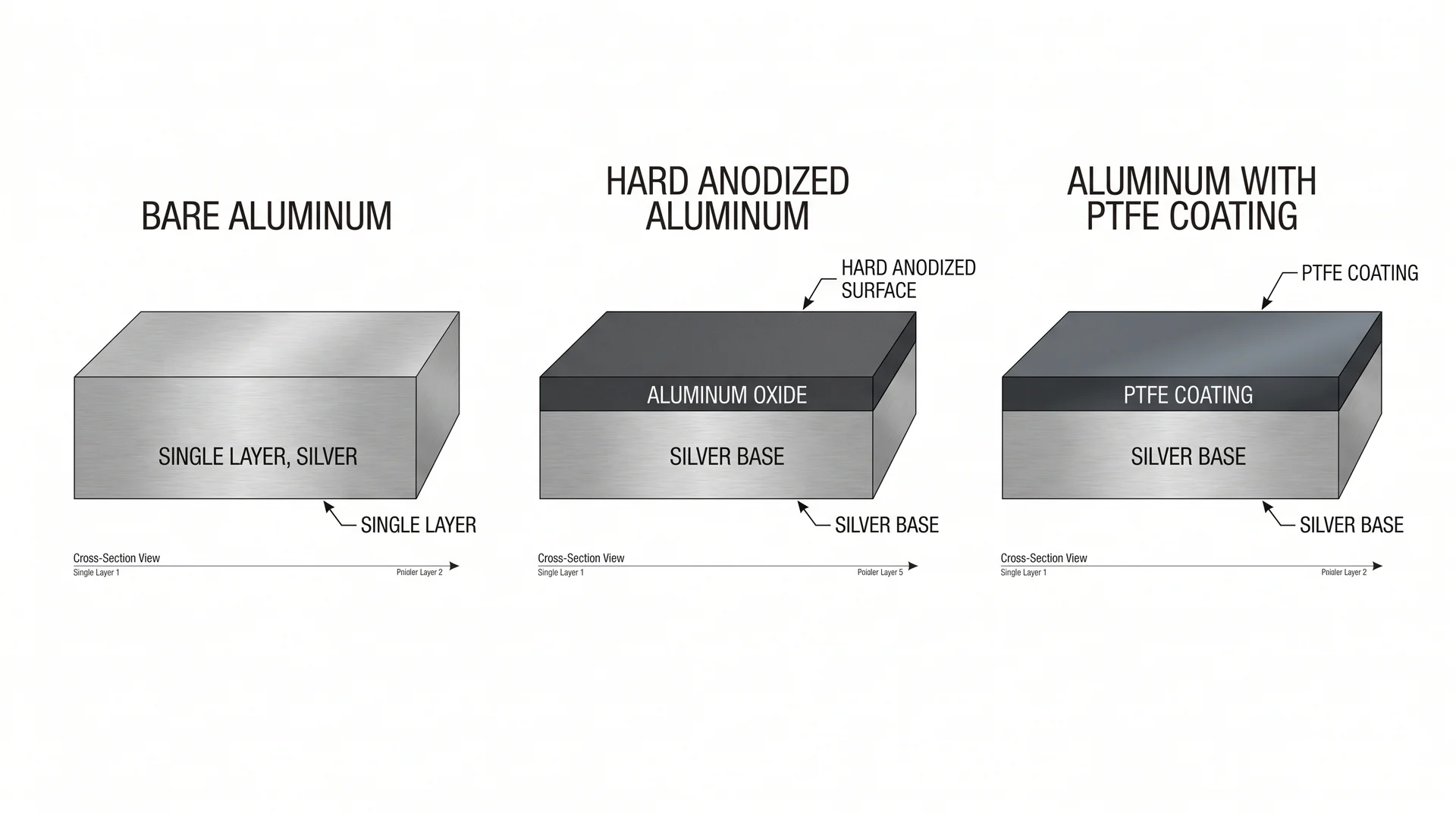
The cooking surface of an aluminum pan can be bare metal, electrochemically treated (that’s hard anodized aluminum), or coated with a nonstick material.
Those are three different things with meaningfully different cooking properties. The base material, aluminum, is the same in all three cases.
Nonstick Is a Coating Applied on Top
Nonstick refers to a surface treatment, most often PTFE (polytetrafluoroethylene), applied to a base material to reduce how much food adheres to it.
PTFE is the chemical name for what most people know as Teflon, though Teflon is a brand name. Not all PTFE coatings come from the same manufacturer.
The base material under that coating is usually aluminum. It can be stainless steel or carbon steel, but aluminum is by far the most common substrate for consumer nonstick pans.
Why a Pan Can Be Both at Once
Most nonstick pans sold today have an aluminum body with a PTFE coating on the interior cooking surface. When you pick up a standard nonstick skillet at any kitchen retailer, you’re almost certainly holding an aluminum pan.
The “aluminum vs nonstick” framing implies two separate categories. They’re largely not.
The meaningful comparison is among bare aluminum, hard anodized aluminum, and aluminum with a nonstick coating. That’s three versions of the same base material, each with a different surface behavior. That’s the real decision in front of you.
The Three Types of Aluminum Pan You’re Actually Choosing Between
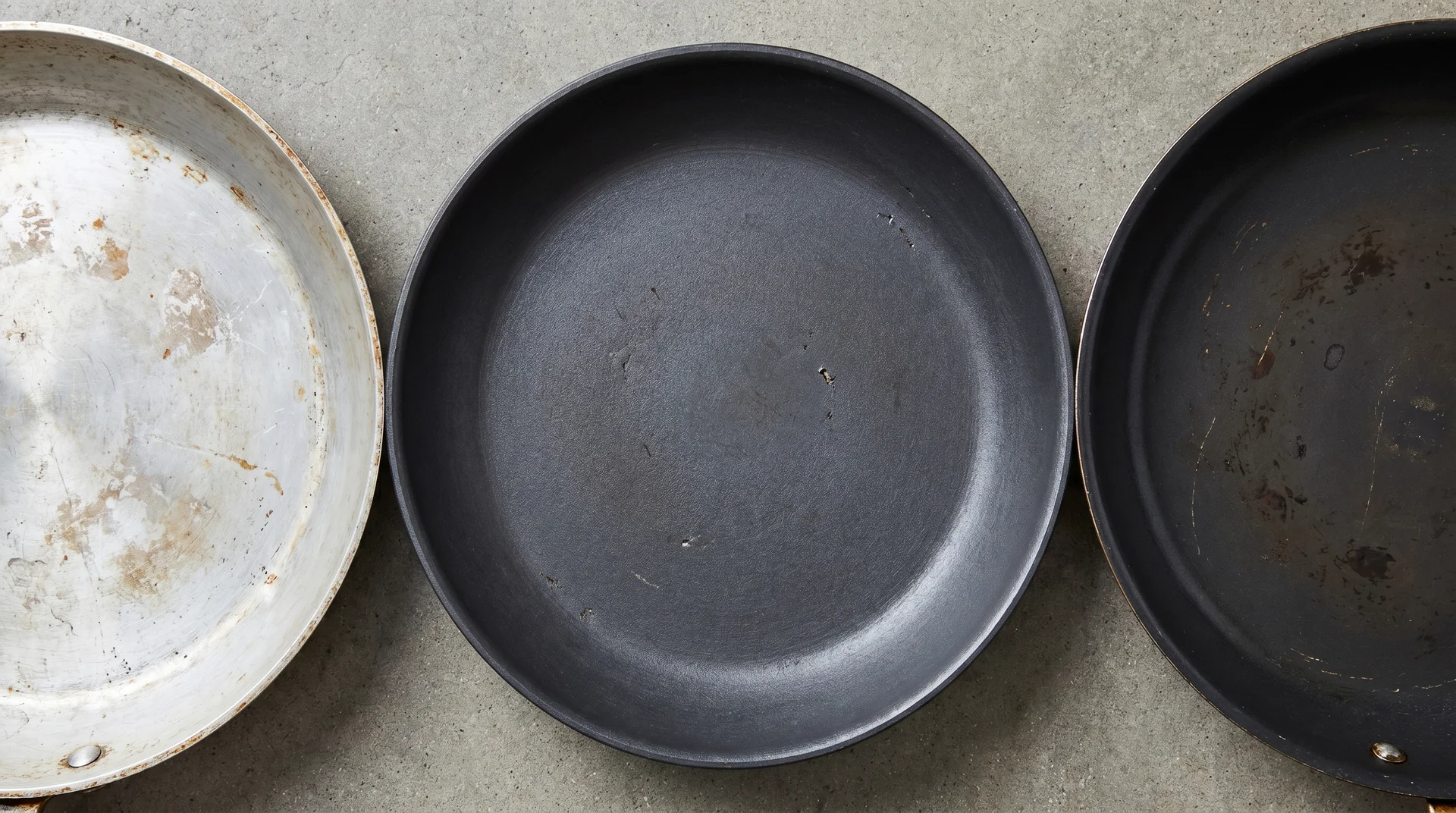
Separate the body from the surface, and the category splits into three distinct tools.
Bare (Uncoated) Aluminum
Bare aluminum has no surface treatment. You’re cooking directly on the metal. It heats up fast, faster than most other materials in a home kitchen, and it doesn’t distribute that heat evenly.
Hot spots form over the burner, and edges run significantly cooler further from the heat source. In a professional kitchen with high-BTU ranges, this is manageable.
On a standard home burner, it shows up in your food.
Bare aluminum is also reactive with acidic ingredients. Tomatoes, citrus, wine-based sauces: cooking these in an uncoated aluminum pan causes trace amounts of aluminum to transfer into the food and can introduce a metallic flavor with extended contact.
It’s a practical cooking concern more than a serious health risk, but it’s worth knowing before you deglaze with wine.
Most bare aluminum in a home kitchen lives in the bakeware category: sheet pans, cake pans, muffin tins. It is the professional baking standard, and the baking section explains exactly why that is.
Hard Anodized Aluminum
Hard anodized aluminum is treated electrochemically, which converts its outer layer into aluminum oxide, a compound significantly harder and less reactive than bare metal.
The result is a dark gray surface that resists scratches better than bare aluminum and outlasts a PTFE coating under normal kitchen use.
This is the category most aluminum vs nonstick comparison articles skip entirely, and that’s a real gap. Hard-anodized pans aren’t nonstick in the PTFE sense. Food will stick if you don’t use fat or manage heat properly.
But the surface is non-reactive with acidic foods, and it handles higher oven temperatures than a PTFE-coated pan.
I’ve used hard-anodized skillets for 18 months as my primary stovetop cookware, not as a single comparative test. They outlasted every PTFE-coated pan I tested in the same period. That’s not a conclusion I’d draw from one month of use, but 18 months across daily cooking is enough to call it a finding.
Hard-anodized pans typically handle 500°F and above. Most PTFE-coated nonstick pans cap at 400 to 450°F before manufacturer guidance starts hedging on safe use temperatures. That ceiling matters if you’re finishing stovetop cooking in a hot oven.
Read: Hard Anodized Cookware
Aluminum With a Nonstick Coating
This is what most people mean when they say “nonstick pan”: an aluminum body with a PTFE-based coating on the interior surface. The aluminum handles the heat. The PTFE handles the food release. They’re doing different jobs inside the same pan.
The tradeoffs are practical. Food releases easily with minimal fat. The coating needs careful handling: no metal utensils, lower heat limits, and no abrasive scrubbing.
A nonstick pan used correctly lasts several years. One consistently overheated or scraped with metal tools degrades faster.
How to Tell Which Pan You Have Right Now
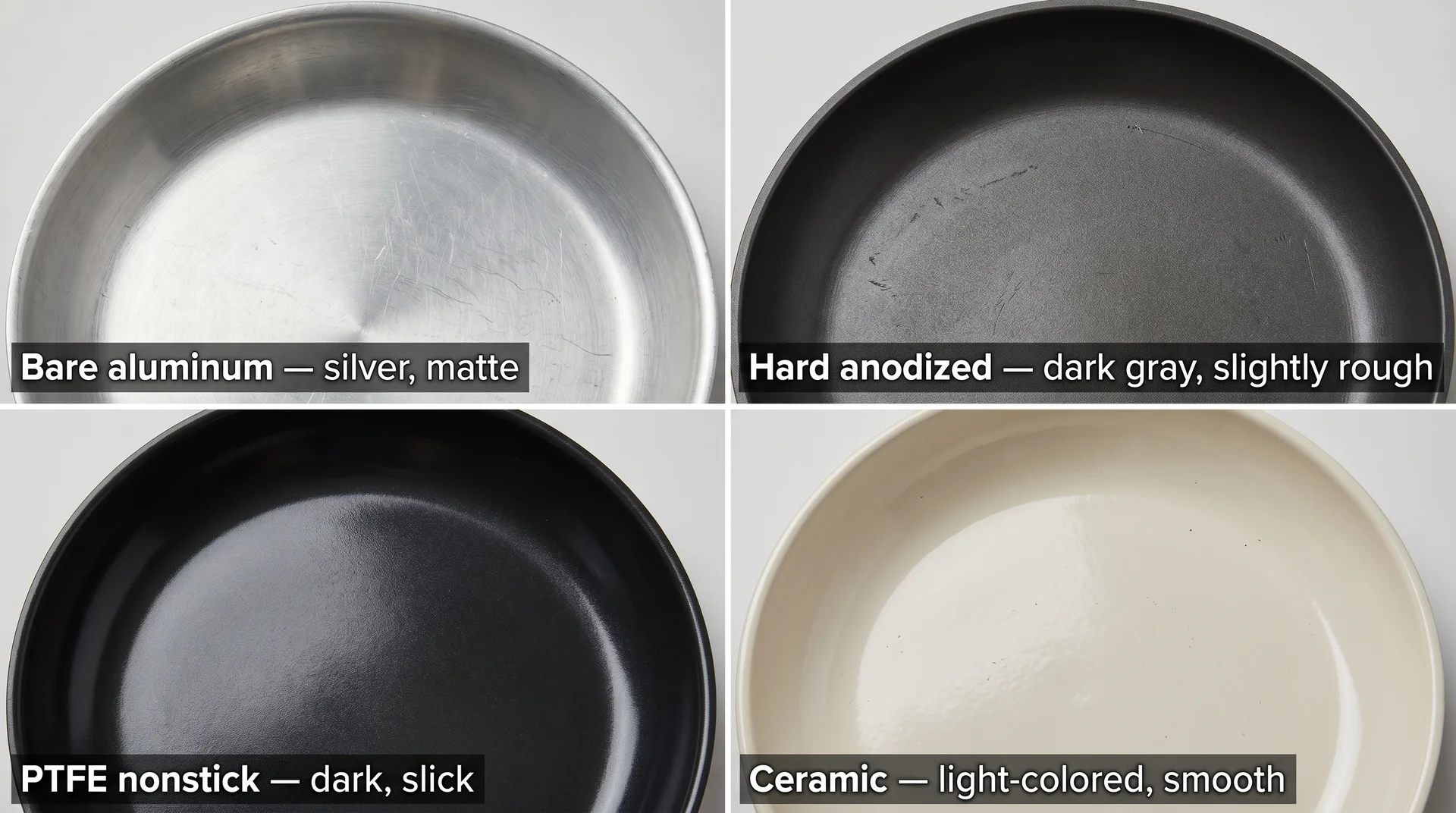
Before buying anything, figure out what’s already in your cabinet.
The Visual and Touch Test
Look at the interior surface under good light and check for color, texture, and sheen.
- Shiny silver interior, matte to slightly reflective: Bare aluminum. The surface shows scratches and oxidation marks from use. It looks and feels like bare metal because it is.
- Dark gray or charcoal interior, uniform color throughout: Hard anodized aluminum. Run a fingernail across it at an angle, and it feels slightly rough, almost like fine-grit sandpaper. It will not feel slippery.
- Slick, dark interior with almost no surface texture: PTFE nonstick coating. Water beads on a cool surface. Nothing catches when you run a finger across it.
- Light-colored, off-white, or speckled smooth surface: Ceramic coating. This is a fourth category worth knowing: ceramic-coated pans use a mineral-based coating rather than PTFE and are often marketed as nonstick alternatives.
The Scratch and Magnet Check
Run a wooden spoon firmly across the interior and look for a gray mark. A gray mark means a coating of some kind is present. Bare aluminum scratches, but the mark looks silver.
Hard anodized is the most scratch-resistant of the three and takes real effort to mark with a wooden utensil.
A magnet won’t stick to aluminum in any form. If your pan is magnetic, the body material is stainless steel or cast iron.
This matters specifically on an induction cooktop, since standard aluminum isn’t induction-compatible unless the pan has a ferromagnetic base plate built into its bottom.
Once you know what you’re working with, the performance differences make considerably more sense.
Read: How to Care for Nonstick Pans?
How Each Surface Performs in Real Cooking
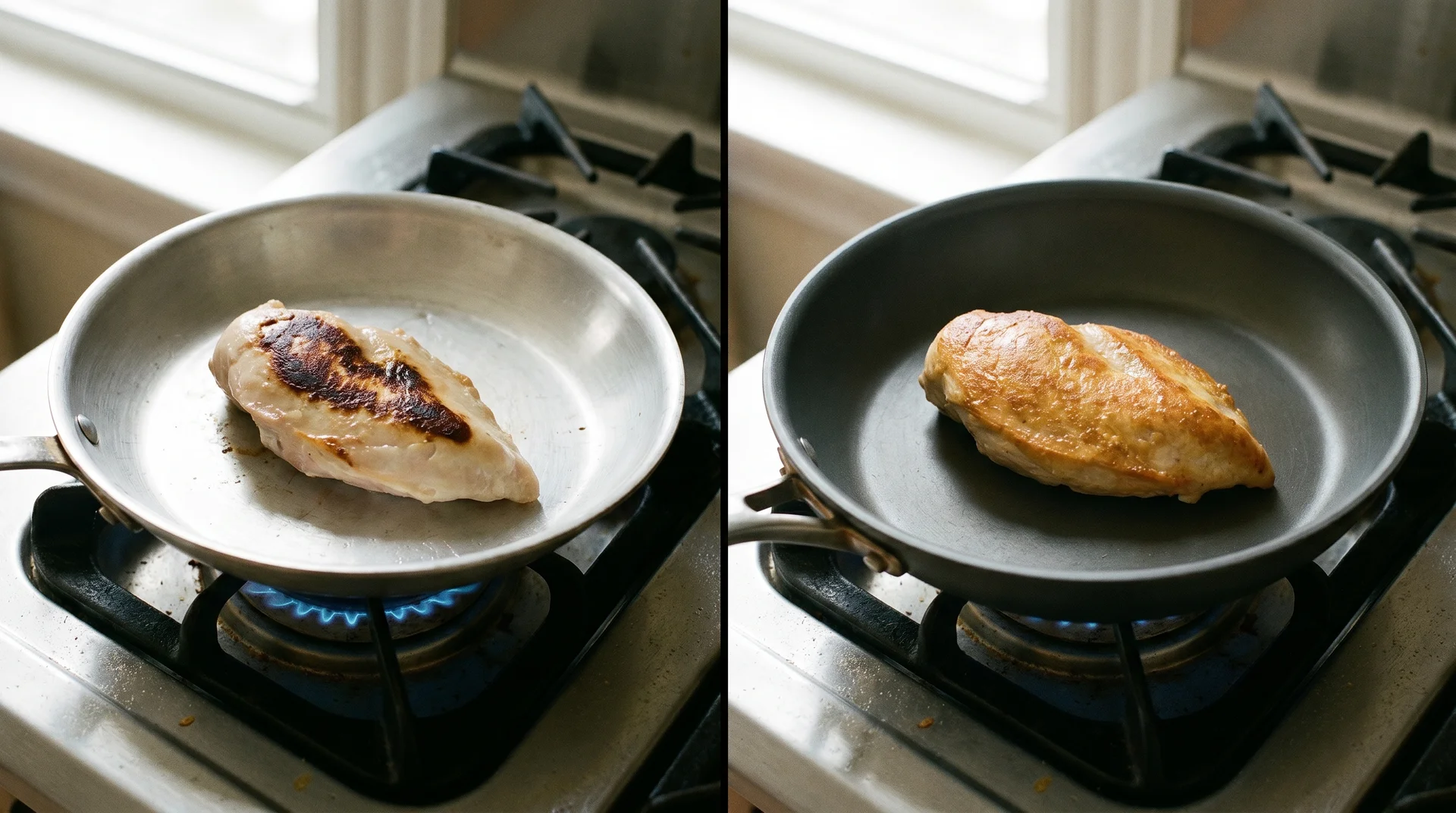
The differences become clear when you cook with them, not when you read the spec sheet.
Heat Distribution and Hot Spots
Bare aluminum heats up fast and does so unevenly over a home burner. The center of the pan, sitting over the heat source, gets noticeably hotter than the edges. That uneven profile matters to what you’re cooking and how it finishes.
Hardened anodized aluminum behaves similarly from a thermal standpoint, since the anodizing changes the surface and not the core metal. The slightly thicker walls on most quality hard-anodized pans smooth out some of the unevenness.
PTFE-coated nonstick pans, which typically have thicker aluminum bodies than baking pans, also distribute heat more evenly than a thin bare aluminum sheet pan on a burner.
I tested this in my own kitchen, not under controlled conditions, and the result was immediate and clear. A bare aluminum cake pan used as a stovetop skillet showed visible browning differences across its surface within two minutes. The edges were barely colored. The center had already browned.
Searing, Browning, and the Fond
A proper fond, the browned residue that deglazes into a pan sauce, doesn’t develop in a nonstick pan. That’s not a design flaw. The whole point of the coating is that food doesn’t stick, which means the caramelized bits that would otherwise adhere and build flavor don’t. They can’t.
If you deglaze pans to build sauces, nonstick gives you the wrong surface for it. Bare aluminum and hard anodized both allow browning and fond development.
Hardened anodized handles the higher heat that proper browning requires and hold up better under those conditions over time.
Eggs, Fish, and Delicate Proteins
This is where PTFE nonstick genuinely earns its place in the kitchen.
Eggs cooked with minimal fat, fish fillets with delicate skin, anything you need to move cleanly without tearing: PTFE nonstick handles these better than bare or anodized aluminum for most home cooks.
A well-seasoned carbon steel pan gets you to the same place, but that’s a technique conversation with a different learning curve.
| Property | Bare Aluminum | Hard Anodized Aluminum | Aluminum with PTFE Coating |
|---|---|---|---|
| Heat-up speed | Fast | Fast | Fast to moderate |
| Even heat distribution | Poor to moderate | Moderate | Moderate (varies by body thickness) |
| Browning and fond development | Yes | Yes | Limited |
| Food release without fat | Poor | Moderate | Excellent |
| Maximum oven temperature | No coating limit | 500°F and above | Typically 400 to 450°F |
| Surface durability | High (no coating to damage) | High | Moderate (coating lifespan is finite) |
| Reactive with acidic foods | Yes | No | No |
Aluminum Pan vs Nonstick Pan for Baking
The baking version of this question has a cleaner answer than the stovetop version.
Why Bakers Default to Aluminum
Uncoated aluminum is the professional baking standard because of how it handles radiant oven heat. Light-colored bare aluminum reflects some of the oven’s radiant energy rather than absorbing it.
The exterior of a baked good, the bottom crust and sides, browns at a rate that the interior can keep up with.
America’s Test Kitchen’s bakeware testing found that aluminum bakeware produces more evenly browned results than darker nonstick bakeware for cakes and cookies.
The lighter surface is doing real thermal work. A dark nonstick coating absorbs more radiant energy and pushes exterior browning faster than the interior can match.
I own a half-sheet pan I’ve used for four years, untreated aluminum, that produces more consistent cookie browning than any other pan in my baking cabinet.
Read: Best Aluminum Baking Sheets
Four years of consistent results are a different kind of evidence than one test. I’ll stand behind that claim accordingly.
What Nonstick Bakeware Actually Changes
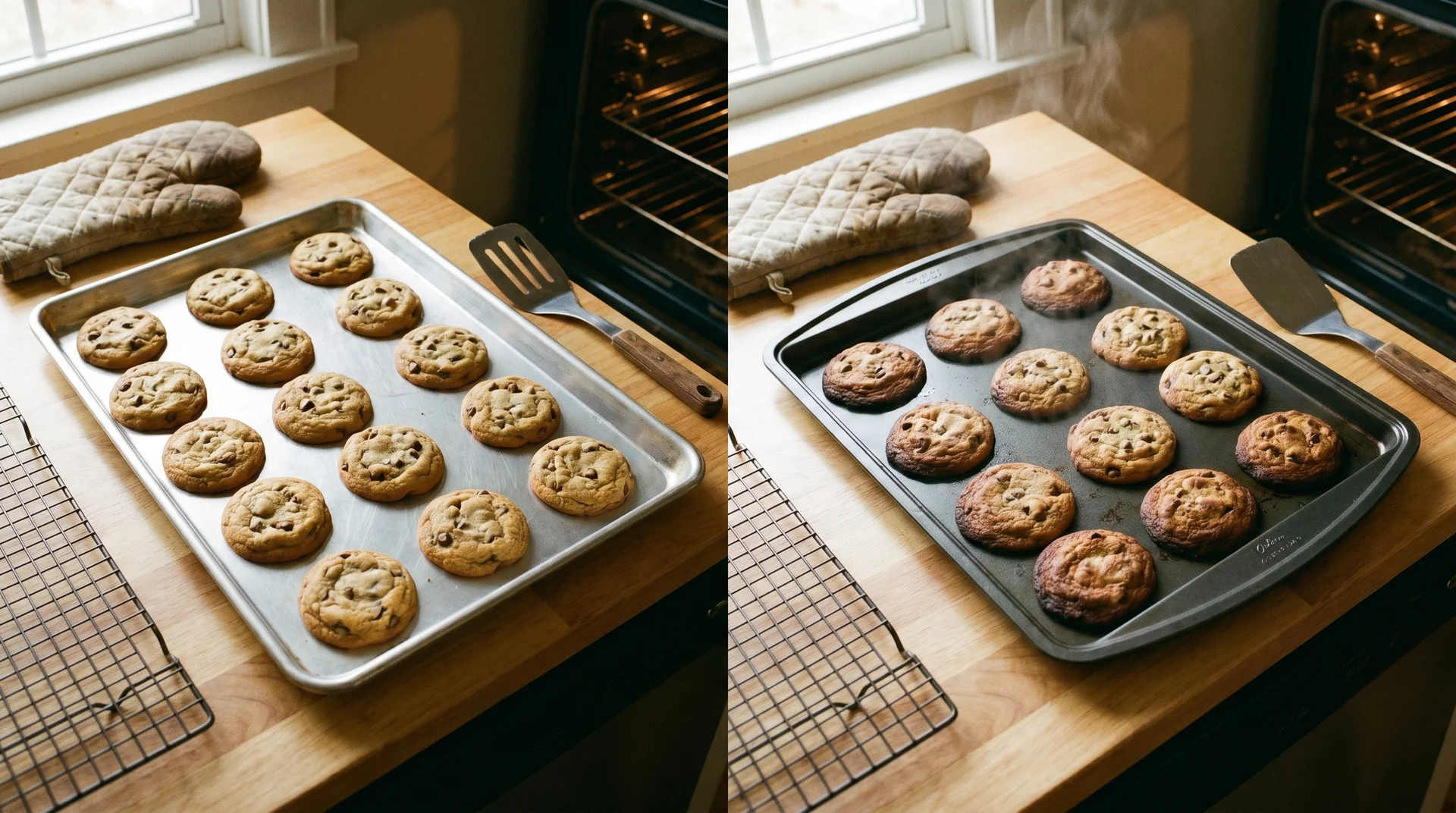
A nonstick coating on bakeware changes two things: how dark the exterior gets, and how easily baked goods release from the pan. The darker surface absorbs more radiant heat, which accelerates browning on the bottom and sides.
This matters more for some items than others.
The release advantage is real. Nonstick cake pans and muffin tins make unmolding easier, particularly for recipes that aren’t heavily enriched with fat. If you’re baking a lean cake and you’d rather skip parchment, nonstick bakeware earns that trade-off.
If your bottoms are consistently over-browning in nonstick bakeware, the pan is the reason. Most baking troubleshooting advice blames the oven or the recipe first. It’s usually the pan.
When to Use Each for Specific Baked Goods
- Cookies and sheet pan baking: Bare aluminum. Even browning on the bottom is the goal, and bare aluminum delivers it consistently across batches.
- Layer cakes: Bare aluminum cake pans. Even heat and less risk of the edges over-browning before the center sets.
- Muffins and cupcakes: Either works. Nonstick wins on release; aluminum wins on even browning. With paper liners in the tin, the release advantage largely disappears. Bare aluminum with liners is a sensible default.
- Bread in a loaf pan: Nonstick is a practical choice here. The crust benefits from more browning, and clean release matters more than it does for cookies.
- Roasting vegetables: Bare aluminum sheet pan. Browning is the goal, and a nonstick surface works against it.
Is Aluminum Even Safe to Cook With?
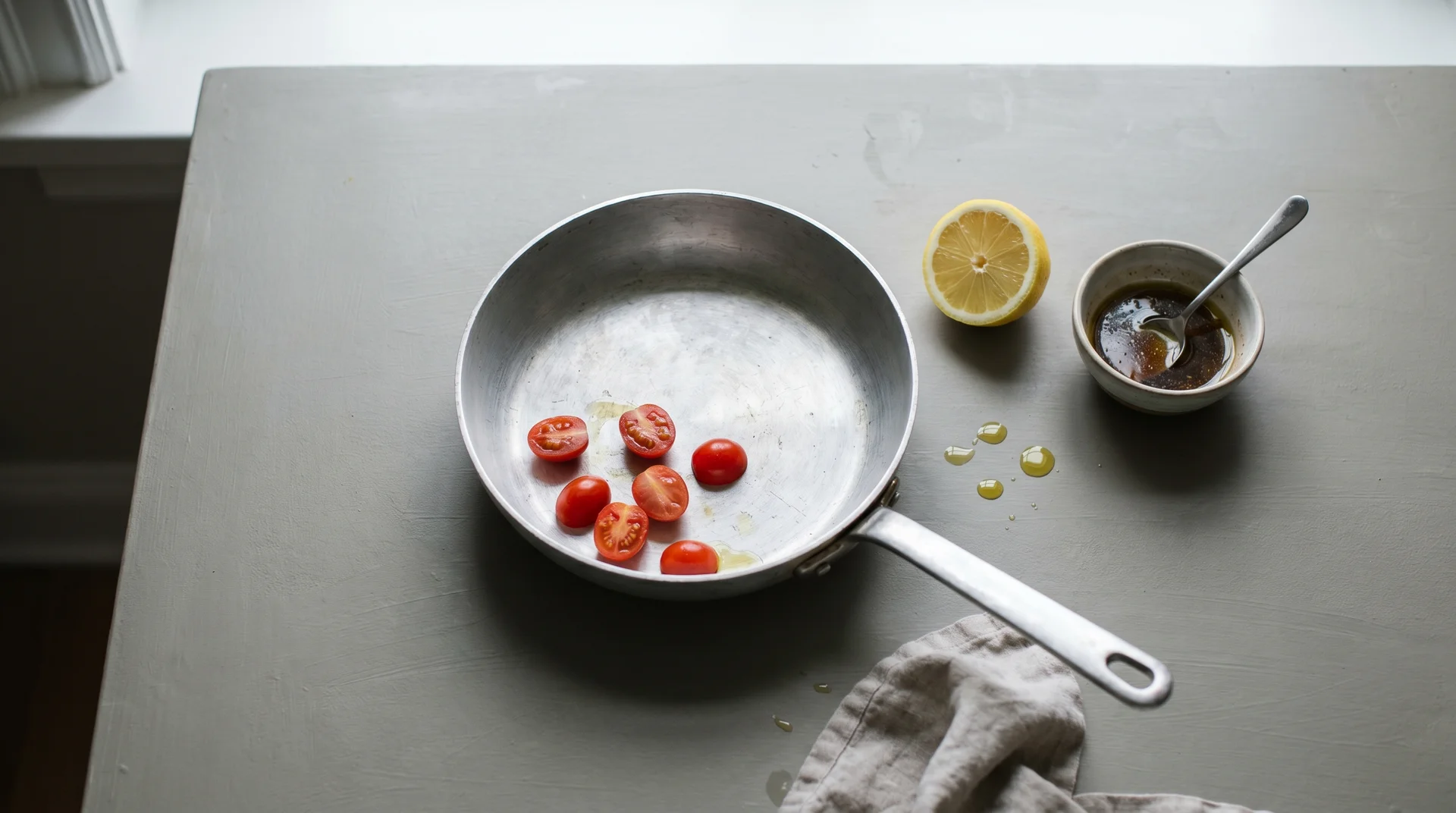
This question gets conflated. Three separate concerns are in play, and they have three different answers.
The PFOA Question and Why It’s Largely Settled
PFOA, short for perfluorooctanoic acid, was the manufacturing chemical that raised legitimate health concerns about nonstick cookware.
As per the EPA’s PFOA Stewardship Program, PFOA was eliminated from US cookware manufacturing by 2015, with most major manufacturers completing the transition earlier. Nonstick pans sold in the US today are PFOA-free.
The concern was real in the context of PFOA. It is not the same concern for pans made in the last decade. A legitimate historical worry has stayed in circulation well past the point where the underlying problem was addressed. If your pans are from the last ten years, PFOA is not the issue.
Aluminum and Food Reactivity
Bare aluminum reacts with acidic foods, and that reaction is worth understanding even if the health stakes are modest.
Cooking tomatoes, citrus, or vinegar-based dishes in an uncoated aluminum pan causes trace aluminum transfer into the food.
FDA guidance does not identify aluminum cookware as a significant dietary health risk, but the reaction affects flavor. Acidic foods can pick up a metallic taste with extended contact in a bare aluminum pan.
Hardened anodized aluminum and PTFE-coated aluminum both address this. The anodized layer and the coating each isolate the base metal from the food.
This is a practical reason to choose either over bare aluminum for tomato sauces and long braises, regardless of where you land on the broader health question.
What Temperature Actually Damages Nonstick Coating
PTFE begins to degrade at temperatures above approximately 500°F, releasing fumes harmful to birds and potentially irritating to humans at sustained exposure.
Most home cooking never reaches this threshold. Sautéing and standard baking temperatures don’t even come close to it.
The practical risk is an empty nonstick pan left unattended on a high burner. An empty pan reaches 500°F within minutes on a high gas flame. That specific scenario is what the warning addresses, not the general act of cooking with a nonstick pan at normal temperatures.
One area of genuine uncertainty
The long-term health data on PTFE alternatives used in newer PFOA-free coatings is considerably thinner than the decades of data that exist for PTFE itself. As noted earlier, the PFOA question is largely settled for pans made in the last decade.
The newer-generation replacement chemistries are a different and less-studied matter. I cook on PTFE nonstick regularly, and I’m not raising this to generate alarm. But “PFOA-free” doesn’t mean “studied for forty years,” and it’s honest to say so.
Which Pan Should You Actually Use
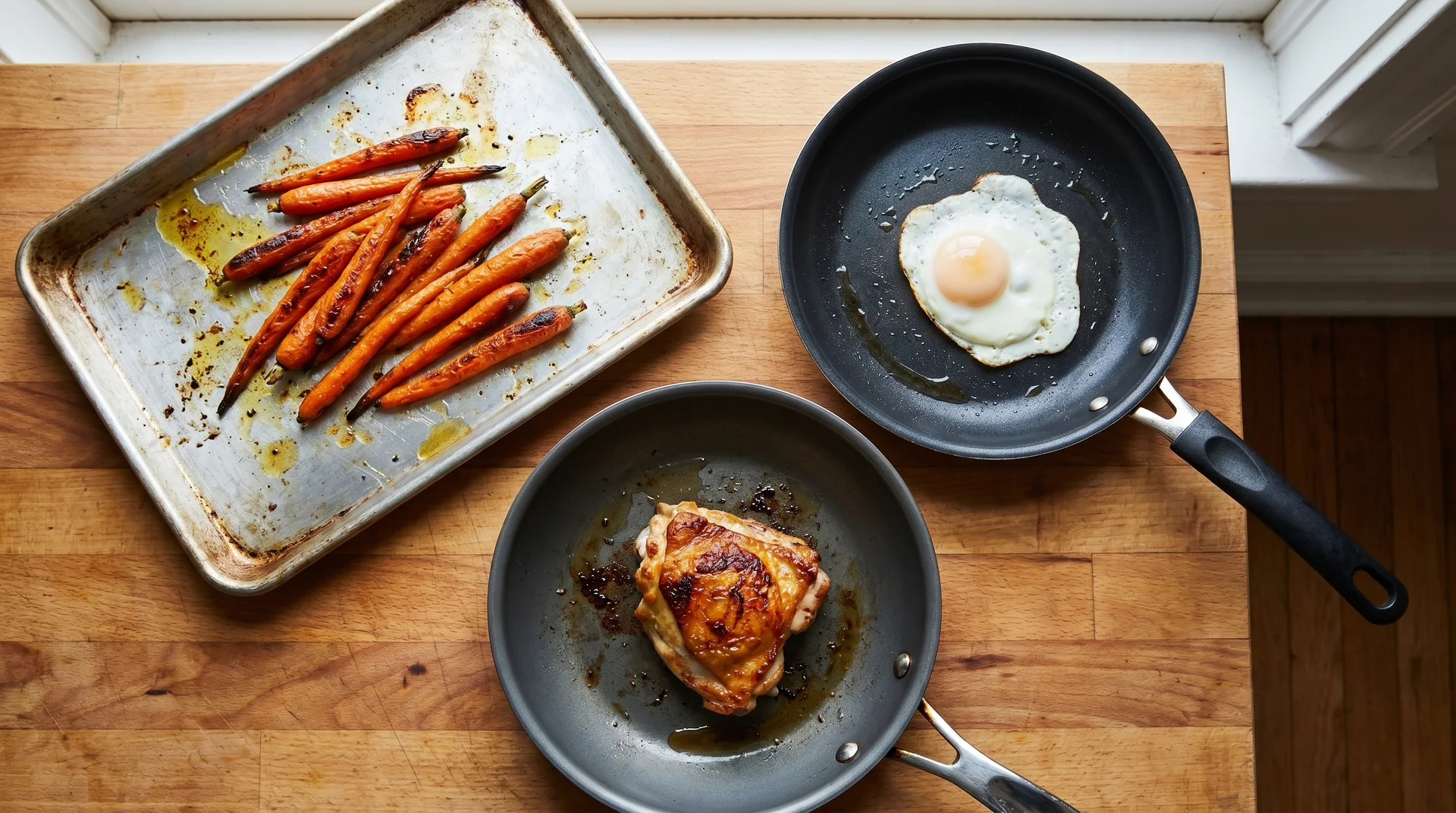
The categories above each have a practical home, and the decision comes down to what you’re actually cooking.
Use Bare Aluminum When…
- You’re baking and even browning on the bottom matters
- The pan is going into an oven above 450°F
- You’re roasting, and a well-browned result is the point
- You want an inexpensive, durable baking pan that requires no special handling
Use Nonstick When…
- You’re cooking eggs with minimal fat
- You’re cooking fish or other delicate proteins that tear when they stick
- You need to unmold a baked good cleanly without parchment
- The person cooking is new to the kitchen and wants a forgiving surface
When Hard Anodized Is the Better Answer for Both
Hard anodized aluminum is the option most comparison articles skip, and in my experience, it earns its place in kitchens that have tried all three. It handles higher heat than PTFE-coated pans, tolerates metal utensils better, is non-reactive with acidic foods, and holds up longer over time.
The tradeoff is real: it’s less forgiving on food release than PTFE nonstick. Food sticks if you don’t preheat properly, or if you add cold protein to a pan that isn’t up to temperature. It rewards technique.
That’s a genuine cost for some cooks and a non-issue for others.
Whether hard anodized is right for your kitchen depends on your stove’s output, how consistent you are about preheating, and what you cook most often. I can’t answer that with certainty for anyone else’s kitchen.